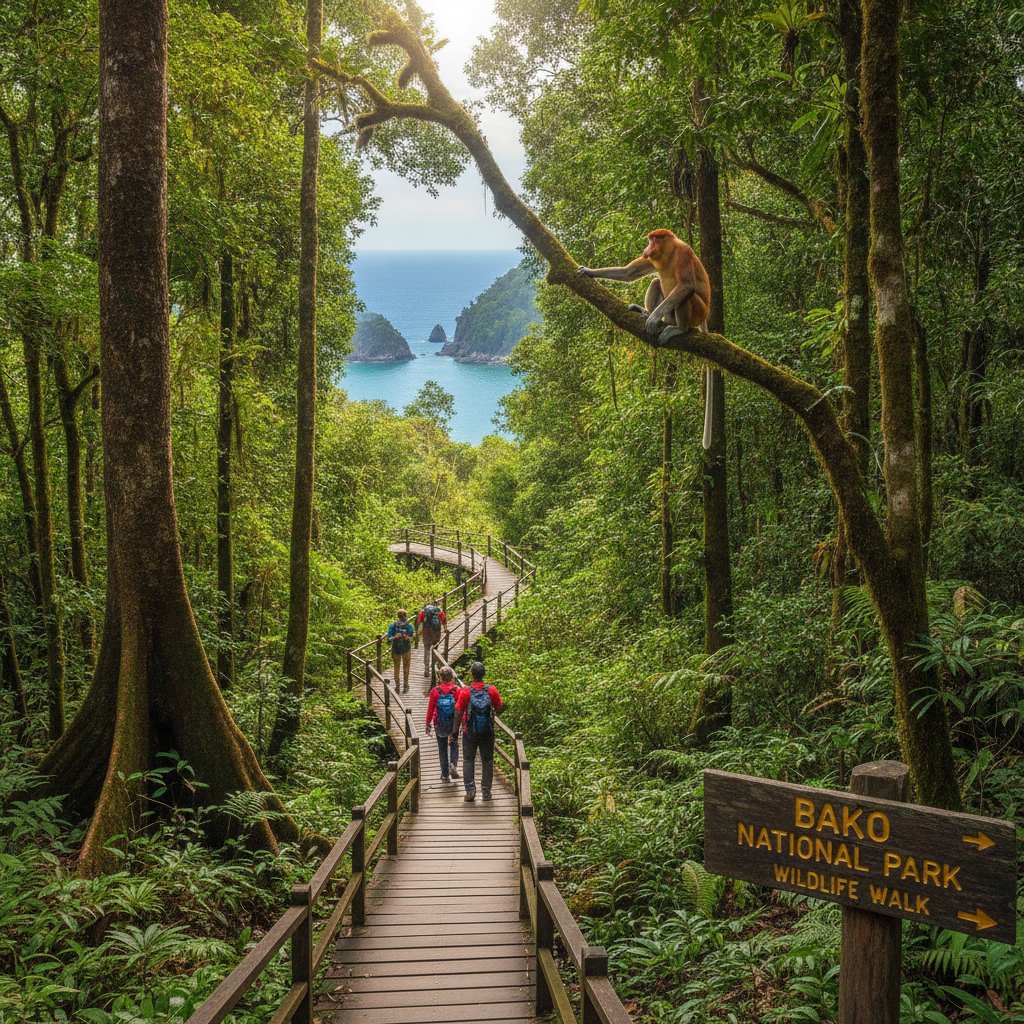
Kuching Bako National Park & Wildlife Walk
Discover the national parks accessible from Kuching — Bako National Park is Malaysia's oldest national park and has the highest density of wildlife per area in Borneo, accessible as a day trip from Kuching and offering encounters with proboscis monkeys, pitcher plants, and the beachside forest of the Sarawak coast.
- 1
Bako National Park Boat Landing
Bako National Park, 37km from Kuching by boat, is reached by a 30-minute boat ride from Kampung Bako — the landing at Teluk Assam in the park's main bay provides the first encounter with the extraordinary diversity of vegetation and wildlife that makes Bako the most visited national park in Sarawak. The dramatic sandstone sea stacks visible from the boat and the mangroves lining the bay's entrance frame the arrival at one of the most biodiverse small nature reserves in Southeast Asia.
- 2
Bako Proboscis Monkey Feeding
Bako National Park has the highest concentration of proboscis monkeys in Sarawak accessible to visitors — the late afternoon feeding aggregations of proboscis monkey troops in the mangrove and kerangas forest near the park accommodation can involve 30-50 individuals in the trees simultaneously, providing the most dramatic proboscis monkey viewing in Malaysian Borneo without requiring a river journey to the Kinabatangan. The silver-grey males with their distinctive pendulous noses and pot-bellied appearance, sitting in the trees at eye level while the park visitors watch from the boardwalks below, create one of the most memorable wildlife encounters in Southeast Asia.
- 3
Bako Pitcher Plant Habitats
Bako National Park has an exceptional diversity of pitcher plants (Nepenthes) growing in the kerangas (heath forest) on its sandstone plateau — the poor, acidic soils of the kerangas have produced a plant community dominated by carnivorous species adapted to extract nutrients from insects in nutrient-poor soil rather than from the soil itself. Walking the Bako plateau trails through the kerangas reveals a landscape of pitcher plants at ground level, the sundews and bladderworts in the wet areas, and the panoramic views of the South China Sea from the sandstone cliffs that frame the kerangas plateau.
- 4
Semenggoh Wildlife Centre
Semenggoh Wildlife Centre 24km south of Kuching is Sarawak's orangutan rehabilitation and conservation centre — the centre that has been rehabilitating Bornean orangutans since 1975 has a semi-wild population of approximately 25 orangutans living in the surrounding forest. The twice-daily feeding sessions (8-10am and 2-4pm) at which the orangutans may choose to come to the feeding platform to collect supplemental fruit provide one of the most accessible wild orangutan viewing experiences in Borneo, with the qualification that the semi-wild animals may choose not to appear if natural forest food is abundant.
- 5
Kubah National Park Palms
Kubah National Park 22km west of Kuching protects Sarawak's most important collection of palms — the park has been called the 'Home of Palms' for its extraordinary diversity of palm species (over 90 species), including the rare and endemic palms of western Sarawak. The park's trails through the hill dipterocarp forest also lead to freshwater pools (telaga) fed by clear mountain streams that are ideal for swimming, providing one of the most accessible waterfall and swimming experiences near Kuching.
- 6
Damai Beach Santubong
Damai Beach at the foot of Mount Santubong 35km from Kuching is the most popular beach resort area accessible from the city — the beach facing the South China Sea has calm water protected by the Santubong Peninsula, the beach resorts and the nearby Sarawak Cultural Village, and the hiking trails on Mount Santubong (810m) that provide views of the Sarawak coastline and the Sarawak River delta. The combination of beach resort, cultural village, and jungle hiking accessible in a day from Kuching makes Damai one of the most versatile day trip destinations from any Malaysian Borneo city.
Walk this route with audio
Stories play automatically as you reach each stop — no tapping needed.