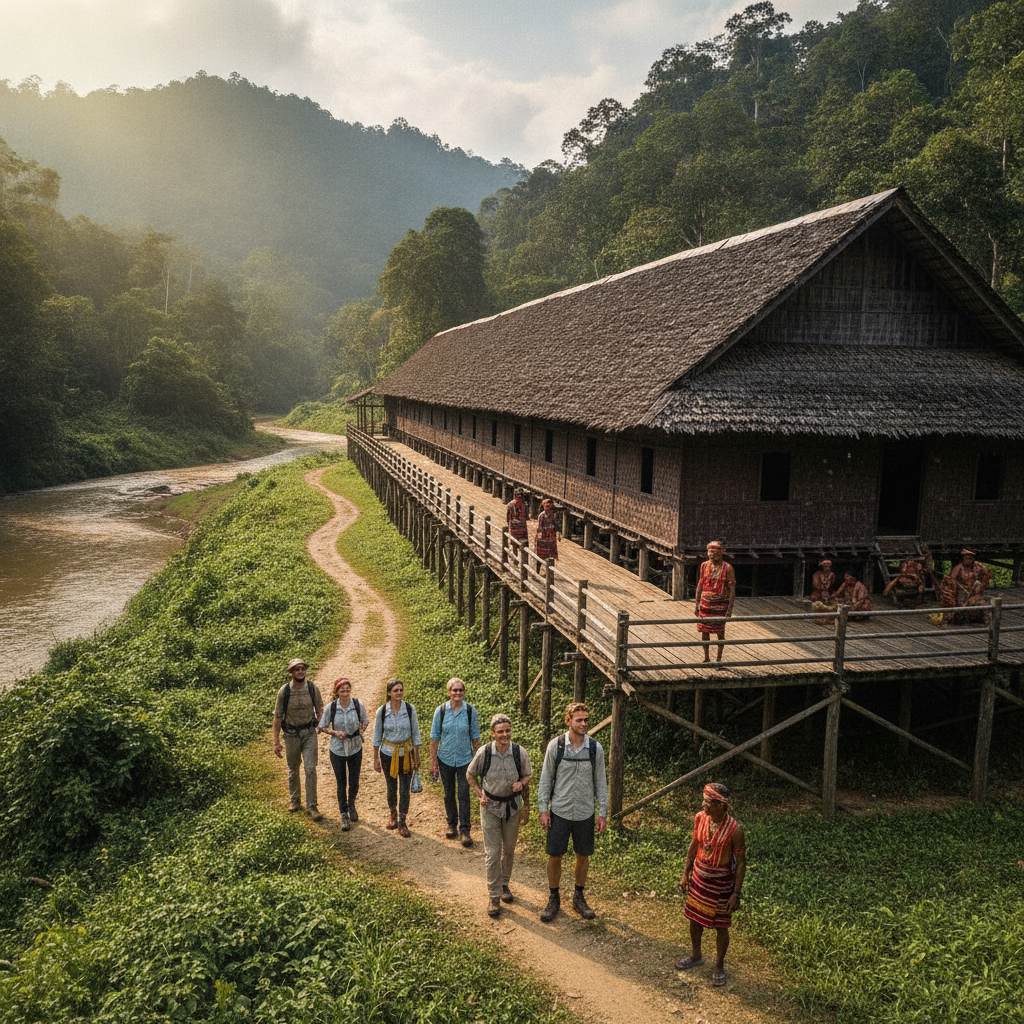
Kuching Iban Culture & Longhouse Walk
Experience Iban culture from Kuching — the Iban are Sarawak's largest indigenous group, famous historically as the 'Sea Dayaks' whose headhunting prowess helped the Brooke Rajahs suppress piracy, and whose longhouse culture, pua kumbu weaving, and contemporary Christian-animist synthesis is most accessible from the Sarawak capital.
- 1
Cultural Village Sarawak
The Sarawak Cultural Village at Damai Beach is the most comprehensive presentation of Sarawak's indigenous cultures — the living museum with full-scale traditional structures representing the Iban, Bidayuh, Orang Ulu, Melanau, Malay, and Chinese communities of Sarawak has cultural performers demonstrating traditional crafts, music, dance, and food preparation in architectural settings that preserve the building traditions of each community. The Rainforest World Music Festival held at the Cultural Village each July brings international musicians together with traditional Sarawak musicians in one of Southeast Asia's most distinctive annual music events.
- 2
Iban Longhouse Architecture
The Iban longhouse (rumah panjai) is the fundamental social unit of Iban society — the long communal building elevated on posts, with a continuous covered veranda (ruai) running its entire length and individual family apartments (bilik) opening off the ruai, houses an entire community under one roof. The longhouse veranda is the social space where community life takes place — meetings are held, guests are received, ceremonies are performed, and the daily activities of communal life are conducted in the shared space that defines Iban social architecture. Longhouse visits from Kuching typically require 2-3 hours by road to reach authentic longhouse communities.
- 3
Pua Kumbu Textile Weaving
Pua kumbu is the Iban ceremonial textile — the warp ikat-resist dyed cotton cloth woven by Iban women using traditional back-strap looms, with its distinctive motifs of crocodiles, mythological figures, and geometric patterns derived from the Iban cosmological tradition. The pua kumbu was traditionally used as a ceremonial cloth for receiving severed heads, for wrapping the dead, and for other ritual purposes, and a woman's weaving skill was as important to her social status as a man's courage in battle was to his. Contemporary pua kumbu is sold as art and craft, with fine antique examples commanding prices equivalent to valuable paintings.
- 4
Rainforest World Music Festival Site
The Rainforest World Music Festival at the Sarawak Cultural Village has been held annually since 1998 and has grown into one of Asia's premier world music events — the three-day festival combining workshops with traditional Sarawak musicians during the day and evening concerts featuring international world music artists creates a unique cultural encounter where the traditional gongs, sape (lute), and ngajat (Iban warrior dance) of Sarawak's indigenous cultures are presented alongside West African drumming, Andean flutes, and Celtic fiddle music. The festival's setting in the forested hills above Damai Beach with the South China Sea visible behind the stage is one of the most beautiful outdoor concert venues in Southeast Asia.
- 5
Gawai Dayak Harvest Festival
Gawai Dayak (June 1-2 each year) is Sarawak's most important public holiday — the celebration of the harvest's end and the new agricultural year is observed by all Sarawak's Dayak (indigenous) communities with open houses, traditional music and dance, tuak (rice wine) drinking, and the gathering of family members who have moved to the cities to return to the longhouses. Gawai is to the Dayak communities what Eid is to Malaysian Muslims and Chinese New Year is to Sarawak's Chinese community, and the open house tradition during Gawai allows visitors to join the celebration by accepting invitations from Dayak families.
- 6
Iban Traditional Crafts Museum
The Sarawak Museum's ethnographic collections document the full range of Iban material culture — the traditional weapons (mandau chopping blades, sunbeams spears, wicker shields), the ceremonial dress and beadwork, the headhunting trophies that remain in the collection from the pre-Brooke era, and the domestic objects of longhouse daily life create the most comprehensive museum documentation of Iban culture available in Sarawak. The museum's collection policy during the Brooke era gathered objects when the traditional cultures were still fully intact, making the collection invaluable despite the ethical complexity of colonial-era collection practices.
Walk this route with audio
Stories play automatically as you reach each stop — no tapping needed.