Koh Phi Phi Environment & Sustainability Walk
Understand Phi Phi's environmental challenges — the extreme concentration of tourist traffic on the small Phi Phi islands has created some of the most pressing sustainable tourism management challenges in Southeast Asia, and the island's story illustrates both the costs of unmanaged tourism and the possibilities for recovery.
- 1
National Park Office
The Hat Noppharat Thara – Mu Ko Phi Phi National Park office on Tonsai pier collects the national park entrance fee from all arriving boats and is responsible for managing the marine protected area that encompasses the entire Phi Phi archipelago — the national park system (established 1983) governs the construction regulations, the boat anchoring zones, the fishing restrictions, and the visitor management policies that determine the environmental trajectory of the islands. The tension between the national park's conservation mandate and the enormous economic pressure of one of Thailand's most commercially successful tourism destinations is visible in every management decision.
- 2
Coral Reef Recovery Zones
The designated coral recovery zones around Phi Phi Don and Phi Phi Leh, established after the 2004 tsunami assessment revealed the full extent of pre-existing reef damage, represent the marine conservation management effort at its most ambitious — the no-anchoring zones, the snorkel-only zones (no fins permitted), and the closure of previously accessible dive sites for recovery document the progressive tightening of visitor management at the most ecologically fragile reef sites. The contrast between the reef areas within active conservation zones and the heavily visited unprotected reef areas provides a live demonstration of what management interventions can achieve within 5-10 years.
- 3
Tsunami Memorial
The tsunami memorial in Loh Dalum Bay commemorates the approximately 2,000 people who died on Koh Phi Phi in the December 26, 2004 Indian Ocean tsunami — the island's flat isthmus, barely above sea level and caught between two bays on opposite sides, suffered devastating flooding from the tsunami that arrived from both the Andaman Sea (the western bay) and from the refraction around the limestone headlands. The memorial and the rebuilt resort infrastructure visible around it document both the scale of the devastation and the speed of the commercial recovery — the first resort hotels reopened within 18 months, and within 5 years the tourist volume had returned to pre-tsunami levels.
- 4
Plastic Waste Challenge
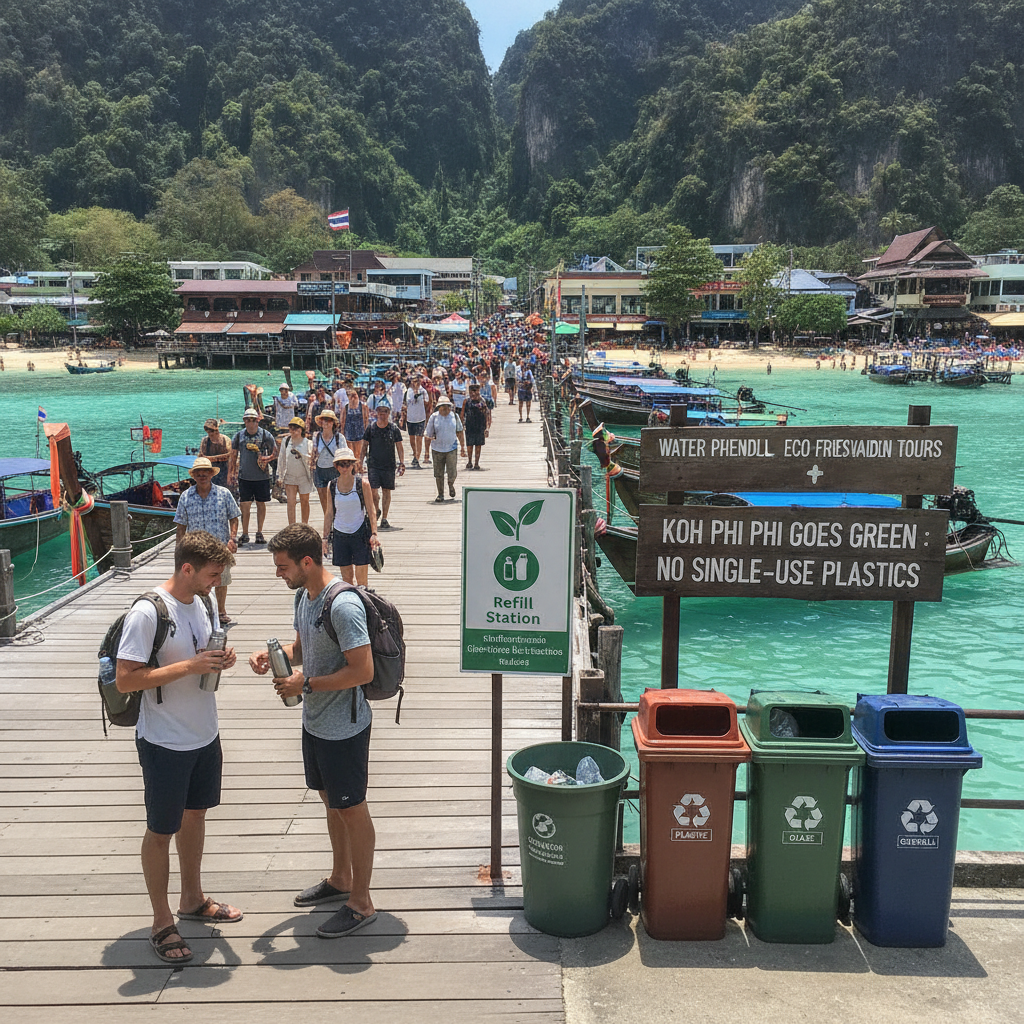
The plastic waste management challenge on Koh Phi Phi — an island where all consumer goods arrive by boat and all waste must be removed by boat (the island has no landfill, no waste water treatment, and no industrial waste processing capacity) — is one of the most visible environmental management failures in Thai tourism. The plastic visible on the beaches, in the near-shore reef areas (where snorkelers regularly encounter plastic bags, bottles, and single-use packaging), and in the island's drainage channels demonstrates the gap between the environmental aspiration of national park status and the practical reality of waste management for an island receiving 10,000 visitors on peak days with no infrastructure for their waste.
- 5
Eco Resort Phi Phi
The eco-resort operations on Phi Phi Don's less-developed eastern shore (Long Beach area) represent the most sustainable accommodation model available on the island — the smaller operations with solar power, composting toilets, grey water recycling, and explicit policies on single-use plastic elimination demonstrate that the island's tourism economy can be conducted at a significantly lower environmental impact than the mainstream resort operations in the main village. The eco-resort guests are typically a different demographic from the mainstream resort market, but the operations demonstrate practically that high environmental standards are compatible with comfortable accommodation on the island.
- 6
Phi Phi Leh Conservation
Phi Phi Leh's uninhabited status (the island has no permanent settlement) provides the most direct comparison available to the managed environment of Phi Phi Don — the same limestone karst landscape, the same Andaman Sea water, and the same reef environment, but without the persistent human settlement and its associated waste, noise, and light pollution, demonstrates what Koh Phi Phi Don looked like before tourism. The Maya Bay management experiment (the 2018-2022 closure and the subsequent managed reopening) is the most ambitious conservation intervention at a specific Thai tourist site and its results are being closely watched by marine conservationists globally as a model for managing overcrowded natural sites.
Walk this route with audio
Stories play automatically as you reach each stop — no tapping needed.