Strandvägen, Östermalm & the Stockholm Waterfront
Strandvägen (the 700-metre boulevard along the Nybroviken waterfront, the most prestigious residential address in Stockholm) and Östermalm (the affluent district of late 19th-century apartment palaces, the Östermalms Saluhall food market, and the Historiska museet (Museum of National Antiquities)) define the elegant eastern face of central Stockholm — the city's equivalent of Paris's 8th arrondissement.
- 1
Strandvägen — Stockholm's Most Elegant Boulevard
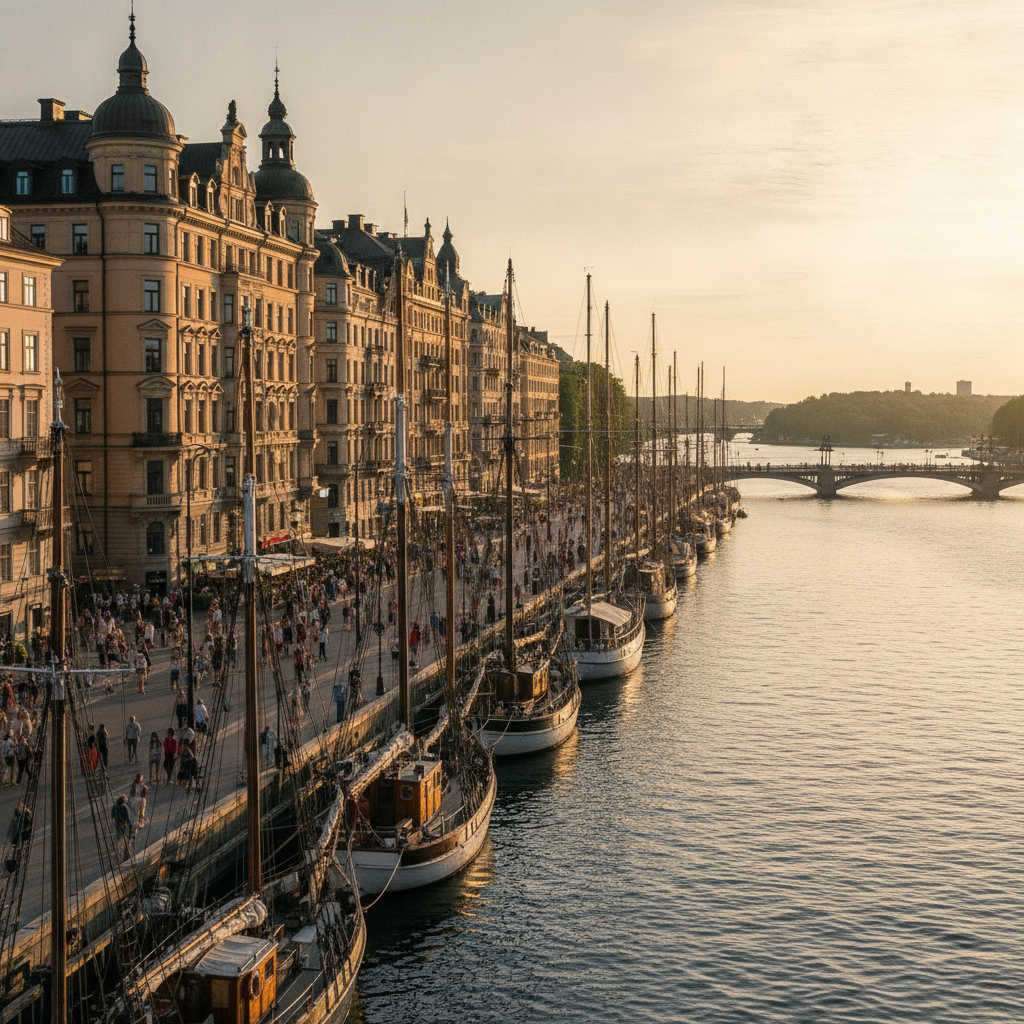
Strandvägen (the 700-metre boulevard running east from Norrmalmstorg along the Nybroviken waterfront to the Djurgårdsbroen bridge — built 1897-1912 as part of the grand urban renewal of central Stockholm in the National Romantic and late Renaissance Revival styles): Strandvägen is the most prestigious residential address in Stockholm (and one of the most expensive in Scandinavia), lined on its northern side by the largest and grandest late 19th-century apartment palaces in the city; the southern quayside is permanently occupied by a line of traditional wooden sailing vessels (segelskutor, pråmar, and other historic wooden boats privately owned and moored here year-round — a beloved Stockholm institution that gives the boulevard its distinctive maritime character); the Nybroviken (the bay at the western end of Strandvägen) is the embarkation point for boat services to Djurgården and the archipelago.
- 2
Östermalms Saluhall — Stockholm's Victorian Food Market
Östermalms Saluhall (Östermalmstorg — the Victorian covered food market in the Östermalm district, built 1888 in the National Romantic brick style (designed by Clason and Kaspar — the same architects as several of the Strandvägen palaces), reopened 2020 after a major renovation): the Östermalms Saluhall is the finest traditional food market in Stockholm and one of the most beautiful indoor markets in Scandinavia, with approximately 20 specialist food stalls (fiskmånglare (fishmongers), charkuterier (delicatessens), ostar (cheese specialists), and the famous Lisa Elmqvist (the fish restaurant founded 1920, one of the oldest continuously operating restaurants in the market)) arranged in the high-vaulted brick interior; the market is the primary source for the finest Swedish artisanal foods (the aged Västerbotten cheese, the wild salmon (lax) from Swedish rivers, the reindeer (ren) products from Sápmi, and the handmade Swedish sausages).
- 3
Historiska museet — Swedish History from the Vikings to Today
Statens historiska museum (The Museum of National Antiquities — Narvavägen 13-17, Östermalm — the national history museum of Sweden, housing the most important archaeological and historical collections in the country): the museum's greatest treasure is the Gold Room (Guldrummet — the basement circular vault containing the largest collection of prehistoric gold in Northern Europe (approximately 52 kg of gold objects), including the magnificent Migration Period gold collars (Guldhalsringarna — the three gold neck-rings from c.400-550 CE, each weighing approximately 800 grams and decorated with over 1,000 granulated gold figures, the most technically accomplished examples of Migration Period goldsmithing in existence)); the museum's Viking Age collection is the most comprehensive in Sweden, documenting the Viking Age (c.793-1100 CE) through grave goods, runestones, and everyday objects; the medieval collection (Swedish church art, reliquaries, and the Skog Tapestry (c.1130, one of the oldest surviving woven tapestries in Scandinavia)) is also outstanding.
- 4
Östermalm — Stockholm's Most Affluent District
Östermalm (the eastern district of central Stockholm, developed primarily 1870-1910 as the residential quarter of the Stockholm bourgeoisie and aristocracy — the district of apartment palaces, private schools, embassy residences, and the most expensive boutiques and restaurants in the city): Östermalm's grid of streets (Grevgatan, Riddargatan, Karlavägen, Narvavägen) is lined with the largest late 19th-century apartment buildings in Stockholm, built in the Italianate, Renaissance Revival, and National Romantic styles by the Stockholm property developers of the Gilded Age; the Humlegården (the large park in central Östermalm, the former hop garden of the royal breweries, now one of the most used urban parks in Stockholm) contains the Royal Library (Kungliga biblioteket — the national library of Sweden, with a legal deposit collection since 1661, containing every book and newspaper published in Sweden since the 17th century).
- 5
Nybroviken & the Royal Dramatic Theatre
Nybroviken (the bay at the western end of Strandvägen — the most theatrical arrival point in Stockholm, where the archipelago ferries dock and the view across the water to Strandvägen and Djurgården is at its finest) and Dramaten (Kungliga Dramatiska Teatern — the Royal Dramatic Theatre, on Nybroplan at the head of Nybroviken — the national theatre of Sweden, the most prestigious dramatic stage in Scandinavia): the Dramaten building (the 1908 Jugendstil/Art Nouveau building, with its white marble facade and characteristic curved entrance loggia — one of the finest Art Nouveau public buildings in Scandinavia) was the professional home of Ingmar Bergman (the Swedish film director (1918-2007), widely regarded as one of the greatest film directors in the history of cinema (Smiles of a Summer Night (1955), The Seventh Seal (1957), Wild Strawberries (1957), Persona (1966)), who served as the artistic director of the Dramaten 1963-1966; the Dramaten's ensemble has also included Greta Garbo (who trained here) and Max von Sydow.
- 6
Stureplan & Stockholm Nightlife
Stureplan (the square in central Östermalm, with the characteristic 'Svampen' (Mushroom — the round concrete shelter/meeting point at the centre of the square, built 1937, a beloved Stockholm landmark and the most famous meeting point in the city)): Stureplan is the centre of Stockholm's upscale nightlife and restaurant scene, with several of the most prestigious clubs and bars in the city (Spy Bar, Sturecompagniet, Riche) surrounding the square; the Sturegallerian (the underground shopping mall beneath and around Stureplan) and the adjacent Sturehof (the traditional Stockholm restaurant and brasserie (opened 1897), the most iconic Stockholm restaurant for the after-work drink and the classic Swedish lunch) define the commercial heart of Östermalm; the Erik's Gondolen (the restaurant suspended on the Katarina Elevator structure in Södermalm, visible from Strandvägen) is the most dramatically sited restaurant in Stockholm, while the Café Opera (at the Royal Opera House, on Kungsträdgården) combines fine dining with the most glamorous bar setting in the city.
Walk this route with audio
Stories play automatically as you reach each stop — no tapping needed.
More in stockholm
Södermalm — Stockholm's Creative Quarter, Fotografiska & City Hall
Midnight Sun, Midsommar & Stockholm's Seasons
Swedish Food in Stockholm — Meatballs, Husmanskost & New Nordic
Gamla Stan — Stockholm's Medieval Old Town & Royal Palace
Vasa Museum, ABBA Museum & Djurgården — Stockholm's Museum Island