Savannah R3-R4: Port of Savannah (largest single-terminal container port US 5.5M TEUs, cotton warehouse Row Factors Walk 1850s-1880s, Eli Whitney cotton gin 1793 Mulberry Grove plantation expanded slave economy), Savannah River and Wormsloe (2.4km live oak avenue cathedral of moss most photographed Georgia, Noble Jones 1733 original settler, Isle of Hope antebellum cottages, Savannah River Site nuclear weapons 1953-1988), Port city culture (Savannah Bee Company 2002 artisan honey 14 stores, Leopold's Ice Cream 1919 Greek brothers unchanged recipes), Literary heritage (Flannery O'Connor born Savannah 1925 Southern Gothic, O'Connor Childhood Home Lafayette Square, Conrad Aiken Pulitzer Prize father murdered mother 11 years old, Savannah Book Festival February free squares), Cumberland Island (largest undeveloped East Coast barrier island, 200 feral horses Carnegie ruins Dungeness burned 1959 Greyfield Inn, JFK Jr Carolyn Bessette secret wedding September 21 1996 40 guests, Jekyll Island Club Resort), Sherman March to the Sea (November-December 1864 60,000 troops 480km, USD 100M destruction total war doctrine, Mayor Arnold surrender December 21 1864 saved antebellum architecture, 10,000 enslaved freed, Georgia Historical Society 1839 oldest Georgia institution)
Savannah R3-R4: port and cotton (Garden City Terminal largest single-terminal US 5.5M TEUs, cotton factors Factors Walk River Street warehouses, Eli Whitney cotton gin 1793 Mulberry Grove Nathanael Greene widow 10hrs per pound to mechanized expanded slave economy to Deep South), Savannah River and Wormsloe (Wormsloe 2.4km live oak avenue Spanish moss cathedral most photographed Georgia, Noble Jones 1733 tabby ruins, Isle of Hope antebellum Victorian bluff cottages, Savannah River Site nuclear weapons 1953-1988 most contaminated federal site), port city culture (Savannah Bee Company 2002 Ted Dennard 14 national stores, Leopold's Ice Cream 1919 Greek brothers unchanged recipes most visited food destination), literary (Flannery O'Connor born March 25 1925 Savannah Southern Gothic A Good Man Hard Find, O'Connor Childhood Home 207 E Charlton, Conrad Aiken Pulitzer Prize father murdered mother shot himself 11 years old 228 Oglethorpe, Savannah Book Festival February free), Cumberland Island (36km largest undeveloped East Coast, 200 feral horses, Carnegie Dungeness burned 1959 ruins Greyfield Inn, JFK Jr Carolyn Bessette secret wedding September 21 1996 reported 2 days later), Sherman March (60,000 troops November-December 1864 480km USD 100M destruction total war doctrine, Arnold surrender December 21 1864 saved antebellum buildings, 10,000 freed, Georgia Historical Society 1839).
- 1
Savannah Port and the Cotton Economy
The Port of Savannah: the Garden City Terminal of the Georgia Ports Authority (at 1 Port Terminal Rd, Garden City, 16 km west of downtown Savannah): the largest single-terminal container port in the United States and one of the busiest ports on the East Coast, with approximately 5.5 million TEUs (twenty-foot equivalent units) of container traffic per year, handling approximately 40% of all US exports from the Southeast. Savannah's cotton heritage: from approximately 1790 to 1860, Savannah was one of the two or three most important cotton trading ports in the world (along with New Orleans and Charleston), with the cotton compresses and warehouses along Factors Walk and River Street (the 1850s-1880s brick warehouses now converted into bars and restaurants and shops) processing millions of bales of cotton grown on the plantations of Georgia, Alabama, and Mississippi. The cotton factors (the commodity traders who brokered cotton sales between plantation owners and Liverpool textile mills) occupied the Factor's Row offices above the River Street warehouses. Eli Whitney and the cotton gin (invented at Mulberry Grove plantation, 20 km northwest of Savannah, in 1793): the cotton gin (which mechanized the separation of cotton fibers from seeds, a process that had previously required 10 hours of hand labor per pound of cotton) was invented by Whitney while he was tutoring children at Mulberry Grove, the plantation of Revolutionary War general Nathanael Greene's widow Catherine. The cotton gin made short-staple cotton profitable to grow throughout the American South, dramatically expanding the slave economy and making Georgia and Alabama major cotton producers in the 1820s-1850s.
- 2
Savannah River and the Wormsloe Historic Site
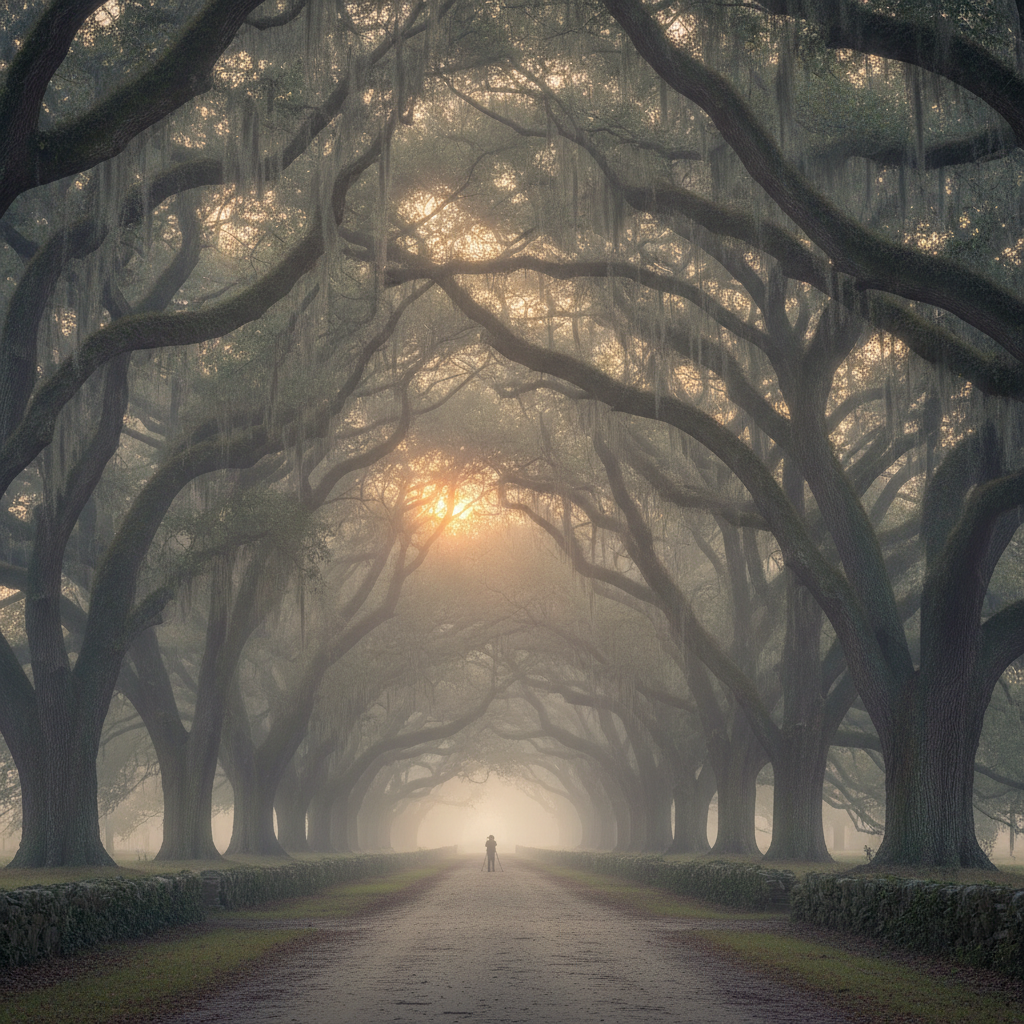
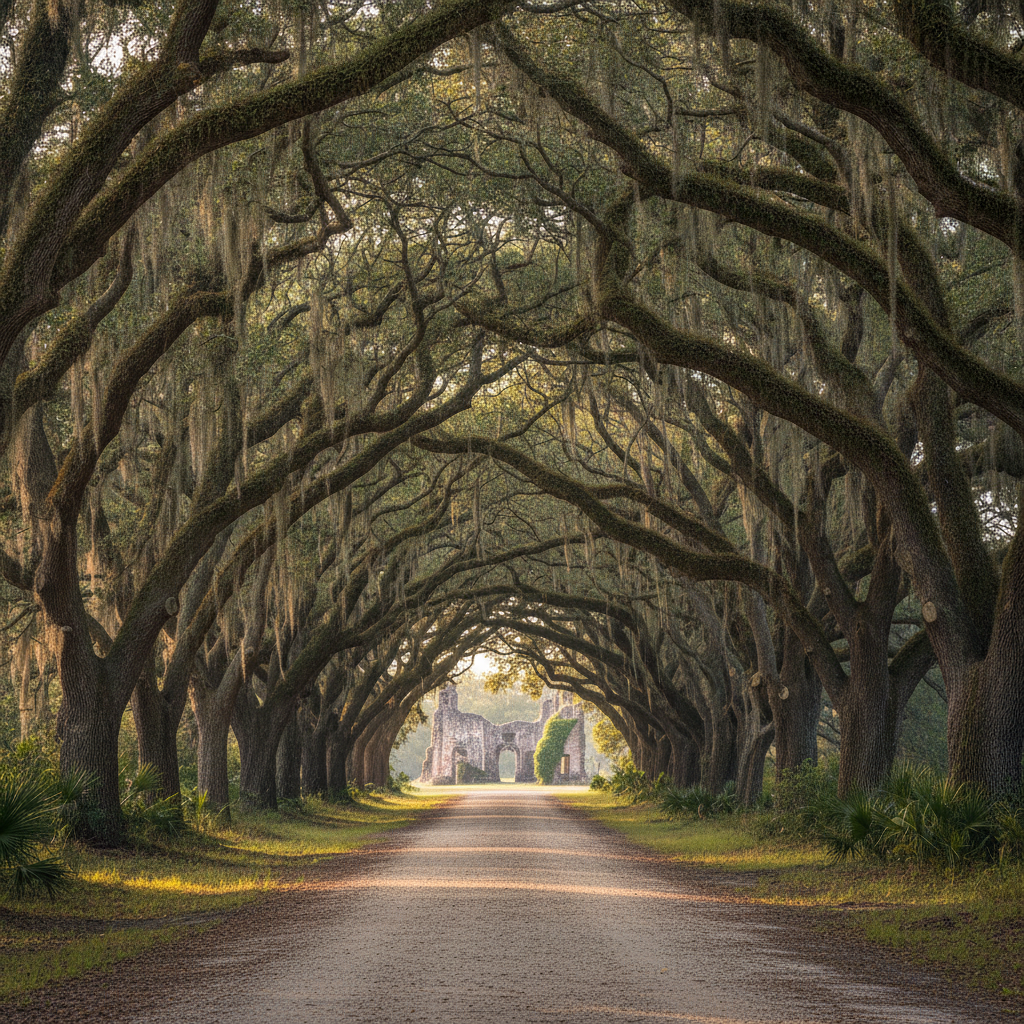
The Savannah River (the 510-km river forming the border between Georgia and South Carolina, rising in the Blue Ridge Mountains of western North Carolina and emptying into the Atlantic Ocean at Savannah): the defining waterway of the Georgia Lowcountry, historically the most important commercial river in Georgia. The Savannah River Site (at New Ellenton, South Carolina, approximately 160 km north of Savannah): the nuclear weapons production facility operated by the US Department of Energy, which produced tritium and plutonium for nuclear weapons from 1953 to 1988, and which remains one of the most contaminated federal nuclear sites in the United States. Wormsloe Historic Site (at 7601 Skidaway Road, Isle of Hope, 15 km south of downtown Savannah): the tabby ruins of the colonial estate of Noble Jones (one of the original 114 settlers who accompanied Oglethorpe to Savannah in 1733), with the most photographed natural scene in Savannah — the 2.4-km avenue of live oak trees that lines the entrance road to the site, with the branches arching overhead and draping in Spanish moss to create a cathedral of living trees that is one of the most dramatic natural landscape experiences in Georgia. The Isle of Hope (the residential island community south of Savannah, connected by a causeway): one of the most beautiful residential communities in the American South, with antebellum cottages and Victorian houses lining the bluff above the Skidaway River, draped in Spanish moss. The Skidaway Island State Park (the state park on Skidaway Island, 20 km south of Savannah): the Georgia barrier island with hiking trails, alligators, and the University of Georgia Marine Extension and Georgia Sea Grant program.
- 3
Savannah's Port City Culture and Southern Hospitality
Savannah's identity as a port city: Savannah developed a distinctive cosmopolitan character as a port city open to influences from Europe, the Caribbean, and West Africa, creating a cultural mix that distinguished it from the more insular plantation culture of the Georgia interior. The Savannah social season (the antebellum tradition of formal balls, visiting, and social display that defined Charleston and Savannah planter culture): the formal social calendar of Savannah's elite has echoes in the contemporary social calendar of Savannah's most traditional institutions. The Savannah tradition of Southern hospitality: the phrase Southern hospitality (the tradition of gracious, unhurried welcome and generous entertaining associated with the antebellum planter class and now associated with the American South more broadly) finds its most sincere expression in Savannah, where the relatively unhurried pace of life (compared to Atlanta, 380 km to the northwest) allows for genuine rather than performative social warmth. The Savannah Bee Company (at 104 W Broughton Street, Savannah, founded 2002 by Ted Dennard): the honey company that has grown from a Savannah farmers market stall to one of the most successful specialty food companies in the American South, with 14 retail stores nationally, built on the commitment to raw, single-origin artisanal honeys and bee products. The Leopold's Ice Cream (at 212 E Broughton Street, Savannah, founded 1919 by the Leopold brothers from Greece): the most beloved ice cream shop in Savannah, serving homemade ice cream from recipes unchanged since 1919, a legendary local institution and one of the most visited food destinations in the Historic District.
- 4
Savannah's Literary and Creative Heritage
Savannah as a literary city: beyond the impact of Midnight in the Garden of Good and Evil, Savannah has a rich literary heritage dating to the colonial era. Flannery O'Connor (born March 25, 1925, Savannah; died August 3, 1964, Milledgeville, Georgia): the most important Southern Gothic writer in American literature, whose works (A Good Man Is Hard to Find, Wise Blood, The Violent Bear It Away) are characterized by grotesque characters, Catholic theology, and the dark undercurrents of Southern culture. The Flannery O'Connor Childhood Home (at 207 E Charlton Street, Lafayette Square, Savannah): the house where O'Connor was born and lived until age 13, now operated as a house museum. Conrad Aiken (born August 5, 1889, Savannah; died August 17, 1973, Savannah): the Pulitzer Prize-winning poet who was born in Savannah and returned there late in life (after 60 years in Boston, London, and New York), whose poem Mayflower is one of the great meditations on New England. Aiken's father killed his mother and then himself when Conrad was 11 years old (the murder-suicide occurred in the house at 228 Oglethorpe Avenue, adjacent to the Colonial Park Cemetery), an event that shaped both Aiken's psyche and his literary preoccupations. John Berendt (born December 5, 1939, Syracuse): the author of Midnight in the Garden of Good and Evil, who spent years in Savannah researching the Williams trial and became the most important literary ambassador of 20th-century Savannah. The Savannah Book Festival (the free annual literary festival held in February in the squares of the Historic District): one of the most beloved public book festivals in the American South.
- 5
Cumberland Island and the Georgia Coast Wilderness
Cumberland Island National Seashore (at the southern tip of Georgia's barrier island chain, accessible only by the public ferry from St. Marys, Georgia, approximately 120 km south of Savannah): the largest undeveloped barrier island on the East Coast of the United States (36 km long, 3-5 km wide), with one of the most diverse and pristine coastal ecosystems in the American Southeast. Cumberland Island wildlife: the island is home to approximately 200 feral horses (descended from horses brought by the Spanish missionaries or introduced by the Carnegie family in the late 19th century), loggerhead sea turtles (nesting May-August), American alligators, white-tailed deer, wild turkey, and over 300 bird species. Cumberland Island Carnegie ruins: the Carnegie family purchased most of Cumberland Island in the 1880s and built Dungeness (the mansion built by Thomas Carnegie, younger brother of Andrew Carnegie, burned in 1959 and now a ruin that is one of the most romantic and atmospheric historic structures on the American East Coast) and Greyfield Inn (the only accommodation on the island, now operated as a luxury inn). The wedding of John F. Kennedy Jr. and Carolyn Bessette (September 21, 1996): the most exclusive celebrity wedding in American history, held in secret at the First African Baptist Church on Cumberland Island, with fewer than 40 guests and no media coverage — the couple arrived by private boat and the wedding was not reported until two days after it occurred. Jekyll Island Club Resort (the restored Jekyll Island Club, now a hotel): the most historically significant luxury resort in Georgia, with tours of the Historic District explaining the Gilded Age wealth concentrated in the Jekyll Island cottages.
- 6
Savannah and the March to the Sea - Civil War Heritage
Savannah's Civil War heritage: the Civil War transformed Savannah as profoundly as any event since the founding, ending the plantation economy that had created the city's wealth and beginning the long process of redefining the city's racial and social landscape. General William T. Sherman's March to the Sea (November 15 to December 21, 1864): the 480-km march of 60,000 Union soldiers from Atlanta to Savannah, cutting a 60-km wide swath of destruction through Georgia's agricultural heartland, destroying approximately USD 100 million worth of property (food, livestock, farms, railroads, and industrial facilities). Sherman's strategy: Sherman intended not merely to defeat Confederate armies but to destroy the economic and psychological capacity of the Confederacy to wage war — the March to the Sea is the first large-scale application of total war doctrine in American history, and a direct predecessor of the strategic bombing campaigns of World War II. The Savannah surrender: rather than allow his city to be burned (as Atlanta had been), Savannah Mayor Richard Arnold offered the city's surrender on December 21, 1864, saving Savannah's antebellum architecture and making it one of the only major Southern cities to survive the Civil War intact. The Juneteenth connection: on December 21, 1864 (the day Savannah surrendered to Sherman), approximately 10,000 enslaved people in the city were freed — among the first mass emancipations in the Deep South. The Georgia Historical Society (at 501 Whitaker Street, Savannah): the oldest cultural institution in Georgia (founded 1839), with archives documenting the full history of Georgia from the colonial period through the present.
Walk this route with audio
Stories play automatically as you reach each stop — no tapping needed.
More in savannah
Savannah: Oglethorpe Plan (1733 founded 12th and last original colony, 22 of 24 original squares surviving, most intact 18th-century urban planning US, Forsyth Park 1858 fountain, SCAD 15,000 students revitalized historic buildings), Midnight in the Garden of Good and Evil (Berendt book 1994 216 weeks NYT bestseller longest nonfiction, Mercer House Jim Williams shooting, Chablis Lady drag performer, Johnny Mercer 1,500 songs Moon River Oscar 1961 Breakfast at Tiffany's), Bonaventure Cemetery (live oak allees Spanish moss, Little Gracie Watson 1889 most visited grave, Bird Girl statue moved to Telfair Museums, Telfair Museums oldest Southern public art museum, Owens-Thomas House 1816 finest US Regency architecture), Savannah food (Olde Pink House 1771 James Habersham Georgian mansion, Pirate's House 1734 oldest building Georgia shanghaied sailors tunnel Treasure Island, Mrs. Wilkes Dining Room 1943 communal soul food), Film history (Forrest Gump 1994 Chippewa Square bench now Savannah History Museum, Midnight movie Clint Eastwood 1997, Savannah Film Festival SCAD October), Practical (Historic District 2.5 sqkm National Historic Landmark walkable, Tybee Island 30km lighthouse 1736 second oldest US site, Jekyll Island Rockefellers Morgans, Cumberland Island wild horses Carnegie ruins)
Savannah R4: Spanish moss (bromeliad not parasite absorbs moisture from air, nesting habitat for 3 bird species, Ford Model T 12,000 tons annually for seat cushions, City of Savannah manages growth in squares), Savannah squares in detail (Chippewa Square Forrest Gump bench now History Museum, Oglethorpe statue Daniel Chester French sculptor Lincoln Memorial, Monterey Square Pulaski monument Mercer House, Johnson Square 1733 first square Nathanael Greene monument), Factors Walk waterfront (cotton factor system 2.5% commission, cobblestones New England granite ballast, River Street cotton warehouses now bars restaurants, Talmadge Bridge 56m clearance container ships), Craft beer bar culture (open container law Historic District plastic cups, Moon River Brewing 1821 City Hotel most haunted bar US ghost James Stark, American Prohibition Museum only US museum Prohibition, Service Brewing veteran-founded), Georgia nature (Okefenokee 440,000ha 11,000 alligators blackwater amber tea tannic acids, Little St. Simons 30 guests bald eagles loggerhead, Georgia Bight 2,200 loggerhead nests per year), SCAD galleries (SCAD Museum of Art 1853 Gothic Revival depot, Telfair Museums oldest Southern public art 1886 Bird Girl bronze, Savannah Fashion Week student collections)
Savannah: Literary City, Victorian Elegance and Oglethorpe Grid
Savannah R2-R4: African American heritage (Sherman Savannah December 21 1864 Christmas gift, Special Field Order 15 January 1865 40 acres and a mule revoked Johnson October 1865, First African Baptist 1773 oldest North American Black Baptist congregation, Underground Railroad West African breathing holes), Tybee Island (lighthouse 1736 second oldest US station, 1958 nuclear B-47 Mark 15 bomb never recovered, Jekyll Island Club 1886-1942 Rockefellers Morgans, 1910 Jekyll Island secret meeting drafted Federal Reserve Act), SCAD (15,000 students largest US art university, 70+ historic buildings restored, Museum of Art 1853 Gothic Revival railway depot, First Fridays Gallery Crawl), Antebellum architecture (Green-Meldrim House Sherman HQ 1864, Isaiah Davenport House 1820 saved 1955 by Historic Savannah Foundation, Owens-Thomas House 1816 finest US Regency, Cathedral of St. John the Baptist 1873 French Gothic), Nightlife ghost tours (open container law Historic District, River Street cotton warehouses, Kehoe House most haunted Savannah, top 3 most haunted US, Savannah Stopover music festival SXSW stop), Practical (St. Patrick's Day 400,000 participants second US, spring azaleas best season, Starland District Back in the Day Bakery, SAV airport direct Atlanta Charlotte)
Savannah: Preservation Legacy, Harbor Power and Living Neighborhoods