Amazon Geoglyphs: Pre-Columbian Cities Hidden in Acre's Forest
The deforestation of Acre revealed thousands of geoglyphs — large geometric earthworks of pre-Columbian origin — proving that the Amazon was home to complex civilisations long before European contact
- 1
The Discovery of the Geoglyphs
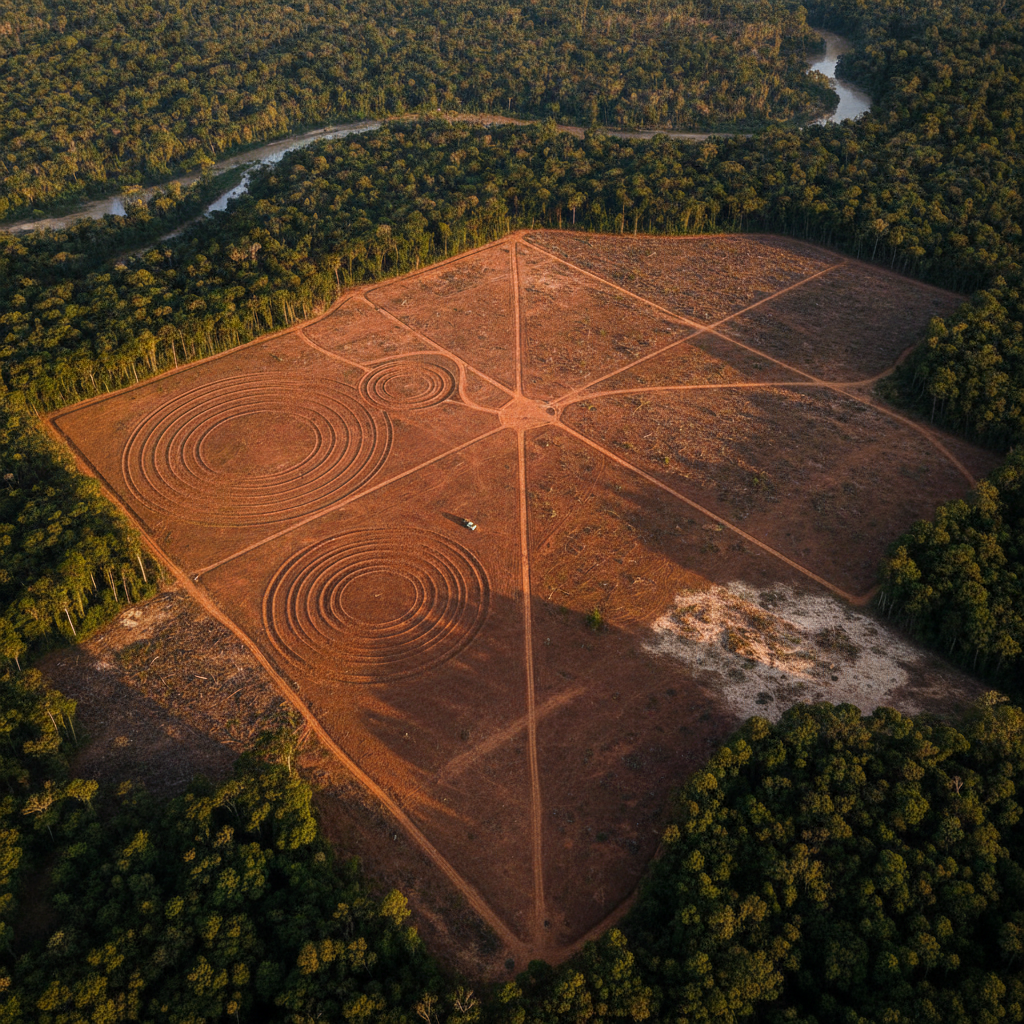
As deforestation cleared Acre's forest in the 1980s-2000s, satellite images revealed hundreds of large geometric earthworks – circles, squares and polygons up to 300 meters across – proving pre-Columbian civilization in the Amazon
- 2
Amazonian Dark Earth (Terra Preta)
The geoglyphs coincide with patches of terra preta - extraordinarily fertile black soil created by human habitation over centuries; the combination proves that the pre-Columbian Amazon was intensively cultivated and densely populated
- 3
Lidar Survey Revelations
The application of lidar (light detection and ranging) surveys to the Amazon in recent years has revealed entire ancient settlement systems invisible beneath the treetops — the extent of pre-Columbian Amazonian civilization is being rewritten
- 4
Population Estimates Revised
Scientists now estimate that 8-10 million people lived in the Amazon prior to European contact – the population collapse from disease after 1492 allowed the forest to regrow over abandoned farmland, creating the "pristine" Amazonian Europeans described
- 5
Scientific Significance
The Acre geoglyphs have been studied by Brazilian, British and American archaeologists - their findings challenge the assumption that the Amazon could not support complex civilizations and fundamentally change our understanding of pre-Columbian America
- 6
Potential for cultural tourism
Several geoglyph sites in Acre are accessible from the Rio Branco - the earthworks visible from the air or from elevated positions give physical form to the extraordinary civilization whose people and culture were almost completely erased
Walk this route with audio
Stories play automatically as you reach each stop — no tapping needed.
More in Rio Branco
Rio Branco's Cultural Scene: Museums, Identity & Forest Art

Acre's Amazon: Brazil's Most Intact Western Forest
Juruá River: Acre's Remote Amazon Heartland
Acre's Amazon Table: Forest Foods & Rubber Tapper Cuisine
