Lucerne Swiss Culture — Fondue, the Museggmauer, the Hofkirche & Swiss Traditions
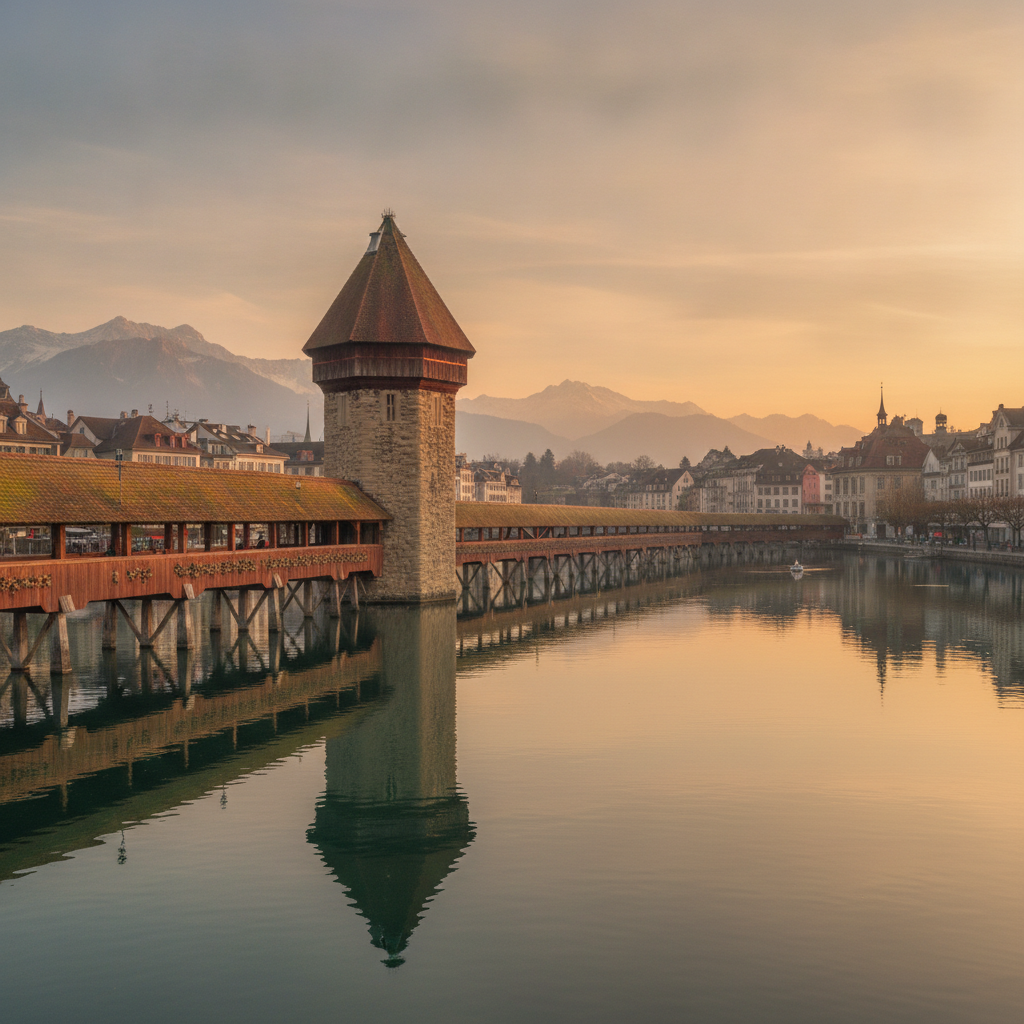
Lucerne is the most accessible Swiss cultural experience — the medieval wall walk, the Renaissance cathedral, the Swiss cheese culture, and the Rosengart art collection within a 1km radius of the Chapel Bridge.
- 1
The Museggmauer — the Best-Preserved Medieval Wall in Switzerland
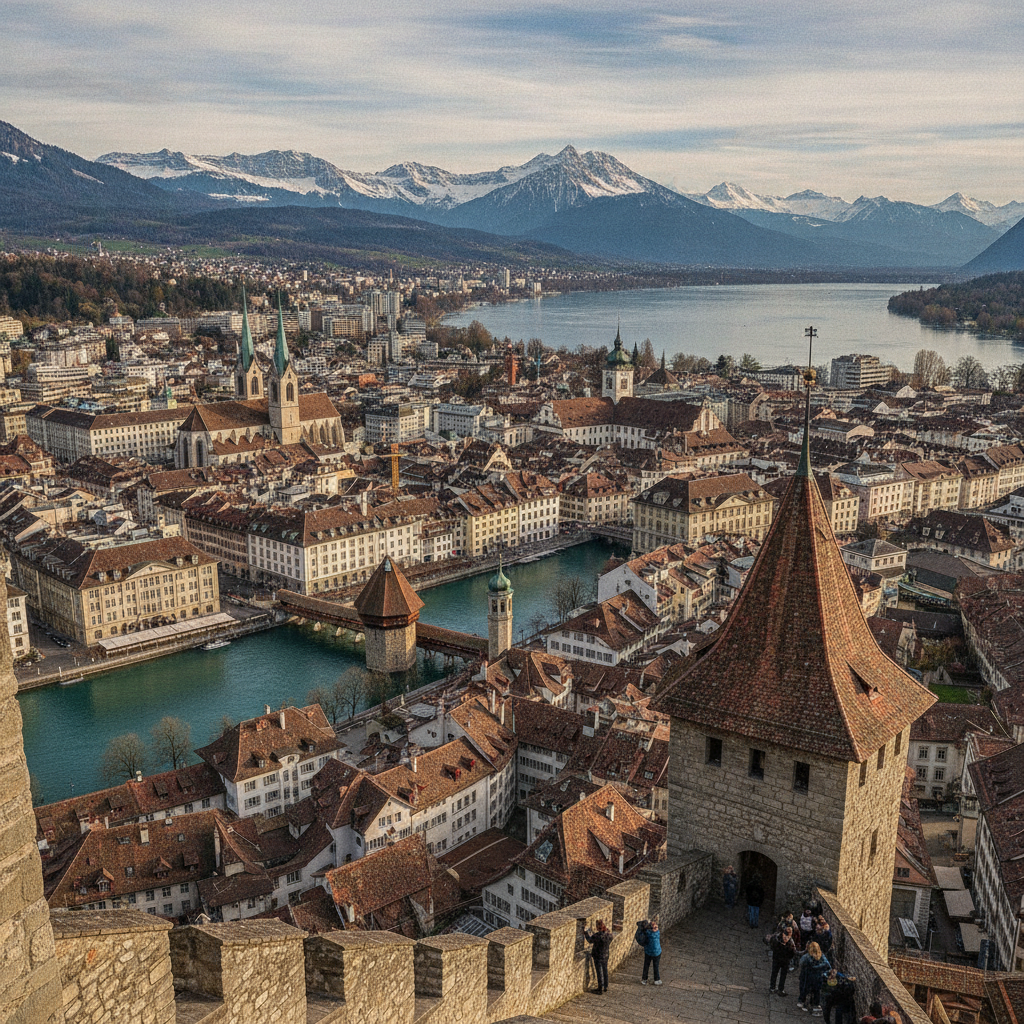
Museggmauer (the 870m medieval city wall with 9 towers on the north edge of the Lucerne Old Town, built 1350-1408, the most complete surviving medieval urban fortification in Switzerland, the wall and the walkway between the Wachturm and the Männliturm towers free and open April-November daily 8am-7pm): the wall walk (the rampart walk from the Wachturm at the west end to the Männliturm at the east end, the 600m open-air promenade on the top of the medieval wall, the most elevated view of the Lucerne Old Town available without a cable car or a funicular — the rooftops, the Kapellbrücke bridge, the lake, and the Alps of Uri and Unterwalden all visible on a clear day from the wall, the walk taking 30 minutes at a relaxed pace), the Zytturm (the Clock Tower, the tower with the oldest clock mechanism in Lucerne, the clock given the privilege of striking one minute before all other Lucerne clocks in 1535 by the City Council as a reward for early morning fire watch duties — the clock still striking one minute early relative to all other Lucerne clocks the most unusual municipal timekeeping privilege in Switzerland), the Männliturm (the last tower on the east end of the walkable section, the tower with the best view east over the Reuss River to the Hofkirche cathedral and the Lake Lucerne beyond, the correct viewpoint for the photographing of the cathedral towers with the lake and the Alps behind) and the descending route (the descent from the Museggmauer via the Kasernenplatz to the Kornmarkt square the most historically layered descent in the Lucerne Old Town — the path passing the Ritterscher Palast of 1556, the most important Renaissance secular building in Lucerne, now the Cantonal Government Building).
- 2
The Hofkirche — the Twin-Towered Cathedral
Hofkirche St. Leodegar (the Cathedral of Lucerne, St.-Leodegar-Strasse 6, the twin-towered Renaissance cathedral rebuilt 1633-1645 after a fire on the foundations of the medieval church, the most important church in Lucerne, free, daily 7am-7pm): the exterior (the twin 68m towers — the towers of the original Gothic church of 1505 that survived the 1633 fire, the only Gothic elements of the current church, the Renaissance nave built between and behind the two surviving Gothic towers the most unusual architectural solution in Swiss religious architecture), the interior (the Renaissance interior with the Baroque organ — the largest Baroque pipe organ in Switzerland, built 1645, renovated 1862, the organ recital programme available at hofkirche.ch, the free Tuesday organ recitals at noon June-September the most accessible classical music experience in Lucerne), the Jesuit Church (the Jesuitenkirche at Bahnhofstrasse 11A on the opposite bank of the Reuss, the earliest Baroque church north of the Alps built 1666-1677, the pink and white Baroque interior the most ornate in Lucerne, free, daily 6:30am-6:30pm), and the Stiftskirche ossuary (the ossuary at the east side of the Hofkirche exterior, the late Gothic arcade sheltering the remains of the plague dead of the 14th and 15th centuries, the skulls and bones arranged in the niches of the arcade in the medieval tradition — the most unusual and the most medieval survival in the Lucerne cathedral precincts).
- 3
The Rosengart Collection — Picasso and Klee in Lucerne
Sammlung Rosengart (Pilatusstrasse 10, the private art collection of the Lucerne art dealer Siegfried Rosengart and his daughter Angela Rosengart, the finest private Swiss art collection in a purpose-built museum, €20 adults, daily 10am-6pm April-October, 11am-5pm November-March): the Picasso collection (200+ works by Pablo Picasso covering the complete span of his career — the early Blue and Rose Period drawings, the Cubist period paintings and the gouaches, the 1950s-60s late works in the ceramics and the lithographs, the final series of 31 photographs by David Douglas Duncan documenting Picasso in his studio 1956-1973 — the most complete photographic record of Picasso's working process in any Swiss museum, the photograph series on the lower floor the most personally revealing Picasso documentation available), the Klee collection (40+ works by Paul Klee, the Swiss-German artist born in Bern — the works spanning 1902-1939 including the characteristic small-format works in the watercolour and the tempera that Klee developed in the Bauhaus period, the Rosengart Klee collection the most important private Klee collection in German-speaking Switzerland — the works complementing the larger Klee collection at the Zentrum Paul Klee in Bern), the Rosengart personal collection (the art accumulated through the Rosengart gallery's direct dealings with Picasso and the major modernists — Picasso gave several works directly to Siegfried Rosengart in payment for and in appreciation of the Rosengart gallery's work promoting his paintings in Switzerland from the 1930s) and the building (the former National Bank building of 1924 with the neoclassical facade, the most architecturally distinguished private museum building in Lucerne, the museum conversion maintaining the bank counter room as the primary gallery space).
- 4
Swiss Watch Culture and Lucerne Shopping
Swiss watches and shopping (Lucerne the primary Swiss watch retail destination for the international visitor, the Old Town the most concentrated watch retail in Switzerland outside Geneva and Zurich): the watch tradition (the Swiss watch industry centred in the Jura mountains — the Neuchâtel, the Biel/Bienne, and the Geneva regions the primary production centres — the brands available in Lucerne: Rolex, Patek Philippe, IWC, Omega, Breitling, TAG Heuer, Longines, Tissot, and Swatch at the dedicated brand boutiques and the multi-brand retailers, the Bucherer store at Schwanenplatz 5 the largest watch retailer in Lucerne and the primary multi-brand destination, the price advantage for the international tourist through the Swiss VAT refund — the 7.7 percent VAT refundable on purchases over CHF 300 for non-EU residents, the form available at the point of sale), the souvenir food (the Läderach Chocolatier Suisse at Surseer Strasse 84 the most locally embedded Swiss chocolate producer — the Läderach Fresh Choc bar the fresh chocolate slab sold by weight at CHF 5-8 per 100g, the Swiss milk chocolate tradition dating from the 1840s invention by Daniel Peter of the milk chocolate process — the most authentic Swiss chocolate experience outside the manufacturer's factory tours), the Swiss Army knife (the Victorinox Swiss Army knife, the most internationally recognized Swiss manufactured object, available from CHF 25 for the standard Soldier model to CHF 180 for the SwissChamp model, the Victorinox factory in Ibach 35km south of Lucerne accessible by bus — the factory outlet at Schmiedgasse 57 in Schwyz, the most direct source for the authentic Victorinox range) and the Lucerne market souvenirs (the Luzerner Lebkuchen — the Lucerne spiced gingerbread in the traditional city shield form, the Swiss linen and the embroidery from the market stalls, the Swiss cow bell at CHF 15-80 depending on the size and the decoration, the most practically specific Swiss souvenir available).
- 5
Lucerne and the William Tell Country — the Swiss National Myth
Tell Country (the Vierwaldstättersee — the Lake of the Four Forest Cantons — the landscape of the Swiss national founding myth, the lake the historical and the legendary setting for both the Rütli oath of 1291 and the Wilhelm Tell story): the Tell legend (the story of Wilhelm Tell — the crossbowman of Uri who refused to bow before the Habsburg bailiff Gessler's hat, forced to shoot the apple from his son's head with the crossbow, then imprisoned on the lake steamer and escaping during a storm to shoot Gessler from ambush, the legend first recorded in the 15th-century White Book of Sarnen and set to the most famous Swiss play by Friedrich Schiller in 1804 — the Schiller version the primary Tell narrative in the German-speaking world, the opera Guillaume Tell by Rossini 1829 with the William Tell Overture the most internationally known musical adaptation), the Tell Chapel at Sisikon (the chapel on the lake shore at the location where Tell leaped from Gessler's boat, accessible by lake steamer from Lucerne pier 1, the 16th-century frescoes depicting the Tell legend inside the chapel free to view, the most atmospheric Tell site on the lake), the Tellspiele Altdorf (the annual open-air Tell performances in Altdorf at the south end of the lake — the Friedrich Schiller play performed in the original Tell landscape since 1899, July-August, accessible by lake steamer, the most historically rooted performance of the Tell play in Switzerland, tickets at tellspiele.ch) and the Swiss Confederation history (the Bundesbrief Museum at Schwyz, the museum holding the original 1291 Federal Charter — the founding document of Switzerland, accessible from Lucerne by lake steamer to Brunnen then bus in 90 minutes, €5 adults, the most historically significant single document in Swiss history on public display).
- 6
Lucerne Day Trips — Engelberg, the Titlis and Central Switzerland
Lucerne day trips: Engelberg and the Titlis (the village of Engelberg 35km south of Lucerne, accessible by train in 45 minutes at CHF 25 return, the Titlis mountain at 3,239m the most accessible glacier experience from Lucerne — the Titlis Rotair cable car the first permanently revolving cable car in the world, rotating 360 degrees during the 5-minute ascent from Stand to the Titlis summit at 3,239m, the Titlis Glacier Cave and the Cliff Walk — the highest suspension bridge in the Alps at 3,041m — the primary summit attractions, €91 adults return for the complete Titlis ascent from Engelberg, the Swiss Travel Pass giving a 50% discount): the Entlebuch biosphere reserve (the UNESCO Biosphere Reserve 30km southwest of Lucerne, the most pristine landscape in central Switzerland — the peat bogs, the karst limestone formations, and the forest of the Entlebuch the natural counterpart to the Alpine landscape of the Lake Lucerne region, accessible by bus from Lucerne in 45 minutes, the Schüpfheim visitor centre at Hauptstrasse 29 the biosphere information point), the Burgenstock resort (the cliff-top resort above Lake Lucerne at 900m, accessible by ferry from Lucerne pier 2 to Kehrsiten then the Bürgenstock funicular in 60 minutes total, the Bürgenstock Resort the most spectacular cliff-top resort in Switzerland — the Hammetschwand Lift, the fastest outdoor elevator in Europe at 12 seconds to the cliff-top — and the lake swimming from the infinity pool 500m above the water) and Stans (the capital of the Canton of Nidwalden 25km south of Lucerne, the Winkelried Monument at the town centre commemorating Arnold von Winkelried — the hero of the Battle of Sempach 1386 who sacrificed himself to break the Habsburg lance formation — the most regionally important medieval battle monument in central Switzerland).
Walk this route with audio
Stories play automatically as you reach each stop — no tapping needed.
More in lucerne
Lucerne Mountains — Pilatus, the Rigi, the Stanserhorn & the Golden Roundtrip
Swiss History from Lucerne — the Rütli, the Federal Charter & the Wilhelm Tell Legend
Lucerne — the Chapel Bridge, the Old Town & Lake Lucerne
Lucerne Food & Nightlife — Swiss Fondue, the Old Town Restaurants & the Lake Bar Scene