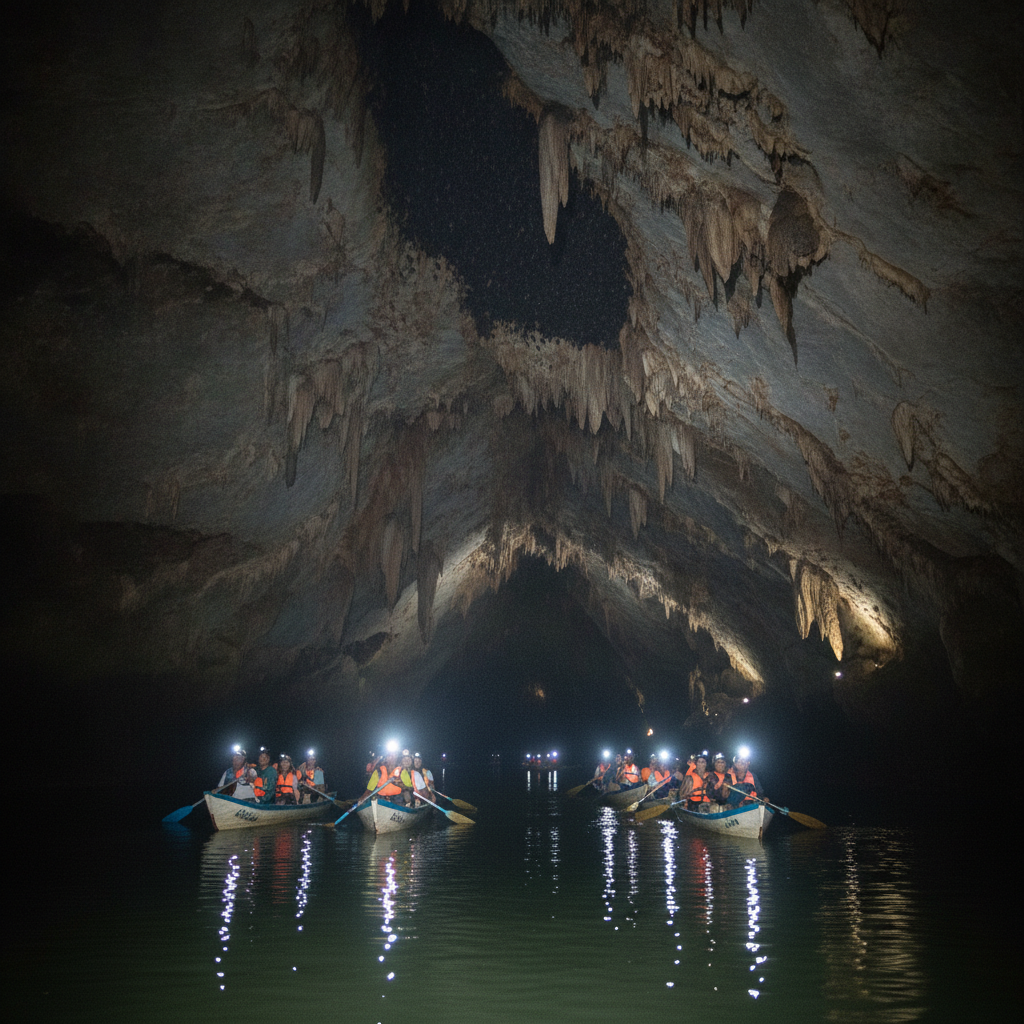


Palawan's Wider World: Puerto Princesa's 8.2km Underground River, the Tagbanua's 50,000-Year Presence & the 14.7km San Vicente Beach That Refused Boracay's Fate
The Puerto Princesa cave's 800,000 Geoffroy's rousette bats exiting each evening in a 30-minute mass flight before the last paddle boats return; the Tagbanua CADC ancestral domain over Calamian islands where their traditional fishing bans constitute one of the Philippines' earliest community marine management systems; Nacpan's 4km beach requiring an unpaved road and offering beginner surf while Las Cabañas' cable car (the Philippines' only beach cable car) offers the sunset view for PHP 250; the 12 Japanese WWII ships sunk in Coron Bay by Admiral Halsey's Task Force 38 in September 1944 now at 10–45 metres in coral-colonised formations; live coral cover at 15% near Tour A destinations versus 55% in remote reef areas showing the direct tourism footprint impact; and San Vicente Long Beach at 14.7km deliberately unbranded to avoid the trajectory El Nido followed from 1,500 visitors in 2000 to 200,000 in 2019.

El Nido After Dark: Dinoflagellate Bioluminescence on the Paddle Stroke, 89,000 Hectares of Palawan Mangroves & San Vicente's 14.7km Beach That Chose Not to Become El Nido
New moon night kayaking when dinoflagellate plankton flash with every stroke—observable June–October but present year-round on dark nights, simultaneous with the Milky Way reflection in the still Bacuit Bay; Shimizu Island's 35–40% live coral cover at the Tour A stop most visitors rush through for the Cathedral Cave photograph; San Vicente's deliberate slow development policy with 200 daily visitors on a 14.7km beach that comfortably holds thousands—the DOT model for avoiding El Nido's 200,000 visitor trajectory; Palawan's 89,000 mangrove hectares and 30 of the world's 40+ species providing the juvenile fish nursery that El Nido's restaurants depend on; the Corong-Corong lagoon 2km from the pier navigable by kayak for 4km into the mangrove system; and El Nido's honest summary: 3–4 days optimal, Tour A essential, dawn kayak before the 09:00 departures, and the magic is in the landscape not the destination.

El Nido's Operating Reality: 80 Simultaneous Tour Boats in the Big Lagoon, the Bajau People's Genetically Larger Spleens & Halong Bay's 3 Million Annual Visitors vs. El Nido's 200,000
Peak season Big Lagoon with 1,000 tourists simultaneously in the 'hidden' lagoon—the off-season shoulder months reduce this to 10–20 boats and give the experience the photographs promise; the 2016 Hague tribunal ruling that China's nine-dash line has no UNCLOS legal basis, which China rejected and which sits 150 km from El Nido's bangca routes; Miniloc Island Resort's solar power and coral restoration programme operating since the early 1990s as the ecological model 400 town guesthouses haven't replicated; the 2018 Cell study finding Bajau spleens 50% larger than non-diving populations through genetic adaptation for freediving; the Palawan scops owl and Philippine eagle-owl at dawn above El Nido town requiring a guide who knows the feeding routes; and El Nido's 200,000 versus Halong Bay's 3 million as the development trajectory nobody wants but the pre-COVID growth rate was delivering.

El Nido at Its Quietest: The 05:30 Dawn Kayak to Big Lagoon Before 80 Tour Boats Arrive, Culion Island's 17,000-Patient Leper Colony & the Lio Estate's 1MW Solar Airport
The Big Lagoon entrance reached by sea kayak at 06:00 with no other boats—the identical limestone walls and turquoise water as the Tour A photographs, with silence instead of 1,000 simultaneous tourists; the Small Lagoon's 60cm entrance requiring life jacket removal for a horizontal rock swim; Culion Island's 40-year American colonial leprosy isolation programme for 17,000 patients now a history museum in a regular municipality; the Linapacan archipelago's 30–40 metre horizontal visibility ranked among the clearest water in the world and almost entirely undeveloped; the Lio estate's solar power, rainwater harvesting, and composting programme versus the displacement of fishing communities from the coastal areas it now manages; and the Batak people—300–450 individuals, the only remaining hunter-gatherer group with primary forest access in Palawan, the most critically endangered indigenous community in the Philippines.

El Nido: The Bacuit Archipelago's Hidden Lagoons Accessible Only Through Rock Cracks, Barracuda Lake's 38°C Salt Water Below 28°C Freshwater & the Last Palawan Pangolin
The Small Lagoon's entrance requires removing your life jacket to squeeze through a crack in the limestone—the tightest passage in a standard Philippine island-hopping tour; Tour A, B, C, and D each visiting different combinations of the 45 Bacuit Bay islands with the Cathedral Cave light shaft in Tour B and the Secret Beach hole in Tour C; Palawan's 50% remaining forest cover versus the 7% national average, protecting the Palawan peacock-pheasant and the world's smallest hoofed animal on Balabac; Barracuda Lake's halocline where 28°C freshwater sits above 38°C saltwater in a visually shimmering boundary at 10 metres; El Nido town going from 1,500 visitors in 2000 to 200,000 in 2019 via AirSWIFT; and the Big Lagoon's 1,000 daily visitors in peak season—quietly degrading the experience they came to have.

El Nido's Fragile Beauty: Ocean Acidification Dissolving the Limestone Towers, the Palawan Peacock-Pheasant at Dawn & the DENR Carrying Capacity Study Nobody Implemented
The same atmospheric CO2 that is warming the planet is also physically dissolving El Nido's limestone towers through ocean acidification—the towers you are photographing are being eroded faster now than in any period since their formation 30 million years ago; the Palawan peacock-pheasant requires hiring a local forest guide at dawn and walking silently above the town; the Milky Way from an anchored liveaboard between the limestone islands and the Magellanic Clouds visible on the southern horizon at El Nido's latitude; the DENR carrying capacity study's 40,000–60,000 annual visitor ceiling versus the 200,000+ who arrived in 2019; COVID's unplanned 18-month reef rest producing improved water clarity and returned wildlife; and the Ayala Corporation's ISO 14001 marine conservation programme as the ecological model that 200 other El Nido operators have not replicated.