
El Nido's Fragile Beauty: Ocean Acidification Dissolving the Limestone Towers, the Palawan Peacock-Pheasant at Dawn & the DENR Carrying Capacity Study Nobody Implemented
The same atmospheric CO2 that is warming the planet is also physically dissolving El Nido's limestone towers through ocean acidification—the towers you are photographing are being eroded faster now than in any period since their formation 30 million years ago; the Palawan peacock-pheasant requires hiring a local forest guide at dawn and walking silently above the town; the Milky Way from an anchored liveaboard between the limestone islands and the Magellanic Clouds visible on the southern horizon at El Nido's latitude; the DENR carrying capacity study's 40,000–60,000 annual visitor ceiling versus the 200,000+ who arrived in 2019; COVID's unplanned 18-month reef rest producing improved water clarity and returned wildlife; and the Ayala Corporation's ISO 14001 marine conservation programme as the ecological model that 200 other El Nido operators have not replicated.
- 1
El Nido's Limestone Geology – How Karst Towers Form
The formation of the Bacuit Archipelago's limestone towers—the geological process that created El Nido's signature landscape over 30–300 million years—provides the context for understanding not just the landscape's beauty but its fragility. The formation sequence: the limestone of El Nido's towers was originally deposited as coral reef material in a shallow tropical sea approximately 300 million years ago; the accumulated calcium carbonate (the shells and skeletons of coral and marine organisms) was compressed into limestone rock; subsequent tectonic uplift (the collision of the Palawan micro-continent with the Philippine plate, approximately 30–20 million years ago) raised the seabed to the current elevation; then the exposed limestone was dissolved by acid rain (rainwater absorbs atmospheric CO2 to form carbonic acid, which dissolves limestone) and eroded by wave action at the sea surface, producing the characteristic towers, caves, and arches. The current erosion: the limestone formations are continuing to erode—at the sea surface, the wave action notches the base of each tower (creating the characteristic 'mushroom' profile where the tower is undercut at the waterline); in the caves, freshwater dissolution continues to form stalactites and stalagmites. The climate vulnerability: the limestone karst of El Nido is particularly sensitive to ocean acidification (the absorption of atmospheric CO2 by the ocean, which increases the sea's acidity and accelerates limestone dissolution)—the same CO2 emissions that are warming the planet are also physically eroding the limestone towers that make El Nido a destination.
- 2
Wildlife Beyond the Water – El Nido's Forest & Birdlife
The forests of the Palawan mainland surrounding El Nido town—and the forests on the limestone island hills above the lagoons—support significant endemic birdlife that provides an alternative activity to island-hopping for ornithologists and wildlife watchers. The Palawan birds accessible from El Nido: the Palawan peacock-pheasant (the most visually spectacular, found in the primary forest above El Nido town—sightings require an early morning walk on the forest trails behind the town; best seen by hiring a local guide familiar with specific feeding sites); the Philippine cockatoo or katala (Cacatua haematuropygia—a critically endangered species with approximately 1,000 individuals remaining in Palawan; seen occasionally in the fruiting fig trees of the forest edge around El Nido); the Palawan hornbill (Anthracoceros marchei—typically seen flying between limestone island forests at dawn); and the Blue-naped parrot (Tanygnathus lucionensis—common and conspicuous, seen in noisy flocks around the town's coconut palms). The wildlife walks: the El Nido Ecotourism Trail (a 4-km guided walk through the forest behind El Nido town, passing through secondary and primary forest with views of the Bacuit Bay from above the cliff edge) is the most accessible wildlife walk in the El Nido area, taking approximately 3 hours with a knowledgeable guide. The monitor lizards: the Palawan monitor (Varanus palawanensis—an endemic monitor lizard species) is commonly seen swimming between the limestone islands and basking on rocky outcrops.
- 3
The El Nido Sunset & the Astronomical Night Sky
El Nido's position on Palawan's western-facing coast—with an unobstructed view of the South China Sea horizon from the town beach and from Las Cabañas—produces sunsets of consistent quality that are among the most photogenic in the Philippines, and the absence of significant urban light pollution means that the night sky above the Bacuit Bay is one of the darkest accessible from a Philippine tourism destination. The sunset geography: the sun sets over the South China Sea to the northwest of El Nido, with the limestone tower silhouettes of the Bacuit Bay islands providing the distinctive foreground; the Las Cabañas cable car viewpoint and the beach along Las Cabañas Beach (both accessible without a boat) are the primary sunset viewing locations. The sunset timing: El Nido's sunsets occur between 17:45 and 18:30 throughout the year (the island's tropical latitude produces consistent sunset times); the best conditions are during the dry season (December–May) when the atmosphere is clearer; the most dramatic photographs occur when there is thin high cloud to colour without blocking the sun. The astronomical dark sky: on a clear night in the Bacuit Bay (best experienced from an overnight liveaboard boat anchored between the limestone islands), the Milky Way is visible as a dense band from horizon to horizon; the Andromeda Galaxy is visible to the naked eye; and the Magellanic Clouds (the two small satellite galaxies of the Milky Way) are visible from El Nido's southern horizon—only observable from locations south of approximately 20° N latitude.
- 4
Responsible Tourism in El Nido – Environmental Pressures & Choices
El Nido's environmental challenges—the result of tourism growth from under 10,000 visitors in 2005 to over 200,000 in 2019—create a specific set of choices for visitors who want to minimise their impact on the environment they have come to see. The waste crisis: El Nido town's waste management system (a single municipal dump, no formal recycling infrastructure) cannot process the volume of waste generated by 200,000+ annual visitors; the result is visible—plastic accumulation on the beaches of uninhabited islands, floating debris in the lagoons, and the town's shoreline regularly strewn with waste. The carrying capacity question: the Bacuit Bay can sustain approximately 40,000–60,000 visitors per year under current management intensity (per the DENR's own carrying capacity study)—at 200,000+ visits, the ecosystem is significantly overloaded. The things that help: booking tours with operators who collect waste from the islands (several El Nido operators now conduct regular island cleanup dives—Sea Explorers El Nido has a documented cleanup programme); choosing accommodation with solar power and rainwater harvesting (several eco-lodges north of El Nido town have these systems); not buying single-use plastic in El Nido (the town has theoretically banned single-use plastic since 2018—enforcement is inconsistent but using reusable water bottles is meaningful at the scale of waste generated). The government response: in 2019, the DENR imposed a temporary ban on construction of new tourism establishments in El Nido municipality—subsequently lifted after the COVID-19 pandemic reduced visitor volumes; as of 2023, the construction moratorium is contested and the development trajectory remains unclear.
- 5
El Nido's Food Scene – From Seafood to the Town Market
El Nido's food scene—which has expanded from the basic rice-and-grilled fish offered by the original handful of backpacker restaurants in 2005 to a varied landscape of 200+ restaurants, cafés, and food stalls in 2023—reflects the tourism demographic (international visitors with varied budgets and food preferences, alongside a small permanent expat community of restaurant operators). The seafood: the most consistent food experience in El Nido is grilled fresh seafood at the beach restaurants—the daily catch from El Nido's fishing fleet (snapper, grouper, barracuda, squid, crab, tiger shrimp) is typically the freshest and most reliable food available; the standard order at any beachside restaurant is 'point at the fresh fish, have it grilled with garlic butter and calamansi (the local lime).' The town market (the El Nido Public Market—on Magsaysay Street in the town centre, open daily 05:00–08:00 for the fresh produce section, 07:00–21:00 for the prepared food section): the most affordable food in El Nido—the market stalls sell local produce (green mango, banana, papaya, calamansi, and the small highland vegetables trucked in from the Quezon area), dried seafood, and the local breakfast (sinangag rice with eggs and dried fish). The restaurant recommendations: Altrove (the most ambitious Italian-influenced restaurant in El Nido, serving wood-fired pizza with Philippine toppings—the 'Palawan pizza' concept); Republica Sunset Bar (the drinks are mediocre but the view of the Las Cabañas sunset is the best in the town area).
- 6
El Nido in the Philippine Tourism Narrative – Beauty & Politics
El Nido's position in the Philippine tourism narrative—as the flagship destination that has brought international attention to Palawan and to the Philippines as a whole, repeatedly topping international 'best island' rankings—makes it the subject of intense political attention at both the national (DOT—Department of Tourism) and local (Municipal Government of El Nido) levels. The national narrative: the Department of Tourism's international marketing ('It's More Fun in the Philippines'—the campaign launched 2012 and still running in various iterations, with El Nido's limestone lagoons as the primary image) has used El Nido's landscape as the primary visual symbol of Philippine tourism internationally; the campaign generated a significant increase in international arrivals from 2012 onward. The political economy: the municipal government of El Nido (the wealthiest municipality in Palawan province, with tourism as the tax base) has a structural conflict of interest between maximising tourism revenue and protecting the environment that generates that revenue. The Ayala Corporation's El Nido Resorts (operating since the early 1990s—the most ecologically responsible large tourism operator in the area, with ISO 14001 environmental certification and a documented marine conservation programme) provides a model that local development has not replicated in scale. The COVID-19 effect: the complete closure of El Nido to tourism for approximately 18 months (2020–2021) provided an unplanned ecological rest period; observers reported improved water clarity, increased fish populations, and the return of wildlife species to previously disturbed areas—evidence that the ecosystem can recover with reduced pressure.
Walk this route with audio
Stories play automatically as you reach each stop — no tapping needed.
More in El Nido
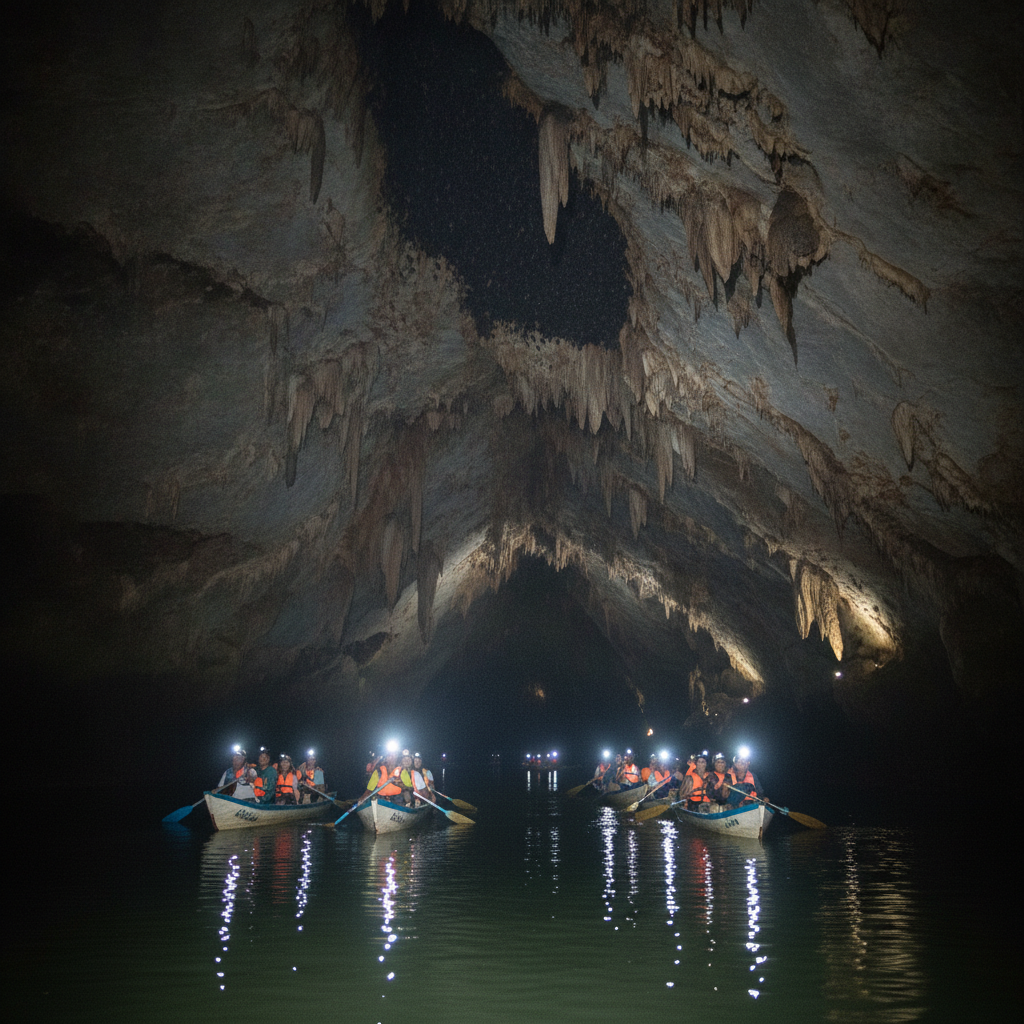
Palawan's Wider World: Puerto Princesa's 8.2km Underground River, the Tagbanua's 50,000-Year Presence & the 14.7km San Vicente Beach That Refused Boracay's Fate
El Nido After Dark: Dinoflagellate Bioluminescence on the Paddle Stroke, 89,000 Hectares of Palawan Mangroves & San Vicente's 14.7km Beach That Chose Not to Become El Nido

El Nido's Operating Reality: 80 Simultaneous Tour Boats in the Big Lagoon, the Bajau People's Genetically Larger Spleens & Halong Bay's 3 Million Annual Visitors vs. El Nido's 200,000

El Nido at Its Quietest: The 05:30 Dawn Kayak to Big Lagoon Before 80 Tour Boats Arrive, Culion Island's 17,000-Patient Leper Colony & the Lio Estate's 1MW Solar Airport