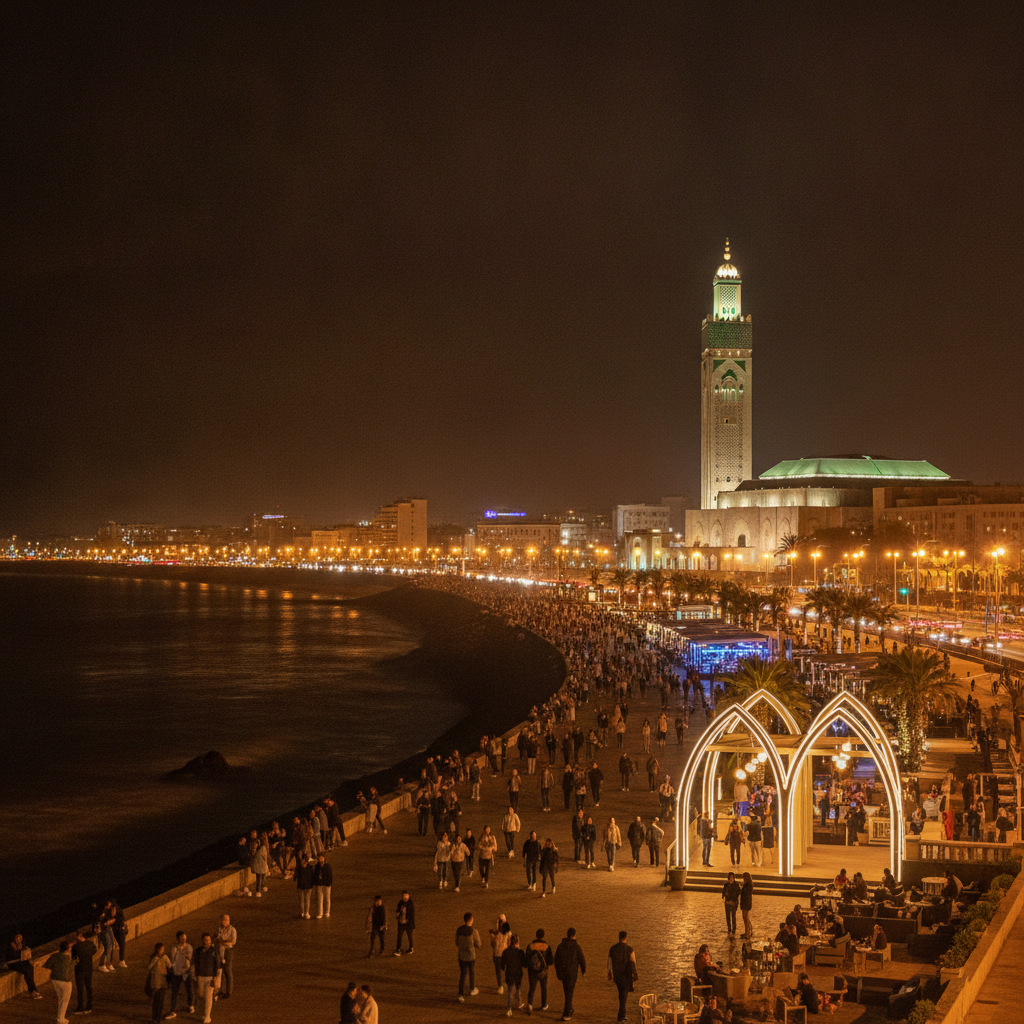


Casablanca Lifestyle: Ain Diab Beach, the Corniche Restaurant Scene, the Morocco Nightlife Capital, the Luxury Hotel Strip, and the Casablanca Urban Middle Class Culture
The Casablanca lifestyle route covers the Ain Diab beach and the private beach clubs, the Corniche restaurant and bar scene as the most active single nightlife strip in Morocco, the Casablanca luxury hotel competition, and the urban middle class culture that makes Casablanca the most socially liberal single Moroccan city.

Casablanca Jewish Heritage: The Mellah District, the Miara Cemetery, the Museum of Moroccan Judaism, the Sephardic Cultural Legacy, and the Moroccan Jewish Community Today
The Casablanca Jewish heritage route covers the Casablanca Mellah district, the Miara cemetery as the largest Jewish cemetery in Africa, the Museum of Moroccan Judaism as the only Jewish museum in an Arab country, the Sephardic cultural legacy in Morocco, and the contemporary Moroccan Jewish community.

Casablanca Modern City: Mohammed V Square, the Habous New Medina, the Villa des Arts, the Casablanca Financial Centre, and the Contemporary Moroccan Art Scene
The Casablanca modern city route covers the Mohammed V Square as the colonial era civic center, the Habous New Medina as the planned Moroccan urban quarter, the Villa des Arts contemporary art museum, the Casablanca Finance City towers, and the contemporary Moroccan art scene that makes Casablanca the most artistically current single Moroccan city.

Casablanca Region: El Jadida and the Portuguese Cistern, the Mazagan Coastal Drive, the Oualidia Oyster Lagoon, and the Atlantic Coast South of Casablanca
The Casablanca region route covers El Jadida as the UNESCO Portuguese colonial city with the extraordinary cistern, the Mazagan coastal fortress heritage, the scenic Atlantic coastal drive south of Casablanca, the Oualidia lagoon as the finest oyster production site in Morocco, and the Atlantic Coast culinary tradition.

The 1942 Casablanca Film Was Shot Entirely in Hollywood by Filmmakers Who Had Never Visited Morocco Yet Accidentally Captured a Real Wartime Dynamic; The Bou Craa Phosphate Mine in Moroccan-Administered Western Sahara Is One of the World's Largest Phosphate Deposits; Moroccan Argan Oil Has Grown From a Cottage Industry to an Approximately USD 10 Billion Annual Global Market
The 1942 Casablanca film shot in Hollywood accidentally capturing a real wartime dynamic; Bou Craa phosphate mine as Morocco's primary economic interest in Western Sahara; argan oil growing to approximately USD 10 billion annually; Mohamed Choukri's For Bread Alone as the most internationally translated Moroccan Arabic-language work; Morocco's 3,000 km Atlantic coastline from Tangier to Dakhla; and Rick's Cafe as a Hollywood fantasy that became a real piece of Casablanca's cultural identity.

Casablanca Practical: Airport Connections, the Train to Marrakech and Fes, Hotel District Guide, the Morocco Circuit Starting Point, and the Departure Summary
The Casablanca practical route covers the Mohammed V Airport train connection, the Al Boraq high-speed train to Marrakech, the intercity train to Fes and Rabat, the hotel district selection between the city center and the Corniche, the optimal Casablanca stay duration, and the departure summary.

The Casablanca Port Was Entirely Artificial Built by the French From 1912 Onward and Now Handles 30 Million Tonnes Annually While Tanger Med Has Surpassed It as Africa's Largest Container Port; Mohammed VI's 2004 Moudawwana Family Law Reform Was Called the Most Progressive Family Law in the Arab World; Gnawa Music Derives From West African Slaves Brought Via the Trans-Saharan Trade and the Lila Healing Ceremony Is an All-Night Trance Ritual
The Casablanca port entirely French-built from 1912 handling 30 million tonnes annually; Mohammed VI's 2004 Moudawwana reform as the most progressive Arab family law; the Gnawa musical tradition from sub-Saharan African enslaved peoples with the lila trance healing ceremony; Casablanca growing from 20,000 people in 1900 to 4.7 million in 2025 driven by French colonial investment; Tanger Med now Africa's largest container port at 9 million TEUs vs Casablanca's 1 million TEUs; and the Casablanca budget guide with the airport train at 45 MAD and sardine meals for 30-50 MAD.

Morocco Has 72-74% of World Phosphate Reserves Making OCP Group a Geopolitical Resource Power Analogous to Saudi Arabia in Petroleum; Mohammed V Was Exiled to Madagascar by the French in 1953 Which Backfired Catastrophically and Accelerated Moroccan Independence; El Jadida Portuguese Cistern's Gothic-Manueline Vaulting Reflected in Its Shallow Floor Water Is Among the Most Photographed Interior Spaces in Morocco
Morocco controlling 72-74% of world phosphate reserves and OCP Group as the world's largest phosphate rock exporter; Mohammed V's exile to Madagascar in 1953 massively strengthening the independence movement and accelerating French withdrawal by 1956; El Jadida Portuguese Cistern's UNESCO-listed Gothic-Manueline vaulting; the Amazigh Tamazight language recognized as co-official in 2011 and Yennayer New Year declared a national holiday in 2023; the Casablanca-Rabat twin capital relationship with Rabat's Hassan Tower (1195 Almohad minaret stopped at 44m when the sultan died); and the Oualidia lagoon oyster cultivation as Morocco's finest Atlantic oysters.

The Hassan II Mosque Minaret at 210m Is the Tallest Minaret in the World With a 30km Laser Beam Pointing Toward Mecca Visible from Ships at Sea; The 1942 Casablanca Film Was Shot Entirely in Hollywood and No Exterior Scenes Were Filmed in Morocco; Morocco Has Approximately 70% of the World's Phosphate Reserves Making OCP Group the World's Largest Phosphate Exporter
The Hassan II Mosque minaret at 210m (world's tallest) with a 30km laser beam pointing toward Mecca; the 1942 Casablanca film shot entirely in Hollywood with no exterior scenes filmed in Morocco; Rick's Cafe opened in 2004 by American businesswoman Kathy Kriger recreating the fictional bar; Morocco having approximately 70% of world phosphate reserves with OCP Group as world's largest phosphate exporter; Casablanca built from a 20,000-person fishing town to a 4.7 million city by French colonial investment; and the Casablanca practical guide including the airport train (45 minutes, 45 MAD).

The Casablanca Anfa Conference of January 1943 Produced the Unconditional Surrender Policy That Shaped All of World War II; Hassan II Survived Two Military Coup Attempts in 1971 and 1972 and Organized the 1975 Green March of 350,000 Civilians Into Spanish Sahara; Morocco's Moroccan Jewish Population Declined From 265,000 in 1948 to Approximately 2,500 Today
The 1943 Anfa Conference unconditional surrender policy; Hassan II surviving two coup attempts and the 1975 Green March; the Moroccan Jewish community declining from 265,000 to 2,500; Casablanca Finance City twin towers as Africa's tallest west of Cairo; Attijariwafa Bank in 23 African countries; and Casablanca's Atlantic position as the primary connector between Europe and West Africa in the 21st century.

Casablanca History: The Ancient Anfa Foundation, the Portuguese Casa Branca, the French Protectorate Transformation, the Casablanca Conference 1943, the Independence, and the Modern Economic Capital
The Casablanca history route covers the ancient Anfa Berber city, the Portuguese Casa Branca, the French Protectorate urban transformation from 1912, the 1943 Casablanca Conference between Roosevelt and Churchill, the 1952 Casablanca massacre and independence, and the emergence as Morocco modern economic capital.

Casablanca Essential: The Hassan II Mosque, the Old Medina, the Corniche, the Art Deco Architecture, Rick's Cafe, and the Real Morocco Behind the Movie Myth
The Casablanca essential circuit covers the Hassan II Mosque as the largest active mosque outside Mecca, the old medina as the authentic pre-colonial city, the Corniche Atlantic Boulevard, the Art Deco commercial district, the mythological Rick's Cafe tribute, and the real Casablanca as Morocco's economic capital behind the Hollywood myth.

Casablanca Daily Life: The Central Market, the Moroccan Cafe Culture, the French-Moroccan Pastry Tradition, the Casablanca Transport Hub, and the Economic Activity of Morocco Capital
The Casablanca daily life route covers the Central Market as the freshest seafood source in Morocco, the Moroccan and French cafe culture on the city boulevards, the extraordinary French-Moroccan pastry tradition, the Casablanca transport hub connecting all Morocco, and the economic activity that makes Casablanca the engine of the Moroccan economy.

Casablanca Has the Largest Concentration of Art Deco Architecture Outside Europe With 300 Significant Buildings Built 1930-1955 Under French Protectorate Urban Planner Henri Prost; The 2003 Casablanca Bombings Killed 45 People and Fundamentally Shaped Moroccan Counter-Terrorism Policy; The Casablanca Brand Founded 2018 by Moroccan-French Designer Charaf Tajer Creates Luxury Sportswear Internationally
Casablanca having approximately 300 Art Deco and Mauresque buildings from 1930-1955 making it the largest Art Deco concentration outside Europe per association Casamemoire; the February 20 Movement of 2011 prompting King Mohammed VI's constitutional reforms approved July 1 2011; the 2003 Casablanca bombings (45 killed) inspiring Nabil Ayouch's 2012 film Les Chevaux de Dieu; the Moroccan caftan tradition and the annual Casablanca Caftan Fair since 1998; the Ain Diab Corniche as the primary nightlife zone; and a complete Casablanca 3-day itinerary covering the Hassan II Mosque, Art Deco downtown, Habous quarter, and a Rabat day trip.