Interlaken's Two Lakes — Lake Thun, Lake Brienz & the BLS Steamer Circuit
Interlaken's unique position between two lakes makes it the most distinctively situated town in Switzerland — the BLS steamer circuit connecting both lakes creates the most complete inland water transport experience in the Alps.
- 1
The BLS Lake Steamers — Belle Époque on the Water
BLS Schifffahrt (the BLS AG lake shipping company operating the steamer fleet on Lake Thun and Lake Brienz, the most historically significant inland lake fleet in Switzerland after the CGN on Lake Geneva): the steamers (the BLS fleet on Lake Thun includes the paddlesteamer Blümlisalp 1906 — the oldest lake steamer in Switzerland still in regular service, the original steam engine maintained in operating condition, the saloon with the original wood panelling and the frosted glass lamps the most intact Belle Époque passenger interior on any Swiss lake — and the motorship Bern 1929; the fleet on Lake Brienz the Lotschberg 1914 the most atmospheric vessel), the Thun circuit (the steamer from the Interlaken West pier east to the Thun west pier, 80 minutes at CHF 18 adults one-way, the Swiss Travel Pass covering the full journey, the steamer stopping at: Gunten, Hilterfingen, Oberhofen — the Oberhofen castle the most completely preserved medieval lakeside castle in the Bernese Oberland, the 13th-century castle on the water edge with the clock tower and the ornate painted rooms, free in the park, CHF 10 adults for the castle interior — Spiez, and Thun), the Brienz circuit (the steamer from Interlaken Ost east to Brienz, 60 minutes at CHF 15 adults one-way, the Swiss Travel Pass covering the journey, stopping at Ringgenberg, Niederried, and Brienz — the Giessbach stop by request in summer for the Giessbach Falls) and the circuit combination (the complete both-lakes circuit by steamer the most relaxed single-day Interlaken experience: steamer from Interlaken West to Thun and back, 2.5 hours round trip, then steamer from Interlaken Ost to Brienz and back, 2 hours round trip — the most scenically complete water-based day at Lake Interlaken without any mountain railway investment, the total cost CHF 36 adults with the Swiss Travel Pass for the day).
- 2
Lake Thun — Castles and the Warm Swimming Lake
Thunersee (Lake Thun, the 18km lake west of Interlaken at 558m altitude, the warmest pre-Alpine lake in Switzerland reaching 23-24 degrees in July-August): the Thun Castle (the Schloss Thun at the west end of the lake above the city of Thun, the most completely preserved medieval castle in the Bernese Oberland — the 12th-century Zähringen castle with the 4 corner towers and the Knight's Hall, the most complete single-room medieval secular interior in the Bernese Oberland, CHF 10 adults, June-October daily 9am-6pm), the Spiez Castle (the Schloss Spiez at the lake shore at the mid-point, the 3-stage medieval castle on the wine-growing promontory in the lake — the Romanesque church of 1073 the oldest complete religious building in the Bernese Oberland, the castle grounds free at the lakeshore park, CHF 10 adults for the interior), Oberhofen Castle (the Schloss Oberhofen at the north shore, the 13th-century lakeside castle with the clock tower in the water, the most photographically distinct castle on Lake Thun — the castle on a spit of land with the lake on 3 sides, the interior decorated in the 18th and 19th-century bourgeois Bernese style, CHF 10 adults, the park and the terraced garden free), the Lake Thun swimming (the municipal lidos at Thun, Spiez, Gwatt, and Hilterfingen — the free swimming in the Lake Thun water from the public beaches, the most relaxed family activity in the Interlaken area on the warmest summer days, the Hilterfingen beach the most recommended for the visitor arriving by steamer) and the Stockhorn (the 2,190m mountain at the northwest end of Lake Thun, the pre-Alpine peak with the 360-degree view of the Bernese Alps and the Swiss Mittelland, accessible by cable car from Erlenbach in the Simmental — a 45-minute drive from Interlaken but worth the diversion for the visitor who has seen the Jungfrau massif from the east and wants the complementary western perspective).
- 3
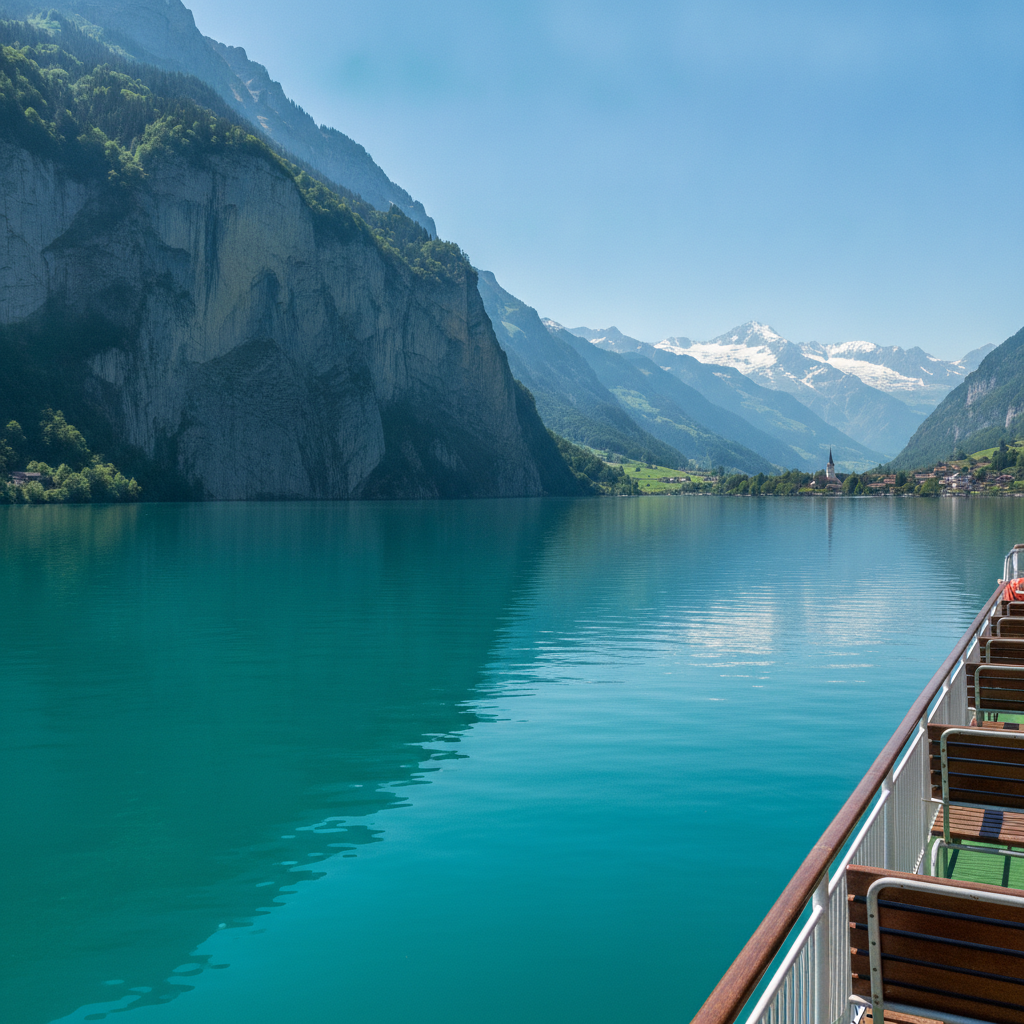
Lake Brienz — the Turquoise Glacier Lake
Brienzersee (Lake Brienz, the 14km lake east of Interlaken at 564m altitude, the most translucent of the pre-Alpine lakes — the glacier-fed water with the suspended mineral particles creating the characteristic turquoise colour visible from the steamer deck and from the hilltops above): the Giessbach Falls (the 500m cascade waterfall in 14 stages descending from the Giessbach cliff into the Brienzersee at the Grandhotel Giessbach — the Belle Époque hotel of 1875 visible from the lake on the cliff, the waterfall visible behind the hotel, the Giessbach pier accessible by BLS steamer from Interlaken Ost in 35 minutes and then the Giessbach funicular — the oldest funicular in Switzerland 1879 — to the hotel level in 4 minutes, CHF 6 adults for the funicular, the most historically layered single waterfall destination in the Bernese Oberland), the Brienz town (the wood-carving village at the east end of the lake — the Brienz School of Wood-Carving the most historically significant craft school in the German-speaking Alps, the 19th-century tradition of carved animals, figures, and decorative objects the primary Brienz industry, the shop at Hauptgasse 111 the most complete source for the authentic Brienz carving), Ballenberg (the Swiss Open Air Museum adjacent to Brienz the most comprehensive folk museum in Switzerland at CHF 32 adults, the most visited destination at the east end of Lake Brienz) and the Brünig Pass (the 1,002m mountain pass at the east end of the Brienzersee accessible by the SBB Brünig Line from Brienz, the pass the boundary between the Bernese Oberland and the Obwalden canton — the most historically significant administrative boundary in the Swiss Alps — the PostBus from the Brünig Pass summit to Lungern and Sarnen the most scenically spectacular bus route connecting the Bernese Oberland to central Switzerland).
- 4
The Iseltwald Pier and the Streaming Era Tourism
Iseltwald (the village on the south shore of Lake Brienz 15km from Interlaken, accessible by bus from Interlaken Ost in 25 minutes, the most recently internet-famous location in the Bernese Oberland): the Netflix effect (the village of Iseltwald specifically the pier — the wooden jetty at the village edge extending 50m into the Brienzersee — achieved international viral status following the filming of a key scene in Netflix 'Squid Game' Season 2 in 2023, the pier the most suddenly famous single point in the Bernese Oberland, the daily visitor count increasing from under 200 to 2,000+ in the weeks following the season release in December 2023, the most visible single streaming-media tourism effect in Switzerland to that date), the village (the car-free historic village on the lake shore — no through traffic, the village accessible from the bus stop at the village entrance on foot in 5 minutes, the village of 380 permanent residents the most unchanged lakeside hamlet in the greater Interlaken area, the 16th and 17th century farmhouses on the Seestrasse the most intact historic street in the Brienzersee village landscape), the lake swimming (the Brienzersee water the coldest of the lakes near Interlaken — the glacier meltwater maintaining the temperature at 14-18 degrees in July-August, the Iseltwald village beach the smallest public beach in the Bernese Oberland but the most turquoise water, the lake floor visible at 5m depth the most transparent lake water near Interlaken), the Iseltwald-Interlaken cycling (the cycle path from Iseltwald north along the Brienzersee shore to the Interlaken Ost station, 12km, the most scenic lake-shore cycling route accessible from the Bernese Oberland centre at no cost beyond the bike rental at CHF 25-35 per day from the Interlaken rental stations) and the BLS boat taxi (the summer boat taxi between Iseltwald and the Giessbach Falls — the on-demand water taxi across the lake connecting the two most visited south-shore destinations, CHF 15 per person one-way in July-August, the most convenient single lake crossing in the Brienzersee circuit).
- 5
Thun — the City at the Western Lake End
Thun (the city at the western end of Lake Thun 28km from Interlaken, accessible by SBB train in 25 minutes at CHF 9 adults or by BLS steamer in 80 minutes at CHF 18 — the city with the most unusual street architecture of any Swiss town): the Obere Hauptgasse (the most unusual single street feature in Switzerland — the main commercial street where the pedestrians walk on the upper storey of the buildings rather than the street level, the shop terraces built above the street level connected by the upper walkway with the view down to the street below, the 14th-century covered upper walkways the defining Thun architectural character), the Thun Castle (the Schloss Thun above the Obere Hauptgasse, the 12th-century Zähringen castle with the 4 corner towers, the most completely preserved medieval castle in the Bernese Oberland — the Knight's Hall on the top floor the single most impressive medieval secular room in the canton, the view of Lake Thun and the Bernese Alps from the tower the most panoramic castle view in the Bernese Oberland, CHF 10 adults), the Thun flower clock (the Blumenuhr on the Rathausplatz at the base of the Schloss hill, the Swiss tradition of the flower clock replicated from the Geneva original in the Thun city version with the local alpine flowers in the seasonal planting), the Wocher Panorama (the cylindrical panoramic painting by Marquard Wocher 1814-1816 depicting the view from the Goldiwil hill above Thun — the earliest topographically accurate panoramic painting of a Swiss city, displayed in the rotunda at the Schadau Park, CHF 5 adults) and the Thun arts scene (the Kunstmuseum Thun at Thunerhof, Hofstettenstrasse 14, the primary contemporary art museum of the Bernese Oberland region — the collection focused on the 20th and 21st-century Swiss art with the particular strength in the Bernese artists — CHF 12 adults, Tuesday-Sunday 10am-5pm, the most specifically regional contemporary art collection in the Bernese Oberland).
- 6
The Beatushöhlen Caves — Lake Thun's Prehistoric Depth
Beatushöhlen (the St. Beatus Caves on the north shore of Lake Thun 12km west of Interlaken, accessible by BLS steamer from Interlaken West to the Beatenbucht pier in 25 minutes then on foot 10 minutes, or by PostBus from Interlaken West, the cave system the most visited natural cave in the Bernese Oberland at 100,000 visitors per year, CHF 18 adults, guided tours every 30 minutes April-October 10:30am-5pm): the caves (the cave system extending 1km into the limestone cliff above the north shore of Lake Thun, the 14 cave chambers with the stalactites, the stalagmites, the underground stream, and the crystal formations — the cave developed through the dissolution of the Jurassic limestone by the slightly acidic glacial meltwater over 15,000 years since the lake formed, the temperature inside the cave a constant 8 degrees year-round making the jacket essential in summer), the St. Beatus legend (the legend of the Irish-British monk Beatus of Vendôme who arrived on the shores of Lake Thun in the 1st century CE and expelled the dragon that inhabited the cave, establishing the first Christian hermitage in the Swiss Alps in the emptied dragon's cave — the legend the reason for the cave's name and the earliest documented hagiographic story associated with the Lake Thun landscape, the cave one of the earliest pilgrimage sites in the Bernese Oberland from the early medieval period), the museum (the cave visitor centre museum with the lake-level geology exhibition — the explanation of the limestone dissolution process and the cave formation in the Lake Thun basin the most comprehensible single-room geology explanation in the Bernese Oberland, free with the cave entry), the trail to the Niederhorn (the hiking trail from the Beatushöhlen cave entrance up the steep forest slope to the Niederhorn gondola mid-station at 1,072m, the 2-hour ascent the most challenging direct trail accessible from the lake shore, the trail signed from the cave entrance) and the swimming at Beatenbucht (the free pebble beach at the steamer pier, the Lake Thun swimming at 22 degrees in July-August the warmest public swimming accessible from the Beatushöhlen excursion).
Walk this route with audio
Stories play automatically as you reach each stop — no tapping needed.
More in interlaken
Grindelwald — the Eiger North Face, the Lauberhorn Race & the Alpine Village Culture
Interlaken's Harder Kulm, Grand Hotels, Paragliding & the Seasons Guide
Interlaken Hiking — Schynige Platte, the Männlichen, Harder Kulm & the Bernese Trails
Interlaken — the Jungfraujoch, the Eiger & the Top of Europe