Ghent — Street Art, the Citadelpark & SMAK, Sint-Pietersabdij, Cycling Culture, dEUS Music & the Flemish Ardennes
The Graffiti Alley is Belgium's most officially sanctioned street art corridor; the SMAK is Flanders' most internationally respected contemporary art museum; the Citadelpark holds the finest Beaux-Arts museum; and the Flemish Ardennes to the south are where the Tour of Flanders climbs its most famous walls.
- 1
The Ghent Street Art and Urban Culture
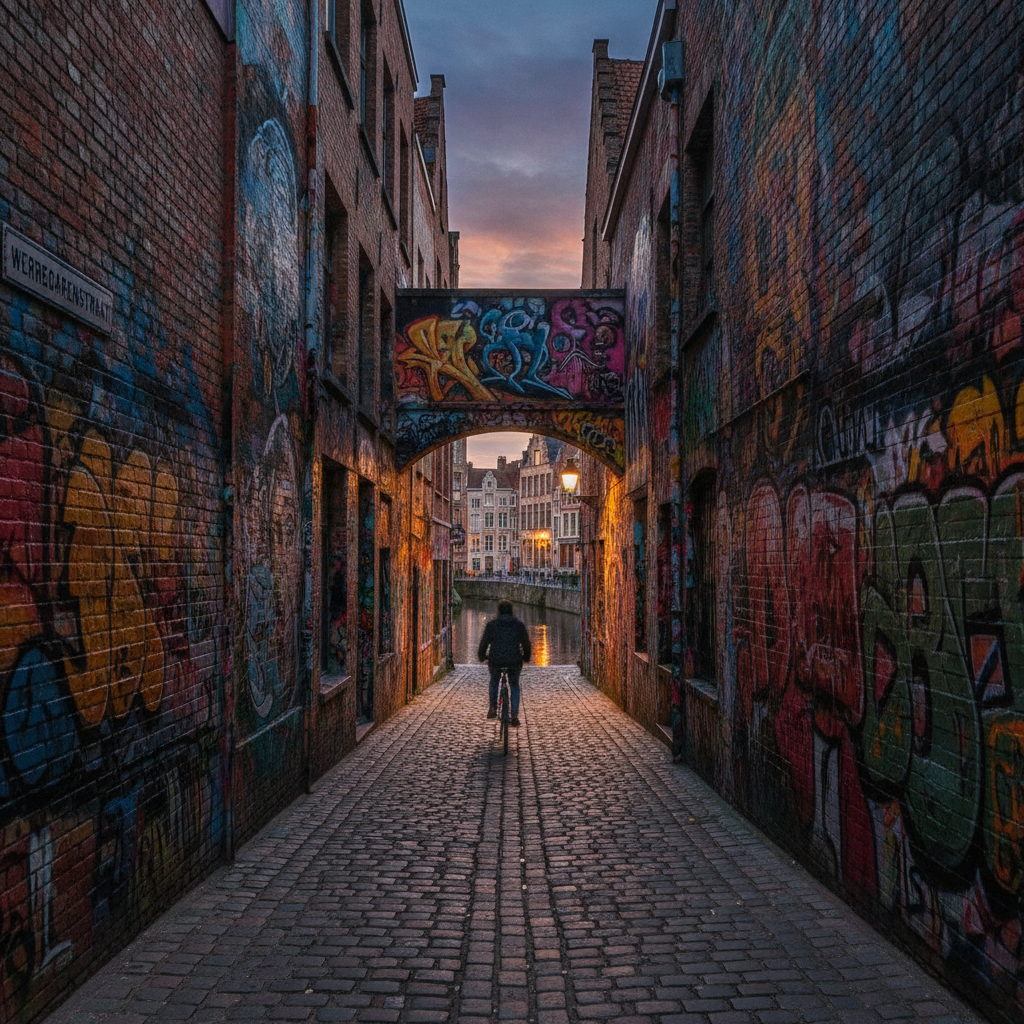
Ghent street art (the Ghent street art scene — the most comprehensively street-art-curated single Belgian city, the Werregarenstraat (Graffiti Alley) the most specifically street-art-designated single alley in any Belgian city centre): the Werregarenstraat (the Werregarenstraat (Graffiti Alley) — the officially designated street art corridor in the Ghent centre, the alley covered floor-to-ceiling in continuously changing street art murals, the most specifically street-art-officially-sanctioned single alley in Belgium, the alley the most photogenically graffiti-covered single urban walkway in any Belgian city, free to visit and photograph 24 hours, the most consistently updated single street art canvas in Ghent), the Muralisme Ghent (the large-format mural art programme in Ghent — the most comprehensively large-scale-mural-programme single Belgian city, the Art Base organisation the most systematically mural-commissioning single Belgian urban art institution, the murals in the Rabot and Dampoort neighbourhoods the most geographically widely spread single Belgian street art collection), the MSK contemporary art (the Museum voor Schone Kunsten contemporary exhibitions — the most regularly programmed single temporary exhibition programme for the 20th-century and contemporary art in the Ghent civic museum, typically 4-6 temporary exhibitions per year, the most comprehensively survey-exhibition-formatted single Ghent museum programme), the KASK (the Koninklijke Academie voor Schone Kunsten (KASK) at Jozef Kluyskensstraat 2 — the most comprehensively fine-arts-and-design-combining single Belgian art school, the KASK the primary training institution for the next generation of Belgian visual artists in Ghent, the KASK gallery exhibition programme the most directly student-art-showcasing single gallery in any Belgian art school), the Night of the Galleries (the Nacht van de Musea (Night of the Museums) in Ghent in April — the most comprehensively museum-and-gallery-simultaneously-open single evening event in Ghent, the late-night opening of the major Ghent museums and galleries the most attended single museum event in the Ghent cultural calendar, the most specifically museum-community-inclusive single Belgian museum access initiative) and the Vooruit programming (the Vooruit arts centre programme — the most comprehensively music-theatre-dance-and-club-night single arts programme in Ghent, the Vooruit the most internationally connected single Ghent arts institution, the residency programme for the national and international contemporary artists the most ambition-signifying single institutional commitment in the Ghent contemporary arts landscape).
- 2
The Ghent Citadelpark and the Exhibition District
Ghent Citadelpark (the Citadelpark at the Ghent south — the most comprehensively 19th-century English-landscape-designed single public park in Ghent, the most museum-adjacent single Belgian public park): the park (the Citadelpark — the former Napoleon-era citadel (demolished 1870) converted to the English landscape park, the most historically militarily-repurposed single Ghent public green space, the park the most used single daily-exercise outdoor space in the Ghent south, the tree canopy the most completely established single mature-tree park in the Ghent centre), the MSK (the Museum voor Schone Kunsten at the Citadelpark — the most beautifully positioned single fine art museum on the edge of any Belgian public park, the neo-Baroque museum building the most formally composed single Beaux-Arts museum exterior in Ghent, the sculpture garden between the museum and the park the most museum-adjacently-contemplative single outdoor space in Ghent), the SMAK (the SMAK (Stedelijk Museum voor Actuele Kunst) at Jan Hoetplein 1 — the most internationally contemporary-art-respected single Ghent museum, the Jan Hoet (1936-2014) legacy (Jan Hoet the most internationally recognised single Belgian contemporary art curator, the director of the SMAK from 1975 to 2003 and the most influential single curatorial figure in the development of Belgian contemporary art), the Documenta 9 (Kassel, 1992) curated by Jan Hoet the most internationally celebrated single Belgian curatorial achievement in the history of contemporary art), the International Floralia exhibition (the Floraliën (International Flower Show in Ghent) every 5 years — the most comprehensively flower-and-plant-exhibition-formatted single Belgian horticultural event, held at the Flanders Expo adjacent to the Citadelpark, the next edition 2025 the most internationally horticulture-community-attended single Belgian flower event), the Sint-Pietersabdij (the Sint-Pietersabdij garden south of the Citadelpark — the most completely enclosed single abbey garden in the Ghent south accessible to the public, the medieval herb and kitchen garden the most historically authentically planted single monastic garden in Ghent, the abbey garden café the most atmospherically monastery-garden-positioned single outdoor café in the Ghent south) and the Bijlokesite (the Bijlokesite concert hall at Bijlokekaai 2 — the most comprehensively ancient-music and historically-informed-performance-practice single concert venue in Ghent, the 14th-century Cistercian hospital refectory the most atmospherically medieval single concert hall in Belgium, the ceiling frescoes the most extensively painted single medieval ceiling in any Belgian concert hall, the Bijloke programme the most historically performance-practice-appropriate single concert programme in the Ghent music scene).
- 3
Sint-Pietersabdij and the Ghent Romanesque Heritage
Sint-Pietersabdij (the Abbey of St. Peter (Sint-Pietersabdij) at Sint-Pietersplein 9 — the most historically ancient single monastic institution in Ghent, the 7th-century Benedictine foundation the oldest confirmed ecclesiastical institution in the Ghent city limits): the abbey history (the Sint-Pietersabdij — founded in the 7th century by St. Amand and St. Bavo (the two patron saints of Ghent), the most venerable single monastic institution in the Ghent ecclesiastical hierarchy, the abbey the primary landowner in the medieval Ghent region, the most comprehensively medieval-estate-controlling single institution in the Ghent hinterland from the 8th to the 12th century, the abbey the primary source of the documented history of early medieval Ghent), the Romanesque crypt (the Romanesque crypt of the Sint-Pietersabdij — the most completely surviving Romanesque ecclesiastical structure in the Ghent city limits, the 11th-12th century crypt the oldest above-ground architectural element in the Sint-Pietersabdij, the column capitals the most specifically Romanesque-architectural-detail-preserving single ecclesiastical basement in Ghent), the abbey church (the Sint-Pieterskerk (Church of St. Peter) at the Sint-Pietersplein — the most architecturally monumental Baroque church in Ghent, the 17th-century dome the most dramatically Baroque single dome visible in the Ghent south skyline, the interior the most completely Counter-Reformation-Baroque decorated single ecclesiastical space in Ghent, free entry), the abbey museum (the Sint-Pietersabdij museum — the most comprehensively Ghent-civic-and-monastic-history-combining single museum in the Ghent south, the exhibition on the medieval abbey economy and the Ghent pilgrimage tradition the most specifically monastic-history-focused single Ghent museum display, €6 adults), the Sint-Pietersplein (the Sint-Pietersplein square at the abbey church — the most spacious single historic square in the Ghent south, the Baroque abbey church dominating the square the most monumentally domed single Ghent church view, the weekly Sunday antique and flea market the most locally-resident-frequented single Ghent south market) and the Ghent saints (St. Bavo and St. Amand — the 2 patron saints of Ghent, the most specifically Ghent-ecclesiastical-identity-associated single pair of patron saints in any Belgian city, the Sint-Baafskathedraal named for St. Bavo the most directly saint-name-associated single Ghent cathedral, the abbey named for St. Peter the most historically ancient single monastic foundation in the Ghent ecclesiastical inheritance).
- 4
Ghent Cycling — Touring the City by Bike
Ghent cycling (the Ghent cycling culture — the most comprehensively cycling-infrastructure-investing single Flemish city since 2012, the most cycle-lane-per-capita single Belgian city under 300,000 population): the Ghent circulation plan (the Ghent Circulatieplan — the 2017 traffic circulation plan the most comprehensively car-traffic-restricting single Belgian city planning initiative, the car-free inner city zone the most extensively pedestrianised and cycle-prioritised single Belgian city centre, the most internationally discussed single Belgian urban mobility transformation, the 30km of new cycle lanes added since 2017 the most rapidly expanded single Belgian urban cycling infrastructure), the Velo cycling (the Blue-bike and the Velo cycling schemes — the most cost-efficiently bicycle-sharing single Belgian city scheme, the Blue-bike at the Ghent Sint-Pieters station at €3.50 per day the cheapest single bike rental at any Belgian train station, the Velo station-based bike sharing the most conveniently located single short-trip cycling system in the Ghent centre), the Ghent cycling routes (the primary Ghent cycling circuits: the inner city canal circuit (8km, 30 minutes) the most completely canal-view single cycle route in Ghent; the Citadelpark and the Bijlokekaai southern circuit (6km) the most park-and-water-view single cycle route in the Ghent south; the Ghent-Bruges cycle path via the Leie valley (55km, the most scenic single full-day cycle excursion from Ghent through the Flemish countryside and the canal landscape); the Ghent-Oudenaarde cycling route (60km, through the Flemish Ardennes, the most topographically challenging single Ghent day cycle excursion)), the Ronde van Vlaanderen (the Tour of Flanders (Ronde van Vlaanderen) — the most internationally famous single Belgian professional cycling race, passing through Ghent as the start city in the historic race editions, the most cycling-culturally significant single annual event in the Ghent cycling tradition, the EX_PO (Ronde van Vlaanderen cycling museum) at Markt 43 in Oudenaarde the most comprehensively cycling-race-heritage focused single museum accessible from Ghent on the race route), the Fixie Ghent (the Ghent fixie and city bike culture — the most actively fixed-gear-cycling-adopted single Belgian city, the most bicycle-as-primary-transport single Belgian city community, the cycling infrastructure the most directly quality-of-urban-life-improving single transport policy investment in recent Ghent history) and the night cycling (the Ghent night cycling — the canal-lit cycling circuits in Ghent after 9pm the most atmospherically illuminated single Belgian city cycling experience, the canal reflections from the bicycle seat the most dynamically moving single Ghent night photography experience, the cycle-path network lit and safe the most cycle-commuter-friendly single Belgian city after dark).
- 5
The Ghent Music Scene — dEUS and the Indie Heritage
Ghent music scene (the Ghent indie and alternative music heritage — the most internationally music-critically recognised single Belgian city for indie and alternative rock, the band dEUS the most internationally famous single Ghent music export): the dEUS connection (the dEUS — the most critically acclaimed single Belgian band of the 1990s and the most internationally reviewed single Ghent music export, the album 'Worst Case Scenario' (1994) the most internationally praised single Belgian indie album of the decade, the 'In a Bar, Under the Sea' (1996) the most ambitious single Belgian alternative album of the 1990s, the most frequently cited single Belgian band in the international indie rock music press from 1994-2008, the Ghent Vooruit arts centre the primary early dEUS performance venue), the Gentse Feesten music (the Gentse Feesten (Ghent Festivities) music programme — the most comprehensively free-outdoor-concert-programme single Belgian festival: 10 stages, 1 million visitors, and 500+ free performances the most attendee-to-free-performance-ratio single Belgian music event, the most internationally artist-curated single free music festival in any Belgian city), the Vooruit (the Vooruit arts centre music programme — the most comprehensively alternative-music-programming single venue in Ghent, the capacity 800 the most appropriately mid-size single music venue in Ghent, the international touring programme the most consistently internationally-connected single Ghent music programme), the Handelsbeurs (the Handelsbeurs (Concert Hall) at Kouter 29 — the most architecturally impressive single converted concert venue in Ghent (the former stock exchange), the classically positioned concerts in the grand trading hall the most formally atmospheric single classical music venue in Ghent, the Symfonieorkest van Vlaanderen residency the most comprehensively orchestral single programming at the Handelsbeurs), the De Bijloke (the Bijloke music venue at Bijlokekaai 2 — the most atmospherically medieval single concert hall in Belgium, the 14th-century Cistercian refectory the most specifically ancient-building single concert venue in Ghent, the early music and historically informed performance programme the most specifically medieval-acoustic single Ghent music programme) and the Ghent Conservatory (the Koninklijk Conservatorium Gent (Royal Conservatory of Ghent) at Gouvernementstraat 4 — the most comprehensively classical-and-jazz-music-training single conservatory in Ghent, the jazz programme the most internationally jazz-performance-recognised single Ghent conservatory programme, the student concerts in the conservatory hall the most directly student-music-accessible single Ghent classical music experience, free for student concerts).
- 6
The Ghent Surroundings — Oudenaarde and the Flemish Ardennes
Ghent surroundings (the landscape south and southeast of Ghent — the most topographically varied single day trip landscape from any Belgian city, the Flemish Ardennes (Vlaamse Ardennen) the most dramatic hills of any Flemish day trip range): the Flemish Ardennes (the Vlaamse Ardennen (Flemish Ardennes) south of Ghent — the most topographically dramatic single landscape in the Flemish provinces, the Kemmelberg (156m), the Koppenberg, and the Wijnberg the most cycle-race-famous single hills in Belgian professional cycling, the Tour of Flanders (Ronde van Vlaanderen) crossing the Flemish Ardennes the most internationally broadcast single Belgian cycling race landscape, the most cycle-hill-sport-challenging single day cycling from Ghent), the Oudenaarde (the Oudenaarde town 30km south of Ghent — the most completely late-Gothic-civic-building-preserving single Flemish town, the Oudenaarde Stadhuis (Town Hall, 1526) the most ornately Gothic-flamboyant single civic building in Belgium, the EX_PO Ronde van Vlaanderen museum at Markt 43 the most comprehensively cycling-race-heritage focused single museum in Belgium, the Oudenaarde beer (the Liefmans Brewery at Aalstraat 200 the most historically Oudenaarde-beer-tradition-preserving single brewery, the Liefmans Goudenband the most internationally recognised single Oudenaarde mixed-fermentation ale), the Leieregio (the Leie river valley region southwest of Ghent — the most impressionist-painter-associated single Belgian river landscape, the 'Painters' Village' of Sint-Martens-Latem the most specifically Belgian Expressionist painting village, the George Minne and Constant Permeke the 2 most internationally recognised single artists of the Sint-Martens-Latem artists' colony, the most art-historically significant single river village in Flemish painting history), the Kortrijk (the Kortrijk (Courtrai) town 50km southwest — the most specifically Golden-Spurs-1302-battle-heritage-associated single Belgian city, the Begijnhof the most atmospherically enclosed single beguinage court in any Flemish city outside Bruges and Ghent, the Groeningemuseum Kortrijk the most specifically 1302-battle-depicting single painting collection in any Belgian museum, the direct IC train in 40 minutes), the Geraardsbergen (the Geraardsbergen hill-top town 40km south — the Muur (the Kapelmuur — the most famous single cycling climb in the Ronde van Vlaanderen, the steepest paved climb at 19.8% maximum gradient accessible from Ghent, the most specifically Belgian professional cycling single heritage site outside the Tour of Flanders EX_PO museum)) and the Gent-Wevelgem (the Gent-Wevelgem cycling classic — the Belgian spring cycling classic starting at the Ghent Waregem racecourse the most specifically cycling-heritage-associated single day of the Belgian spring cycling season accessible from Ghent, the most directly professional-cycling-spectator-experience single event accessible from the Ghent centre by public transport in 30 minutes).
Walk this route with audio
Stories play automatically as you reach each stop — no tapping needed.
More in ghent
Ghent — the Altarpiece Restoration, Gruut Medieval Beer, Gothic Masterworks, Belgium's Vegan Capital & Charles V
Ghent — Patershol Quarter, the Vrijdagmarkt, SMAK Contemporary Art, the Gentse Feesten & Ghent Architecture
Ghent — Open Monuments Day, the Lys Valley Painters, Art Nouveau Heritage, Cuberdons, Family Visits & Seasonal Festivals
Ghent — the World's Most Important Painting, the Gravensteen Castle, the Graslei, Three Towers & Flemish Food