Cologne — Ehrenfeld, Deutz Panorama, Perfume Heritage, Cathedral Interior & Romanesque
Cologne's creative Ehrenfeld quarter, the iconic Rhine panorama from Deutz, the 4711 perfume heritage, the cathedral's medieval art treasures, and the 12 Romanesque churches complete the city's essential portrait.
- 1
Ehrenfeld Street Art and the Creative Quarter
Ehrenfeld (the neighbourhood west of the Ring — the most creatively active neighbourhood in Cologne): the Venloer Strasse (the most ethnically diverse shopping street in Cologne with Turkish grocery stores, Syrian restaurants, and Cologne-label fashion boutiques in 1km, the Stadtgarten park and concert venue at No. 40 the most culturally active venue on the street with the jazz and contemporary music programme the most internationally booked in Cologne), the street art (the most densely muralled single neighbourhood in Cologne — the Heliosstrasse, the Körnerstrasse, and the Lichtstrasse the primary mural streets, the Helios tower mural at 40m the most technically ambitious single mural in Cologne, the free self-guided walk the most Instagram-active neighbourhood circuit in the city), the Braustelle brewery (the Braustelle at Christianstrasse 2 — the most critically respected craft brewery in Cologne, the pioneer of the craft beer movement in the most Kölsch-traditional beer city in Germany, the tap room the most locally authentic Ehrenfeld drinking experience), the Helios building (the former Helios electrical cable factory of 1883 at the Ehrenfeld Bahnhof — the most architecturally distinguished industrial heritage building in Ehrenfeld, the Helios tower the most photographed industrial structure in the Cologne neighbourhood circuit), the Ehrenfeld Werkstattfest (the annual June street festival — the Venloer Strasse and the Körnerstrasse closed to traffic with the local restaurant terraces and the live music stages, the most authentically Cologne summer street festival outside the Karneval season, free entry) and the Cologne Photography scene (the Ehrenfeld galleries — the Loock Gallery and the Johnen Galerie the 2 most commercially active photography dealer venues in the neighbourhood, the Cologne Photo Art Festival the most internationally collected photography art fair in Germany after the Berlin Photo Week).
- 2
Cologne from the Deutz Bank — the Rhine Panorama
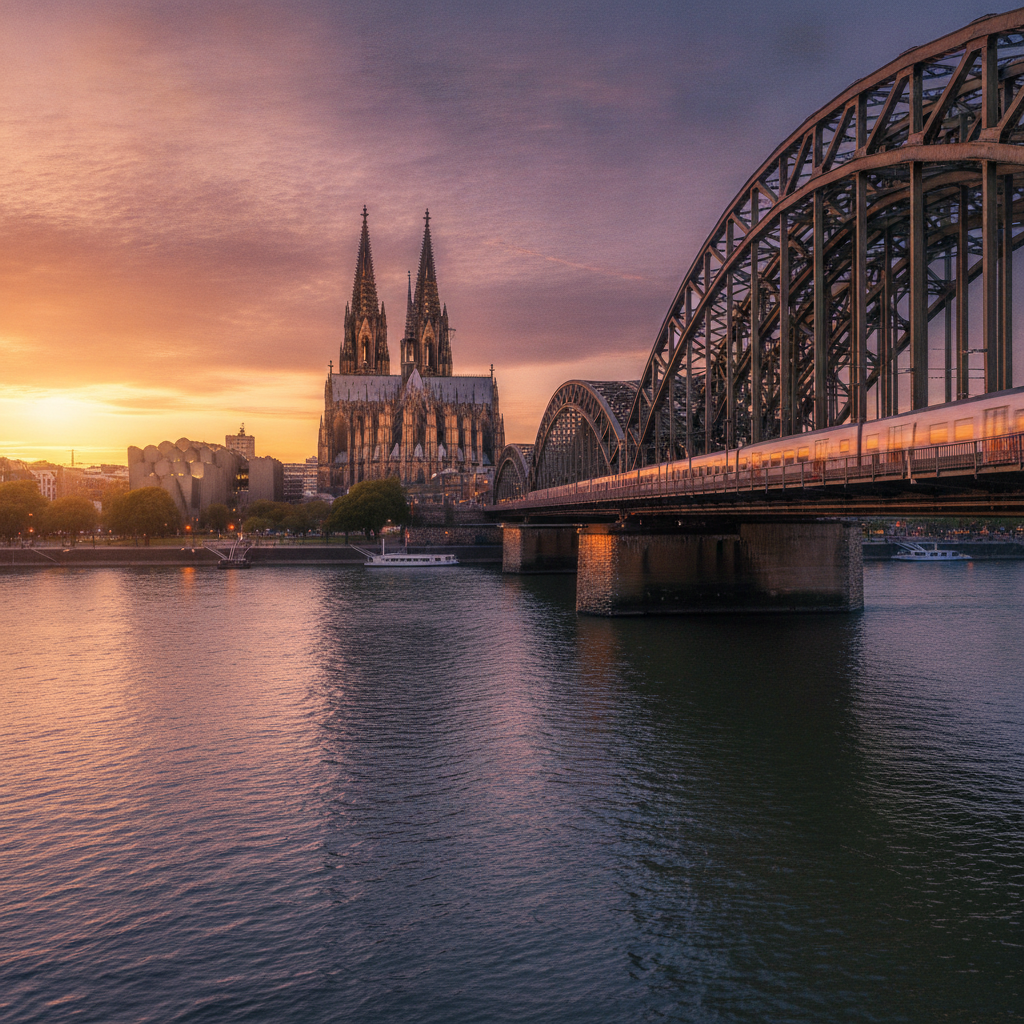
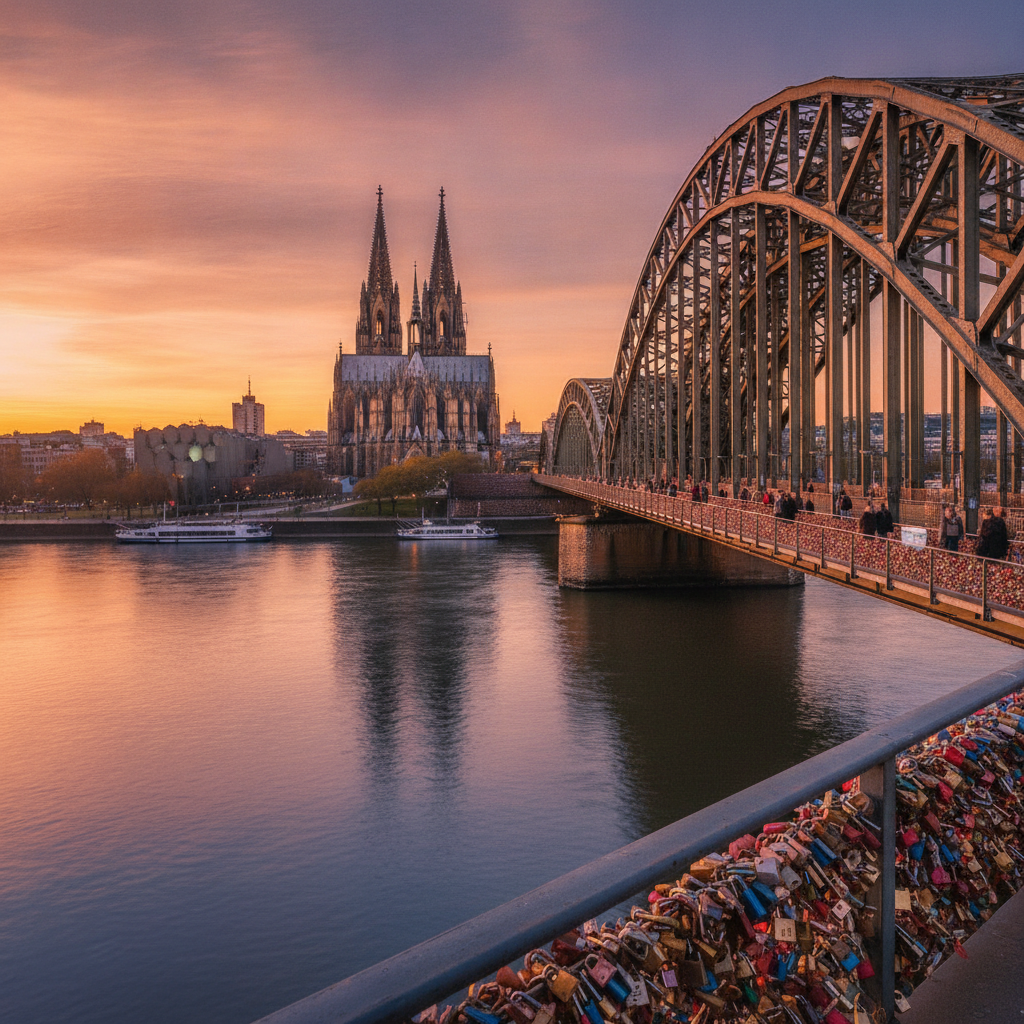
Cologne Deutz (the right Rhine bank — the most panoramically positioned neighbourhood for the Dom and Altstadt view): the Deutz viewpoint (the Rheinufer Deutz at the river level — the most precisely framed Dom-over-Rhine composition in the city, the most Instagram-active single photo location in Cologne, best light at sunrise and at sunset when the Dom towers turn gold, free access 24 hours), the Hohenzollernbrücke (the railway and pedestrian bridge with 500,000+ love padlocks — the most densely love-locked bridge in the world at an estimated 500 tonnes of padlocks, the Dom towers framed from the bridge the most visited single viewpoint in Cologne, free pedestrian access 24 hours), the Rheinpark (the 66-hectare park on the Deutz waterfront — the Tanzbrunnen amphitheatre hosting free Sunday afternoon concerts in summer, the panoramic Rhine-and-Dom view the most freely accessible Dom panorama without Altstadt crowds), the Claudius Therme (the most comprehensively equipped urban thermal spa in the Rhine region at Sachsenbergstrasse 1 — the outdoor Rhine-view pool with the Dom visible the most dramatically positioned outdoor thermal pool in Cologne, €22 adults for 2 hours, daily 9am-midnight), the KölnMesse (the Cologne Trade Fair complex at Messeplatz 1 — the most internationally significant trade fair in Germany after Hannover, the Art Cologne the most commercially consequential art fair in Germany, the Zaha Hadid pedestrian bridge 2006 the most architecturally distinctive structure at the fair complex) and the Deutzer Freiheit (the neighbourhood commercial street on the right bank — the Turkish bakeries, the Kölsch brewery restaurants, and the local barbers the most demographically mixed commercial strip within 5 minutes of the Rhine view, the most locally authentic right-bank street experience in Cologne).
- 3
Cologne's Perfume Heritage — 4711 and the Farina Museum
Cologne perfume (Cologne the birthplace of Kölnisch Wasser (Eau de Cologne) — the most internationally famous single product invented in any German city): the 4711 tradition (the 4711 Echt Kölnisch Wasser first commercially produced by Wilhelm Mülhens at Glockengasse 4711 in 1799, the most historically documented fragrance origin story in commercial perfumery, the 4711 Dufthaus at Glockengasse 4 the primary heritage retail destination, the free fragrance fountain in the shop entrance the most specifically Cologne retail sensory experience, the shop open Monday-Friday 9am-6pm, Saturday 9am-5pm), the Farina Museum (the Farina Fragrance Museum at Obenmarspforten 21 — the most historically specific single perfumery museum in the world, the Farina family the claimed original inventors of Kölnisch Wasser in 1709, the 45-minute guided tour through the 18th-century shop and the archive at CHF 5 adults, the competing origin story with the 4711 brand the most commercially litigated fragrance dispute in German history), the Schildergasse shopping (the Schildergasse pedestrian zone — the highest-footfall retail street in Germany outside Munich and Hamburg, the most commercially concentrated retail kilometre in the Rhine region, the Galeria flagship and the H&M anchor the primary retail, the Neumarkt at the west end the primary transport hub), the Hohe Strasse (connecting the Dom to the Neumarkt — the most tourist-trafficked commercial street in Cologne, the amber shop at No. 72 the most specifically Cologne natural jewellery purchase, the Lindt flagship at No. 89 the most visited confectionery shop in the zone), the Mittelstrasse (the Mittelstrasse and the Apostelnstrasse in the Neustadt — the most upscale independent retail and fashion district in Cologne, the Fassbender & Rausch luxury chocolate at Apostelnstrasse 8 the most prestigious single confectionery address in Cologne) and the Cologne craft shops (the Handwerksform at Breite Strasse 62 — the most comprehensively stocked craft and applied arts retail shop in Cologne, the ceramics, the glassware, and the jewellery from the NRW craft studios the most specifically Rhine-region artisan product range, open Tuesday-Saturday 11am-6:30pm).
- 4
The Cologne Cathedral in Depth — Gero Cross and the Shrine
Cologne Cathedral interior (the detailed interior of the Kölner Dom — the artefacts and spaces that repay the visitor's attention beyond the overwhelming exterior): the choir stalls (the medieval choir stalls of 1308-1311 — the most complete surviving medieval choir stall ensemble in Germany, the 104 stalls with the carved misericords, each misericord carved with the unique medieval figures and grotesques, the most comprehensively preserved single medieval woodcarving ensemble in any German church), the Gero Cross (the Gerokreuz of 976 CE — the oldest surviving large-scale carved crucifixion image in northern Europe, the life-size Christ figure in oak the most emotionally direct single medieval artwork in the Cologne Cathedral, displayed in the Chapel of the Cross off the north aisle), the Adoration altarpiece (the Altar of the City Patrons by Stefan Lochner c. 1440 — the most important single panel painting in the Cologne art tradition, the triptych in the Chapel of Our Lady the most visited painting in the Dom interior, the Madonna of the Rose Bower figure the most copied single image from the Cologne late-medieval painting tradition), the Shrine of the Three Kings (the Dreikönigsschrein of 1181-1225 — the golden reliquary behind the main altar the most artistically important medieval reliquary in the world and the primary reason for the medieval pilgrimage that made Cologne the wealthiest city in the Holy Roman Empire north of the Alps), the treasury (the Domschatzkammer in the crypt — the 10th-century Milan Cross and the Cross of Gero the most significant single objects, the episcopal vestments, and the early medieval goldsmith work the most comprehensive ecclesiastical treasury in Germany, CHF 7 adults, Monday-Saturday 10am-6pm, Sunday 1pm-6pm) and the south tower climb (the 533 steps to the 98m viewing platform — the most panoramic city and Rhine view from any German church tower, CHF 5 adults, daily 9am-6pm in summer).
- 5
Cologne's Romanesque Churches Circuit
Kölner Romanik (the 12 Romanesque Churches of Cologne — the most remarkable single ensemble of Romanesque religious architecture in the world, 12 churches built between 1000 and 1250 CE within 1.5km of the Dom): Great St. Martin (the Gross St. Martin at Fischmarkt — the crossing tower with the 4 corner turrets and the 12th-century cloverleaf apse the most distinctive Cologne Romanesque exterior, on the Rhine waterfront the primary visual counterpart to the Dom), St. Gereon (the Basilika St. Gereon at Gereonsdriesch — the 10-sided oval nave (Dekagon) of 1227 on the site of a Roman oval mausoleum of 380 CE, the most architecturally extraordinary of the 12 and the most unusual single church plan in Germany), St. Ursula (the Basilika St. Ursula at Ursulaplatz — the Goldene Kammer (Golden Chamber) with the bones of the 11,000 martyred virgins arranged decoratively on the walls the most uniquely extreme Catholic devotional interior in Germany, free, Tuesday-Sunday 9am-12pm and 3pm-5pm), St. Maria im Kapitol (at Kasinostrasse 6 — built 1040-1065 on the site of the Roman Capitoline temple, the carved wooden doors of 1049 the oldest surviving large-scale carved wooden doors in Germany, the most historically specific single artefact in the circuit), the practical circuit (the complete walk of all 12 churches takes 3-4 hours, the free self-guided map available at the Cologne Tourist Office at Kardinal-Höffner-Platz 1, all churches free entry, the most cost-efficient single architectural heritage walk in Cologne) and St. Aposteln (the Basilika der Heiligen Aposteln at Neumarkt — the 3-towered west facade of 1200 and the trefoil choir the most complete surviving Romanesque western facade in Cologne, the most centrally located of the 12 churches in the ring circuit).
- 6
Cologne Practical — KölnCard, Seasons and Christmas Markets
Cologne practical guide (the essential logistics for the Cologne visit): the KölnCard (the KölnCard at €9 for 24 hours — all KVB subway, bus, and S-Bahn within the Cologne city zone, plus 50% discount at Museum Ludwig, 50% at the Romano-Germanic Museum, and 25% at the Cologne Philharmonie, the 48-hour KölnCard at €18 the best value, available at the Tourist Office at Kardinal-Höffner-Platz 1 and KVB machines), the KVB transport (the 9 Stadtbahn lines and 40+ bus lines — the single-journey ticket at €3.20 adults, the Cologne Airport S-Bahn S13 to the Hauptbahnhof in 15 minutes at €3.20 the most efficiently connected large German airport to the city centre), walking distances (Dom to Schokoladenmuseum 15 minutes; to Museum Ludwig 2 minutes; to Belgisches Viertel 20 minutes; to Ehrenfeld 30 minutes; to the Rhine promenade 5 minutes — all major Cologne attractions within 15 minutes of the Dom), the Christmas markets (Cologne's 7 Christmas markets: the Cathedral Market with the Dom backdrop the most architecturally framed in Germany; the Angel Market at the Neumarkt with the 30m angel pyramid the most spectacularly accessorised; the Gnome Market at the Rudolfplatz the most whimsically themed — the most individually themed Christmas market collection of any German city, all free entry, late November to December 23), the Cologne Lights (the Kölner Lichter Rhine fireworks in July — the largest single fireworks display in Germany at 5 million Rhine-bank spectators, the Rhine between the Hohenzollern and the Deutzer bridges the best viewing position, free from both banks) and the seasons (the best time to visit: May-June for the Rhine promenade at its liveliest without the Karneval crowds; July for the Cologne Lights fireworks; the Karneval in mid-February the most festive but the most expensive with the accommodation booked 12 months in advance for the Rose Monday weekend).
Walk this route with audio
Stories play automatically as you reach each stop — no tapping needed.
More in cologne
Cologne — Belgian Quarter, Romanesque Churches, Gastronomy, Nightlife & Day Trips
Cologne — Museum Ludwig, Wallraf-Richartz, Food Markets, Jewish Heritage & Kölsch Culture
Cologne — Philharmonie, Neustadt, Contemporary Art Galleries, Parks & Transport Hub
Cologne — Medieval History, Media Industry, Karneval, Südstadt & LGBTQ+ Culture