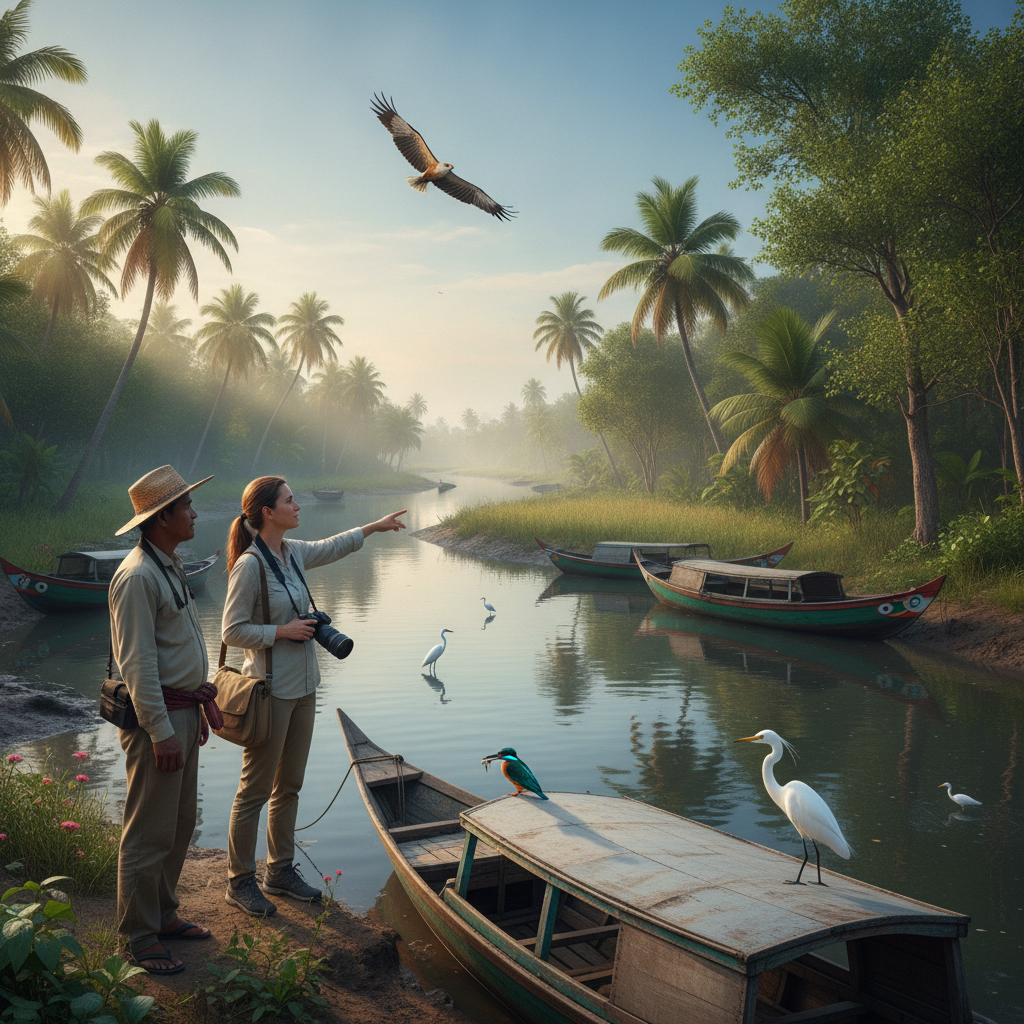
Ngapali Birdwatching & Nature Walk
Watch birds at Ngapali — the Bay of Bengal coastline, the mangroves, and the coastal scrub around Ngapali support a rich coastal bird community including migratory shorebirds, seabirds, and the endemic species of the Myanmar coast, making it one of the most productive single birdwatching destinations accessible at any beach in Southeast Asia.
- 1
Beach Shorebird Walk
The tidal flat at the low-tide Ngapali beach (the wet sand exposed by the tide at its lowest extent, the feeding habitat for the migratory shorebird species that use the Bay of Bengal coast as a stop-over on the East Asian-Australasian Flyway migration route) provides the most directly birdwatching-productive section of the Ngapali beach environment accessible during the morning low tide — the shorebird species visible at the Ngapali tidal flat (the sandpipers, the plovers, and the larger waders including the whimbrel and the curlews that feed at the water's edge during their southbound migration in August-November and the northbound return in February-May) represent the most species-diverse single birdwatching encounter accessible at the beach destination. The beach shorebird walk's timing (the low tide in the morning, when the birds are most actively feeding and the lighting is most favourable for identification) is the most practically productive single birdwatching activity accessible without a guide at the Ngapali beach area.
- 2
Mangrove Bird Survey
The mangrove fringe accessible at the southern and northern ends of the Ngapali bay (the tidal mangrove woodland that provides the most structurally complex bird habitat accessible from the Ngapali beach, hosting the kingfishers, the herons, the egrets, and the various species of mangrove-specialist birds that are the most ecologically diverse single avian community accessible at the coastal destination) is the most productive single birdwatching habitat accessible by the Ngapali birdwatcher who ventures beyond the main beach — the mangrove's bird community (the Collared Kingfisher perched on the mangrove roots at the water's edge, the various egret species visible on the mud flat at low tide, and the Mangrove Pitta that is the most sought-after single species accessible in the Ngapali area mangroves) provides the most complete coastal bird survey accessible in a single morning's walk. The mangrove access (by the village tracks at the beach edges or by the arranged kayak paddled into the mangrove channels) is the most directly immersive nature encounter available at the Ngapali destination.
- 3
Seabird Boat Trip
The offshore boat trip from Ngapali for seabird observation (the longtail boat journey to the fishing grounds in the open bay where the large flocks of terns, the Brown Boobies, and the various gull species visible in the open water provide the most species-diverse single seabird encounter accessible from the Ngapali shore) is the most actively targeted birdwatching activity accessible at the beach destination — the seabird flocks (the assemblages of Bridled Terns, Black-naped Terns, and the various large white terns visible over the fish schools in the open bay, diving and plunging for the small fish driven to the surface by the larger predatory fish below) are the most dramatically aerial single bird behaviour observable from the boat in the open Bay of Bengal waters. The offshore boat trip's additional wildlife value (the sea turtle sightings that are seasonally common in the waters offshore from Ngapali, and the occasional dolphin pods visible in the bay) makes it the most multi-species wildlife encounter accessible from the beach destination.
- 4
Palm Grove Bird Walk
The palm grove behind the Ngapali beach (the coconut and casuarina woodland that backs the coastal sand, providing the woodland bird habitat most accessible from the resort section) is the most conveniently available birdwatching habitat for the resort guest who has limited time for exploration beyond the beach — the palm grove's bird community (the various sunbird species feeding in the coconut flowers, the bulbul species in the undergrowth, and the various flycatcher and warbler species that move through the coastal woodland during the migration seasons) provides the most accessible introduction to the Myanmar lowland bird community available without leaving the immediate resort environment. The early morning bird activity in the palms (the most active hour immediately after dawn when the feeding activity is at its peak in the cooling morning temperature) makes the pre-breakfast palm grove walk the most time-efficient single birdwatching activity accessible at the Ngapali resort area.
- 5
Rice Paddy Bird Survey
The rice paddy bird community accessible on the inland cycling or walking route behind the Ngapali coast (the waterbirds, the open-country birds, and the edge-habitat species that use the rice field environment for feeding and nesting) provides the most ecologically diverse single inland birdwatching encounter accessible from the Ngapali base — the paddy bird community (the Purple Swamphen wading at the paddy edges, the various egret and heron species standing in the flooded paddies, the open-billed stork visible in the wet season paddies, and the various kingfisher species hunting the paddy drainage channels) creates the most species-rich single birdwatching survey accessible within a short distance of the beach resort. The paddy bird survey's combination with the agricultural landscape observation (the rice cultivation cycle, the farmers visible at work in the fields, and the traditional irrigation system that maintains the water level in the paddy plots) provides the most completely environmental encounter accessible on the inland route from the Ngapali coast.
- 6
Night Nature Walk
The Ngapali night walk (the after-dinner torch-light walk through the coconut grove and the beach edge in the darkness, when the nocturnal species become active and the daytime bird community is replaced by the frog chorus, the nightjar calls, and the occasional owl visible in the torchlight) is the most completely different single nature encounter accessible at the beach destination from the daytime activities — the night walk's most distinctive sounds (the chorus of the various frog species in the paddy margins and the beach-edge pools, the Large-tailed Nightjar calling from the beach scrub, and the occasional Barn Owl visible in the palm tops above the torchlight) provide the most completely different acoustic landscape from the daytime beach environment accessible at the Ngapali resort. The night beach itself (the bioluminescent plankton occasionally visible in the gentle surf at the wave break, the dark water of the Bay of Bengal beyond, and the starfield overhead) is the most atmospheric single natural environment accessible at the Ngapali destination after dark.
Walk this route with audio
Stories play automatically as you reach each stop — no tapping needed.