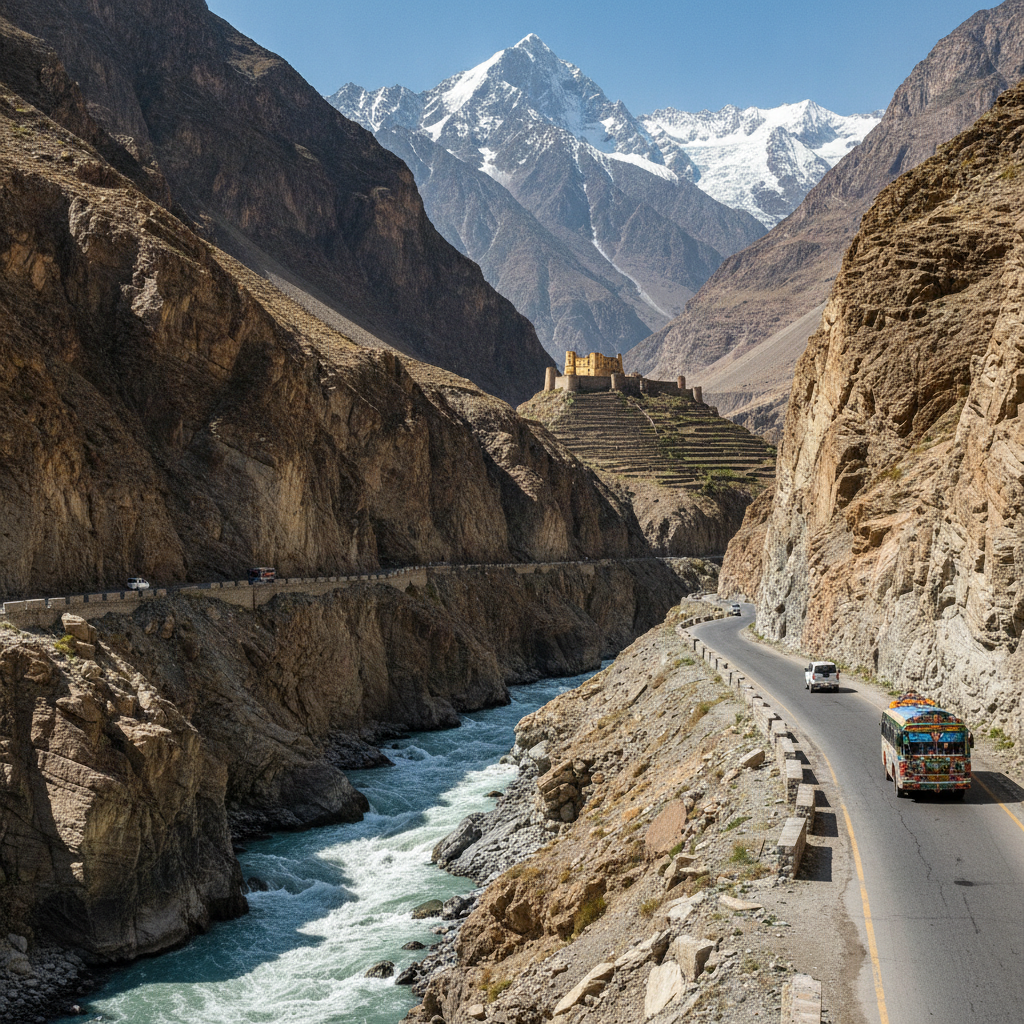
Gilgit Ancient Silk Road and Buddhist Kingdom History
Explore the deep history of Gilgit — the Silk Road town that served as a crucial junction between India, China, and Central Asia for over a millennium, where the Buddhist kingdom of Gilgit accumulated Sanskrit manuscripts now in museums worldwide, and where the rock inscriptions of the Karakoram record the passage of pilgrims, merchants, and diplomats across the roof of the world.
- 1
Gilgit Historical Museum
The small museum in Gilgit town documenting the pre-Islamic history of the region — the Gilgit Manuscripts discovered in 1931 (now held in Islamabad, London, and Srinagar), the Buddhist coins and artifacts of the Patola Shahi kingdom, and the material culture of the Silk Road junction that Gilgit controlled for centuries.
- 2
Kargah Nullah Buddhist Site
The Kargah Nullah valley above Gilgit where Buddhist monks carved their meditations and images into the cliffs — the 7th-century standing Buddha relief being the most prominent, but dozens of smaller carvings and inscriptions recording the religious life of the Buddhist community that preceded Islam in these mountains.
- 3
Silk Road Caravanserai Site
The location of the ancient caravanserai in Gilgit where Silk Road merchants rested before or after crossing the mountain passes — the junction point where the high road from China via the Khunjerab came together with the routes from India via the Babusar Pass and from Central Asia via the Darkot Pass.
- 4
Ancient Mountain Pass Routes
The viewpoint above Gilgit from which the convergence of mountain pass routes is visible — the valley corridors leading to the Khunjerab (to China), the Shandur (to Afghanistan), the Babusar (to Pakistan's plains), and the Mintaka (to Tajikistan), the geography that made Gilgit strategically irreplaceable on the ancient trade network.
- 5
Chinese Pilgrim Route
The path of the Chinese Buddhist pilgrims who traveled through Gilgit on their way to the great Buddhist monasteries of India — Xuanzang in 630 CE and Hui Chao in 727 CE both passed through Gilgit and left accounts of the Buddhist kingdom they found here, their writings the primary historical sources for this period.
- 6
Darel Tangir Ancient Temples
The sites in the neighboring Darel and Tangir valleys where ancient Hindu and Buddhist temples survive in remote communities that maintained pre-Islamic traditions into the 20th century — the cultural continuity of the mountain valleys where conversion to Islam came centuries later than in the plains.
Walk this route with audio
Stories play automatically as you reach each stop — no tapping needed.