Rhine Falls & Schaffhausen — Europe's Largest Waterfall
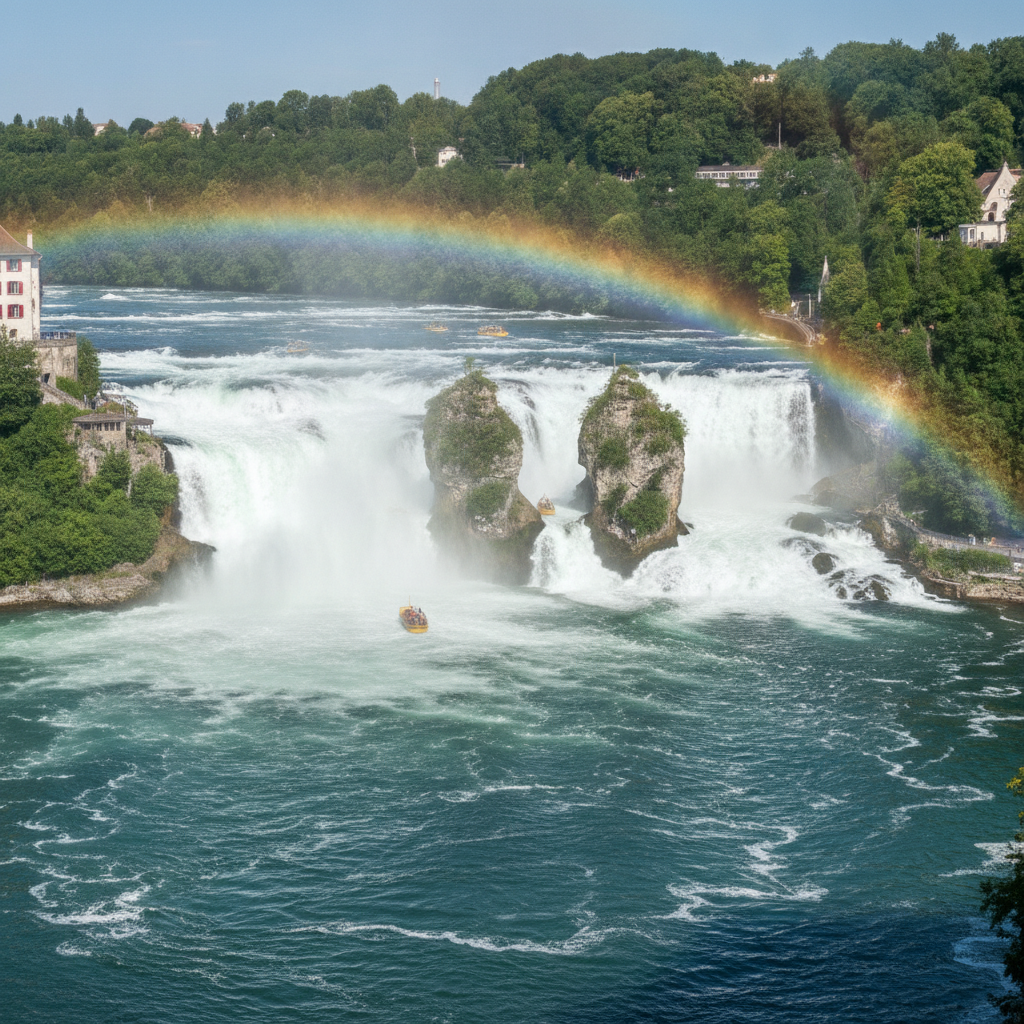
Rhine Falls (Rheinfall — the largest waterfall in Europe by volume of water, located at Schaffhausen on the German-Swiss border, 30 km north of Zurich and 30 minutes by direct train from Zurich Hauptbahnhof): the Rhine at this point plunges 23 metres over a natural Jurassic limestone shelf 150 metres wide, producing an average flow of 700 cubic metres per second (rising to over 1,000 in spring snowmelt), visible and audible from a considerable distance, and accessible via boat from both banks — one of the most spectacular natural sites in Switzerland.
- 1
Rhine Falls — The Falls Themselves
Rheinfall (the main viewpoint on the south bank, Schloss Laufen — the medieval castle on the cliff above the south bank of the Rhine Fall, now containing the Rhine Falls visitor centre and the pathway to the viewing platforms at the base of the falls): the Rhine Falls are the largest waterfall in Central Europe by volume (approximately 700 m³/second average flow, rising to 1,100 m³/second in peak spring conditions), with a width of 150 metres and a drop of 23 metres over the Jurassic limestone rock shelf that crosses the Rhine at this point; the characteristic double rock in the middle of the falls (the Felseninseln — the two rocky islands that rise from the water in the centre of the falls) can be reached by the yellow Rhine Falls boats that operate year-round from both banks; on Swiss National Day (August 1) the falls are illuminated by torchlight and fireworks, creating one of the most spectacular celebrations in Switzerland.
- 2
Schaffhausen Old Town — The Rhine City
Schaffhausen (the capital of the Canton of Schaffhausen, the northernmost Swiss city, on the north bank of the Rhine — a remarkably well-preserved medieval and Renaissance town with an outstanding collection of bay windows (Erker) on its Old Town buildings): the Schaffhausen Old Town (designated as a whole as a Swiss heritage site of national significance) contains the finest surviving collection of painted house facades in Switzerland, with approximately 30 late Gothic and Renaissance bay windows (Erker) projecting from the facades of the guild houses along the Vordergasse and Vorstadt; the Munot (the circular Renaissance fortress completed 1589 on the hill above the Old Town, the most important Renaissance fortification in Switzerland) provides the finest view over the Old Town and the Rhine; the Museum zu Allerheiligen (the cantonal museum in the former Benedictine monastery) has an outstanding collection documenting Schaffhausen's history.
- 3
Boat Rides on the Rhine Falls
Rhine Falls Boat Trips (the year-round boat services operating from the landing stages on both banks of the Rhine Falls): the yellow Rhine Falls boats operate three services — the short trip to the central rocks (the most popular, sailing directly to the largest of the two central rocks where passengers can disembark and stand on the rock with the falls crashing around them on three sides — one of the most thrilling tourist experiences in Switzerland), the longer cruise downstream to the Schaffhausen landing stage, and the Illumination Cruise (operating on summer evenings when the falls are illuminated by coloured lights); the south bank (Schloss Laufen side) also has walking paths descending to the base of the falls, where the spray is so intense that waterproof clothing is recommended; the north bank (Neuhausen) approach has the panoramic overview platform.
- 4
Rhine Path Walking — Zurich to Basel Upstream
The Rhine Path (Rheinweg — the long-distance walking trail following the Rhine from its source in the Swiss Alps to Basel and beyond into Germany): the stretch of the Rhine path between Schaffhausen and Stein am Rhein (approximately 20 km downstream from the Rhine Falls, one of the best-preserved medieval towns in Switzerland with its painted facades and the extraordinary Hohenklingen castle above) is the finest day-walk accessible from Zurich, following the north bank of the Rhine through wooded gorge landscapes alternating with open agricultural plains and vineyard slopes; Stein am Rhein (with its Stadtplatz lined with completely intact medieval painted house facades, dating 15th-18th century, and the Benedictine Kloster St. Georgen (founded 1007) with its Romanesque cloister) is one of the most beautiful towns in Switzerland.
- 5
Zurich to Rhine Falls — Transport & Logistics
Transport from Zurich to Rhine Falls (the Rhine Falls are the most easily accessible major natural attraction from Zurich): by train, the Swiss Federal Railways (SBB) operates direct trains from Zurich Hauptbahnhof to Neuhausen Rheinfall (the station on the north bank, 5 minutes walk from the north bank viewpoint) in approximately 35 minutes, and to Schaffhausen (the main station in the city, 15 minutes walk from the south bank approach via Schloss Laufen) in approximately 45 minutes, with trains running every 30 minutes throughout the day; by car, the Rhine Falls are approximately 50 km from central Zurich via the A1/A4 motorway, with parking available on both banks; by bicycle, the Rhine Falls are on the National Cycling Route 2 (Rhine Route), accessible from Zurich along a well-signposted cycle path via Eglisau and Marthalen (approximately 40-50 km).
- 6
Stein am Rhein — Switzerland's Best-Preserved Medieval Town
Stein am Rhein (the small town on the Rhine 20 km downstream from Schaffhausen, at the western end of the Untersee (the western section of Lake Constance/Bodensee) — the best-preserved medieval town in Switzerland and one of the finest in Central Europe): the Stadtplatz (the main market square and street of Stein am Rhein) is lined on both sides by completely intact Gothic and Renaissance town houses with extraordinarily elaborate painted facades (Fassadenmalerei) in the style of the Rhineland late medieval tradition, with trompe l'oeil architectural details, historical scenes, heraldic motifs, and figurative paintings covering the entire facade area of each building; the Benedictine Kloster St. Georgen (founded 1007, dissolved 1525 during the Reformation, now the cantonal museum of Schaffhausen for the Stein am Rhein area) has the finest intact Romanesque cloister in the German-speaking part of Switzerland.
Walk this route with audio
Stories play automatically as you reach each stop — no tapping needed.
More in zurich
Swiss National Park & Graubünden — Switzerland's Alpine Wilderness
Cabaret Voltaire — Where Dada Was Born & Zurich's Cultural Underground
Uetliberg Mountain — Zurich's Local Mountain & Alpine Panorama
Swiss Food in Zurich — Fondue, Raclette, Rösti & Swiss Chocolate
Zurich Old Town, the Grossmünster & Lake Zurich