The 357-Meter Rock Pillar That Inspired Avatar's Pandora, the World's Tallest Outdoor Elevator on a Cliff Face & the Tujia Brocade With 100 Traditional Patterns
Zhangjiajie's Hallelujah Mountain official renaming after James Cameron's Avatar reference; the Bailong Elevator's 326m cliff-face ascent in 1 minute 32 seconds; Tianmen Mountain's 30x57m arch as the world's largest natural karst arch and the aircraft flight-through; the Tujia brocade's 100-pattern tradition as Hunan's most elaborate textile; the Golden Whip Brook trail as the most immersive valley-floor pillar walk; and the optimal Zhangjiajie visit timing in April-May and October-November.
- 1
The Pillar Mountains – Avatar's Pandora & Geology
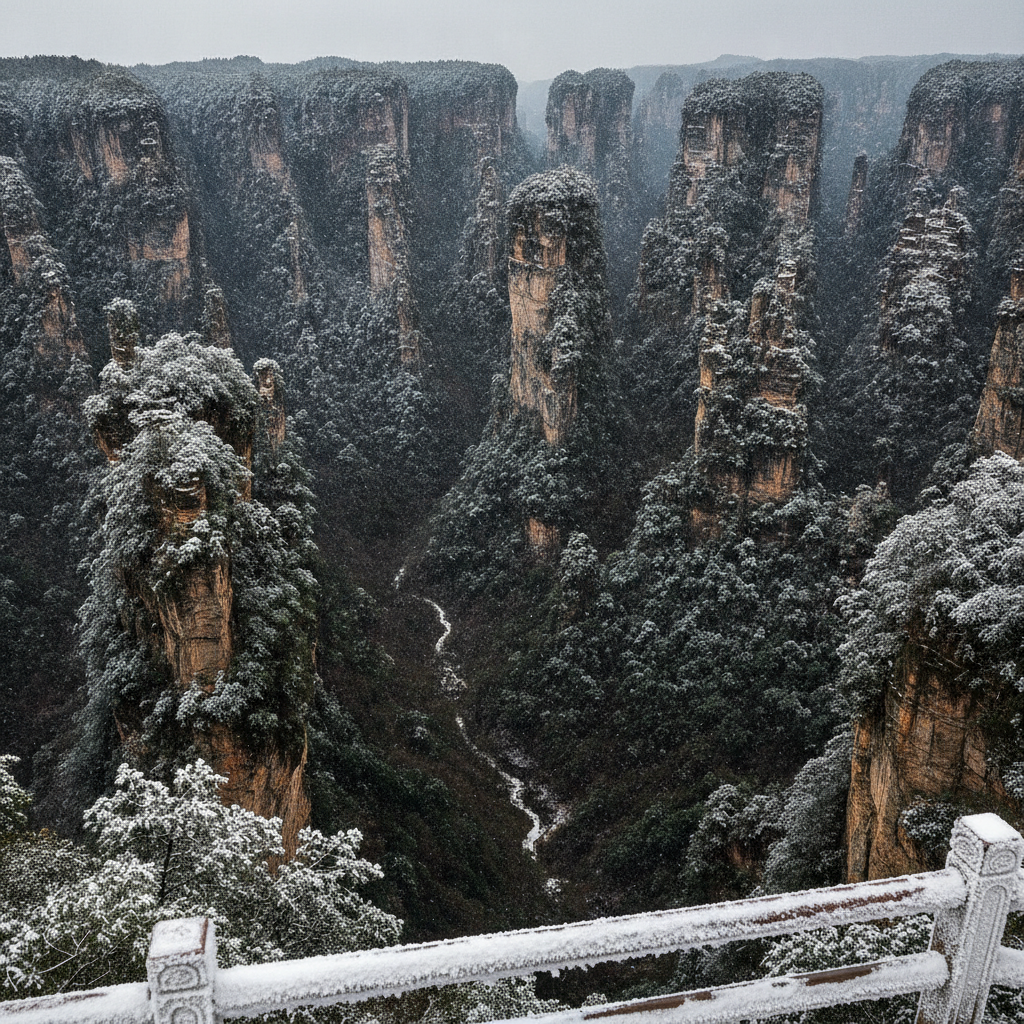
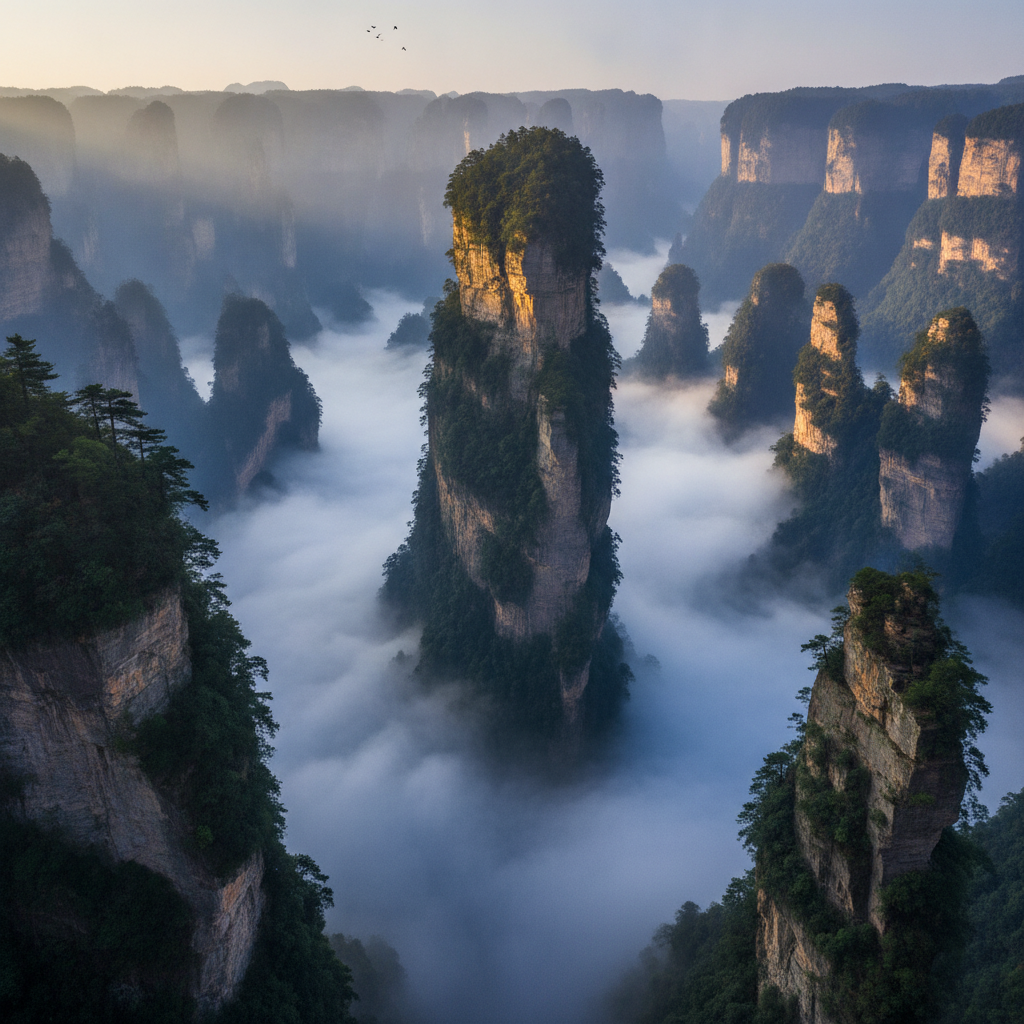
The Zhangjiajie sandstone pillar landscape (张家界砂岩峰林—the quartzite sandstone pillar formations of the Zhangjiajie National Forest Park (张家界国家森林公园)): the most otherworldly terrestrial landscape on earth. The Avatar connection (the film director James Cameron confirmed in 2010 that the Zhangjiajie pillar formations—specifically the Hallelujah Mountains (哈利路亚山)—were the primary visual reference for the floating mountains of Pandora in 'Avatar' (2009)): the official renaming (the Chinese authorities renamed the 'Southern Sky Pillar' (南天一柱) formation 'Avatar Hallelujah Mountain' (阿凡达·哈利路亚山) in January 2010—the most direct film-to-geography renaming in tourism history). The geology (the pillars are formed from Devonian quartzite sandstone (420–360 million years old)—the sandstone was originally a horizontal sedimentary layer; the vertical joints in the rock were exploited by erosion over 380 million years, isolating individual columns): the statistics (Zhangjiajie contains over 3,000 individual sandstone pillars above 200m; 243 pillars exceed 400m in height; the tallest pillar—the Qiankunzhu (乾坤柱—'Heaven and Earth Pillar')—stands 357m above the valley floor): the pillar ecosystem (the pillar tops support isolated forest communities that have evolved in isolation from the valley floor since the Quaternary period).
- 2
The Glass Bridge & Sky-High Infrastructure
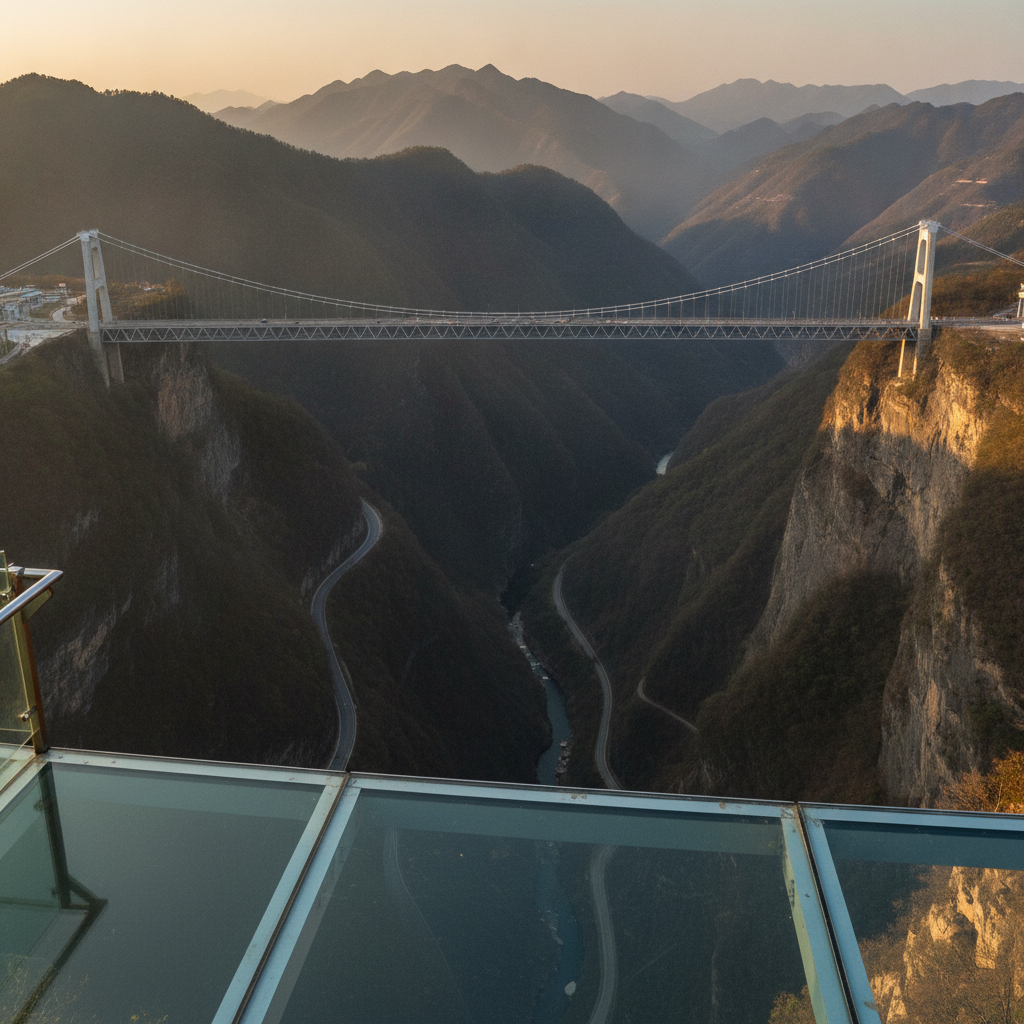
Zhangjiajie's sky-high infrastructure (the cluster of altitude-based attractions that have made Zhangjiajie the engineering tourism destination in China): the built environment that the landscape provoked. The Zhangjiajie Glass Bridge (张家界大峡谷玻璃桥—the glass-bottomed suspension bridge across the Zhangjiajie Grand Canyon (张家界大峡谷), 10 km from the national park entrance): the specifications (430m span, 300m above the valley floor, 6m wide, with a transparent glass deck—opened in 2016 as the world's longest and highest glass-bottomed bridge): the designer (Haim Dotan, the Israeli architect who described the Zhangjiajie landscape as 'the most beautiful place I've ever seen in my life'). The Bailong Elevator (百龙天梯—'Hundred Dragon Sky Lift'): the outdoor elevator on the face of a 300m sandstone cliff in Zhangjiajie National Forest Park: the specifications (326m tall, 3 double-deck glass cabins traveling on parallel tracks on the cliff face, carrying 50 passengers per cabin, capacity 4,000 persons per hour, ascent time 1 minute 32 seconds—the world's tallest outdoor elevator): the access role (the Bailong Elevator provides the primary access from the Yuanjiajie valley floor to the top of the Zhangjiajie pillar plateau). The Tianmen Mountain Cable Car (天门山索道—the world's longest passenger cable car: 7.5 km, ascending 1,279 m in elevation, 28 minutes end-to-end).
- 3
Tianmen Mountain – The Heaven Gate & Sky Walk
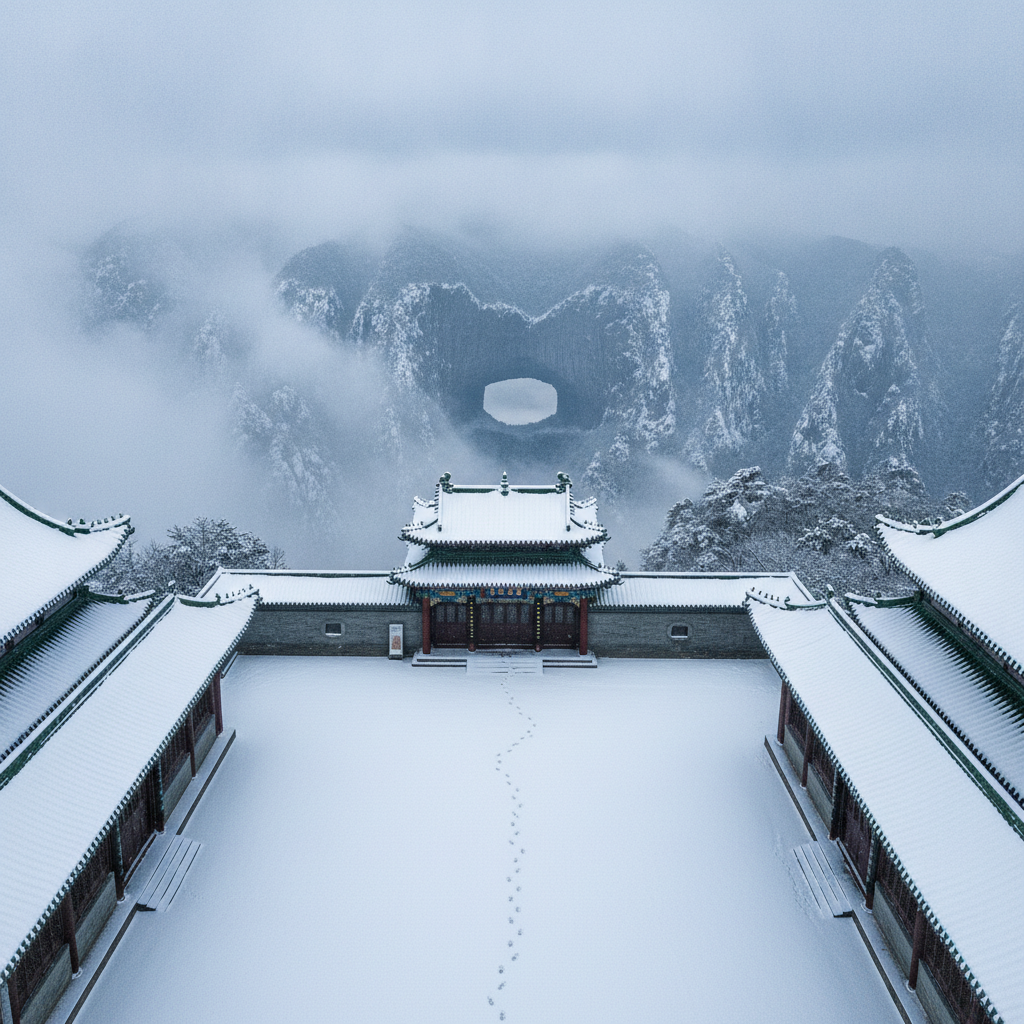
Tianmen Mountain (天门山—'Gate of Heaven Mountain'): the mountain whose 30m × 57m natural arch (天门洞—'Heaven Gate Hole') forms the largest natural karst arch in the world and the most recognizable single feature on the Zhangjiajie skyline. The geology of Tianmen Mountain (the limestone mountain separate from the quartzite sandstone of the National Forest Park—the Tianmen arch was formed by limestone dissolution (the same karst process as the Guilin cave system) but at much larger scale and at the face of a near-vertical cliff): the arch dimensions (30m wide, 57m high—large enough to fly aircraft through, which has been done: the Skywings aerobatic team flew a formation through the Tianmen arch in 2015). The Skywalk (天门山玻璃栈道—the glass-floored walkway built along the cliff edge of Tianmen Mountain at 1,400m elevation): the path (1,600m long, the glass walkway follows the outer edge of the limestone peak with a 1,000m+ drop below the glass panels): the entry by winding mountain road (the Tongtian Road (通天大道—'Road to Heaven'): the road from the cable car upper station to the Heaven Gate arch follows 99 switchback turns—the number 99 chosen to represent the Taoist concept of 99 Heavenly Layers).
- 4
The Tujia People – Zhangjiajie's Indigenous Culture
The Tujia people (土家族—Tǔjiā zú): the indigenous ethnic minority of the Zhangjiajie area (the mountain ethnic group that has inhabited the Wuling Mountains (武陵山) since before the Han Dynasty—now the 6th largest ethnic minority in China with approximately 8.35 million people). The Tujia history (the Tujia ancestors (the Ba people (巴人)) established the Ba Kingdom (巴国) in the Wuling Mountains before the Qin conquest of 316 BCE; the Ba were known to the Han Chinese for their distinctive 'Barbarian Warfare' (巴人之勇—the ferocity attributed to the Ba soldiers who fought with the Qin in the conquest of the competing states). The Tujia culture: the Hand Waving Dance (摆手舞—bǎi shǒu wǔ—the large-scale collective Tujia folk dance performed at the New Year festival—the dance involves simultaneous limb movements coordinated across hundreds of dancers): the Tujia brocade (西兰卡普—Xīlán Kǎpǔ—the Tujia woven brocade using over 100 traditional pattern designs—the most elaborate traditional textile tradition in Hunan Province). The Tujia stilt houses (吊脚楼—diàojiǎo lóu—the wooden houses built on stilts on the mountain slopes—the architectural response to the steep terrain): the Zhangjiajie Tujia Folk Culture Village (土家风情园—the most accessible concentration of traditional Tujia architecture in the Zhangjiajie area).
- 5
Zhangjiajie National Forest Park – Trails & Strategy
The Zhangjiajie National Forest Park (张家界国家森林公园): the practical guide to navigating the park—the trails, the zones, and the sequence that minimizes time and maximizes visual impact. The park structure (the park is divided into 3 major scenic areas: Zhangjiajie National Forest Park (张家界国家森林公园—the original park with the Golden Whip Brook trail); Tianzi Mountain (天子山—'Son of Heaven Mountain'—the highest plateau in the park at 1,262m, offering the most elevated views of the pillar formations); Yuanjiajie (袁家界—the plateau at 1,048m containing the highest density of Avatar-reference pillar formations including the 'Hallelujah Mountain')). The Golden Whip Brook Trail (金鞭溪—the 7.5 km valley floor trail through the core pillar zone, following the brook between the pillars): the most visually immersive trail in Zhangjiajie. The Bailong Elevator strategy (the elevator is the fastest ascent to the Yuanjiajie plateau but the most crowded—arrive before 09:00 to avoid 40–90 minute waits). The park entrance (the Wulinhuyuan entrance (武陵源 gate—the main entrance with the visitor center): 3-day pass (¥245) is the minimum recommended for the full park circuit.
- 6
Zhangjiajie Practical Guide – Getting There & Staying
The Zhangjiajie practical guide. Access: Zhangjiajie Hehua International Airport (DYG—direct flights: Beijing 2h30m, Shanghai 2h, Guangzhou 1h30m, Chengdu 1h20m; limited international flights—most international visitors transit through Changsha Huanghua Airport (CSX—1h30m domestic connection to Zhangjiajie): the Changsha connection (Changsha is also the gateway for those combining Zhangjiajie with Mao Zedong's birthplace at Shaoshan (韶山) or the Hunan Provincial Museum's Mawangdui Han Dynasty mummy collection). Train: Zhangjiajie to Changsha by high-speed rail: 2h; Xi'an to Zhangjiajie via Changsha: 4h total. Accommodation zones: the Wulinhuyuan town (武陵源镇—the town immediately adjacent to the park's main entrance—the most convenient base, with ¥100–500/night guesthouses and mid-range hotels on the main street): the Zhangjiajie city center (45 km from the park—less convenient but with better restaurant options and the urban amenities of the regional city). The peak season (July–August is the most crowded—the park capacity (80,000 visitors/day) is frequently reached and the park implements timed entry in peak season): the optimal season (April–May (spring green + occasional mist) and October–November (autumn foliage in the valleys) are the most photogenic and the least crowded).
Walk this route with audio
Stories play automatically as you reach each stop — no tapping needed.
More in Zhangjiajie
The 42 Hotels Demolished to Protect a UNESCO Site, the 19-Meter Stalagmite in the Yellow Dragon Cave & the Complete Zhangjiajie Circuit for Under USD 100
The Vine Tea That Isn't Tea, the World's Largest Cave Chamber Bigger Than Any Sports Stadium & Why Zhangjiajie Beats Every Other Chinese Nature Destination for a First-Time Visitor
The 1,800-Year Pilgrimage to the Temple on the Summit, the Avatar Effect That Increased International Visitors 9× & the Trail Behind the Widest Waterfall in Asia
The Pillar That Was Renamed After a Movie, the Living-Fossil Tree Discovered in the Park in 1941 & the Red Bull Wingsuit Pilots Flying Through a 30-Meter Rock Arch at 200 km/h