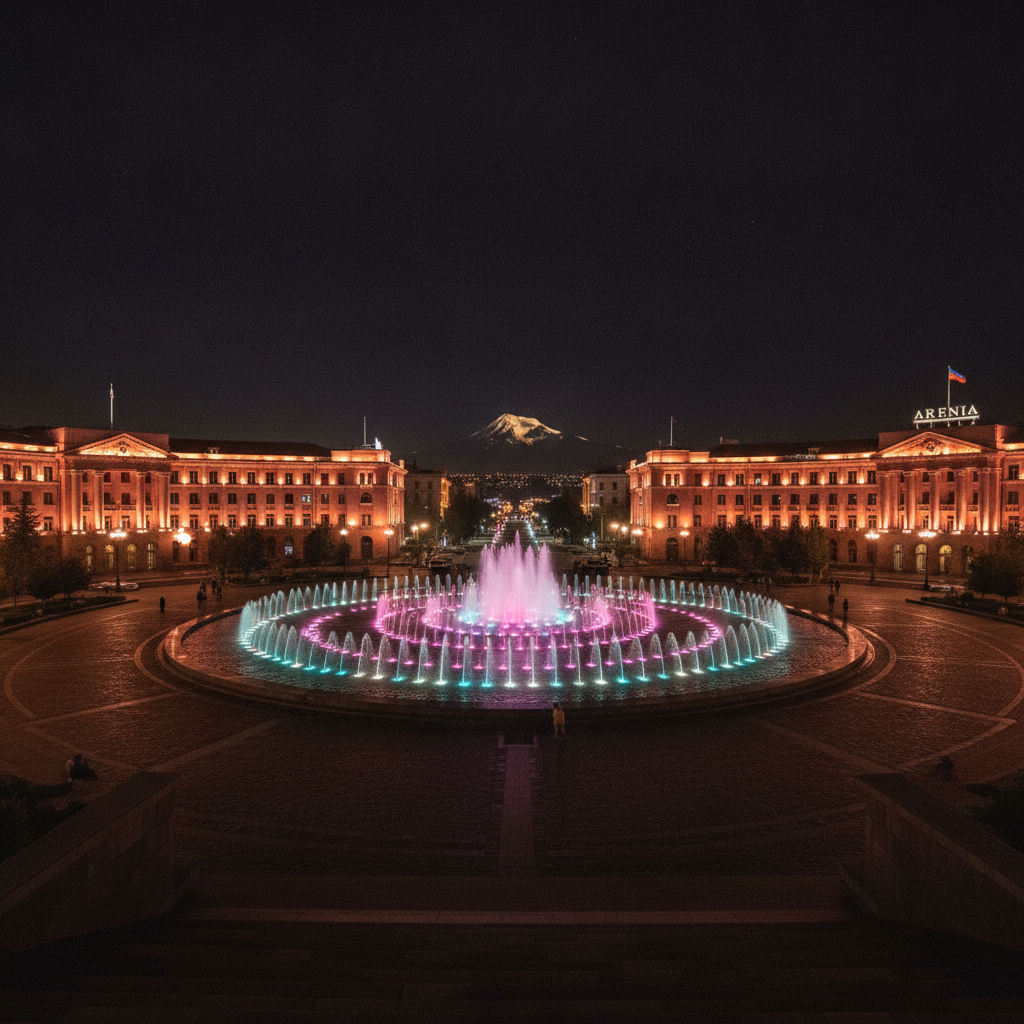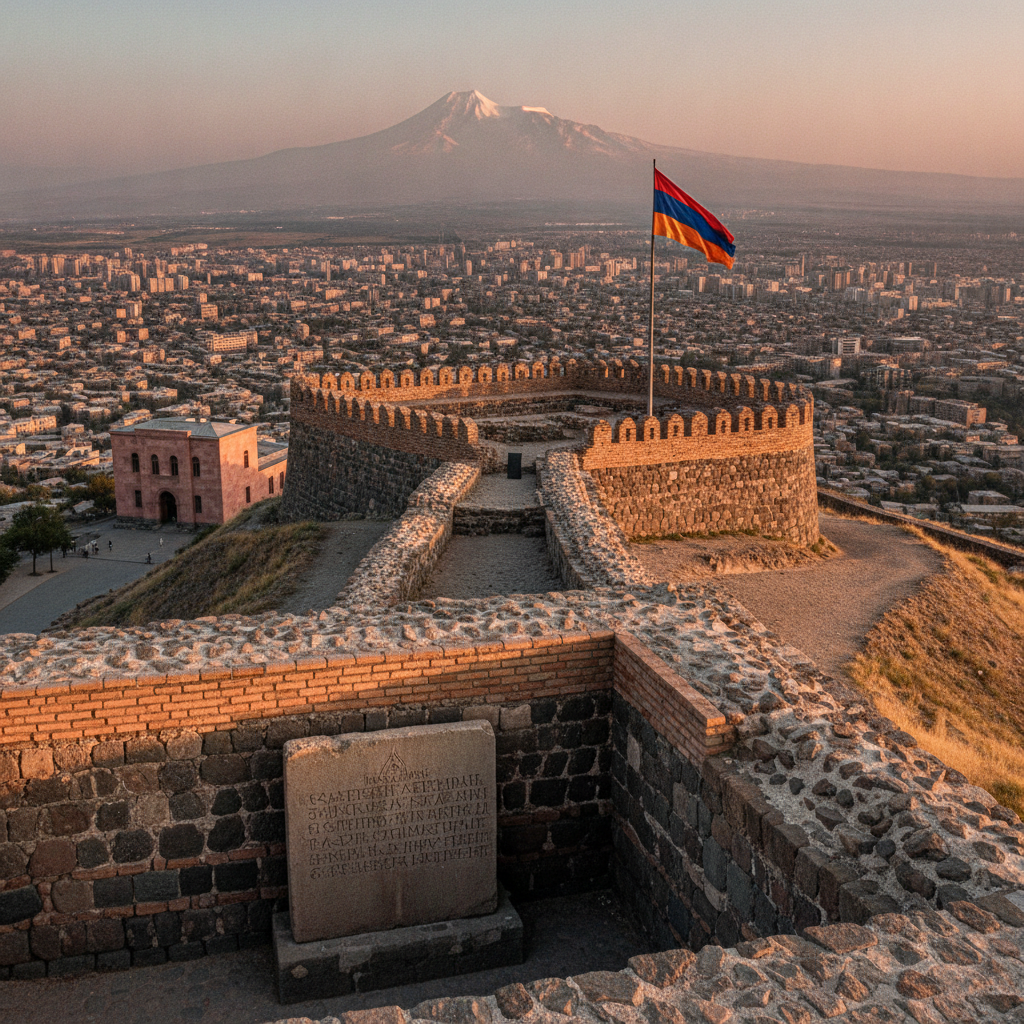
Erebuni Fortress Founded 782 BCE By King Argishti I Giving Yerevan Its Name Through 2,800 Years of Phonetic Evolution, Sergei Parajanov's Color of Pomegranates Among the 10 Greatest Films Ever Made & 200,000 People in Republic Square in 2018 With No Deaths in the Velvet Revolution
Erebuni fortress (782 BCE) giving Yerevan its name via Erebuni → Yerevan over 2,800 years of phonetic evolution; Sergei Parajanov's The Color of Pomegranates (1969) suppressed in USSR until 1982 and now ranked in multiple international top-10 greatest films polls; 200,000 people in Republic Square in April 2018 with no deaths or significant violence in the entire Velvet Revolution month; Armenia's 301 CE state Christianity adoption 22 years before Constantine's Edict of Milan; the 120,000 Armenians who fled Nagorno-Karabakh in September 2023 in the largest South Caucasus displacement since 1994; and Daniel Varoujan killed in the 1915 genocide at age 31 having written the Song of Bread published posthumously.
- 1
Urartu – Armenia Before Armenia
The Urartu kingdom (the ancient civilization that preceded Armenia in the same geographic territory—the first state centered on the Armenian plateau): the ancient heritage guide. The Urartu kingdom (Urartu (Biainili in the Urartian language)—the kingdom of the Armenian plateau that flourished 860–585 BCE: the kingdom was centered on Lake Van (now in Turkey) and controlled territories from the Araxes River (modern Armenia-Turkey border) to the upper Euphrates—the largest state in the ancient Near East at its peak (850–735 BCE), larger than the contemporary Assyrian Empire): the Erebuni Fortress (the Erebuni Fortress (Armenian: Էրեբունի)—the Urartian military and administrative center founded by King Argishti I in 782 BCE on the Arin Berd hill 8 km southeast of modern Yerevan: the fortress is believed by most Armenian historians to be the origin of the name Yerevan (Erebuni → Yerevan through 2,800 years of phonetic evolution)): the Erebuni Museum (the museum adjacent to the fortress site contains the excavated artifacts from the fortress—including the remains of the ceremonial hall frescoes (the oldest figurative wall paintings in the South Caucasus, 8th century BCE) and the cuneiform inscriptions of Argishti I): the Urartian legacy (the Urartians were the first people to drain the Ararat swamps with irrigation canals, creating the agricultural potential of the Ararat plain; the Urartian metallurgy tradition (iron swords, bronze shields, and gold jewelry of remarkable quality) formed the technological base for the subsequent Armenian metalworking tradition): the Mher's Door (the bas-relief of Urartu's last king Rusa IV at the cliff face near Van in Turkey—the most visible surviving Urartian monument—visible only to Armenian-diaspora visitors who travel to eastern Turkey).
- 2
Armenian Christianity – The First Christian Nation
The Armenian claim to be the world's first Christian nation (the 301 CE adoption of Christianity as the state religion of Armenia—22 years before the Roman Empire): the Christian heritage guide. The 301 CE adoption (in 301 CE, King Tiridates III of Greater Armenia adopted Christianity as the official state religion of Armenia—the first time any sovereign state formally adopted Christianity as its state religion: the event preceded Constantine's Edict of Milan (313 CE, which established religious tolerance in the Roman Empire) by 12 years and the formal Christianization of Rome itself by several decades): Gregory the Illuminator (Grigor Lusavorich—the Armenian monk who converted King Tiridates III: Gregory had been imprisoned in the Khor Virap pit by the king (who was a pagan) for 13 years; the king fell ill with a mysterious illness (described in Armenian sources as him transforming into a boar); Gregory was released and healed the king, who converted to Christianity in gratitude): the Armenian Apostolic Church (the Armenian Apostolic Church (the Armenian Orthodox Church)—one of the three Oriental Orthodox churches (with the Coptic and Ethiopian): the Armenian Apostolic Church is not in communion with the Eastern Orthodox or Roman Catholic churches—it rejected the Council of Chalcedon (451 CE) which the Roman and Byzantine churches accepted: the church is governed by the Catholicos of All Armenians, whose seat is at the Etchmiadzin Cathedral 20 km west of Yerevan): the Etchmiadzin Cathedral (the Etchmiadzin Cathedral (Surb Etchmiadzin—the seat of the Catholicos)—the first cathedral built in Armenia (301 CE, on the site of Gregory's vision of Christ descending to earth)—the oldest cathedral in the world built as a state commission): the UNESCO status (the Cathedral and Churches of Etchmiadzin are UNESCO World Heritage inscribed in 2000).
- 3
Photography in Yerevan – Tuff, Mountains & Markets
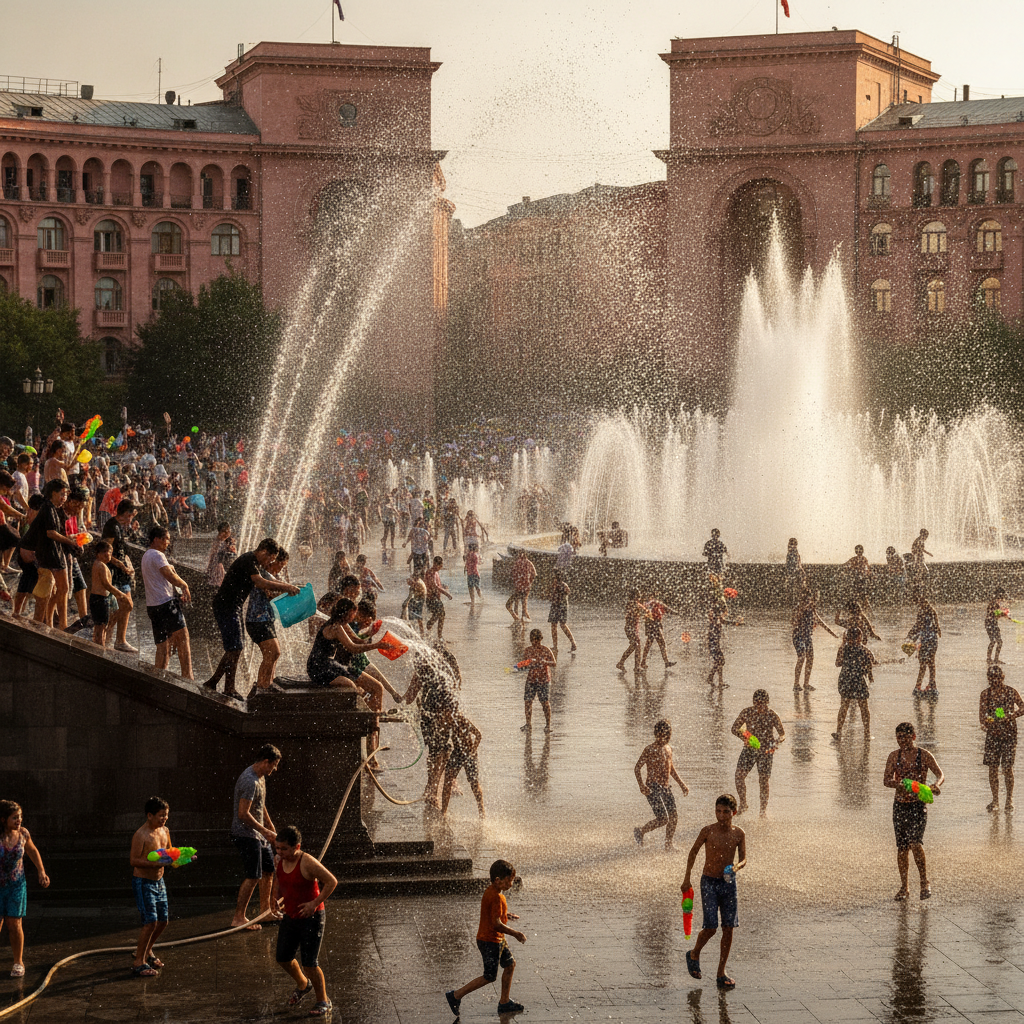
The Yerevan photography guide (the practical handbook for photographing the most architecturally distinctive capital in the Caucasus—a city where the pink stone, the mountain backdrop, and the Soviet-Armenian streetscape create unique photographic opportunities): the photographer's guide. The Ararat backdrop (the primary photography challenge and opportunity in Yerevan: the Mount Ararat view (the twin peaks 40 km south)—the mountain is visible on clear days from across the city but the best photographic compositions combine it with Yerevan architecture or heritage sites: the Khor Virap monastery (the monastery with Ararat directly behind—the most photographed view in Armenia; the best light for Khor Virap is early morning (06:00–08:00) when the sun is behind and to the right of the photographer looking south): the Cascade summit view (the panoramic view of Yerevan with Ararat visible from the Cascade summit—the city's pink tuff buildings in the middle ground with the mountain behind): the Republic Square (the Republic Square fountains at night: photograph from the museum steps at the southern end of the square looking north—the fountains fill the center frame with the water-music performance: the best performances are on warm summer evenings (June–August)): the Vernissage Market (the craft market—the portrait photography opportunity: the khachkar carvers and duduk craftsmen in the market stalls on Saturday morning (09:00–11:00) provide the most direct human-connection photography opportunity in Yerevan): the tuff texture (the pink volcanic tuff stone texture photographs best in the soft diffuse light of overcast days—the direct sun creates glare on the porous stone surface that reduces the legibility of the carved ornamental details).
- 4
Yerevan in Literature & Cinema – The Armenian Voice
The literary and cinematic heritage of Yerevan (the city that has produced writers and filmmakers of global significance—despite (or because of) the trauma of the genocide and diaspora): the literary-cultural guide. The literary tradition (the Armenian literary tradition: the oldest surviving Armenian text (the 5th century translations of the Bible and the Greek philosophers by the Armenian translators (Terjumans)—scholars who translated the entire corpus of Aristotle and Plato into Armenian in the 5th century, before many of these works survived in other languages): the modern Armenian poetry (the poets of the genocide era: Daniel Varoujan (1884–1915—the greatest Armenian poet of the early 20th century, killed in the genocide at age 31; his collection The Song of Bread (1921, published posthumously) depicts the pre-genocide Armenian agricultural life in Anatolia): the post-genocide poetry (Hovhannes Shiraz (1914–1984—the 20th century Armenian national poet): the Soviet Armenian literary tradition (Paruyr Sevak (1924–1971), the most internationally translated Soviet Armenian poet)): the cinema (the Hayk (Armenian) Film Studio established 1923 in Yerevan: the most internationally acclaimed Armenian film: Sergei Parajanov's The Color of Pomegranates (Sayat-Nova, 1969)—the biographical portrait of the 18th-century Armenian-Georgian poet Sayat-Nova told entirely through non-narrative visual tableaux: the film was suppressed in the USSR until 1982 for its non-ideological aesthetic and Parajanov was imprisoned 1973–1977: the film is considered one of the 10 most important films in cinema history by multiple international polls).
- 5
Families in Yerevan – Children's Armenia
The Yerevan families guide (the practical guide for visiting Yerevan with children—the attractions, experiences, and child-appropriate activities in Armenia's capital): the families travel guide. The History Museum of Armenia (the History Museum on Republic Square: the best single museum for children in Yerevan—the collection traces Armenian history from the earliest stone tools to the 20th century: the Erebuni artifacts section (the 8th century BCE bronze shields and iron swords from the Urartian military arsenal—the most visually impressive ancient objects); the medieval jewelry section (the Armenian gold jewelry—rings, earrings, and belts in the sophisticated Armenian goldsmith tradition): the Erebuni Museum and Fortress (8 km southeast of the city center—the fortress walls are accessible and provide a children-appropriate experience of a 2,800-year-old military site with visible stone walls and foundations): the duduk workshop (the Vernissage market craftsmen who demonstrate the duduk (apricot-wood flute) carving—the most sensory craft experience for children: the characteristic sound of the duduk is immediately recognizable and children are drawn to it): the Khor Virap family visit (the visit to the Khor Virap monastery and the descend into Gregory's pit (the narrow 6m underground pit): older children (8+) find the dark underground pit and the story of Gregory's 13-year imprisonment compelling): the Republic Square fountains (the dancing fountains at 21:00 are universally popular with children—the 20-minute performance of synchronized water and light is the most accessible family entertainment in Yerevan): the Yerevan Zoo (the zoo in Mashtots Park—bears, wolves, and Caucasian leopards).
- 6
Yerevan's Recent Velvet Revolution & Democratic Trajectory
The Yerevan Velvet Revolution (the 2018 peaceful uprising that brought Nikol Pashinyan to power—the most significant political transformation in Armenia since independence): the contemporary history guide. The Velvet Revolution (April–May 2018): the background (Serzh Sargsyan, Armenian president since 2008, was constitutionally barred from a third presidential term—but had engineered a shift to a parliamentary system that would allow him to remain in power as Prime Minister): the revolution (the opposition leader Nikol Pashinyan led a series of rolling street demonstrations in April 2018 that grew to 200,000 people in Republic Square (40% of Yerevan's population) demanding Sargsyan's resignation: the army and police refused to disperse the protesters; Sargsyan resigned on April 23, 2018: the revolution was entirely peaceful—no deaths or significant violence recorded in the entire month of demonstrations): the Pashinyan government (the Pashinyan government won the parliamentary election of December 2018 with 70% of the vote—the most decisive democratic mandate in post-Soviet space: the anti-corruption program, the judicial reform, and the economic liberalization measures improved the TI Corruption Perceptions Index from 107th (2017) to 62nd place (2022)): the 2020 Karabakh war (the September–November 2020 Second Karabakh War—Azerbaijan's military reconquest of Nagorno-Karabakh resulted in Armenia's defeat and significant loss of territory—the war severely damaged the Pashinyan government's popularity and led to a constitutional crisis in 2021): the 2023 Karabakh dissolution (the September 2023 Azerbaijani military operation ended the Armenian Republic of Artsakh (Nagorno-Karabakh)—120,000 ethnic Armenians fled to Armenia in the largest population displacement in the South Caucasus since 1994).
Walk this route with audio
Stories play automatically as you reach each stop — no tapping needed.
More in Yerevan
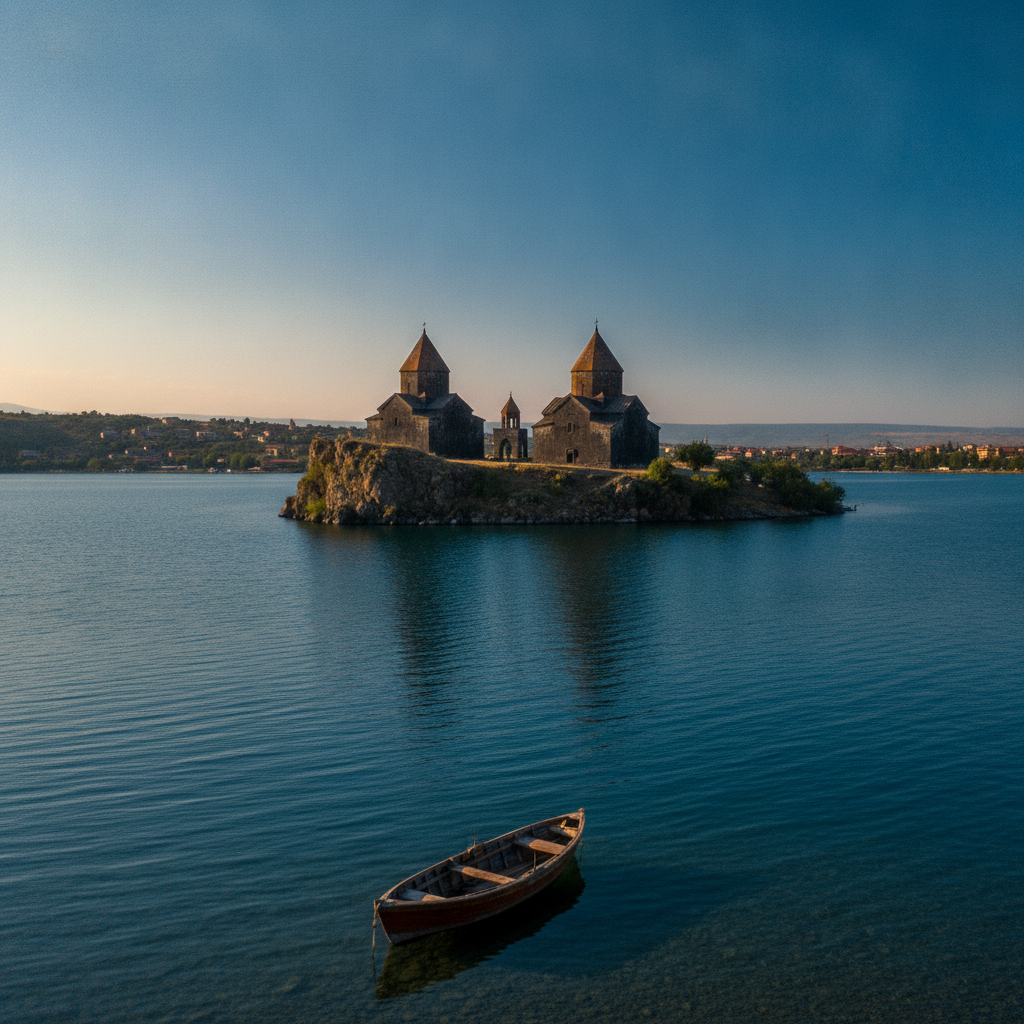
The Areni-1 Cave 6,000 BCE Wine Press Predating Even the Georgian Gadachrili Find by 200 Years Making Armenia the Oldest Winemaking Site, Lake Sevan Lowered 19m by Soviet Hydroelectric Projects & 10 Days in Three Caucasus Capitals for USD 400-600 Total
The First Sentence Written in Armenian Being the Book of Proverbs Verse 1:2, the Armenian Cognac Winning the 1900 Paris Exhibition Gold Medal Before the Judges Realized It Was Not French & the 2,000 Khachkars Destroyed in Azerbaijan in 2005 Documented by Satellite Imagery

Armenian Heritage: Garni Temple, Geghard Monastery, the Genocide History, the Ancient Christian Church, and the Most Historically Layered Single Armenian Day Trip
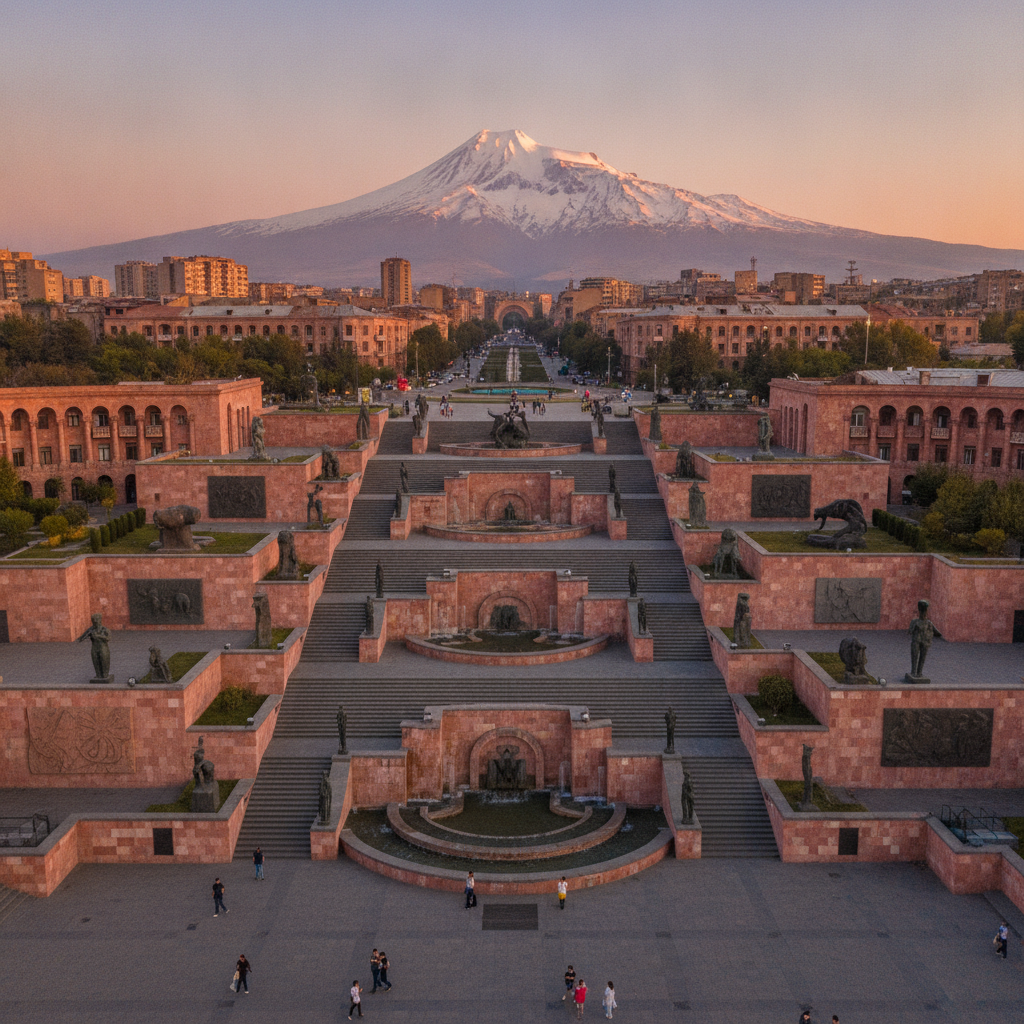
Yerevan Essential: The Cascade, Republic Square, Mount Ararat, the Genocide Memorial, the Vernissage, and the Most Emotionally Resonant Single Caucasus Capital
Prunus Armeniaca the Latin Name Embedding Armenia Into the Scientific Name of the Apricot Since Pliny the Elder's 1st Century CE Natural History, Picsart the First Armenian Tech Unicorn With 150 Million Monthly Users & 120,000 Karabakh Armenians Fleeing to Armenia in Days After September 2023