Stalin's Reply That Turkey's Crescent Moon Coat of Arms Does Not Mean Turkey Owns the Moon, the 1971 Cascade Still Not Fully Complete After 50 Years & the 23,000 Manuscripts Including the 862 CE Oldest Dated Armenian Manuscript
Stalin's reply to Turkish complaints about Ararat on Armenia's coat of arms: the Turkish crescent moon doesn't mean Turkey owns the moon; the Cascade begun in 1971 still not complete at 5 of 7 planned stages in 2024; the Matenadaran's 23,000 manuscripts including the 862 CE Gospels of Queen Mlke as the oldest dated Armenian manuscript; the Botero sculptures at the Cascade as his largest permanent outdoor collection outside Colombia; the dancing fountains on Republic Square as the largest choreographed fountain in the former Soviet Union when installed in 2008; and the Treaty of Kars (1921) assigning the Ararat plain and its mountain to Turkey against the wishes of the Armenian SSR.
- 1
Republic Square – The Pink Tuff Heart of Yerevan
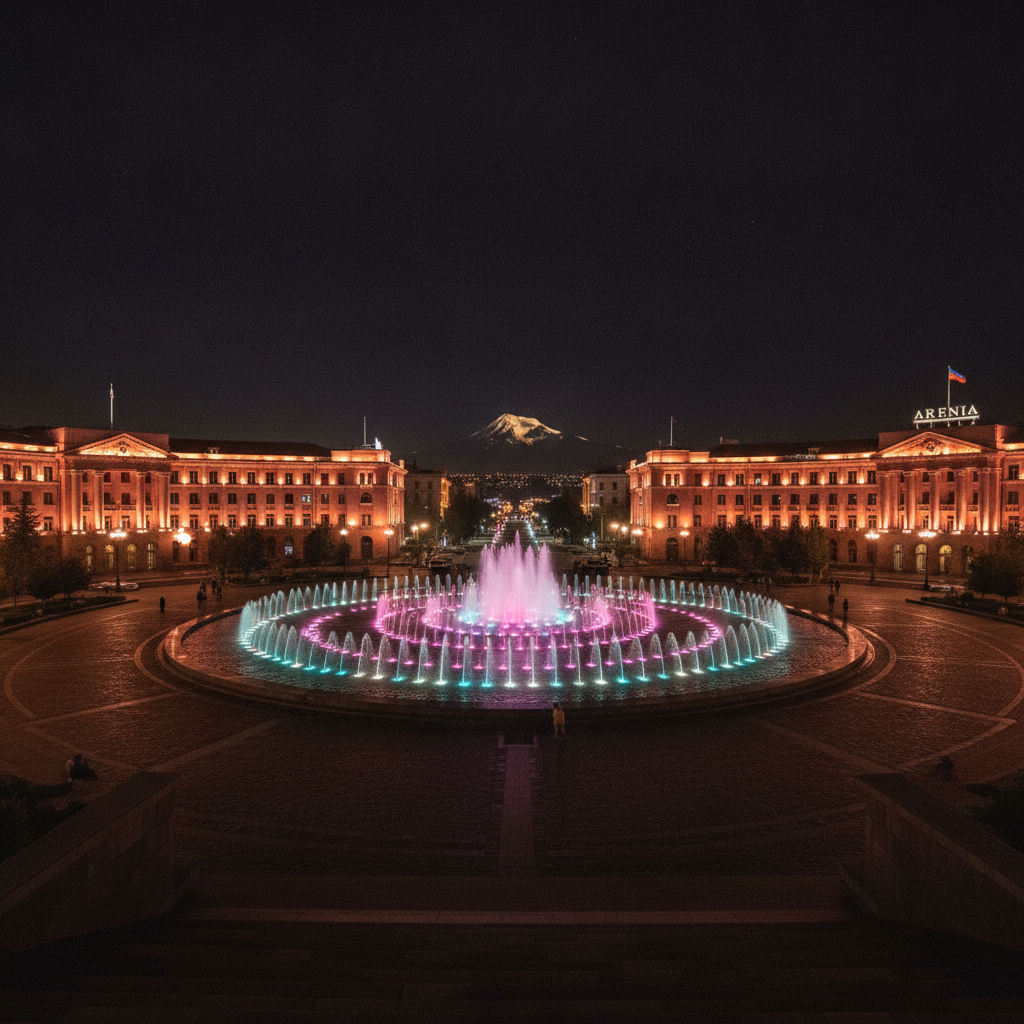
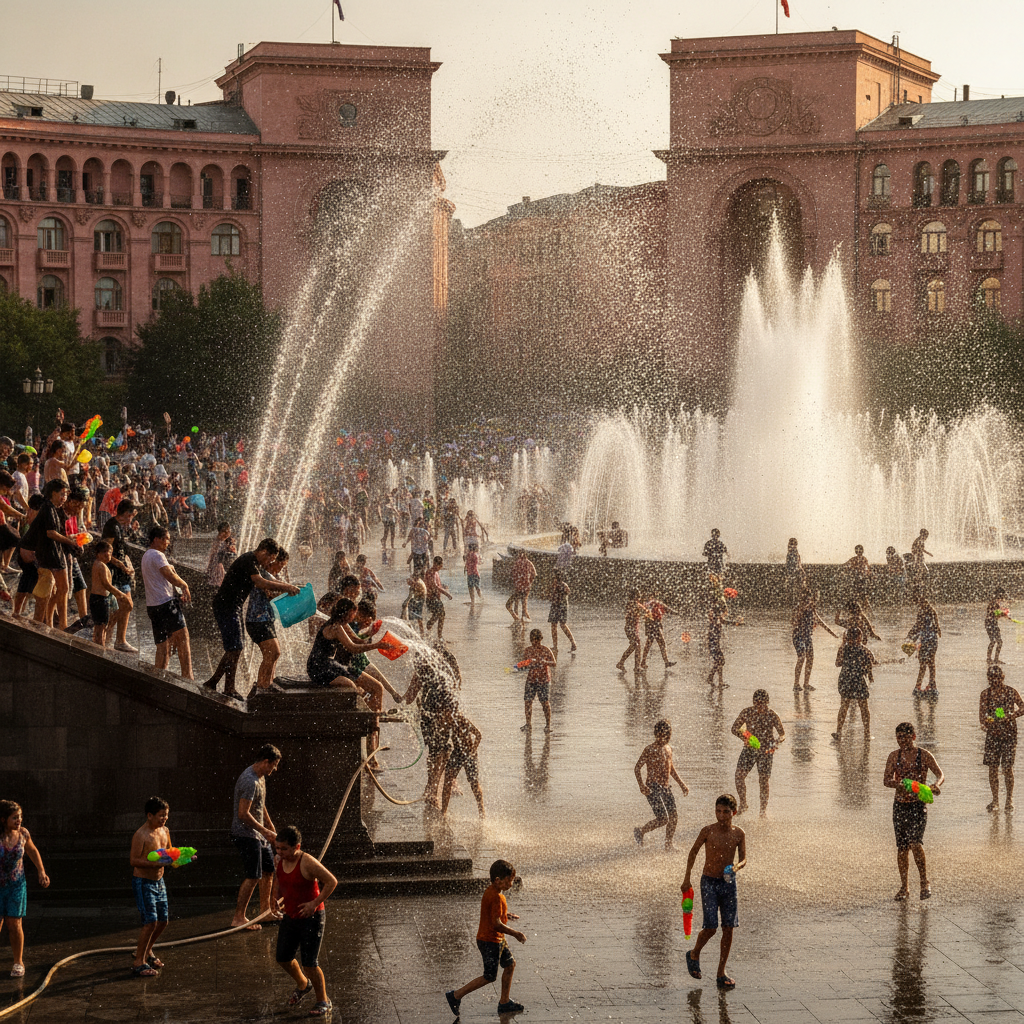
Republic Square (Hanrapetutyan Hraparak—the central square of Yerevan and the defining public space of the Armenian capital): the city center guide. The square (Republic Square was designed by the Soviet architect Alexander Tamanyan (1878–1936) as the centerpiece of his 1924 master plan for the new Soviet capital: the square is elliptical (200m × 130m) and enclosed by five buildings in the Armenian national style (using the pink, orange, and cream volcanic tuff stone that defines the architecture of Yerevan): the buildings (the five buildings enclosing the square: the Government Building (1926, Tamanyan); the Ministry of Foreign Affairs (1952, Mark Grigoryan); the History Museum of Armenia and National Gallery (1950, Grigoryan); the Armenia Hotel (1958, Edward Sarapian); the Post Office building (1956)—all five in variations of the neo-classical style with Armenian decorative elements): the dancing fountains (the Republic Square music fountains—the fountain system installed 2008 (the largest choreographed fountain in the former Soviet Union at the time): the fountains operate May–September at 21:00 and 22:00 nightly—the 600-jet system synchronized to classical and Armenian folk music, changing color throughout the performance): the pink tuff (the volcanic tuff stone (tufa—Armenian: տուֆ) is the defining material of Yerevan's architecture: the tuff is quarried from the Artik and Ani regions of Armenia and ranges in color from pale cream to deep rose to orange-red—the color depends on the iron oxide content: the pink-rose tuff of the central buildings is from the Artik quarries in Shirak Province).
- 2
The Cascade – Yerevan's Monumental Stairway
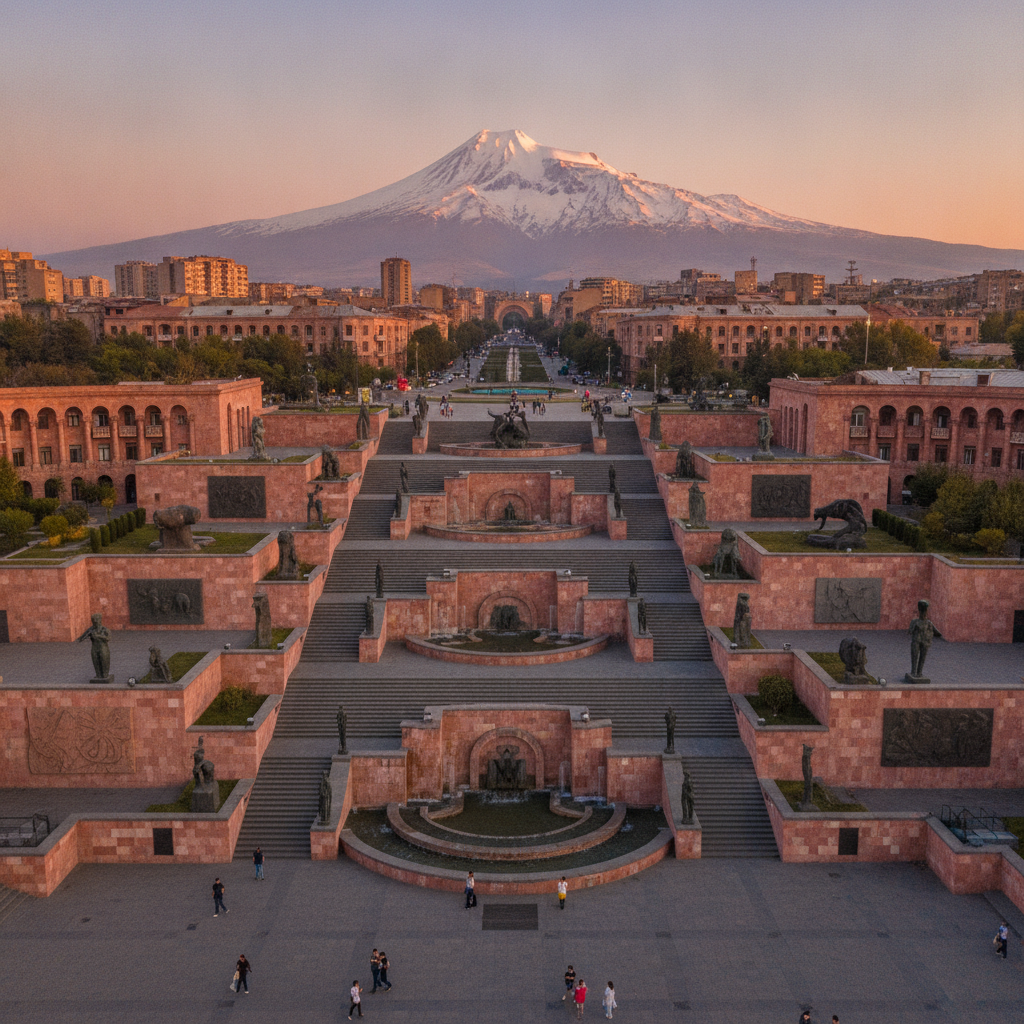
The Cascade (the giant staircase complex in central Yerevan—the most ambitious Soviet-era public art installation in Armenia and the city's primary contemporary art venue): the Cascade guide. The structure (the Cascade is a 572-step staircase carved into the hillside of the Kond district north of the city center: the staircase was designed by the architects Jim Torosyan and Sarkis Gurzadyan in 1971 and is still not fully complete (the original plan called for 7 stages of which 5 are complete): the Cascade complex (the interior of the staircase contains a covered escalator (operational 2001) and a sequence of 3 gallery levels: the Cafesjian Center for the Arts (the primary contemporary art venue in Armenia, named for the Armenian-American businessman Gerard Cafesjian who funded the completion of the Cascade and donated his personal art collection): the sculpture garden (the open-air sculpture park at the base of the Cascade: the collection of 19 large-scale sculptures by Fernando Botero (the Colombian figurative sculptor known for his inflated rounded human forms—the Botero sculptures at the Cascade are his largest permanent outdoor collection outside Colombia): the view (the summit of the Cascade (at 105m above the city center) provides a panoramic view of Yerevan with Mount Ararat (5,165m) dominating the southern horizon—on clear days (best October–November) the mountain's twin peaks (Masis and Sis) fill the upper quarter of the southern view with permanent snow).
- 3
Vernissage Market – Armenian Crafts & Antiquities
The Vernissage Market (the open-air weekend market adjacent to the Republic Square—the primary craft and antique market in Yerevan and the best place to understand the material culture of the Armenian diaspora and homeland): the market guide. The market (the Vernissage (the name derives from the French term for an art opening—Vernissage—used ironically for a market): operating Saturday–Sunday 10:00–17:00 and Friday 12:00–17:00, in the park adjacent to the History Museum on Abovyan Street: the market has approximately 400 stalls organized into sections: the carpet section (the Armenian carpet (karpet)—traditional hand-knotted wool carpets with the characteristic Armenian geometric designs—the most concentrated carpet market in Armenia outside the village producers): the antiquities section (Soviet-era objects, Armenian silver jewelry, church candleholders, old cognac bottles): the crafts (the Armenian duduk (the apricot-wood double-reed woodwind instrument—the primary instrument of Armenian folk music): the Armenian cross-stones (khachkar replicas—the decorative carved cross-stones that are the most recognizable symbol of Armenian Christian art): the miniature paintings (the Armenian miniature painting tradition—tiny paintings on apricot seeds, eggshells, and small panels in the tradition of the medieval Armenian illuminated manuscripts)): the price guidance (the Vernissage is negotiable—the standard discount is 20–30% from the first asking price; the antique khachkar replicas range from USD 10–50; the hand-knotted carpets (small, 50cm × 80cm) from USD 80–200).
- 4
The Matenadaran – The World's Greatest Armenian Manuscript Collection
The Matenadaran (the Mesrop Mashtots Institute of Ancient Manuscripts—the library and research center on Mashtots Avenue containing the largest collection of Armenian manuscripts in the world): the manuscript heritage guide. The collection (the Matenadaran contains 23,000 manuscripts and 500,000 archival documents—the collection includes: Armenian religious manuscripts (Bibles, psalters, liturgical books); Armenian secular manuscripts (chronicles, medical texts, poetry, historical documents); manuscripts in Arabic, Persian, Ethiopian, Greek, Syriac, and Latin from the Silk Road and Byzantine connections): the most significant manuscripts (the Gospels of Queen Mlke (862 CE)—the oldest dated Armenian manuscript; the Gospels of Mughni (11th century)—the most artistically celebrated illuminated manuscript with full-page miniatures of exceptional quality; the Marmarashen Gospel (1223 CE)—the largest illuminated Armenian manuscript (the full-page miniatures depict 16th-century court scenes of the Zakarian dynasty)): the building (the Matenadaran building (1957—designed by Marc Grigoryan) is built into the hillside above Mashtots Avenue: the facade features a colonnaded entrance flanked by four statues of Armenian scholars: Mesrop Mashtots (the inventor of the Armenian alphabet); Gregory the Illuminator (the baptizer of Armenia in 301 CE); Movses Khorenatsi (the 5th-century Armenian historian); and Anania Shirakatsi (the 7th-century Armenian mathematician)): the Mesrop Mashtots (the Armenian alphabet inventor—see Route 2).
- 5
Ararat & the Impossible Mountain – Armenia's National Symbol
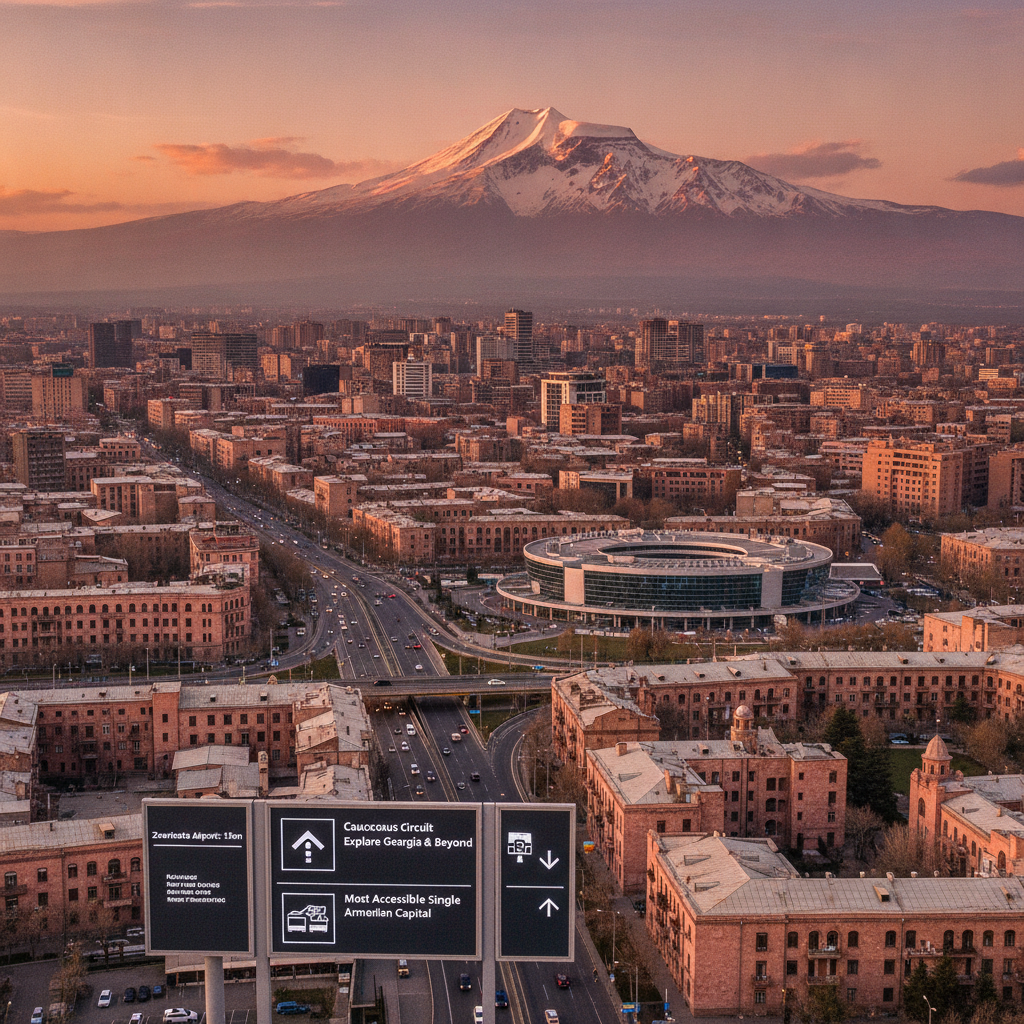
The Mount Ararat view from Yerevan (the snow-capped volcano that dominates the southern horizon of Yerevan but sits entirely within Turkey—the most politically loaded mountain view in the world): the Ararat heritage guide. The mountain (Mount Ararat (Armenian: Արարատ, Masis—5,165m): the stratovolcano on the Ararat plain 40 km south of Yerevan: the Armenian plateau was divided by the 1921 Treaty of Kars (the post-WWI Soviet-Turkish border settlement) which assigned the Ararat plain and the mountain to Turkey—the treaty was signed by the Soviet government against the wishes of the Armenian SSR): the Biblical connection (Mount Ararat is the mountain identified in Genesis 8:4 as the landing site of Noah's Ark—the Armenian tradition has maintained that Noah's descendants populated Armenia after the flood, making Ararat the founding mountain of the Armenian nation): the political meaning (the mountain visible from Yerevan is in Turkey—a state that does not recognize the Armenian Genocide—making the view of Ararat from Yerevan simultaneously a national symbol and a reminder of loss: the Soviet Azerbaijani joke (attributed to Anastas Mikoyan): 'Turkey complained that the coat of arms of Soviet Armenia shows Mount Ararat, which is in Turkey'; Stalin's reply: 'The coat of arms of Turkey shows a crescent moon; does that mean Turkey owns the moon?'): the best view (the clearest Ararat view from Yerevan: the Cascade summit (105m elevation in the city); the Khor Virap monastery (40 km south of Yerevan—the monastery in the Ararat plain with the mountain directly behind).
- 6
Yerevan Practical Guide – Arrival, Currency & Orientation
The Yerevan practical guide (the essential logistics for visiting the capital of Armenia—the most compact and walkable capital city in the South Caucasus): the practical handbook. The airport (Zvartnots International Airport (EVN)—10 km west of the city center: direct connections to Moscow (3h, multiple daily), Dubai (3h30m, daily), Paris (4h30m, daily (Air France)), Vienna (4h, 3× weekly), Istanbul (3h, daily (Turkish Airlines, Pegasus)—the Turkish connection reopened in 2022 for the first time since 1993): the visa (citizens of 120+ countries can visit Armenia without a visa for stays up to 180 days—including all EU countries, USA, UK, Canada, Australia, and Russia: one of the most liberal visa policies in the world): the currency (the Armenian Dram (AMD): 1 USD = approximately 390 AMD (2024)): the city layout (Yerevan is exceptionally compact—all major attractions are within a 20-minute walk of Republic Square: the Cascade (15 min north); the Vernissage (5 min east); the Matenadaran (20 min northwest); the opera house (10 min north on Mashtots Avenue)): the transport (Yerevan Metro (1 line, 10 stations)—useful for accessing the train station and the northwest of the city but most central attractions are walkable; taxis via the GG (formerly Yandex Go) app (AMD 500–800 = USD 1.30–2.00 within the center)): the budget (Yerevan is among the most affordable European-standard capitals: a full restaurant dinner USD 10–15; a beer in a bar USD 1.50–2.00; a hostel dorm USD 8–12; a mid-range hotel USD 60–100/night).
Walk this route with audio
Stories play automatically as you reach each stop — no tapping needed.
More in Yerevan
The Areni-1 Cave 6,000 BCE Wine Press Predating Even the Georgian Gadachrili Find by 200 Years Making Armenia the Oldest Winemaking Site, Lake Sevan Lowered 19m by Soviet Hydroelectric Projects & 10 Days in Three Caucasus Capitals for USD 400-600 Total
The First Sentence Written in Armenian Being the Book of Proverbs Verse 1:2, the Armenian Cognac Winning the 1900 Paris Exhibition Gold Medal Before the Judges Realized It Was Not French & the 2,000 Khachkars Destroyed in Azerbaijan in 2005 Documented by Satellite Imagery

Armenian Heritage: Garni Temple, Geghard Monastery, the Genocide History, the Ancient Christian Church, and the Most Historically Layered Single Armenian Day Trip
Yerevan Essential: The Cascade, Republic Square, Mount Ararat, the Genocide Memorial, the Vernissage, and the Most Emotionally Resonant Single Caucasus Capital
Prunus Armeniaca the Latin Name Embedding Armenia Into the Scientific Name of the Apricot Since Pliny the Elder's 1st Century CE Natural History, Picsart the First Armenian Tech Unicorn With 150 Million Monthly Users & 120,000 Karabakh Armenians Fleeing to Armenia in Days After September 2023