Yangon's Hard Questions: Rohingya Genocide Context, the Ethics of Visiting & Shan Noodles in the Tea House
The necessary Yangon—Shan noodles and mont hin gar as the migration story of a city where every state's food arrives with its people, the Myanm/art gallery's 2014–2021 window of politically engaged contemporary art now operating in exile or coded language since the coup, the Sule Pagoda's 2,000-year-old stupa marooned in a British colonial roundabout showing two cities occupying the same space, the Rohingya crisis context: 730,000 people fled to Bangladesh in 2017 after village burnings the UN called genocide (and Aung San Suu Kyi's silence that cost her the Nobel community's respect), Iron Cross frontman Lay Phyu's post-coup political music, and the hotel-tax-to-military-government ethical question every 2026 visitor must answer.
- 1
Yangon's Street Food – From Shan Noodles to Mont Hin Gar
Yangon's street food landscape reflects the city's position as Myanmar's largest city and primary domestic migration destination—a place where the food traditions of every state and region (Shan, Rakhine, Mon, Kachin, Kayah, Chin, Bamar) are represented in the street markets and tea houses. The geography of street food in Yangon: the downtown area's tea houses (mohinga for breakfast, rice dishes for lunch, laphet thoke at all hours), the Chinatown night market (grilled items, Chinese-influenced noodle soups), the Indian quarter's South Indian snacks (samosas, paratha, biryani from Muslim tea houses), and the Dagon township markets. Shan noodles (noodles in a mild tomato and pork or chicken broth, served with pickled vegetables and sesame oil—brought to Yangon by Shan migrants)—have become as ubiquitous in Yangon as they are in Shan State. Mont hin gar (a slightly different version of mohinga, using the same base ingredients but with a thicker, more glutinous broth)—the Mon ethnic group's version of the national dish. The Theingyi Zei market (a large downtown covered market with excellent street food in the surrounding lanes) is the most complete single food destination in central Yangon.
- 2
Yangon's Art Scene – Paint, Protest & the Military Era
Yangon has developed a contemporary art scene of surprising vitality despite—and in direct response to—the political conditions of the military era. The 2010–2020 democratic opening (from the military's managed transition to the Thein Sein government through Aung San Suu Kyi's NLD governance) created a brief period in which Yangon galleries, artist studios, and public art events could operate with relatively limited censorship. The Myanm/art gallery (founded 2014—the most prominent contemporary Burmese art gallery, representing emerging artists)—showed work that engaged with Myanmar's political history (the 1988 student uprising, the Rohingya crisis, the environmental destruction of the Ayeyarwady) in ways that would not have been possible under full military censorship. The 2021 coup: many of Yangon's artists left the country (to Thailand, to Singapore, to wherever they could get visa); others remained and have continued making work that references the coup and the civil war in coded or oblique ways. The art that has emerged from Myanmar's civil conflict since 2021—political imagery, protest graphics, documentary photography—has circulated primarily online.
- 3
Yangon's Green Space – Maha Bandula Park & the Heritage Walk
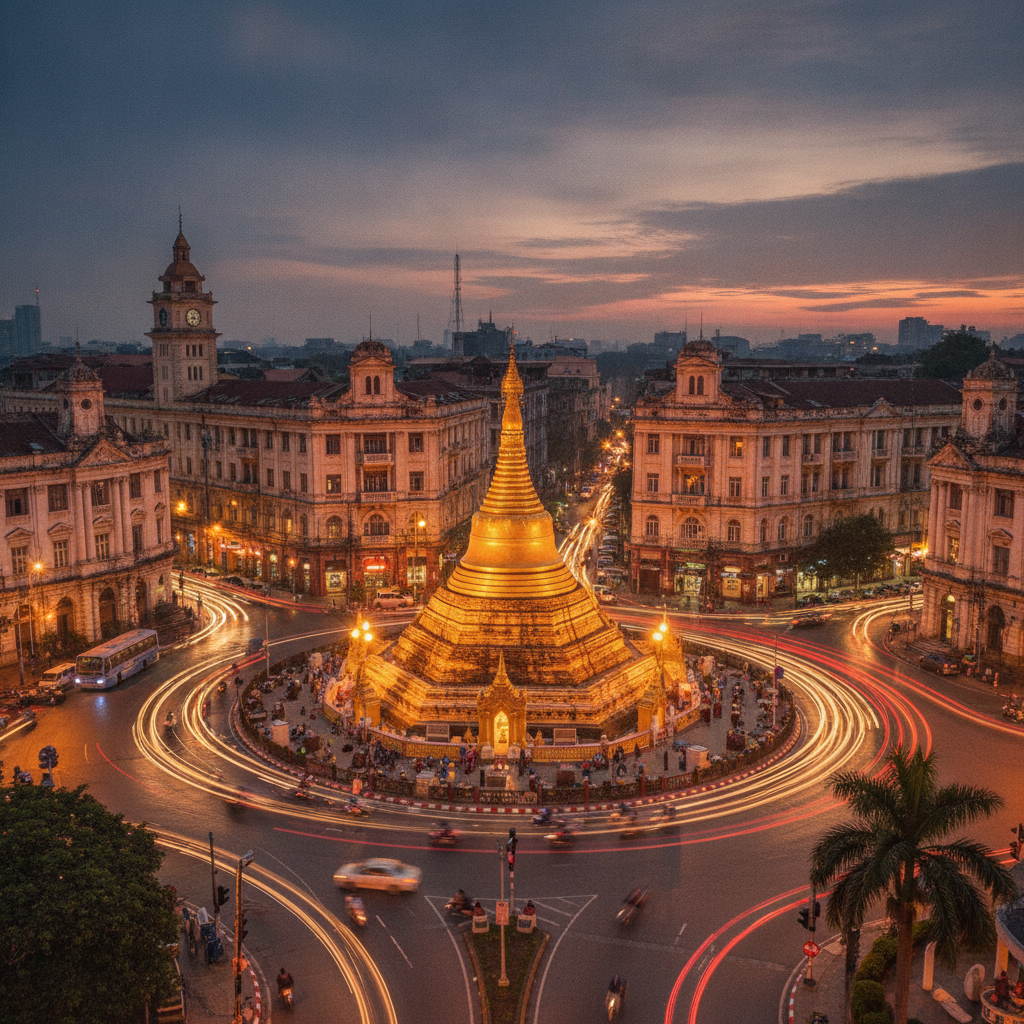
Maha Bandula Park (formerly Fytche Square—named for a British commissioner, renamed after Myanmar's independence for General Maha Bandula, who died fighting the British in the First Anglo-Burmese War 1824–1826): the primary downtown green space, a small park of trees and benches anchored by a tall column topped with a large chinthe (lion-griffin) in the centre of Yangon's colonial downtown grid. The Independence Monument (a modest column in the park) and the surrounding colonial buildings—the High Court, the Sule Pagoda (an ancient stupa marooned in the middle of a colonial roundabout, serving as the traffic centrepiece of the downtown grid)—form the most visually coherent heritage streetscape in Yangon. The Yangon Heritage Trust's walking tour app (available for iPhone and Android—released 2014, covering the colonial downtown grid in a self-guided 2.5-hour route)—was developed before the coup; the Trust's work has been suspended since 2021. The Sule Pagoda: a 2,000-year-old stupa that predates the colonial grid that was built around it, surviving into the present as a remarkable layering of a pre-colonial religious monument inside a British colonial city plan.
- 4
Rakhine State & the Rohingya Crisis – Context for Yangon
No visit to Yangon can be fully understood without engaging with Myanmar's most acute contemporary crisis: the situation of the Rohingya Muslim minority of Rakhine State. The Rohingya (approximately 1 million people in Myanmar before 2017, concentrated in the Maungdaw and Buthidaung townships of northern Rakhine)—who identify as an indigenous Muslim ethnic group with deep roots in the Arakan region—were denied citizenship by Myanmar's 1982 Citizenship Law (which recognised 135 ethnic groups but not the Rohingya), rendering them stateless in their own territory. In August–September 2017, the Myanmar military (Tatmadaw) conducted a military operation in northern Rakhine—in response to Rohingya militant attacks on police posts—that involved the burning of 350+ villages, mass killings, and sexual violence on a scale that UN investigators concluded constituted genocide; approximately 730,000 Rohingya fled to Bangladesh in the following weeks, joining 200,000 already in camps at Cox's Bazar. The camps in Bangladesh remain the world's largest refugee settlement. Aung San Suu Kyi's failure to condemn the military operation (while still in government) resulted in the return of many international humanitarian awards and a fundamental revision of her international reputation.
- 5
Yangon's Music Scene – Traditional Anyein & Contemporary
Myanmar's music tradition—one of the most distinctive in Southeast Asia—has two tracks in Yangon: the traditional anyein performance (a variety entertainment combining comedy, dance, music, and audience participation—the traditional public theatre of Myanmar, performed at pagoda festivals and public events, with a format that has been relatively stable for centuries) and a contemporary music scene that emerged from the democratic opening. The traditional: hsain waing ensembles (a circular arrangement of tuned drums played by a single drummer—the most characteristic sound of Burmese ceremonial music), the saung gauk (the boat-shaped Burmese harp—one of the oldest stringed instruments in Asia), and the mahagita classical repertoire. The contemporary: Myanmar's popular music scene (from the '70s rock era under Ne Win's cultural restrictions through the 1990s 'golden era' of popular music when the relaxed censorship allowed rock and pop to flourish) produced artists like Lay Phyu (frontman of Iron Cross, Myanmar's most enduring rock band) who have been explicitly political in their post-coup output. The street musicians around Shwedagon and the pagoda festival circuits provide the most accessible traditional music experiences for visitors.
- 6
Practical Yangon – Entry, Safety & the Ethics of Visiting
Visiting Myanmar in 2026 involves navigating a complex ethical and practical landscape that is substantially different from any other destination in this guide. Practical entry: most Western governments maintain 'Do Not Travel' or 'Reconsider Travel' advisories for Myanmar; the military government issues e-visas (available online, typically processed in 1–3 days); flights operate from Bangkok (Air Asia, Myanmar National), Singapore (Scoot, Singapore Airlines codeshare), and Kuala Lumpur. Safety in Yangon: the city has not experienced the direct combat that has affected Sagaing, Chin State, Kayah State, and Karen State; however, arbitrary detention of foreigners (for photographing military installations, for social media posts critical of the junta, for visa irregularities) has been documented since 2021. The ethics of visiting: tourism revenue—hotel taxes (10% to government), visa fees, entry fees to government-managed sites (Shwedagon admission for foreigners: $8, paid to a military-connected trust)—flows to the military government. Counter-argument: spending in locally owned tea houses, market stalls, and independent guesthouses supports ordinary Burmese families who have already suffered enormously. The decision to visit is one each traveller must make informed by current conditions.
Walk this route with audio
Stories play automatically as you reach each stop — no tapping needed.
More in Yangon
Yangon Deeper: The $0.10 Circular Train Loop, 19th Street Chinatown Barbecue & Aung San Suu Kyi's Lake House
Yangon's Weight: Bago's 55-Metre Reclining Buddha, the 1962 Military Coup's Roots & a City of Resilient Dignity
Yangon 2026: The Last Synagogue With 20 Jews, World's Largest Opium Producer & a City of 7 Million Persisting
Yangon: 60 Tonnes of Gold on Shwedagon Pagoda, Victorian Rangoon's Last Streets & the Tea House Where Myanmar Talks