The Mercury Rivers in the Unexcavated Tomb, the Hijacked Minaret That Looks Like a Pagoda & the Silk Road Merchant Who Was Captured for 10 Years and Opened Trade with Rome Anyway
Qin Shi Huang's mercury rivers confirmed by soil surveys; the Great Mosque's 'Imam Hat Tower' as a Chinese pagoda-minaret hybrid unique in Islamic architecture; Zhang Qian captured for 10 years by the Xiongnu and still opening the Silk Road; Mount Hua's plank walk safety record and the pre-2012 fatality history; the Datang Evernight City's 'Undefeated Nezha' dancing robot performer; and the Han Chang'an Weiyang Palace ruins as 6.5x larger than the Forbidden City.
- 1
The First Qin Emperor – Unification, Terror & Tomb
Qin Shi Huang (秦始皇—'First Sovereign Emperor of Qin', 259–210 BCE): the most consequential ruler in Chinese history, the man who unified 7 warring states into a single empire in 221 BCE and created the template for Chinese governance that lasted until 1912. The unification campaign (221 BCE—the Qin army conquered the last of the 6 rival states in 25 years of continuous war, standardizing weights, measures, the axle width of carts, the Chinese writing system, and the legal code across a territory larger than Rome at its peak). The costs (the construction projects of Qin Shi Huang's reign killed an estimated 700,000–2,000,000 laborers: the Great Wall expansion; the Epang Palace (阿房宫—the largest palace in Chinese history, burned by Xiang Yu in 206 BCE); the Mount Li Mausoleum (the construction began when Qin Shi Huang was 13 years old and employed 700,000 workers for 38 years)). The mercury rivers (the historian Sima Qian (司马迁), writing in the Han Dynasty, reported that the Mount Li tomb interior contained flowing rivers and seas of liquid mercury (representing the rivers and seas of the Qin Empire)—the 2005 geological survey confirmed elevated mercury levels in the soil above the unexcavated mound at exactly the locations Sima Qian specified).
- 2
The Han Dynasty Xi'an – The Other Empire Nobody Talks About
Han Dynasty Chang'an (202 BCE–9 CE and 23–220 CE): the capital city that hosted the Han Dynasty immediately following the Qin—the dynasty that gave the Han Chinese people their name (汉族—Hàn zú, 'Han ethnic group') and established the first stable Silk Road trade system. The Han Chang'an ruins (the Weiyang Palace ruins (未央宫—the Han imperial palace that served as the seat of the Chinese empire for 240 years—larger in area than today's Forbidden City by a factor of 6.5): accessible at the Han Chang'an City Site Museum (汉长安城遗址) on the northern edge of modern Xi'an: the ruins are much less visited than the Tang sites or the Terracotta Army but are archaeologically more significant for the study of early imperial Chinese urbanism). The Han Silk Road: the Han Emperor Wu (汉武帝, r. 141–87 BCE) sent the diplomat Zhang Qian (张骞) westward in 138 BCE, establishing the first direct diplomatic contact between China and Central Asia (the mission that formally opened the Silk Road): Zhang Qian returned 13 years later having been captured by the Xiongnu for 10 years—the overland Silk Road opened within a decade of his return.
- 3
Mount Hua – China's Most Dangerous Sacred Mountain
Mount Hua (华山—Huà Shān—'Splendid Mountain'): the most dramatic of the 5 Taoist Sacred Mountains (五岳—Wǔ Yuè) of China, 120 km east of Xi'an by HSR (25 minutes to Huashan North Station). The mountain's claim (Mount Hua is described in Chinese tourism materials as 'the world's most dangerous hiking trail'—the Huashan Plank Walk (长空栈道—the iron-chain traverse along wooden planks bolted to a sheer cliff face at 2,160m elevation)): the statistical reality (deaths on the plank walk average fewer than 5 per year (the mountain authority does not publish figures)—the sections are equipped with iron chains and safety cable harness attachment points since 2012; the pre-2012 fatality rate was significantly higher). The 5 peaks: the North Peak (北峰, 1,614m—accessible by cable car), the East Peak (东峰, 2,096m—sunrise peak), the South Peak (南峰, 2,154m—the summit, 'Sky Ladder' access), the West Peak (西峰, 2,082m—the most photographed), and the Central Peak (中峰, 2,042m—the hermit caves). The Taoism of Mount Hua (the mountain has been a center of Taoist practice since the Han Dynasty—the current Jade Spring Temple (玉泉院) at the base houses 7 Taoist monks in active residence).
- 4
The Great Mosque of Xi'an – Tang Dynasty Islamic Architecture
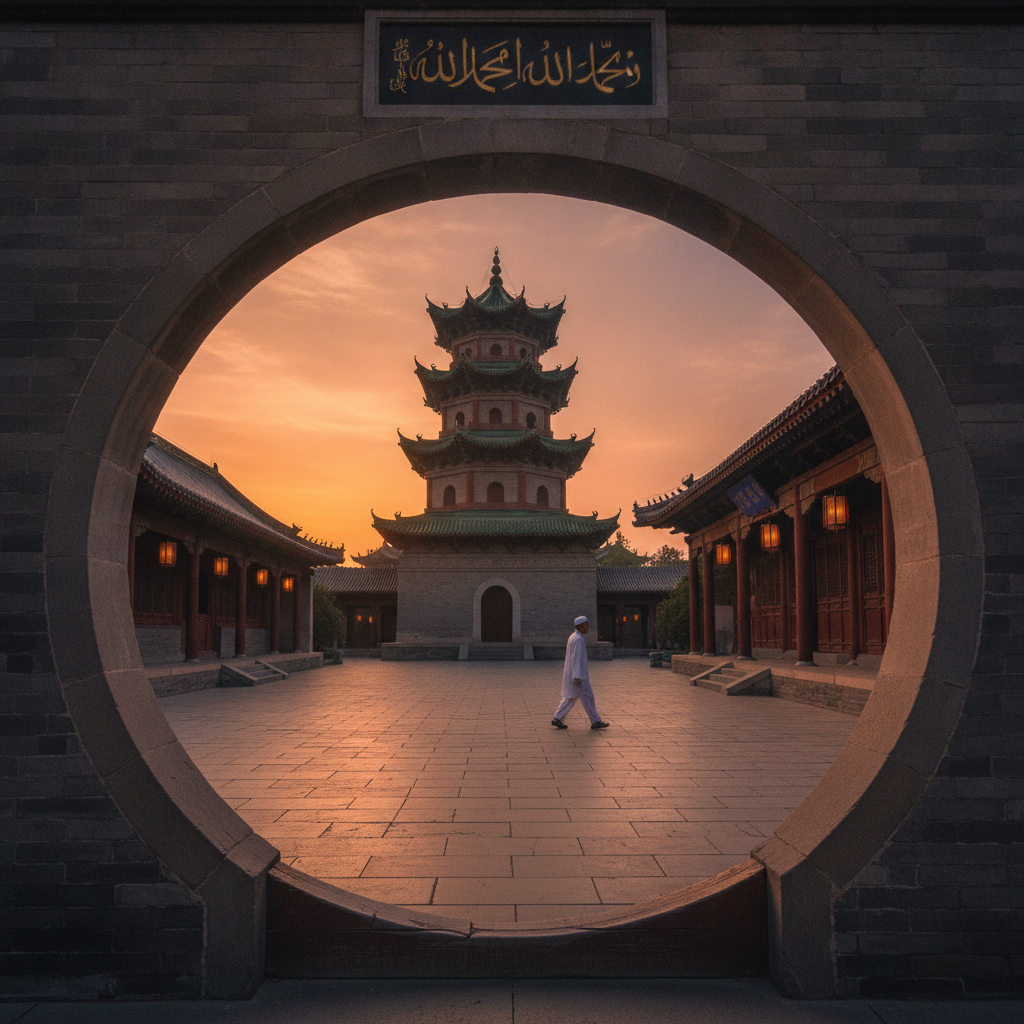
The Great Mosque of Xi'an (西安大清真寺—Xi'an Dà Qīngzhēn Sì): the largest mosque in mainland China built in the Tang Chinese architectural style—the building that most completely represents the hybridization of Islamic religious function and Chinese architectural form. The founding (the mosque was established in 742 CE during the reign of the Tang Emperor Xuanzong (唐玄宗), according to the mosque's own records—the founding at the height of Tang cosmopolitanism when Chang'an was receiving Silk Road merchants from across the Islamic world): the current structures (the majority of the current buildings date to the Ming (14th–17th centuries) and Qing (18th century) Dynasties, with some Tang Dynasty foundations). The architecture (the mosque complex is organized along the east–west axis (oriented toward Mecca in the west) using the traditional Chinese courtyard sequence—4 courtyards connected by decorative gateways): the 'Imam Hat Tower' (邦克楼—the Arabic call-to-prayer tower designed in the form of a 3-story Chinese pavilion—the most photographed single structure in the mosque compound): the prayer hall (the 1,300 m² main prayer hall decorated with Arabic calligraphy and Chinese lacquer panels in a style found nowhere else in the Islamic world).
- 5
The Silk Road from Xi'an – The Ancient Highway West
The Silk Road from Xi'an (the western terminus of the overland Silk Road that ran from Chang'an to Rome via Central Asia—the 6,400 km trade route that transmitted silk, paper, gunpowder, and Buddhism eastward and westward for 1,400 years): the most important single trade network in pre-industrial history. The Silk Road chronology: the Han Dynasty opening (138 BCE, Zhang Qian's mission); the Tang Dynasty peak (618–907 CE—the most cosmopolitan period, with Sogdian merchants from modern Uzbekistan operating trading compounds within Chang'an itself); the Mongol Pax (1206–1368 CE—the Pax Mongolica opened the entire Silk Road from Xi'an to Venice under a single political administration, enabling Marco Polo's journey of 1271–1295). The products (silk was the primary export but the Silk Road also transmitted: paper-making technology (from China to the Islamic world via the Battle of Talas, 751 CE), block printing, gunpowder, porcelain westward; and Buddhism, Islam, Nestorian Christianity, mathematics, astronomy, musical instruments (the pipa/lute) eastward into China). The Xi'an Silk Road Museum (丝绸之路博物馆—the museum in the Qujiang Cultural District presenting the full Silk Road history).
- 6
Xi'an's Nightlife & the Tang Dynasty Recreation
Xi'an's evening and entertainment culture: the city that has most successfully commercialized its Tang Dynasty heritage for contemporary tourism. The Tang Paradise (大唐芙蓉园—the 1,000-acre Tang Dynasty garden reconstruction in the Qujiang District—the largest Tang Dynasty cultural park in China): the evening light show (the 'Dreaming Back to Tang Dynasty' water and light performance at the Tang Paradise lake at 20:30 nightly—the most elaborate outdoor Tang Dynasty spectacle in Xi'an). The Datang Evernight City (大唐不夜城—'The Tang Dynasty City That Never Sleeps'—the pedestrian boulevard south of the Big Wild Goose Pagoda): the 500m entertainment street with Tang Dynasty costume street performers, the 'Undefeated Nezha' (哪吒) dancing robot performer (the viral social media sensation attracting thousands of nightly visitors), and the entire street illuminated in Tang lantern-style lighting after dark. The Bell Tower and Drum Tower evening (the twin towers in the center of Xi'an are illuminated after sunset—the 'Drum Tower Sound Show' (鼓楼鼓乐表演): the 30-minute Tang Dynasty drum performance inside the Drum Tower at 09:00/11:30/15:00/17:00 daily).
Walk this route with audio
Stories play automatically as you reach each stop — no tapping needed.
More in Xi'an
The 108 Tang Court Dumplings Including One Stuffed With Camel Fat, the World's 4th Largest Student City & How to Cycle Through 3 Ancient Empires on a Flat Agricultural Plain
The An Lushan Rebellion That Killed 36 Million and Started in a Hot Spring Palace, the Xianyang Miniature Han Army Nobody Visits & Every European Book Before 1100 Written on Sheepskin Because of One Battle Near Xi'an
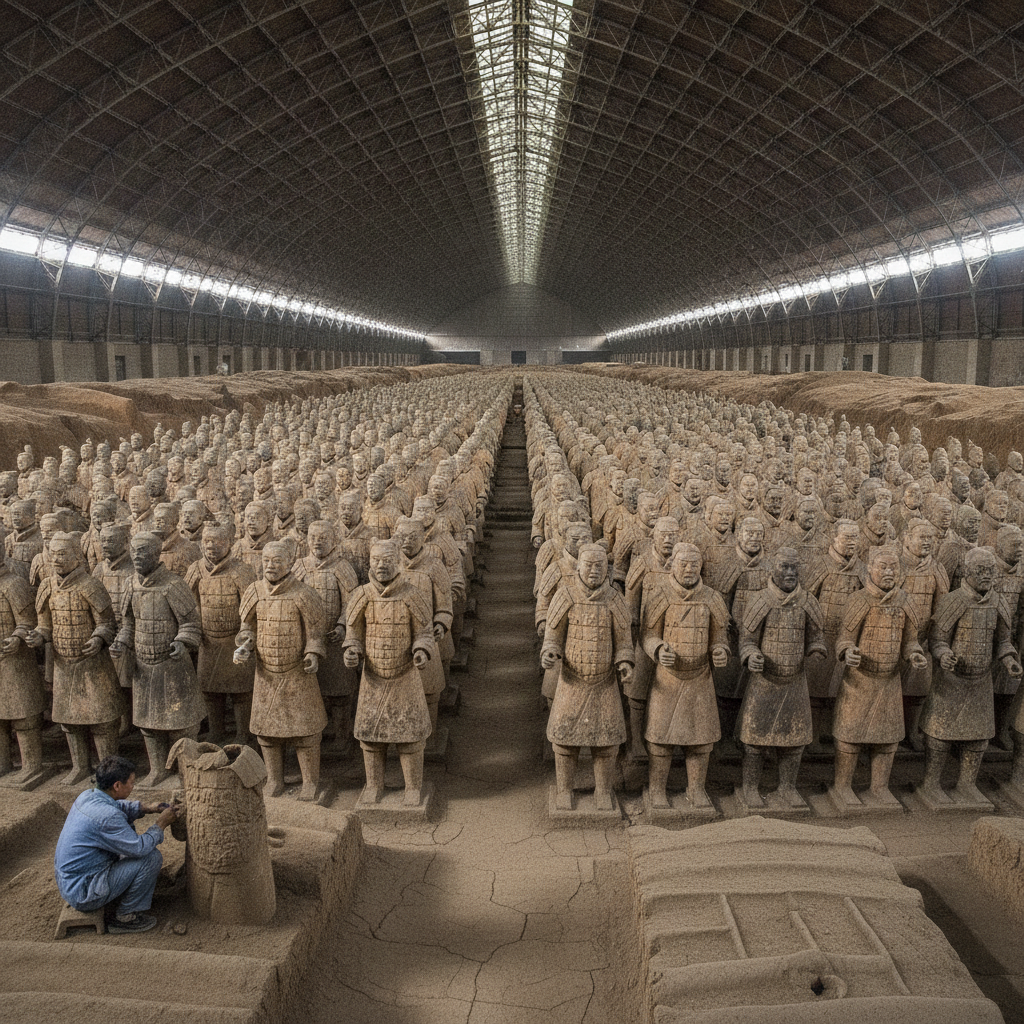
The 8,000-Warrior Clay Army That Was Gray When Buried (It Wasn't), the World's First Zoning System & the Arabic Traders Who Became Xi'an's Muslim Quarter
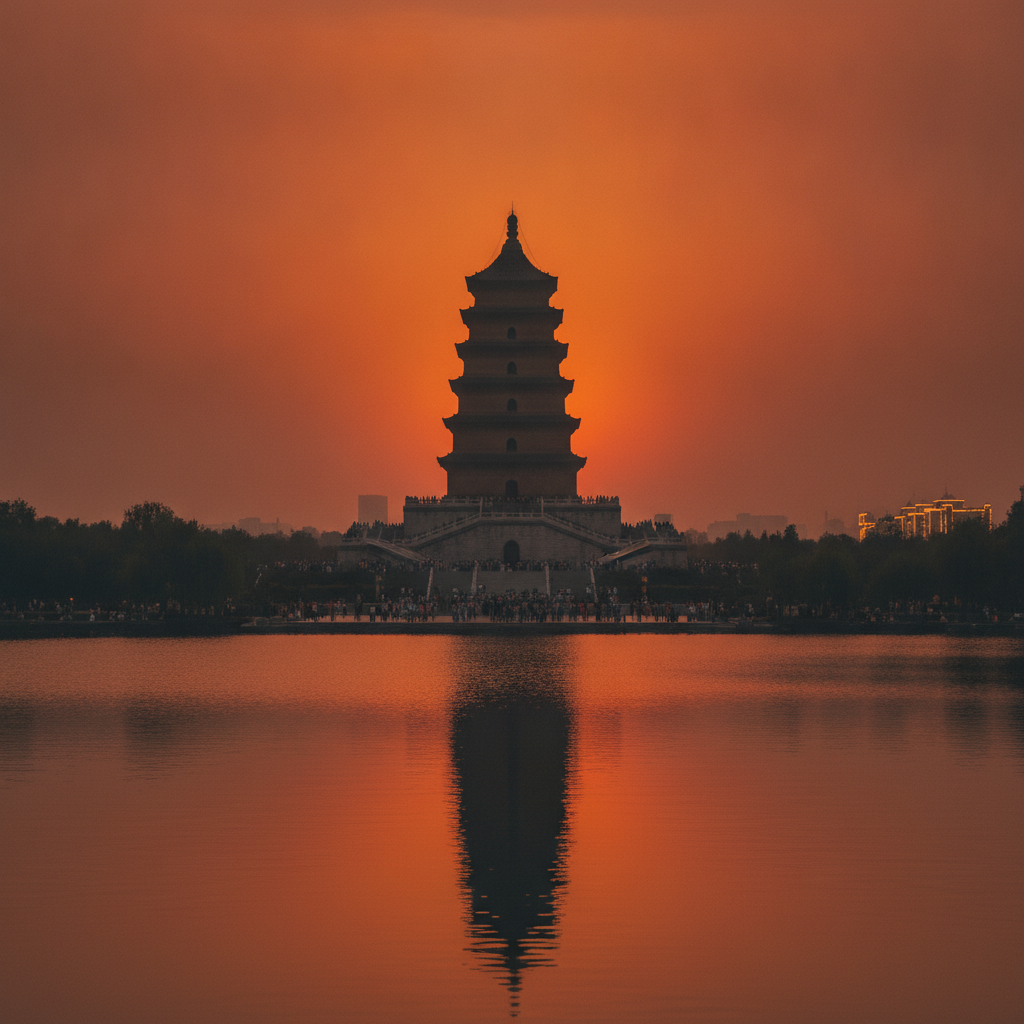
The Monk Who Left Without Permission, Walked 25,000 km & Inspired the Monkey King; the Brown Pandas of the Qinling Range; and the Wordless Stele That Was Left Blank On Purpose