The An Lushan Rebellion That Killed 36 Million and Started in a Hot Spring Palace, the Xianyang Miniature Han Army Nobody Visits & Every European Book Before 1100 Written on Sheepskin Because of One Battle Near Xi'an
The An Lushan Rebellion's 36 million deaths making it the largest pre-20th century loss of life in human history; Yang Guifei's execution at Mawei Postal Station as the most retold moment in Tang history; the 2002 archaeology proving the Epang Palace was never actually completed; the Han Yangling Museum's 40,000 naked miniature clay soldiers under glass floors; the Battle of Talas capturing paper-making craftsmen as the origin of all European paper; and the pipa's journey from Tang Chang'an to the European Renaissance lute.
- 1
Xi'an Itinerary – 3 Days, 5 Days & 7 Days
The Xi'an itinerary planner (the optimal route through Xi'an's sites for visits of 3 different durations): 3-Day Itinerary: Day 1 (City Center): Bell Tower → Muslim Quarter breakfast (biangbiang noodles + roujiamo) → Great Mosque → Drum Tower → Muslim Quarter lunch (yangrou pao mo) → City Wall bicycle circuit (afternoon) → Tang Paradise evening light show. Day 2 (Terracotta Army): Terracotta Army full morning (Pit 1 + Pit 2 + Pit 3 + Bronze Chariot gallery) → Huaqing Palace hot spring ruins (afternoon) → Xi'an Muslim Quarter night food (evening). Day 3: Shaanxi History Museum (Tang murals gallery) → Big Wild Goose Pagoda → Qujiang area → Datang Evernight City (evening). 5-Day addition: Day 4 (Mount Hua): full day at Mount Hua (cable car to North Peak + plank walk): Day 5 (Qianling or Famen Temple): choose the Qianling Mausoleum (Empress Wu) or Famen Temple (Buddha relics). 7-Day addition: Day 6 (Dunhuang fast option via overnight train from Xi'an to Lanzhou + connection): Day 7 (return): the 7-day itinerary makes Xi'an the anchor for the broader Silk Road circuit.
- 2
The Shaanxi Countryside – Loess Plateau & Cave Dwellings
The Shaanxi loess plateau (the 黄土高原—the Yellow Earth Plateau extending north of the Wei River from Xi'an to the Great Wall): the distinctive cultural and geological landscape of rural Shaanxi and the heartland of the Chinese rural revolutionary experience. The loess (the Shaanxi loess (黄土) is wind-blown sediment accumulated over 2.4 million years from the deserts of Central Asia—the plateau averages 100–200m depth of windblown soil, the deepest single sediment deposit of any terrestrial landscape on earth). The cave dwellings (窑洞—yáodòng—the traditional cave homes carved directly into the loess cliff faces of the Shaanxi plateau): the cave dwelling population (approximately 30–40 million people in Shanxi, Shaanxi, and Gansu Provinces still lived in cave dwellings as of 2010—the number has fallen sharply since then as rural migration to cities accelerated). The Yan'an connection (延安—the Shaanxi plateau town 270 km north of Xi'an that served as Mao Zedong's headquarters from 1937–1947—the revolutionary base camp in the loess plateau caves where the Chinese Communist Party formed its political identity during the Yan'an period): the Yan'an cave dwelling visit (the caves in Yangjialing (杨家岭) where Mao, Zhou Enlai, and Zhu De lived and worked are preserved as revolutionary heritage museums).
- 3
Hua Qing Palace – The Hot Springs of Empire
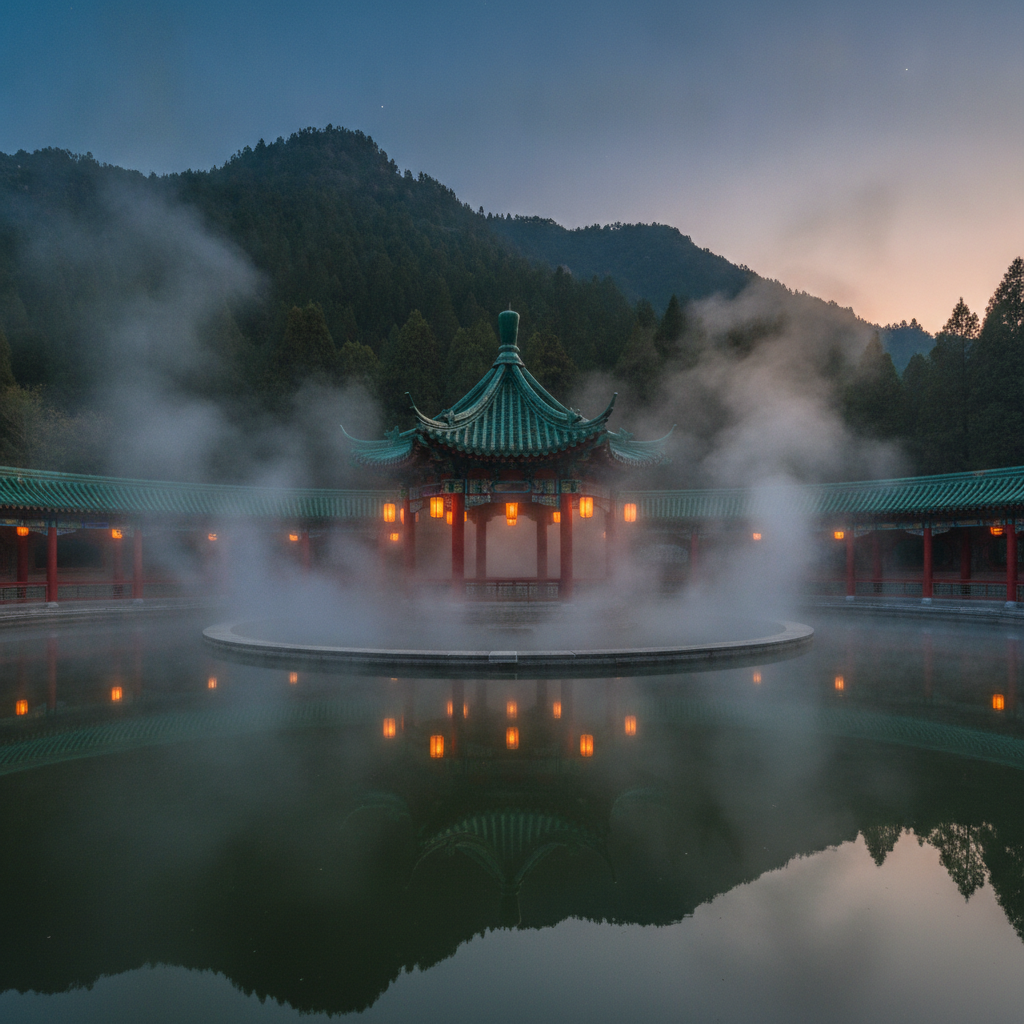
The Huaqing Palace (华清宫—the imperial hot spring palace 30 km east of Xi'an, directly adjacent to the Terracotta Army site): the Tang Emperor Xuanzong's primary winter court—the site where the love affair between the emperor and the concubine Yang Guifei (杨贵妃—the 'Precious Consort Yang', the most celebrated beauty in Chinese history, 719–756 CE) unfolded over 11 years, ending in the An Lushan Rebellion. The An Lushan Rebellion (安史之乱, 755–763 CE): the military general An Lushan (安禄山), a Sogdian-Turkic general who had been one of Tang Emperor Xuanzong's most favored commanders, led a rebellion from the northeastern frontier against the Tang court in 755 CE—the rebellion that killed an estimated 26–36 million people (the largest loss of life in human history before the 20th century) and permanently weakened the Tang Dynasty. The death of Yang Guifei (the Tang Emperor Xuanzong fled Chang'an as the rebel army advanced; the imperial guard soldiers mutinied at the Mawei Postal Station (马嵬驿, near modern Xingping) and demanded the execution of Yang Guifei as the cause of the rebellion—Xuanzong consented and she was strangled at age 37): the Bai Juyi poem (长恨歌—'Song of Everlasting Regret', 806 CE—the 840-line poem commemorating the love story—the most quoted Chinese romantic poem).
- 4
Xianyang – The Qin Capital Forgotten Next Door
Xianyang (咸阳—the Qin Dynasty capital 25 km northwest of Xi'an on the Wei River north bank): the city that housed the Qin imperial court during the unification of China (221–206 BCE)—the most historically important city in China that virtually no tourists visit. The Epang Palace site (阿房宫—the unfinished Qin palace that was burned by Xiang Yu in 206 BCE): the excavations (the 2002–2004 archaeological excavation definitively established that the palace was never completed—the burned layer found in the soil is from later Han Dynasty buildings built on the Epang site, not from the Qin palace itself): the revision of history (the Epang Palace was the most cited example of Qin excess for 2,000 years based on Sima Qian's description—the archaeology suggests Sima Qian may have exaggerated or conflated the Epang plans with later structures). The Xianyang Museum (咸阳博物馆—the original museum in the Xianyang Confucian Temple (文庙) building): the Han Dynasty terracotta army (the Xianyang Museum's Han Dynasty miniature terracotta soldiers (the Yang Ling Mausoleum (汉阳陵) near Xianyang airport): the 40,000 miniature clay figures (25–30cm tall, naked—the Han figures are clothed in silk and wooden armor that has decayed—1/3 the scale of the Qin warriors): the Han Yangling Museum (汉阳陵博物苑—the glass-floored museum allowing visitors to look down into the lit excavation pits below).
- 5
Night Train Culture – Sleeper to Xi'an
The Xi'an night train experience (the long-distance sleeper train arriving into Xi'an Station (the original Xi'an mainline station, not Xi'an North HSR): the traditional mode of arrival that shaped the experience of Xi'an for most Chinese travelers before the 2010 HSR network). The train culture (the Chinese sleeper train (硬卧—hard sleeper: 3-tier bunk in an open carriage; 软卧—soft sleeper: 2-tier bunk in a 4-person closed compartment): the hard sleeper from Beijing West to Xi'an (approximately 11–12 hours overnight; departing 19:00–21:00; arriving 07:00–09:00): the practical accommodation saving and the most sociable long-distance travel mode in China (the hard sleeper carriage is the place where Chinese strangers share food, phone chargers, and life stories over 12 hours). The Xi'an Station arrival ritual (arriving at Xi'an Station (the old station on the north side of the Ming city wall): the city wall's north face is the first sight of Xi'an—the Tang-era moat (now a park) below the Ming wall, the 1000-year old structure visible before passing through the North Gate into the walled city). The contemporary alternative (the G-train (高铁) from Beijing West to Xi'an North: 4h30m—faster, more comfortable, but delivers the traveler to the soulless HSR periphery rather than the historic walled city center).
- 6
Xi'an's Global Influence – What the World Borrowed
Xi'an's contribution to world civilization (the inventory of what the rest of the world received from the Tang capital of Chang'an via the Silk Road): the most concrete answer to 'why does Xi'an matter'. Paper-making (the Chinese paper-making technique was transmitted to the Arab world following the Battle of Talas (751 CE), where Arab forces captured Chinese craftsmen who knew the process—paper reached Europe via the Arab world by the 12th century; before paper, European manuscripts were written on vellum (sheepskin)): the calculation (every manuscript, book, and document in Europe between 1100 and 1450 CE was only possible because the technology escaped from a single battle 25 km from Talas, Kyrgyzstan—a location reachable in 2 days from Xi'an). Printing (block printing was perfected in Tang Chang'an and transmitted westward): the medical transmission (the Tang pharmacopoeia (唐本草—the Tang Materia Medica of 659 CE, commissioned by the Tang Emperor Gaozong—the first state-sponsored pharmacopoeia in world history): the Chinese materia medica influenced the Islamic medical tradition (Ibn Sina's Canon of Medicine) and thence European medicine. The musical instruments (the pipa (琵琶—the Chinese lute) arrived in Chang'an from Central Asia via the Silk Road and was adopted and modified into the European lute—tracing the lute from Tang court music to Renaissance Europe).
Walk this route with audio
Stories play automatically as you reach each stop — no tapping needed.
More in Xi'an
The 108 Tang Court Dumplings Including One Stuffed With Camel Fat, the World's 4th Largest Student City & How to Cycle Through 3 Ancient Empires on a Flat Agricultural Plain
The 8,000-Warrior Clay Army That Was Gray When Buried (It Wasn't), the World's First Zoning System & the Arabic Traders Who Became Xi'an's Muslim Quarter
The Monk Who Left Without Permission, Walked 25,000 km & Inspired the Monkey King; the Brown Pandas of the Qinling Range; and the Wordless Stele That Was Left Blank On Purpose
The Mercury Rivers in the Unexcavated Tomb, the Hijacked Minaret That Looks Like a Pagoda & the Silk Road Merchant Who Was Captured for 10 Years and Opened Trade with Rome Anyway