Smithsonian Museums & Washington DC's Free World-Class Culture
Washington DC is the only major American city where the finest museums are entirely free — the 19 Smithsonian museums and galleries, along with the National Gallery of Art, the Library of Congress, and the National Archives, form the most concentrated collection of free world-class cultural institutions in any city in the world.
- 1
National Museum of Natural History — Hope Diamond & 145 Million Specimens
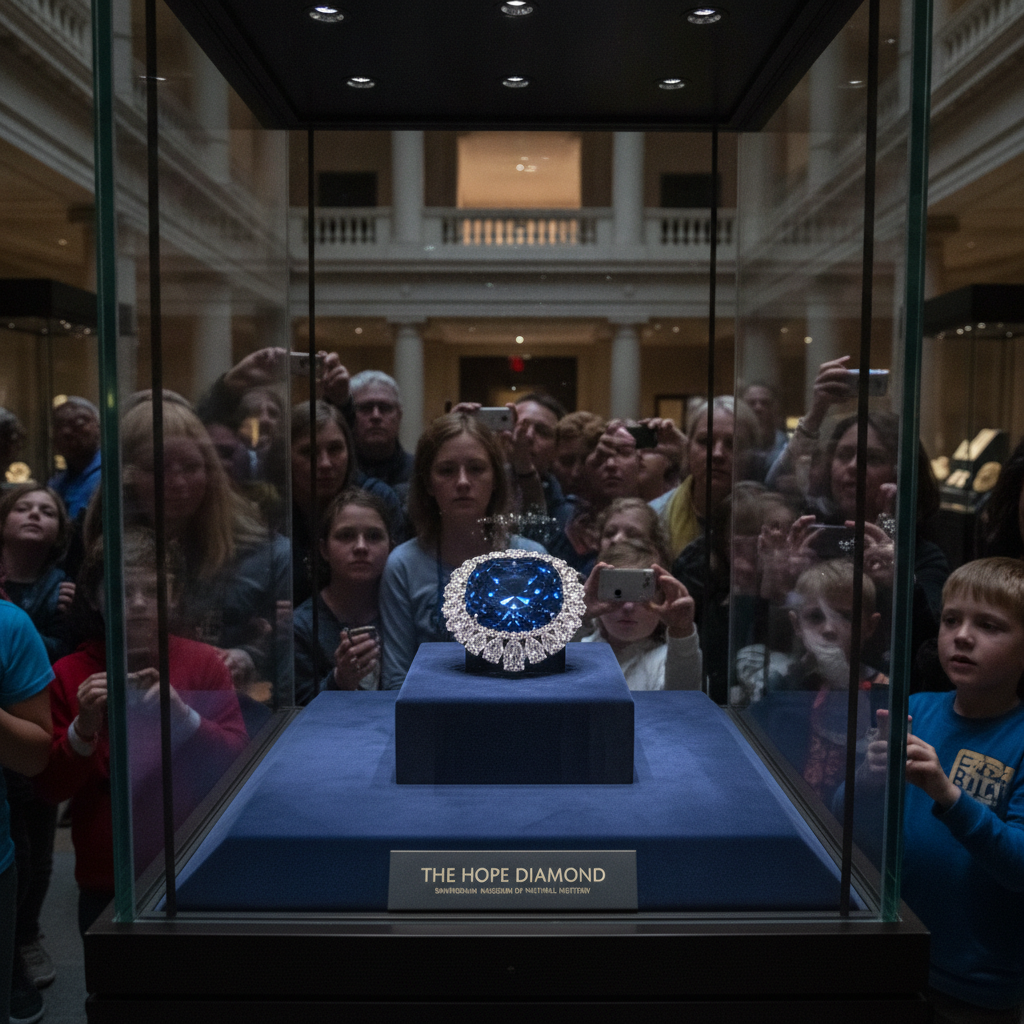
National Museum of Natural History (10th Street and Constitution Avenue NW — the Smithsonian museum dedicated to the natural world, opened 1910 and now the most visited natural history museum in the world (approximately 8 million visitors per year)): the museum's primary attractions are: the Hope Diamond (the 45.52-carat deep-blue Type IIb diamond in the Janet Annenberg Hooker Hall of Geology, Gems, and Minerals — the most famous gemstone in the world (the blue colour results from trace amounts of boron in the crystal structure), donated to the Smithsonian by New York jeweller Harry Winston in 1958 after arriving via registered mail (Winston insured the parcel for $1 million — the most famous piece of mail in American history)); the African Elephant in the Rotunda (the 8-metre (26-foot) mounted bull African elephant (Loxodonta africana) in the domed entry rotunda — the largest land animal museum specimen in the United States, collected in Angola in 1955); the Sant Ocean Hall (the 2,400 m² (26,000 sq ft) ocean exhibition featuring the Phoenix (the 45-foot (14-metre) North Atlantic right whale skeleton) and the full range of ocean ecosystems); the David H. Koch Hall of Human Origins (the exhibition tracing 6 million years of human evolution, with full-size reconstructions of hominin species from Ardipithecus to Homo neanderthalensis, the finest human evolution exhibition in the United States); and the collection of approximately 145 million natural history specimens (the second-largest natural history collection in the world after the Natural History Museum London).
- 2
National Air and Space Museum — First Flight to the Moon
National Air and Space Museum (Independence Avenue at 4th Street SW — the Smithsonian museum of aviation and spaceflight history, opened 1976 for the American Bicentennial, and the single most-visited museum in the United States (approximately 7-8 million visitors per year — the highest annual attendance of any museum in the US, typically slightly ahead of the Natural History Museum)): the museum's centrepiece objects are: the Wright Brothers' 1903 Flyer (the actual aircraft — the 'Kitty Hawk Flyer' or '1903 Wright Flyer' — in which Orville Wright made the first powered, heavier-than-air, controlled airplane flight on December 17, 1903 at Kitty Hawk, North Carolina, suspended from the ceiling of the entrance hall — the most historically significant aircraft in the world); Charles Lindbergh's Spirit of St. Louis (the single-engine Ryan NYP monoplane in which Lindbergh made the first non-stop solo transatlantic flight (New York to Paris, 3,600 miles (5,800 km) in 33.5 hours) on May 20-21, 1927 — the most famous solo flight in aviation history); the Apollo 11 Command Module Columbia (the conical capsule that carried Neil Armstrong, Michael Collins, and Buzz Aldrin to the Moon and back in July 1969 — the most historically significant spacecraft in the world); and the Hubble Space Telescope Backup Mirror (the test mirror that revealed the manufacturing error in the original Hubble Mirror that caused the initial blurred images — the physical evidence of the most expensive mistake in space exploration history).
- 3
National Gallery of Art — Europe's Greatest Paintings in Washington
National Gallery of Art (Constitution Avenue NW between 3rd and 9th Streets — the national art museum of the United States, comprising the West Building (the 1941 neoclassical building designed by John Russell Pope) and the East Building (the 1978 triangular building designed by I.M. Pei (the same architect who designed the Louvre Pyramid in Paris and the Rock and Roll Hall of Fame in Cleveland)) — free admission): the National Gallery is the finest art museum in Washington DC and one of the finest in the United States, with a collection of approximately 150,000 works including: the only Leonardo da Vinci painting in the Western Hemisphere (Ginevra de' Benci (c. 1474-1478) — the portrait of the Florentine noblewoman Ginevra de' Benci, the earliest undisputed surviving oil painting by Leonardo (the reverse bears the juniper sprig device and the motto 'Virtù et Honor' of the sitter, identifying her conclusively) — acquired by the Gallery from the Princely Collections of Liechtenstein in 1967 for $5 million (the highest price ever paid for a painting at that date, a record that stood until 1970)); the finest collection of early Netherlandish painting in the US (the Jan van Eyck, Roger van der Weyden, Hans Memling, and Gerard David panels from the collection of Andrew Mellon (1855-1937), the Secretary of the Treasury who founded the Gallery and donated his personal collection as its founding gift); and the American Impressionist and post-Impressionist works (the Mary Cassatt, James McNeill Whistler, and Winslow Homer paintings, among the finest American art in any museum).
- 4
Library of Congress & National Archives
Library of Congress (101 Independence Avenue SE, Capitol Hill — the national library of the United States and the largest library in the world by total holdings (approximately 173 million items in 470 languages, occupying approximately 1,350 km (838 miles) of bookshelves across three buildings on Capitol Hill)): the Library of Congress (founded in 1800 as the Congressional library — a reference library for members of Congress — and gradually evolved into the de facto national library of the United States (the US, unlike most other major nations, does not have a single official National Library — the Library of Congress fulfils this role de facto)) is housed in three buildings on Capitol Hill: the Thomas Jefferson Building (the 1897 Italian Renaissance building — the most architecturally magnificent library building in the United States, with the Great Hall (the entry hall with its marble columns, mosaics, stained glass, and elaborately painted ceiling — the finest public interior space in Washington DC)), the John Adams Building (1939), and the James Madison Memorial Building (1980); the National Archives and Records Administration (700 Pennsylvania Avenue NW — the federal archive and museum displaying the most important documents in American history): the Declaration of Independence (the 1776 document — the founding document of the United States, handwritten on parchment by Timothy Matlack from Thomas Jefferson's draft), the Constitution (1787), and the Bill of Rights (1791) are displayed together in the Rotunda for the Charters of Freedom — the most important collection of original historical documents on permanent public display in any country.
- 5
National Museum of African American History & Culture
National Museum of African American History and Culture (NMAAHC — 1400 Constitution Avenue NW, on the National Mall adjacent to the Washington Monument — the newest Smithsonian museum (opened September 24, 2016, designed by David Adjaye Associates in the 'Corona' form — the three-tiered bronze lattice exterior cladding (the pattern derived from the ironwork of the enslaved African-American craftsmen of the American South, particularly the decorative ironwork grilles and railings of Charleston, South Carolina and New Orleans, Louisiana)) and the most visited museum on the National Mall since its opening (typically with a 6-month advance ticket reservation requirement — the museum was oversubscribed from the first day it opened)): the museum (with a collection of approximately 40,000 artefacts spanning 400 years of African American history, from the period before the Atlantic slave trade to the present) tells the story of African Americans in the United States with the greatest depth and detail of any museum in the world; the collection highlights include: Harriet Tubman's shawl and hymnal (artefacts belonging to Harriet Tubman (c.1822-1913), the abolitionist and Underground Railroad conductor who rescued approximately 70 enslaved people in 13 missions), Chuck Berry's custom red Cadillac (the 1973 Eldorado that the father of rock and roll drove to performances in his later career), Muhammad Ali's boxing gloves and Emmett Till's casket (the open casket in which Emmett Till (1941-1955) was displayed by his mother Mamie Till-Mobley — the most emotionally powerful single object in the museum).
- 6
Kennedy Center & DC's Performing Arts Scene
John F. Kennedy Center for the Performing Arts (2700 F Street NW, on the Potomac River waterfront — the national cultural center and memorial to President John F. Kennedy, designed by Edward Durell Stone and opened September 8, 1971 — the most important performing arts venue in Washington DC and the busiest performing arts facility in the United States (approximately 2,000 performances per year attended by 3 million people)): the Kennedy Center (the 630-foot (192-metre) long white marble building on the Potomac River waterfront, containing five main performance halls: the Concert Hall (the 2,442-seat hall of the National Symphony Orchestra — the finest concert hall in Washington DC), the Opera House (the 2,364-seat hall of the Washington National Opera (the home company founded in 1956) and the Washington Ballet), the Eisenhower Theater (the 1,163-seat dramatic theater), the Terrace Theater (the 513-seat chamber performance space), and the Family Theater (the 324-seat children's performance space)) is famous for the Kennedy Center Honors (the annual gala ceremony held in December honouring five performing artists for lifetime achievement — the most prestigious performing arts honour in the United States, awarded to artists including Frank Sinatra, Ella Fitzgerald, Leonard Bernstein, Katharine Hepburn, Luciano Pavarotti, Steven Spielberg, and Oprah Winfrey) and the free Millennium Stage performances (the free 60-minute performance held every evening at 6 PM on the Grand Foyer stage — the most democratically accessible great cultural venue in Washington DC).
Walk this route with audio
Stories play automatically as you reach each stop — no tapping needed.
More in washington-dc
K Street, Think Tanks & the World of Washington DC Power
Washington DC Food Scene — From Ethiopian to Fine Dining
White House, Capitol Hill & the Architecture of American Power
Cherry Blossoms & the Tidal Basin — Washington in Spring
Arlington Cemetery, the Pentagon & DC's Military Heritage