Warsaw Music & Culture — Chopin, Łazienki Park, the Palace of Culture & the Museum Circuit
Warsaw's cultural infrastructure (the most concentrated in Poland, the product of the communist-era investment in cultural institutions as ideological capital) includes the most important Chopin heritage sites in the world, the largest park in the city centre, and a museum quarter that has been significantly expanded since 1989.
- 1
Frédéric Chopin — the Warsaw Connection
Frédéric Chopin (born 1 March 1810 in Żelazowa Wola, 50km west of Warsaw, baptized in the church at Brochów, educated in Warsaw at the Warsaw Conservatory and the Warsaw Lyceum, the prodigy giving his first Warsaw concert at age 7, leaving Warsaw permanently in November 1830 at age 20 for Vienna and then Paris — never returning to Poland during the remaining 19 years of his life, his heart sent back to Warsaw per his dying wish in 1849, the heart interred in the Church of the Holy Cross on Krakowskie Przedmieście): the Chopin Museum (Muzeum Fryderyka Chopina, Okólnik 1 in the Ostrogski Palace, €10 adults, Tuesday-Sunday 11am-8pm, the most important Chopin museum in the world, the collection including Chopin's Pleyel piano used for his final Paris concerts, his childhood piano, the autograph manuscripts of his compositions, the death mask and plaster cast of his left hand, the personal letters including the correspondence with George Sand, the museum's interactive audio stations allowing visitors to listen to specific recordings of each composition in the collection). The Żelazowa Wola birthplace museum (50km west of Warsaw, accessible by the PKP bus from Warsaw on weekend mornings, the 19th-century manor house where Chopin was born, the garden concerts on summer Sundays).
- 2
The Sunday Chopin Concerts in Łazienki Park
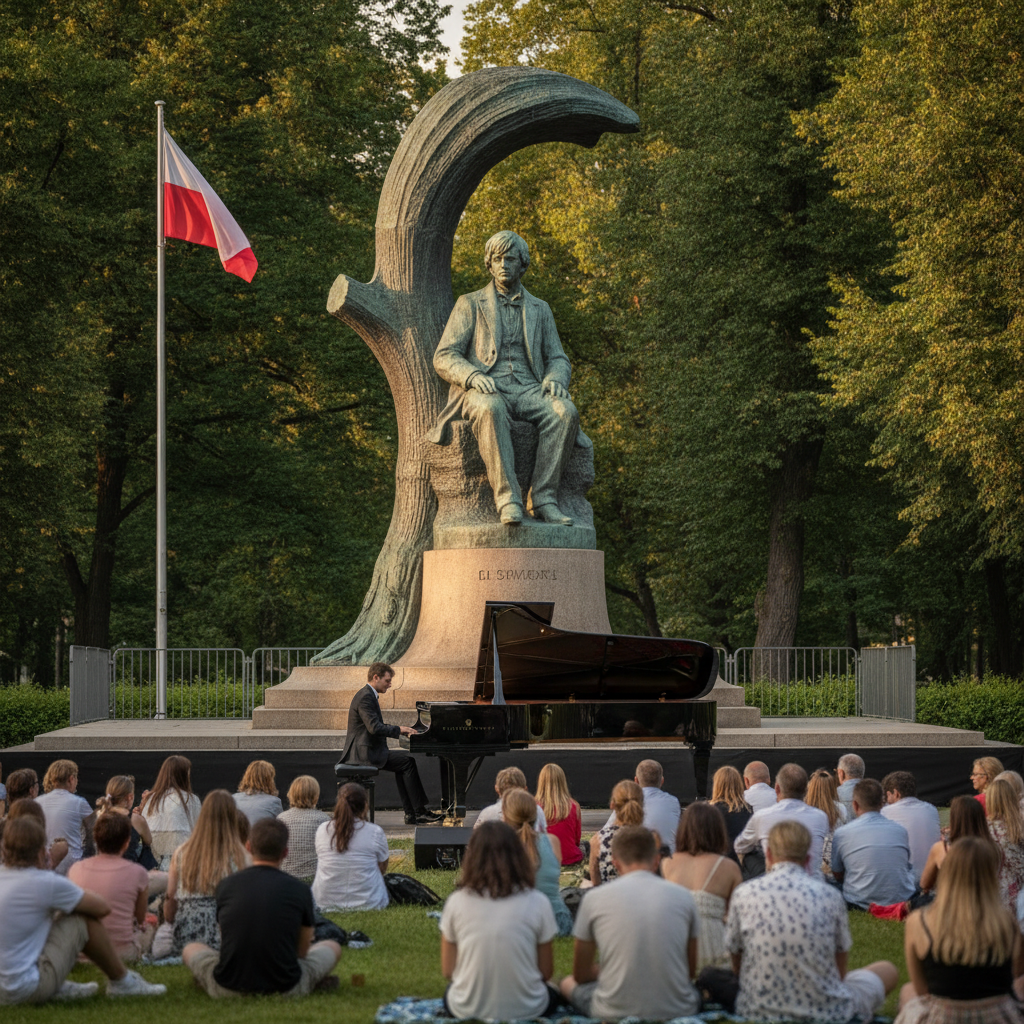
The free open-air Chopin piano concerts in Łazienki Park (the concerts performed every Sunday at noon and 4pm from May to September at the Chopin Monument, the programme of Chopin's solo piano works performed by the prize-winners of the International Chopin Piano Competition and other distinguished Polish pianists, the audience of 200-400 people seated on the grass or standing, free entry, the concert running for 45-60 minutes per performance, rain cancellation confirmed on the day via the Łazienki Park website) are the most accessible classical music event in Europe. The Chopin Monument (the 1926 bronze statue by Wacław Szymanowski showing the composer under a stylized weeping willow whose branches resolve into the wind-swept figure, the statue destroyed by the Germans in 1940 and recast from the original moulds in 1958, the statue now the central image of Warsaw's Chopin identity) stands at the centre of the Sunday concert geography. The Łazienki Park context (the 76-hectare park established by King Stanisław Augustus Poniatowski in the 18th century, the park containing the Palace on the Island, the amphitheatre on the lake, the Myślewicki Palace, and the Old Orangery Theatre — the peacocks and squirrels that have lived in the park for over 200 years still present) makes the concert the correct combination of natural, architectural, and musical experience.
- 3
The Palace of Science and Culture — Stalin's Gift
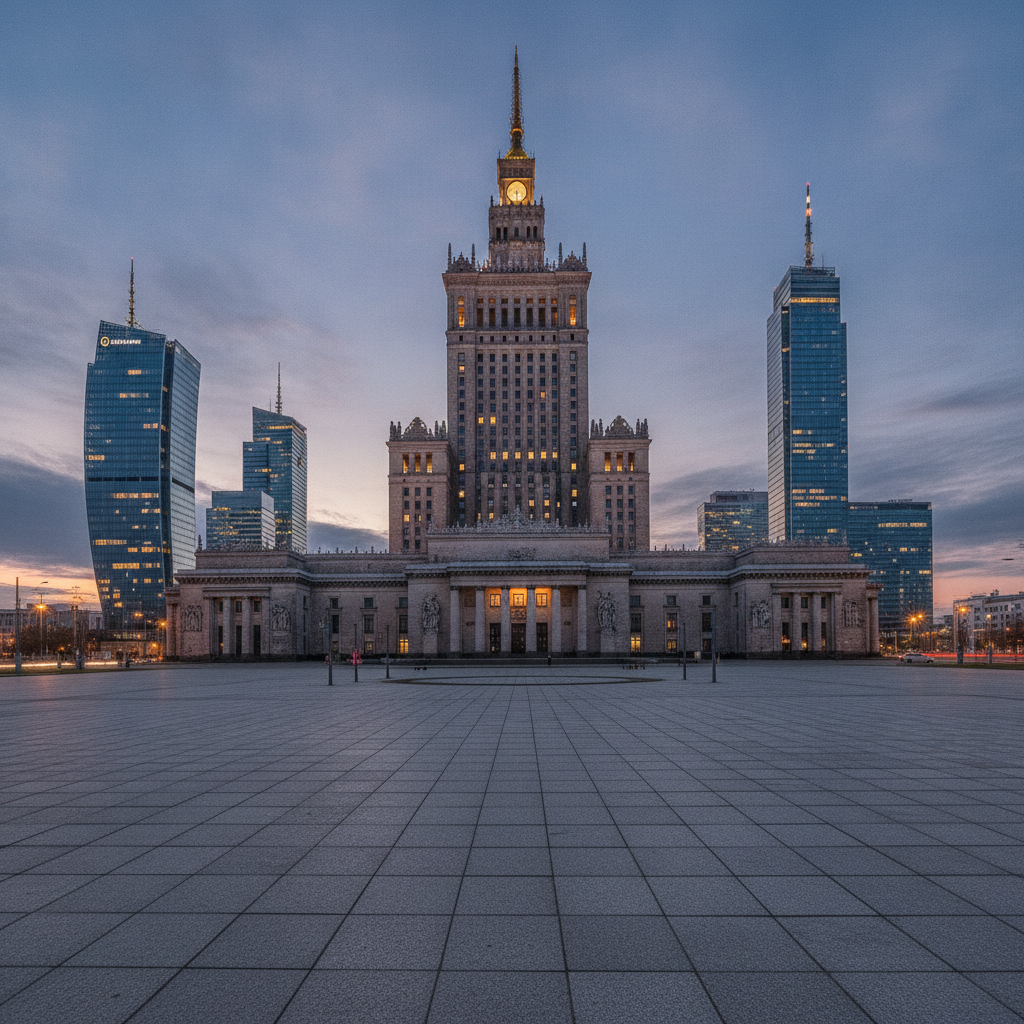
The Palace of Culture and Science (Defilad Square, the 231m Stalinist skyscraper completed in 1955, the 'gift from the Soviet people to the Polish people' — an ironic gift as the surrounding Warsaw blocks were demolished to accommodate it and the Soviet style was imposed over Polish architectural preferences, the building housing 3,288 rooms including 30 cinema halls, 3 theatres, 2 museums, the highest observation deck in Poland at 114m altitude, the panorama view of Warsaw including the reconstructed old town, the modern city centre with its post-1989 glass towers, and the Vistula river visible from 3 sides of the observation platform, €20 adults, daily 10am-8pm) is the most ambivalent monument in Warsaw — the largest and most visible building in the city, hated for its political symbolism and its architectural imposition, simultaneously the building that defines the Warsaw skyline and the view that appears in the background of every Warsaw photograph. The interior (the socialist realist decoration of the public spaces — the carved stone reliefs, the ornamental metalwork, the mosaic floors, the auditoriums in the Stalinist neoclassical style) is a coherent artistic environment that its own ideological context makes impossible to assess as architecture without political consciousness.
- 4
The National Museum and the Polish Modern Collection
The National Museum in Warsaw (Muzeum Narodowe w Warszawie, Aleje Jerozolimskie 3, the largest art museum in Poland, €20 adults for the permanent collection, Tuesday-Thursday and Saturday-Sunday 10am-6pm, Friday 10am-9pm, the collection of approximately 830,000 objects organized across: the Gallery of Ancient Art — the Egyptian, Greek, and Roman collection, the most important ancient art collection in Poland — the Gallery of Faras — the extraordinary collection of Coptic Christian murals and sculptures from the Polish Archaeological Mission's excavations in Sudan in the 1960s, the only such collection in Europe — and the Gallery of Polish Art) is the primary art museum destination in Warsaw. The Gallery of Polish Art (the medieval religious sculpture, the 16th-18th century Polish painting, the 19th-century historical painting — the Matejko canvases, the Chełmoński realist landscapes, the Young Poland symbolist works — and the 20th-century modernist collection, the most complete survey of Polish art in one institution). The design of the museum building (the 1927 modernist palace by Tadeusz Tołwiński, the only major Warsaw museum building to survive 1944 substantially intact, the collection stored in the countryside for the war's duration and returned to the building in 1945).
- 5
Łazienki Park — the Royal Garden and the Palace on the Island
Łazienki Park (76 hectares, the largest park in central Warsaw, established by King Stanisław Augustus Poniatowski as his private landscape garden in the 1770s-90s, the park donated to the city in 1918, free access from dawn to dusk daily) contains: the Palace on the Island (the neoclassical palace built on an artificial island in the central lake, the construction 1772-1795, the palace housing the king's private apartments and the picture gallery — the painted ceilings, the Bacchus Room, the Solomon Room — €15 adults, Tuesday-Sunday 9am-4pm in summer, the approach along the lakeside path with the peacocks the most elegant garden promenade in Warsaw), the Amphitheatre on the lake (the 18th-century open-air theatre with the stage on a small island in the lake and the seating on the shore, the orchestra pit below the water level, used for outdoor performances from May to September, tickets at the Łazienki box office), and the Belvedere Palace (the neoclassical palace at the southern end of the park, the official residence of the Polish head of state — President Lech Wałęsa and his successors — the exterior visible from the park boundary, the interior not accessible to the public). The park is most beautiful in October when the horse chestnuts and maples turn.
- 6
The Copernicus Science Centre and the Modern Warsaw
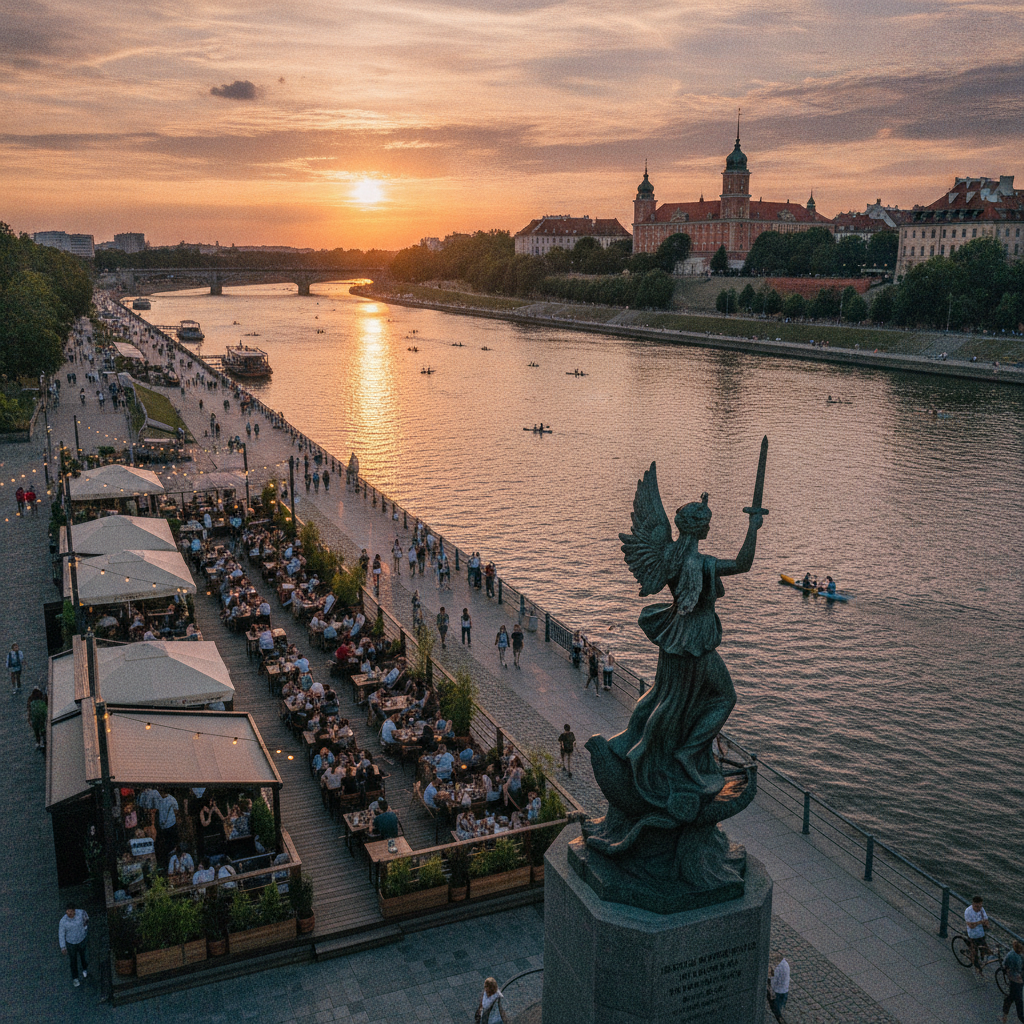
The Copernicus Science Centre (Centrum Nauki Kopernik, Wybrzeże Kościuszkowskie 20, the science museum on the Vistula riverbank, the most visited museum in Warsaw with over 1 million visitors per year, €27 adults for the full day including the Planetarium, Monday-Friday 9am-6pm, Saturday-Sunday 10am-7pm, the 450 interactive exhibits across 5 thematic galleries, the Planetarium with the 15m digital dome showing astronomical films, the Rooftop Garden with the view over the Vistula) and the Vistula riverbank boulevard (the 4km promenade from the Śląsko-Dąbrowski Bridge to the Siekierkowski Bridge on the left bank, the boulevard opened 2011-2016, the seasonal bars and music venues operating on the riverbank from May to September, the view of the Old Town on the cliff above the right bank, the Warsaw beach clubs — the temporary sandy beach bars on the Vistula sand banks in summer — the most genuinely relaxed outdoor space in the city) represent the post-1989 Warsaw — the city that has rebuilt its physical identity as a European capital in the 30 years since communism ended, the glass towers of the financial district visible behind the riverbank.
Walk this route with audio
Stories play automatically as you reach each stop — no tapping needed.
More in warsaw
Warsaw Jewish Heritage — POLIN Museum, the Ghetto & the Uprising of 1943
Warsaw Old Town — the Royal Castle, Sigismund Column & the Rebuilt Medieval City
Warsaw Under Communism — the Palace of Culture, Solidarity & the Cold War City
Warsaw Practical Guide — Transport, Seasons, the Vistula & Day Trips