Varanasi's Seasons: The Month-Long Street Ramayana, Bismillah Khan's Shehnai & the Buddhist Circuit to Bodh Gaya
Catch Varanasi at its deepest—the Ramnagar Ramlila that transforms an entire town into the Ramayana landscape for a month, with the Maharaja's elephant as the royal box, the Sanskrit university tradition where pandits memorise texts taking decades to master, Bismillah Khan who refused every international residency offer to stay by the Ganga and play shehnai by the temple, the train to Bodh Gaya where the Buddha sat under a direct descendant of the original Bodhi Tree, weaving households where a ₹100,000 saree returns ₹700 a day to the weaver, and the panda priests whose family registers track your family's pilgrimages back 200 years.
- 1
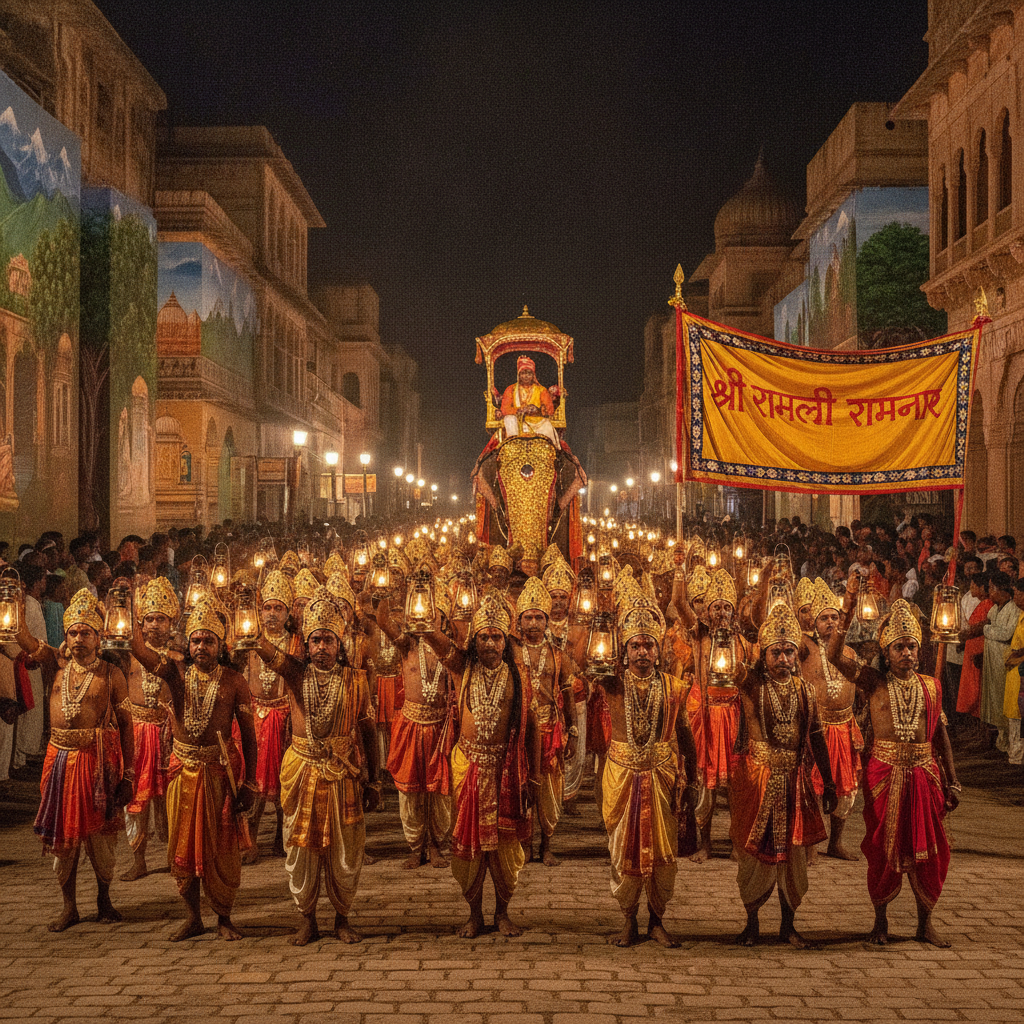
Ramnagar Ramlila – A Month-Long Ramayan in the Streets
The Ramnagar Ramlila—performed in Ramnagar (across the river from Varanasi) for one month each year in September–October, culminating on Dussehra—is considered by many scholars the most authentic, most elaborate, and most significant of the hundreds of Ramlila performances across North India. Unlike stage productions, the Ramnagar Ramlila uses the entire town as its stage: different locations in Ramnagar represent Lanka, Ayodhya, the forest, the ocean—and the audience follows on foot or by vehicle, moving between locations to follow the narrative. The performance involves 500+ performers, all male (women's roles played by boys), many of whom are professional or semi-professional traditional actors from families who have performed specific roles for generations. The Maharaja of Varanasi watches from a decorated elephant or boat.
- 2
Varanasi's Sanskrit Learning Tradition
Banaras Hindu University (BHU)—founded 1916 on a 1,300-acre campus south of the city, one of Asia's largest residential universities (40,000 students)—maintains one of India's strongest Sanskrit departments alongside engineering, medicine, and arts faculties. The Sampurnanand Sanskrit Vishwavidyalaya (Central Sanskrit University, founded 1791 by British administrator Jonathan Duncan as the Benares Sanskrit College—making it the oldest Sanskrit institution in India)—continues to train pandits (Sanskrit scholars) in traditional pathshala (Sanskrit school) methods alongside modern academic Sanskrit. Varanasi traditionally has the largest concentration of practicing Sanskrit pandits in India; the city's puja (worship ceremony) ritual traditions require specialist knowledge that takes decades to master.
- 3
Varanasi's Music Season – Dhrupad & Classical Concerts
Varanasi's winter months (November–February) bring a concentrated season of classical music concerts. The Sankat Mochan Music Festival (held annually over 5 days in April at the Sankat Mochan Temple)—founded by the musician-activist Veer Bhadra Mishra (who was simultaneously a professor of hydraulic engineering and the head priest of Sankat Mochan Temple)—is one of India's finest classical music festivals, held in the temple courtyard with free entry. Dhrupad—the most ancient and austere form of Hindustani classical vocal music—has strong roots in Varanasi; the Dagar family tradition (the most prestigious Dhrupad dynasty) performs at the Tulsi Ghat dhrupad festival annually. Bismillah Khan (shehnai player, Bharat Ratna, 1916–2006) spent his entire life performing in Varanasi and refused international residency offers to remain by the Ganga.
- 4
Day Trip: Bodhgaya & the Buddhist Circuit from Varanasi
Bodh Gaya—250 km south of Varanasi (4–5 hours by train to Gaya, then 13 km by auto-rickshaw)—is the most sacred site in Buddhism: the location of Siddhartha Gautama's enlightenment under the Bodhi Tree (Ficus religiosa) in 528 BC. The Mahabodhi Temple (UNESCO World Heritage Site, 2002)—a 55-metre spire built by Emperor Ashoka and reconstructed in the 5th–6th century AD—marks the spot. A direct descendant of the original Bodhi Tree (brought from Sri Lanka as a cutting in 288 BC) stands in the temple compound. The Bihar–Jharkhand Buddhist circuit (Bodh Gaya–Rajgir–Nalanda–Vaishali) can be completed in 3–4 days from Varanasi and represents the most concentrated Buddhist heritage of any region in Asia.
- 5
Varanasi's Weaving Villages – Handloom Communities
The Banarasi saree weaving industry is dispersed across the villages of eastern Uttar Pradesh surrounding Varanasi—principally the communities of Madanpura, Jaitpura, Pilikothi, and Lohta within the city, and Mubarakpur (50 km) and Azamgarh district beyond. The industry is organised around the mahajan (master weaver or trader) system: individual weavers own their own handlooms but work to mahajan contracts, typically earning ₹500–1,000/€5.50–11 per day for 10–12 hours of work on a single saree that retails for ₹25,000–100,000 (€275–1,100). The Muslim weaving community of Varanasi has been particularly affected by communal tensions; the industry has also suffered from demonetisation (2016) and GST implementation (2017). Community tourism visits to weaving households can be arranged through Varanasi's certified guides.
- 6
Varanasi's Spiritual Economy – Priests, Astrology & the Business of Piety
Varanasi's economy is substantially organised around the provision of religious services. The panda system (hereditary Brahmin priests who maintain family registers and perform puja and ritual services for pilgrims whose families have used the same panda for generations—records sometimes going back 200+ years) represents a form of religious institutional memory unique to Varanasi. Astrology—jyotish shastra—is practiced at Varanasi's Sanskrit university and by thousands of private practitioners who set auspicious timings for weddings, business openings, and pilgrimages. The flower (mainly marigold), lamp oil, incense, and puja supplies market supports tens of thousands of small traders. The total economic value of Varanasi's religious sector is estimated by Uttar Pradesh tourism at ₹12,000 crore (€1.3 billion) annually—making piety one of the city's largest industries.
Walk this route with audio
Stories play automatically as you reach each stop — no tapping needed.
More in Varanasi
Varanasi Complete: Cremation-Ash Holi, the House Where People Go to Die & the Ashoka Lion Capital at Sarnath
Varanasi Deeper: Classical Music at Shiva's Court, the Ganga's Lethal Pollution & the Poet Who Rejected Both Hinduism and Islam
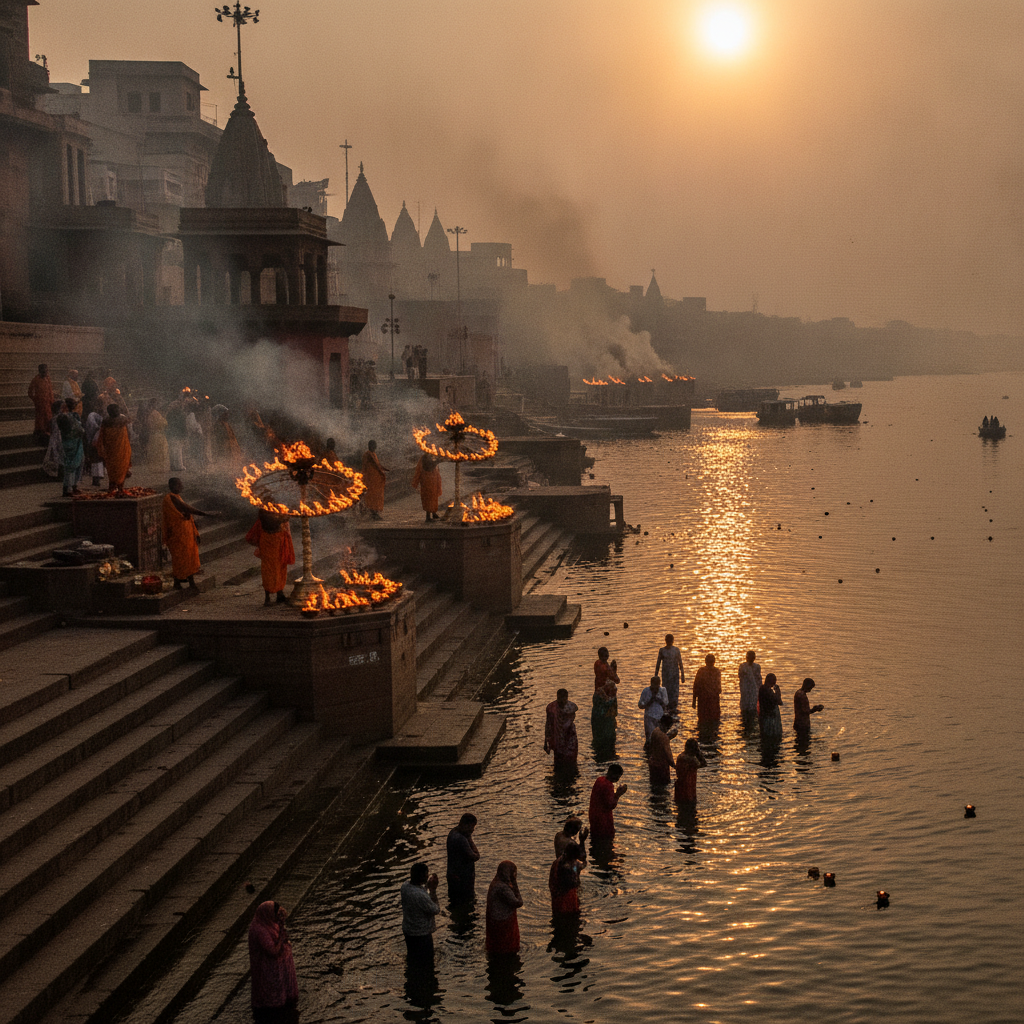
Varanasi Essentials: 88 Ghats, the Burning Ghat That Never Stops & the Buddha's First Sermon at Sarnath
Varanasi's Depths: 3,000 Years of Continuous Life, the Aghori Who Meditate in Cremation Grounds & the Ethics of Watching Death