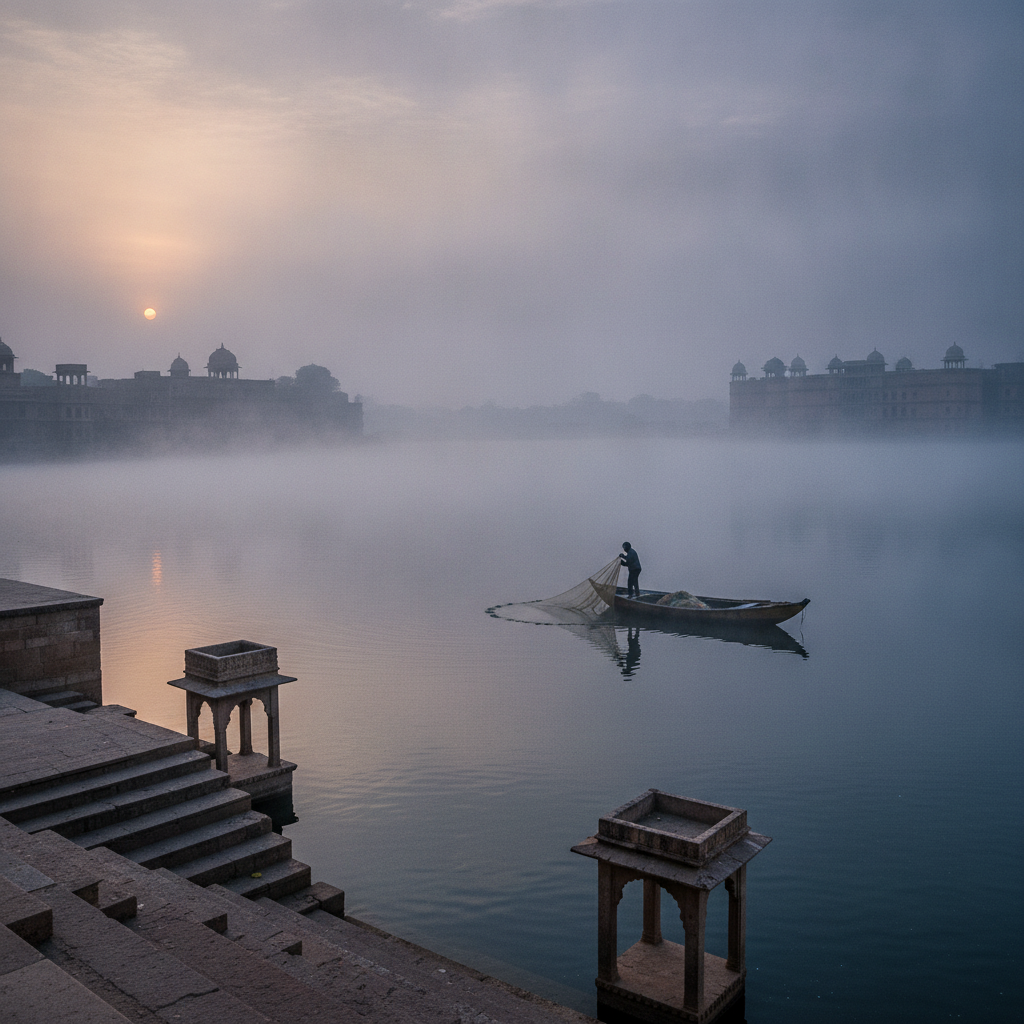
Udaipur Evenings: James Bond's Lake, Miniature Painting Workshops & the Ambrai Restaurant View Across the Water
Live Udaipur fully—the Octopussy Lake Palace Hotel location where Udaipur venues still screen the 1983 Bond film to guests, half-day miniature painting workshops in Mewar school technique with natural pigments and squirrel-hair brushes near Jagdish Temple, the Ambrai restaurant table with the City Palace lit across Lake Pichola as the definitive Udaipur dinner, sunrise over the lake from the Neemach Mata Temple steps (free, no vehicle needed, 20 minutes from the old city), water chestnut boats harvesting the floating gardens of Fateh Sagar, and Udaipur as the launch point for the Asiatic lion's only wild habitat at Gir and India's first UNESCO World Heritage City at Ahmedabad.
- 1
Udaipur in Film – Octopussy & Bollywood's Favourite City
Udaipur's cinematic credentials begin with James Bond: Octopussy (1983) was filmed extensively at the Lake Palace Hotel, the City Palace, and on Lake Pichola; the film brought international recognition to a city that was little-known outside India. Several Udaipur venues show Octopussy screenings regularly. Bollywood has returned to Udaipur repeatedly: the 2018 film Padmaavat (Sanjay Leela Bhansali's controversial epic about Rani Padmavati and Alauddin Khalji) was partly filmed at Chittorgarh Fort near Udaipur; Goliyon Ki Raasleela Ram-Leela (2013, also Bhansali) filmed at Udaipur. The lake, the Palace, and the old city lanes appear in dozens of Hindi films. Udaipur's most famous foreign-film connection beyond Bond: 'Monsoon Wedding' (Mira Nair, 2001) is set partly at a Rajasthan palace.
- 2
Udaipur's Craft Workshops – Learning to Paint Miniatures
Udaipur offers genuine opportunities to learn traditional Rajasthani craft skills rather than simply observe or purchase. Miniature painting workshops (several studios near the Jagdish Temple, particularly the Mewari Miniature Art School) offer half-day and full-day instruction in the Mewar school technique: natural pigments, fine squirrel-hair brushes, the layered application of colour and detail. A typical 3-hour session produces a small painting on paper or silk; prices ₹500–1,500 (€5.50–16.50) including materials and instruction. Pottery workshops (Kumhar caste potteries on the city outskirts), blue pottery painting courses, and block printing workshops (the Bagru block printing technique is taught at several Udaipur workshops) offer alternatives. The Shilpgram complex coordinates artisan demonstrations and paid workshop sessions with tribal crafts specialists.
- 3
Udaipur's Garden Restaurants & Rooftop Culture
Udaipur's eating and drinking culture is inseparable from the lake view. The best sunset spots are: Ambrai Restaurant (on the opposite bank from the City Palace, looking directly at the lit palace and Lake Palace Hotel across the water—the finest free view in Udaipur alongside a meal); Upré restaurant at the Lake Pichola Hotel (mid-range, good food, excellent views); the Rooftop at Jagat Niwas (budget option, crowded but reliably beautiful views). The restaurant scene has evolved significantly in the 2010s: Beyond Nirvana (DJ nights on a rooftop), Millets of Mewar (health food using traditional Rajasthani millets), and multiple 'Garden Café' operations combining craft shopping and food in old haveli courtyards. The Jag Mandir island restaurant (reached by hotel boat, ₹700/€7.70 including return boat, restaurant prices for food separately) is the most exclusive setting.
- 4
The Aravalli Hills – Day Hikes & Sunrise Viewpoints
The Aravalli range—extending 800 km from Gujarat to Delhi, the world's oldest mountain range at 2.5 billion years old—rises immediately around Udaipur, providing accessible trekking terrain within 5–15 km of the city. The Sajjangarh hill (30-minute walk or jeep from the city) is the most popular; Badi Lake (7 km north) has a trail around the lake with bird watching. The Neemach Mata Temple hill—immediately above the old city, a 20-minute walk up a stone staircase—provides the best sunrise viewpoint over the city and Lake Pichola that doesn't require a vehicle. The Kumbalgarh Wildlife Sanctuary (covering the Aravalli hills between Udaipur and Kumbhalgarh Fort) has marked trekking trails and leopard sightings; overnight camping with a forest guide is permitted with advance Forest Department permission.
- 5
Udaipur's Water Market & Floating Gardens
The lakes around Udaipur host a distinctive floating garden economy: water chestnuts (singhara), lotus stems, and aquatic vegetation are harvested by boatmen from Lake Pichola and Fateh Sagar using flat-bottomed boats. The water chestnut harvest (October–December) is sold fresh in Udaipur's markets. The Fateh Sagar lakeside market (Sunday morning haat) brings vendors from surrounding villages selling seasonal produce, traditional craft items, and street food alongside the Sunday recreational crowds. The Chandpol market (near Chandpol Gate, old city) is the most authentic daily market for locals rather than tourists. The Lake Udaisagar (12 km east, a reservoir lake) is the least visited of Udaipur's lakes but has the most serene environment for an early-morning walk along its bunded embankments.
- 6
Beyond Rajasthan – Udaipur as Gateway to Gujarat
Udaipur's position at the southern tip of Rajasthan makes it a natural gateway to Gujarat, the neighbouring state with its own distinct culture, cuisine, and heritage. Key Gujarat destinations accessible from Udaipur: Ahmedabad (250 km, 4 hours)—a UNESCO World Heritage City (2017, the first Indian city to receive this designation), with the finest surviving Indo-Saracenic architecture in India, Gandhi's Sabarmati Ashram, and India's best street food city. The Rann of Kutch (360 km south)—the world's largest salt desert, host of the Rann Utsav festival (October–March) when the white salt flat stretches to the horizon under a full moon. The Gir National Park (460 km, 8 hours)—the only habitat of the Asiatic lion in the world (approximately 700 lions, the world's entire wild Asiatic lion population).
Walk this route with audio
Stories play automatically as you reach each stop — no tapping needed.
More in Udaipur
Udaipur's Layers: Bhil Tribal Crafts, Haveli Hotels with Lake Views & the Sanskrit Inscription That Covers 25 Ghats
Udaipur Essentials: Lake Pichola at Sunset, James Bond's Floating Palace Hotel & 400 Years of Mewar Architecture
Udaipur's Mewar Legacy: Maharana Pratap's Battle of Haldighati, Ranakpur's 1,444 Pillar Temple & the 36km Fort Wall
Udaipur Deeper: Chittorgarh's Three Mass Self-Immolations, India's Most Spectacular Destination Wedding City & Kathputli Puppets