Ubud Beyond the Swing Photos: Batur Crater Sunrise Trek, Geringsing Double-Ikat & Green School's Bamboo Campus
The resident Ubud—the 5,000–10,000 long-term Western residents on 60-day visa runs who discovered Bali in the 1970s then returned in successive waves (Eat Pray Love, digital nomad, COVID), Green School Bali's bamboo campus teaching in English as Asia's most discussed alternative education project, the Batur Guide Association's enforced monopoly with geothermal egg breakfast at the summit and Mount Agung on the eastern horizon, Goa Gajah's demon-faced 11th-century rock-cut sanctuary whose bathing pools were only excavated in 1954, cacao ceremony and kirtan in Ubud's alternative spirituality market versus the Balinese Hindus whose 4,000-year tradition it borrows from, Tenganan's geringsing double-ikat (one of three places on Earth making it), and hiring a local driver rather than taking an Instagram swing package.
- 1
Ubud's Expat Community & the Long-Term Resident Economy
Ubud has one of the most established long-term expatriate communities of any small town in Asia: an estimated 5,000–10,000 long-term Western residents (the figure is difficult to quantify given visa tourism—many live on 'visa runs' to Singapore or Australia every 60 days), complemented by a significant community of Indonesians from Java and other islands who have moved to Ubud to work in the tourism economy. The original wave: artists, alternative health practitioners, and spiritual seekers who discovered Bali in the 1970s–1980s and found in Ubud the most hospitable environment for their lifestyle (cheap rent, beautiful setting, absence of the beach-resort tourism of Kuta and Seminyak). The subsequent waves: the Eat Pray Love demographic (mid-2000s–2010s—solo Western women, wellness-oriented), the digital nomad wave (2015–present—remote workers with laptops who need only WiFi and a café), and the COVID wave (2020–2022—people who left expensive Western cities and found Ubud's cost-of-living arbitrage compelling). The infrastructure that has developed to serve this community: international schools (Green School Bali—an eco-school teaching entirely in English on a bamboo campus, founded 2008, the most discussed alternative education project in Asia), co-working spaces, and a sophisticated English-language cultural calendar.
- 2
Mount Batur – The Crater Lake Sunrise Trek
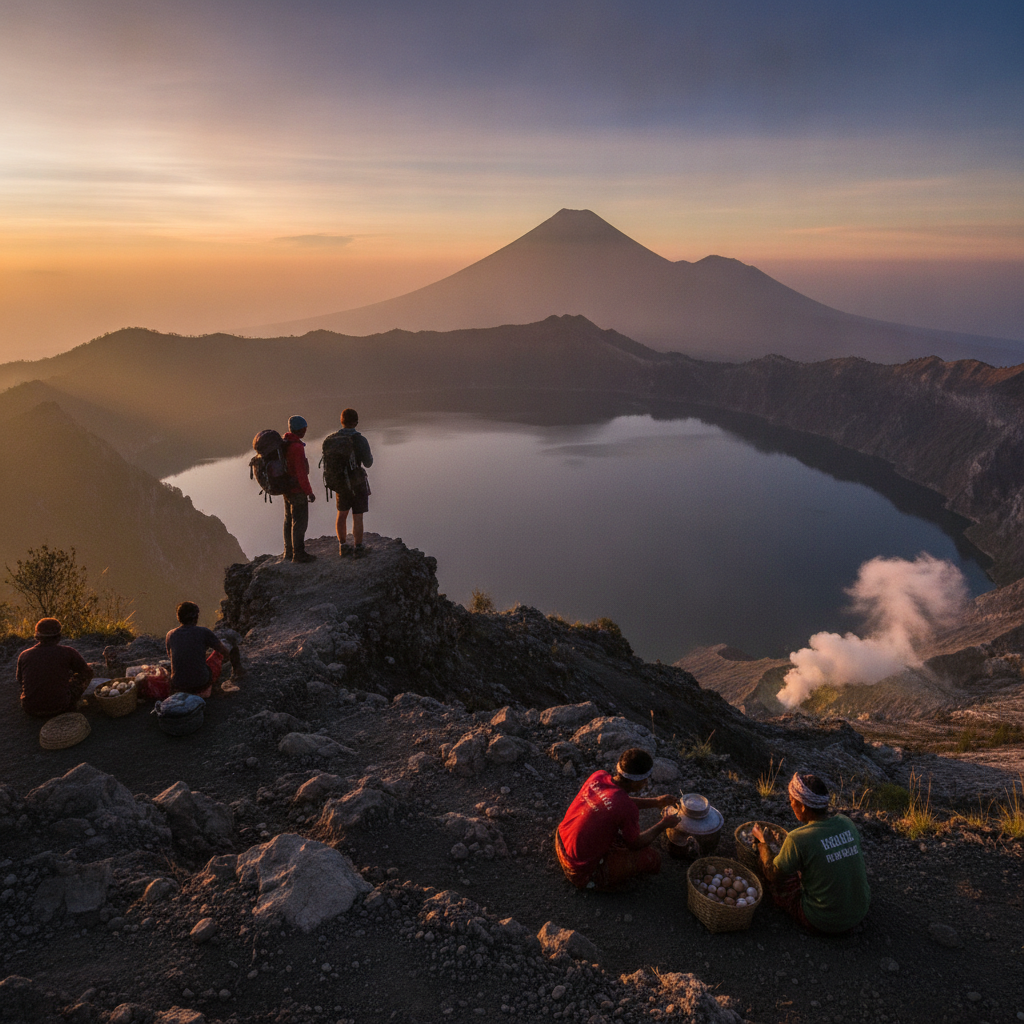
Mount Batur (Gunung Batur)—1,717 metres, 28 km northeast of Ubud—is the most accessible volcano trekking destination in Bali and one of the most popular sunrise trekking experiences in Southeast Asia. The trek: departing from Toya Bungkah village on the shore of Lake Batur (at 1,050 metres altitude—the lake occupies the caldera of the outer volcano) at 04:00, the trail ascends 667 vertical metres through black volcanic lava fields to the summit (2–2.5 hours); the summit view at dawn: the crater lake below, the outer caldera wall, Mount Agung (Bali's highest point, 3,031 metres) to the east, the Java volcanoes on the horizon to the west. The guide requirement: the Batur Trekking Guide Association has a monopoly on guiding at Batur (guides cannot be bypassed—the routes through the lava fields are genuinely difficult to navigate without local knowledge and the guide system is enforced at the trailhead). The crater kitchen: a tradition specific to Batur—guides carry raw eggs to cook in the steam vents at the summit, producing breakfast from geothermal energy—the most whimsical summit breakfast in Asia. The Pura Ulun Danu Batur (the most important temple of Bali's water religion—managing the water that flows from the Batur crater lake through the island's irrigation system).
- 3
The Goa Gajah & Gunung Kawi Archaeological Sites
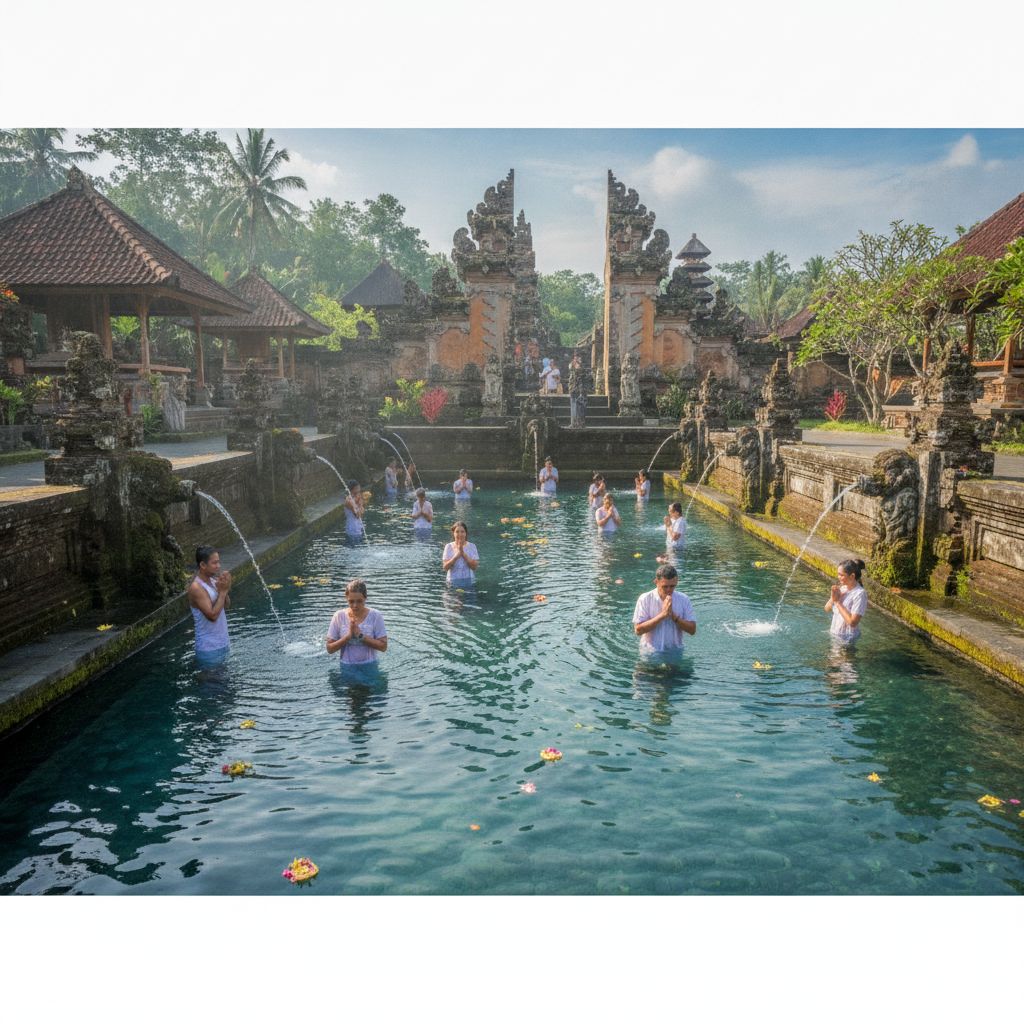
The archaeological landscape northeast of Ubud contains two of Bali's most significant ancient sites—both dating to the 11th century and both substantially different in character from the active Hindu temples of the contemporary period. Goa Gajah ('Elephant Cave')—4 km east of Ubud on the Bedulu road: an 11th-century rock-cut sanctuary carved directly into a rock face (the entrance is a large carved demon face—commonly interpreted as Ganesha, giving the cave its name, though no elephant carvings are inside); the interior contains carved niches with Hindu and Buddhist images; the bathing pools in front of the cave (six stone fountains) were only discovered in 1954 during archaeological excavation. The site has been a place of Balinese Hindu pilgrimage since at least the 11th century and remains active; the 'tourist' area and the 'sacred' area are somewhat separated. Gunung Kawi ('Mountain of Poetry')—10 km north of Ubud at Tampaksiring, a 10-minute walk down 300 steps): 10 royal memorials (candis—shrine niches) carved directly into a rock face beside the Pakerisan River, approximately 7 metres high each—the only monuments of this type in Bali, dated to the 11th-century Warmadewa dynasty; the setting (a narrow river valley with rice terraces and jungle) is the finest archaeological landscape in Bali.
- 4
Ubud's Kirtan, Community & Alternative Spirituality
The alternative spirituality ecosystem that has developed around Ubud over the past two decades is one of the most diverse and commercially active in Asia: a mix of Balinese Hindu ceremonial practices, Western New Age adaptations of Indian and Balinese traditions, ayurvedic healing, sound healing, kirtan (Hindu devotional chanting adapted to Western context), cacao ceremony (the use of raw cacao in a ceremonial setting borrowed from Mesoamerican indigenous practices), breathwork, and ecstatic dance. The market: the same demographic that practices yoga in the Yoga Barn attends kirtan concerts at the Kura Kura (community event space), receives balian healing sessions (increasingly commercialised), takes morning cacao ceremony in lieu of coffee, and participates in multi-day silent retreats at centres like Fivelements. The tension: Balinese Hindus, who have their own 4,000-year spiritual tradition deeply embedded in daily life and community practice, observe the tourism industry's adoption and adaptation of 'Balinese spirituality' with varying reactions—some see it as sincere cultural engagement, others as appropriation and commodity extraction. The ceremony tourism question: visitors who attend actual Balinese temple ceremonies as observers (always possible, with appropriate dress and respectful behaviour) create very different dynamics from visitors who pay to participate in 'authentic ceremonies' designed for tourist consumption.
- 5
Ubud's Textile Heritage – Ikat, Songket & Batik
Ubud and the villages of the Gianyar regency surrounding it are the centre of Bali's textile production—both the traditional handmade varieties and the commercially produced garments that fill the market stalls. The primary Balinese textiles: endek (Balinese ikat—a technique of resist-dyeing threads before weaving to create patterns, producing silk and rayon fabrics with the slightly blurred edges characteristic of ikat weaving); songket (supplementary weft weaving using gold or silver metallic threads on a silk base—the ceremonial textile of Bali, worn at temple festivals and significant ceremonies); the geringsing (a rare double-ikat textile produced only in the village of Tenganan Pegringsingan in East Bali—one of only three places in the world where double ikat is made, requiring both the warp and weft threads to be individually resist-dyed before weaving). The market at Gianyar (7 km south of Ubud—the regency capital's traditional Saturday night market, where Balinese endek and food are sold at local prices rather than tourist prices): the most authentic textile shopping experience in the Ubud area. The ARMA textile collection: the Agung Rai Museum of Art holds a significant reference collection of Balinese ceremonial textiles.
- 6
Practical Ubud – Getting There, Getting Around & Responsible Tourism
Getting to Ubud: Ngurah Rai International Airport (DPS—in Denpasar/Kuta, 35 km south of Ubud) receives direct international flights from Singapore, Kuala Lumpur, Sydney, Tokyo, and many other cities; domestic connections from Jakarta (1.5 hours), Yogyakarta (1 hour), and Lombok (40 minutes). From the airport: hired car (Rp 200,000–300,000/€12–19 by official taxi or Rp 150,000–200,000 by GoJek—which cannot legally be summoned inside the airport, requiring a short walk to the pickup area), shuttle bus (Rp 70,000–100,000 sharing with other travellers, departs when full, 1–1.5 hours). Getting around Ubud: the town itself is walkable (Jl. Raya Ubud, Jl. Monkey Forest, Jl. Hanoman cover the main areas on foot in 20 minutes); hired scooter (Rp 60,000–80,000/day—the most practical for surrounding villages and rice paddy visits; driving in Bali traffic requires experience); private driver (Rp 500,000–700,000/day for a car and driver, covering Batur, Tirta Empul, Besakih, or any combination of sites). Responsible tourism: employ locally owned transport, buy from artisan producers directly rather than market intermediaries, respect temple dress codes (sarong and sash provided at temples), and do not photograph worshippers at prayer without explicit permission. Avoid the Bali 'tourist bubble' of identical rice-paddy swing photographs and €20 yoga retreats that exist primarily to be documented on Instagram.
Walk this route with audio
Stories play automatically as you reach each stop — no tapping needed.
More in Ubud
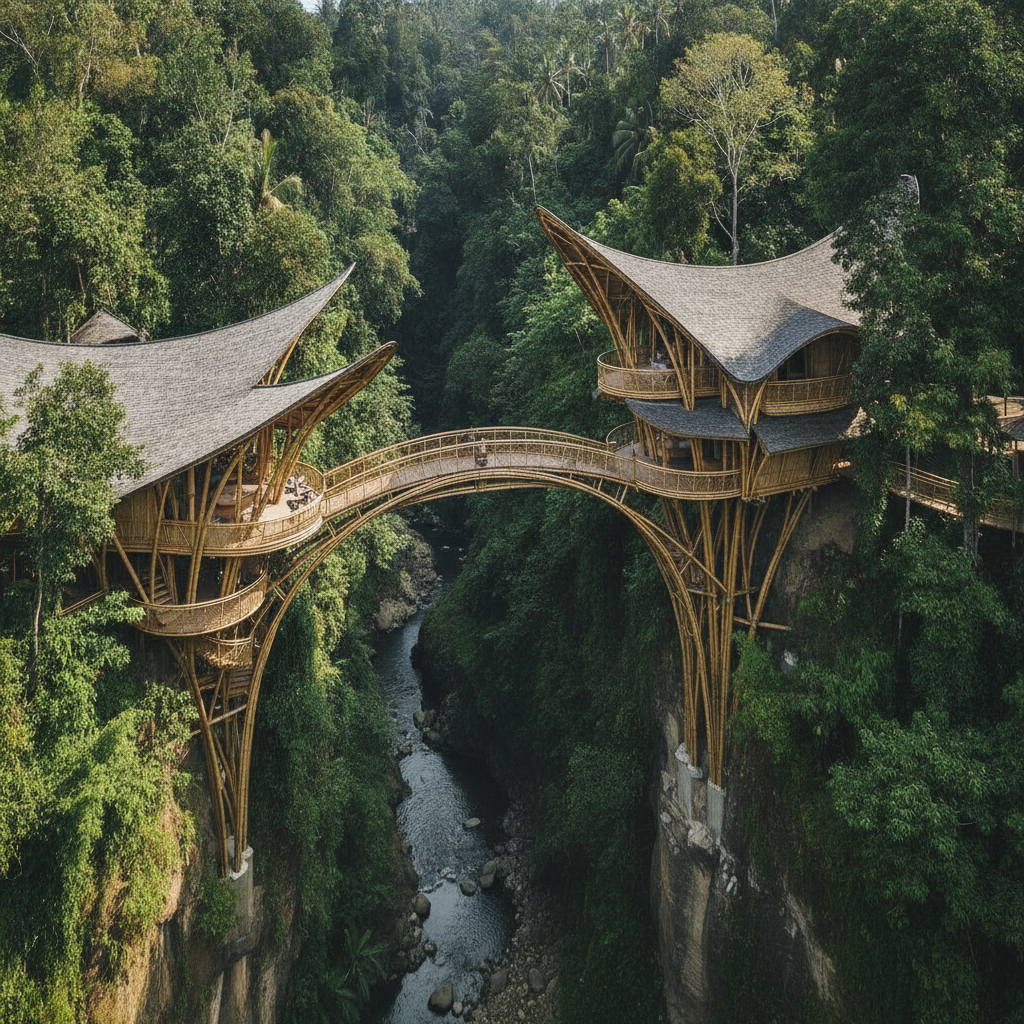
Ubud's Built Future: IBUKU Bamboo Architecture, Ayung Gorge Rafting & the Water Crisis Threatening the Subak System
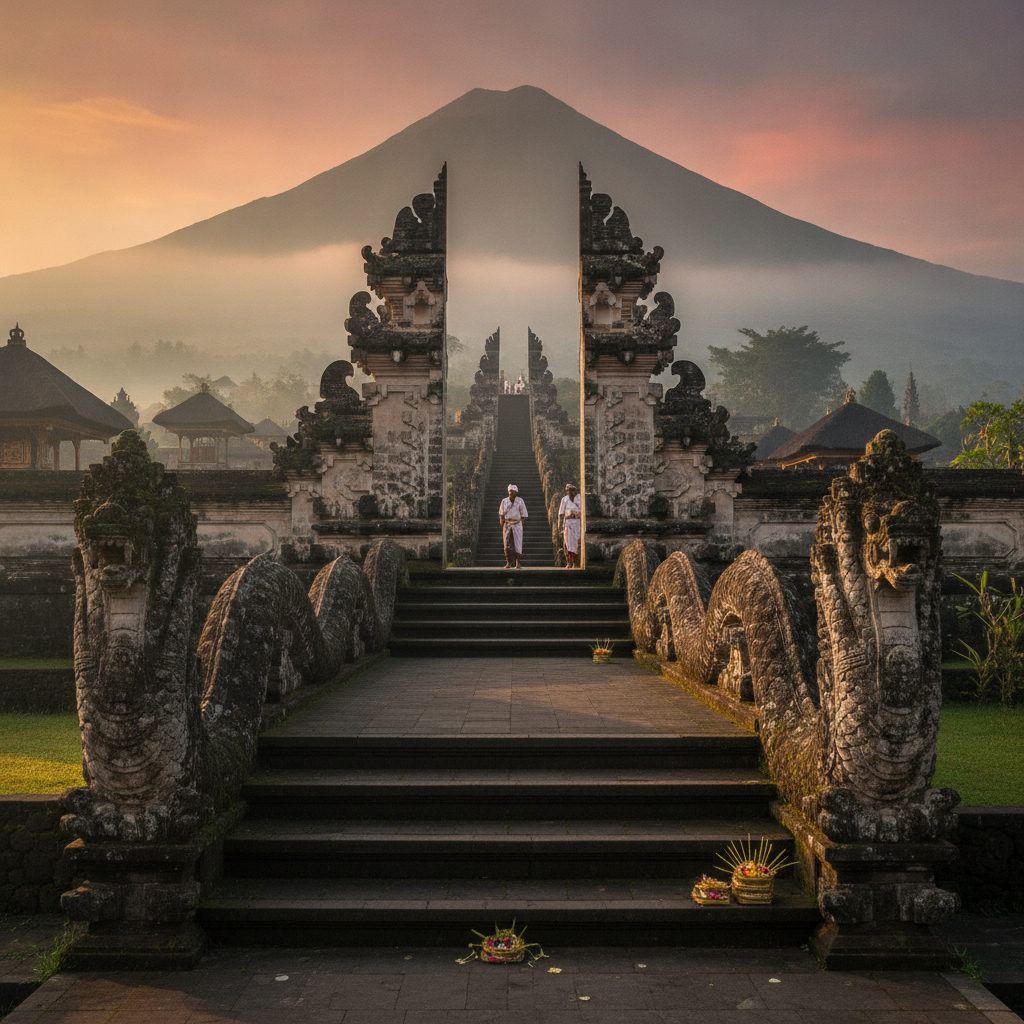
Ubud's Future: Tourism Carrying Capacity, Besakih's Mother Temple & the Eastern Indonesia Archipelago Beyond Bali
Ubud: Sacred Monkey Forest Temples, UNESCO Subak Rice Terraces & Walter Spies' 1930s Art Revolution
Ubud Off the Beaten Track: Tjokorda Dynasty's Art Patronage, Wayang Kulit's UNESCO Puppetry & Tenganan's Double-Ikat Aga Village