Tucson: Titan Missile Museum, Dark Skies, Hotel Congress, Neighborhoods, Kartchner Caverns, and Practical Info
Tucson: Titan Missile Museum (40km south Green Valley National Historic Landmark 1994, only preserved Titan II site worldwide, 9-megaton W-53 warhead 700x Hiroshima 15,000km range 58-second launch, 18 missiles ringed Tucson 162 megatons combined more than all WWII x27, decommissioned 1984 SALT II framework 3-hour guided tour 18m into launch control blast doors), dark skies (1972 Tucson first municipal dark sky ordinance world, Milky Way visible city limits, Kitt Peak National Observatory 90km SW Tohono O'odham Nation 2,096m 27 optical 2 radio telescopes Tohono O'odham lease 1958 maintained 65+ years, Bigelow Observatory Catalina Sky Survey predicted 2019 MO Caribbean asteroid entry June 22 2019 4th predicted hit in history), Hotel Congress (1919 National Historic Landmark, Dillinger capture January 22 1934 firefighters recognized wanted posters, Cup Cafe 1930s Art Deco, Club Congress 300+ shows/year, Linda Ronstadt born 1946 Tucson, Calexico 1996 desert borderlands fusion, Giant Sand 1980 progenitor desert rock, 4th Avenue Street Fair 400 vendors 300,000+ visitors), neighborhoods (Sam Hughes 1920s-1940s Bungalow Craftsman Spanish Colonial most intact Tucson residential, El Presidio presidio San Agustin August 20 1775 founding date, Armory Park 1880s-1910s railroad era Victorian, South 4th 6th Avenue Mexican-American taquerias panaderias carnicerias), Kartchner Caverns (75km east discovered October 21 1974 Gary Tenen Randy Tufts 14 years secret, Throne Room Kubla Khan column 21.2m 200,000 years forming, soda straws 2m most delicate US state park cave, Big Room closed April-September 1,000 cave myotis bat nursery roost, constant 20C 99% humidity air-lock system), practical (TUS airport 20 non-stop cities, Sun Link streetcar 6.2km Amtrak to UA, Sunset Limited New Orleans to LA 3 stops/week Tucson, Arizona Inn 1930 Isabella Greenway first Arizona congresswoman USD 250-400, best March-May October-November).
- 1
Titan Missile Museum and the Cold War in the Desert
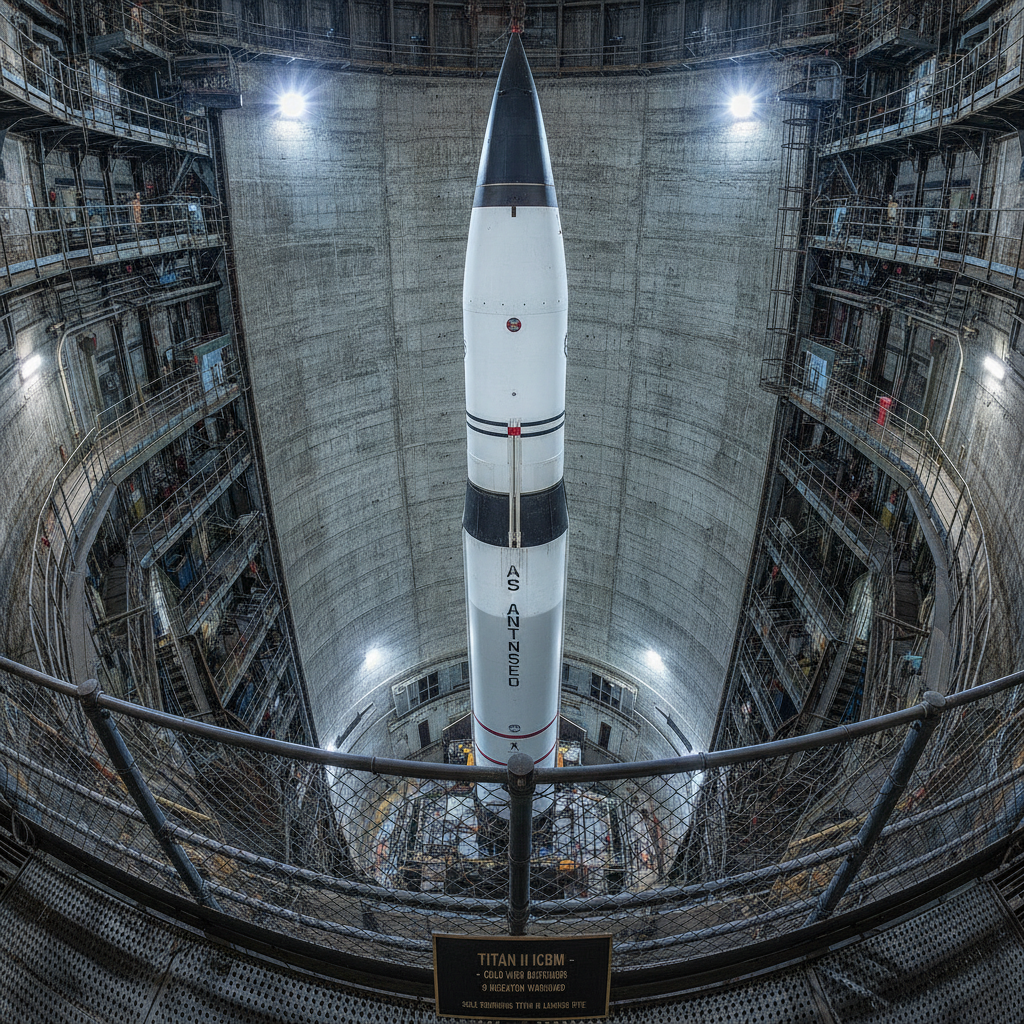
The Titan Missile Museum (at 1580 West Duval Mine Road, Green Valley, AZ, 40 km south of Tucson, the only Titan II ICBM site preserved and open to the public worldwide, established as a museum 1986, National Historic Landmark 1994): the decommissioned Titan II intercontinental ballistic missile complex (one of 54 Titan II sites that ringed Tucson and the American Southwest from 1963 to 1984) preserved with the original missile in the silo, the launch control center with original equipment, and the 57-meter-deep silo accessible by guided tour. The Titan II missile: the most powerful liquid-fueled ballistic missile ever deployed by the United States, with a range of 15,000 km, a speed of 24,000 km/h (Mach 20), a launch time of 58 seconds from order to ignition, and a W-53 thermonuclear warhead with a yield of 9 megatons -- 700 times more powerful than the Hiroshima bomb. The Tucson Titan missile complex: the 18 Titan II missiles clustered around Tucson during the Cold War contained the single largest concentration of nuclear firepower of any metropolitan area in the United States -- the combined yield of Tucson's 18 missiles was 162 megatons, more destructive power than all the bombs dropped in World War II multiplied by 27. The Titan II program was decommissioned under the SALT II treaty framework (though SALT II was never ratified by the U.S. Senate, the missiles were decommissioned in 1984 under the Reagan administration's transition to the Peacekeeper missile system). The museum tour: the 3-hour guided tour descends 18 m into the launch control capsule and passes through the blast doors (designed to withstand a nuclear near-miss) to the silo, where the actual Titan II missile (demilitarized with a simulated warhead) still stands in its launch position.
- 2
The Sonoran Desert at Night - Astronomy and Dark Skies
Tucson's relationship with dark skies: Tucson is the only major American city to have enacted and maintained enforceable outdoor lighting regulations specifically to preserve dark skies for astronomical observation (the Tucson City Code, Chapter 4, Outdoor Lighting Code, originally adopted 1972 -- the first municipal dark sky ordinance in the world, now also adopted by Pima County): the result is that Tucson has better dark skies than any comparable American city, with the Milky Way visible from the city limits on clear nights and the surrounding mountains offering spectacular stargazing. Kitt Peak National Observatory (at 950 North Cherry Avenue, Tucson headquarters; the telescopes at Kitt Peak, 90 km southwest of Tucson on the Tohono O'odham Nation, at 2,096 m elevation): the most diverse collection of optical and radio telescopes in the world (27 optical telescopes and 2 radio telescopes, operated by multiple universities and research institutions), including the Mayall 4-meter telescope (in operation since 1973), the WIYN 3.5-m telescope (operated by the University of Wisconsin, Indiana University, Yale, and NOAO), and the Solar Telescope (the largest solar telescope in the world until the completion of the Daniel K. Inouye Solar Telescope in Hawaii). The Tohono O'odham Nation granted the lease for Kitt Peak to the National Science Foundation in 1958 in exchange for agreements on telescope size and night lighting restrictions that have been maintained for 65+ years. The Bigelow Observatory on Mount Lemmon (UA Catalina Sky Survey): discovered the near-Earth asteroid 2019 MO, which exploded over the Caribbean on June 22, 2019 -- the fourth asteroid ever successfully predicted to hit Earth before it entered the atmosphere. The Vera Rubin Observatory (under construction in Chile by a UA-led consortium): will revolutionize the detection of near-Earth objects when operational approximately 2025.
- 3
Tucson's Music Scene, the Hotel Congress, and Desert Bohemia
The Hotel Congress (at 311 East Congress Street, downtown Tucson, built 1919, a National Historic Landmark): the most historically significant hotel in Tucson, famous as the site of the capture of John Dillinger (the FBI's most wanted criminal, born June 22, 1903, Indianapolis; died July 22, 1934, Chicago, shot by FBI agents outside the Biograph Theater after 13 months as the most dangerous man in America) on January 22, 1934 -- Dillinger and his gang were staying at the Hotel Congress when a fire broke out and firefighters, recognizing the gang members from wanted posters while carrying their luggage out of the burning hotel, notified police. The Hotel Congress Cup Cafe (at 311 East Congress Street, still operating, one of the most beloved breakfast and lunch destinations in Tucson): the Art Deco restaurant in the Hotel Congress with the original 1930s counter, booths, and pendant lights. The Club Congress (the live music venue in the Hotel Congress basement): the primary mid-size rock and indie music venue in Tucson, booking 300+ shows per year. The Tucson music scene: Tucson has produced an extraordinary number of musicians relative to its size, including Linda Ronstadt (born July 15, 1946, Tucson; died -- no, still living as of early 2024, but diagnosed with Parkinson's disease in 2013 and retired from performing), the Calexico band (the desert-influenced rock band led by Tucson-based Joey Burns and John Convertino, formed 1996, known for fusing rock, mariachi, norteño, and country influences into the definitive sound of the Sonoran borderlands), and Giant Sand (the experimental rock band led by Howe Gelb, formed 1980, the progenitor of the desert rock genre). The 4th Avenue Street Fair (held twice annually, in spring and winter): the 400-vendor arts and craft fair drawing 300,000+ visitors and one of the largest street fairs in the American Southwest.
- 4
Tucson Neighborhoods - Sam Hughes, Armory Park, and the Urban Core
Tucson neighborhoods: the city of Tucson has one of the best-preserved collections of early 20th century residential neighborhood fabric of any Arizona city, with distinctive building traditions reflecting the multiple cultural streams of its history. The Sam Hughes neighborhood (the historic residential neighborhood immediately east of the University of Arizona campus, established 1920s-1940s): the most architecturally intact early-20th century residential neighborhood in Tucson, with Spanish Colonial Revival, Bungalow Craftsman, Mission Revival, and early Ranch-style homes on tree-lined streets with well-established desert landscaping. The El Presidio Historic District (downtown Tucson, the area of the original 1775 Spanish Colonial presidio -- the San Agustin del Tucson presidio, established August 20, 1775, the founding date of Tucson as a European settlement): the most historically significant neighborhood in Arizona, with adobe buildings from multiple periods and the Barrio Viejo (described in Route 1). The Armory Park neighborhood (immediately south of downtown, with Victorian commercial and residential buildings from the 1880s-1910s Tucson railroad era): the neighborhood containing the oldest surviving commercial buildings in Tucson, built when the Southern Pacific Railroad arrived in 1880 and transformed Tucson from a remote desert town into a regional commercial hub. The South 4th Avenue and South 6th Avenue corridors: the most vibrant Mexican-American commercial corridors in Tucson, with taquerias, panaderias (Mexican bakeries), carnicerias (butcher shops), and quinceañera shops serving the predominantly Mexican-American south side of Tucson. The Rillito Regional Park (at 3500 North Oracle Road, the linear park along the Rillito Creek): the 19-km riverside park with paved recreation trail connecting 12 neighborhoods from Ina Road to Craycroft Road.
- 5
Kartchner Caverns and the Living Cave
Kartchner Caverns State Park (at 2980 State Route 90, Benson, AZ, 75 km east of Tucson, established as an Arizona State Park November 5, 1999): the most scientifically significant cave in Arizona, discovered October 21, 1974 by Gary Tenen and Randy Tufts (two UA students who spent 14 years keeping their discovery secret to protect the cave from vandalism while quietly negotiating with the landowners James and Lulu Kartchner to transfer the cave to state ownership), and now considered one of the living wonders of the American Southwest. The cave: Kartchner Caverns is a wet cave (actively growing, with living speleothems still being formed by calcium carbonate-rich groundwater seeping from the surface), with two tour rooms: the Rotunda Room and Throne Room (open year-round) and the Big Room (open October 15 through April 15 only, to protect the 1,000 cave myotis bats -- Myotis velifer -- that use the Big Room as a nursery roost from April through September, raising their pups in one of the largest bat maternity colonies in the American Southwest). The Throne Room: the most spectacular cave room in Arizona, with the Kubla Khan column (the largest cave column in Arizona, 21.2 m tall, the result of a stalactite growing down from the ceiling meeting a stalagmite growing up from the floor -- a joining process that began approximately 200,000 years ago). The cave soda straw stalactites (extremely thin hollow stalactites, some exceeding 2 m in length): the most delicate and impressive collection of soda straw stalactites in any US state park cave. The cave temperature: a constant 20C and 99% relative humidity year-round -- visitors enter through an air-lock system to prevent warm exterior air from entering the cave and disrupting the delicate equilibrium that allows the speleothems to grow.
- 6
Tucson Practical Guide - Getting There, Accommodations, and the Best Seasons
Tucson International Airport (at 7250 South Tucson Boulevard, IATA code TUS): the commercial airport with non-stop service to approximately 20 US cities, handling approximately 4.5 million passengers annually -- smaller than Phoenix Sky Harbor (50 million passengers) but dramatically more convenient for the Tucson area, with no traffic congestion and 15-minute drive to downtown. Sun Tran (the Tucson regional transit system): the bus network covering 500 km of routes, with the Sun Link modern streetcar (the 6.2-km streetcar line running from the Tucson Amtrak station on Toole Avenue through downtown and the 4th Avenue district to the University of Arizona main gate): the most useful public transit for visitors, connecting the hotel district near the Amtrak station to the university and the downtown arts corridor. The Amtrak Sunset Limited: the train running between New Orleans and Los Angeles (3 days, 2 nights, one of the most scenic long-distance train routes in the US), stopping in Tucson three times per week in each direction -- one of the most distinctive and unhurried ways to arrive in Tucson. Tucson accommodation: the Arizona Inn (at 2200 East Elm Street, Tucson, established 1930 by Isabella Greenway -- the first Congresswoman from Arizona -- USD 250-400 per night): the most elegant historic hotel in Tucson, with Territorial-style architecture, lush gardens, and a croquet lawn. The Hotel Congress (described above, USD 80-130): the most historically significant accommodation. The Loews Ventana Canyon Resort (at 7000 North Resort Drive, at the base of the Santa Catalinas, USD 200-400): the desert resort with saguaro views and a Tom Fazio-designed golf course. Best season: March-May (warm, wildflowers, green from winter rain) and October-November (harvest season, moderate temperatures) are optimal; summer is spectacular for monsoon watchers.
Walk this route with audio
Stories play automatically as you reach each stop — no tapping needed.
More in tucson
Tucson: Mount Lemmon, Tombstone, Colossal Cave, the Border at Nogales, Bisbee, and the Desert Monsoon
Tucson: UNESCO Food Heritage, Cold War Missiles and Sky Island Summits
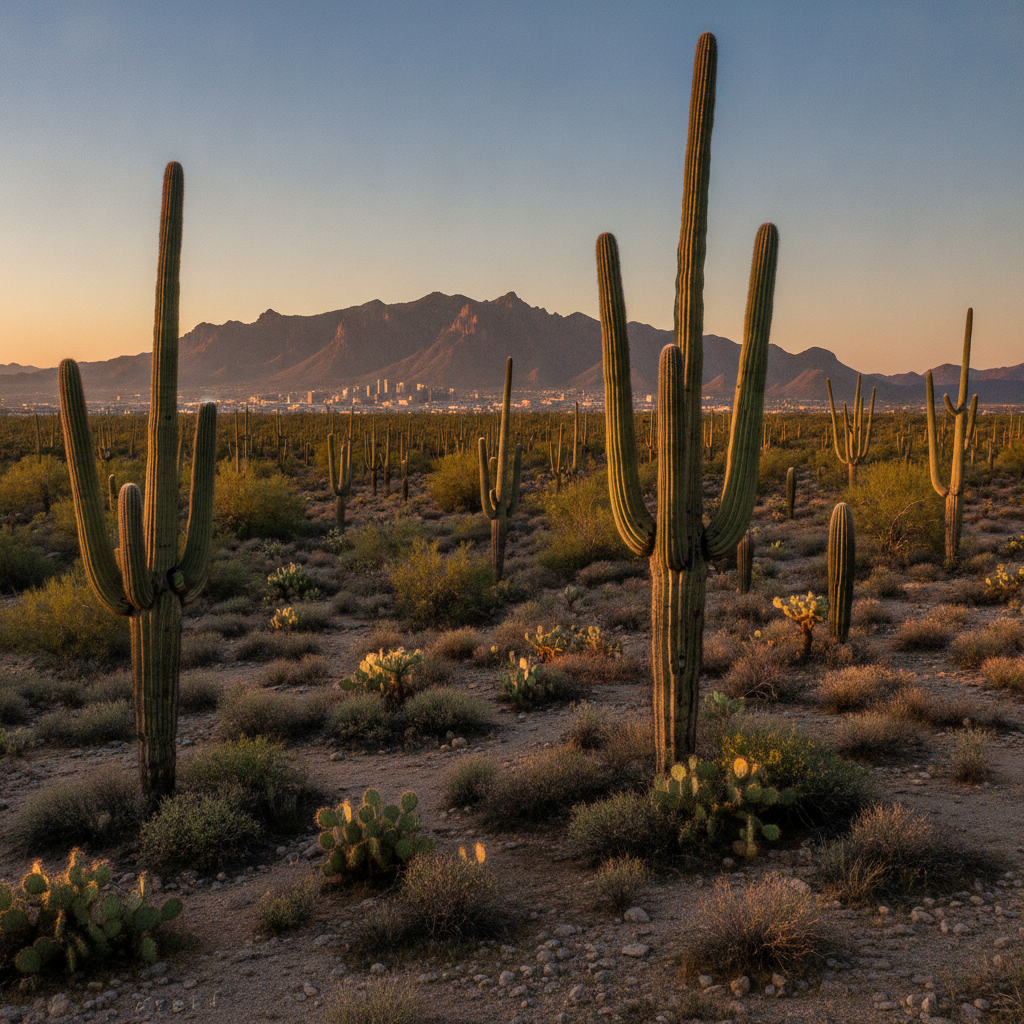
Tucson: Saguaro National Park, University of Arizona, Tohono O'odham Nation, San Xavier Mission, Biosphere 2, and Sonoran Food
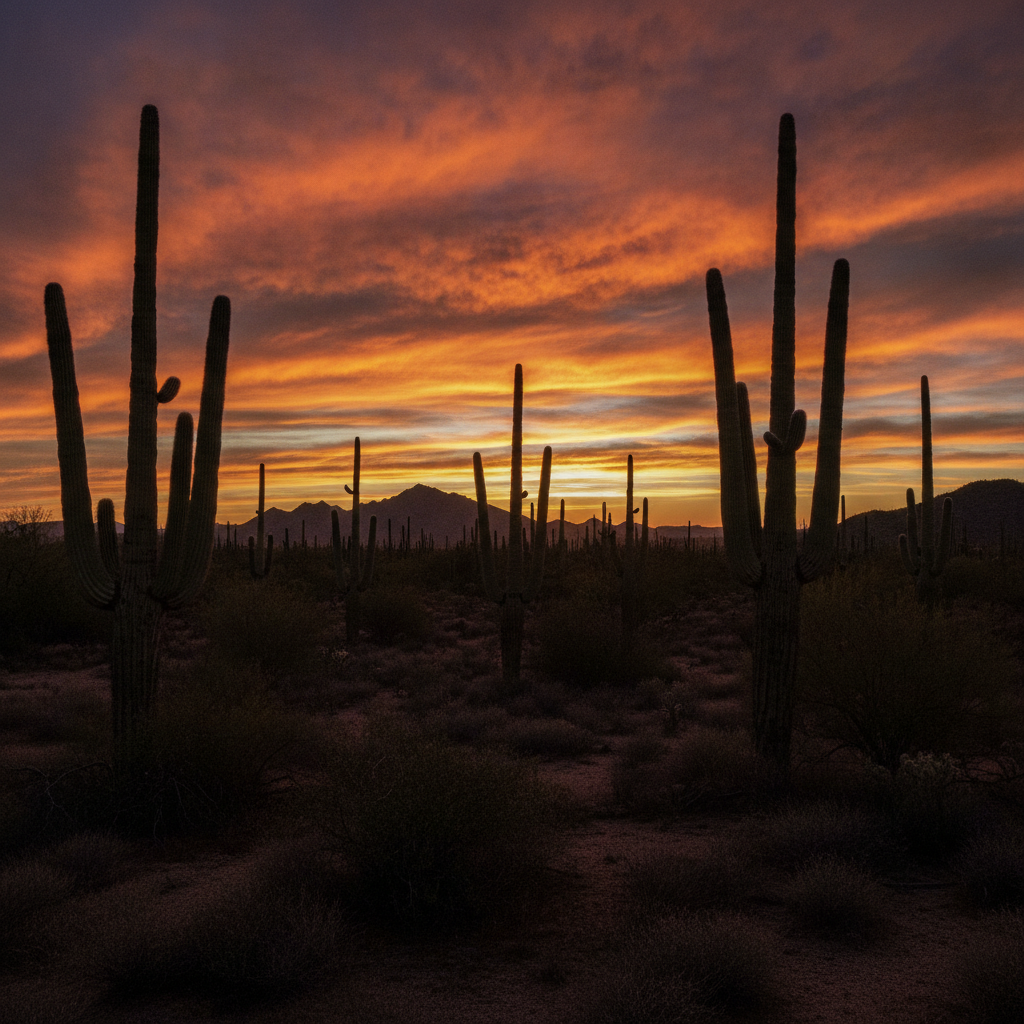
Tucson: Giant Cactus Wilderness, Desert Science and Sonoran Heritage
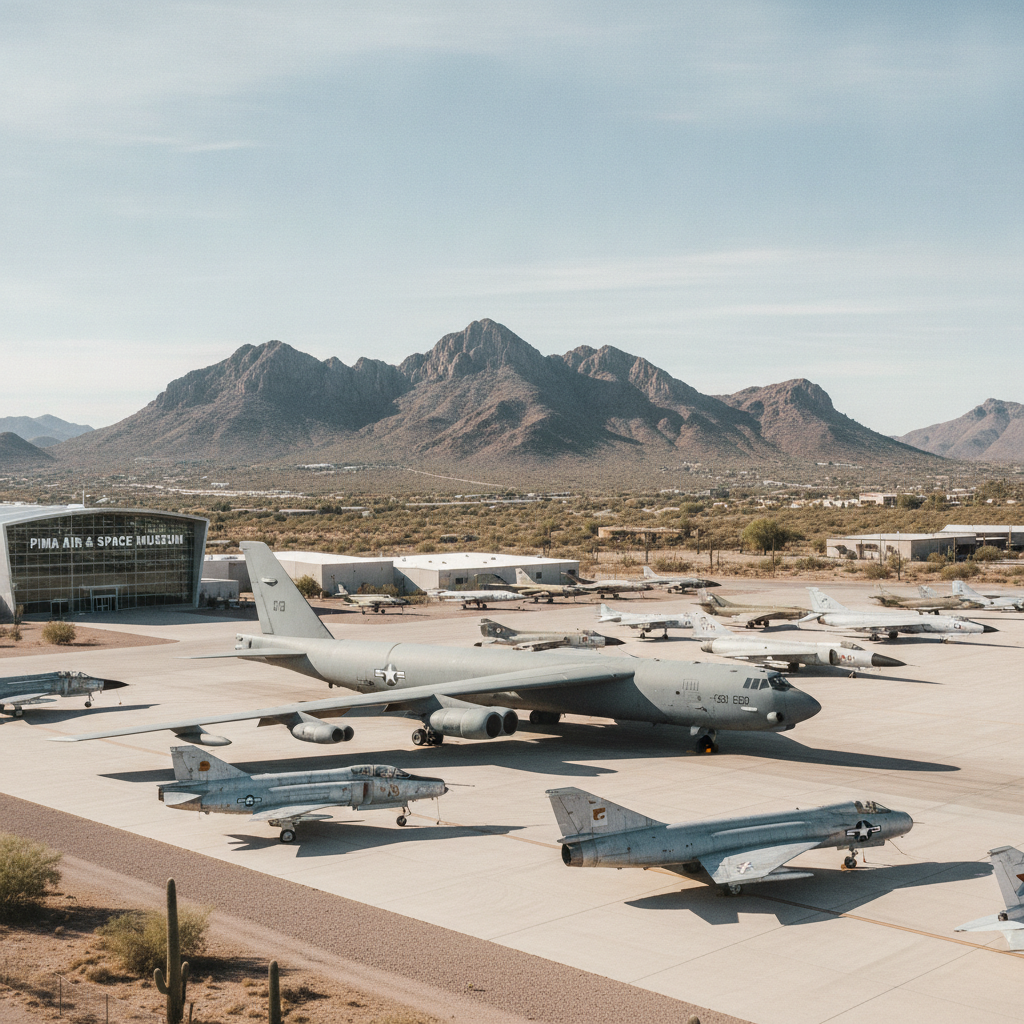
Tucson: Adobe Neighborhoods, Mission Ruins and 3,400 Stored Aircraft