Tucson: Saguaro National Park, University of Arizona, Tohono O'odham Nation, San Xavier Mission, Biosphere 2, and Sonoran Food
Tucson (elevation 728 m, population 545,000, the second-largest city in Arizona after Phoenix) is the oldest continuously inhabited city in the United States, with archaeological evidence of Hohokam habitation at the confluence of the Santa Cruz River and Rillito Creek dating back 4,000+ years. The city is surrounded on all four sides by mountain ranges -- the Santa Catalinas to the north (2,791 m), the Rincons to the east (2,641 m), the Tucsons to the west, and the Santa Ritas to the south (2,885 m, with the Mount Wrightson summit the highest peak in the range) -- creating a sky island topography that produces extraordinary biodiversity. Tucson is UNESCO Creative City of Gastronomy (the first US city, 2015), home to Saguaro National Park (370 square km protecting the iconic saguaro cactus ecosystem on both flanks of the city), the University of Arizona (46,000 students, 1885, oldest institution in Arizona Territory), and the adjacent Tohono O'odham Nation (11,500 sqkm second-largest US reservation). The city has a desert climate with 310+ days of sunshine, a summer monsoon season (July 4 to September 15) that delivers 60-70% of annual rainfall, and the distinctive Sonoran Desert landscape of saguaro, palo verde, ocotillo, and cholla.
- 1
Saguaro National Park - The Forest of Giants
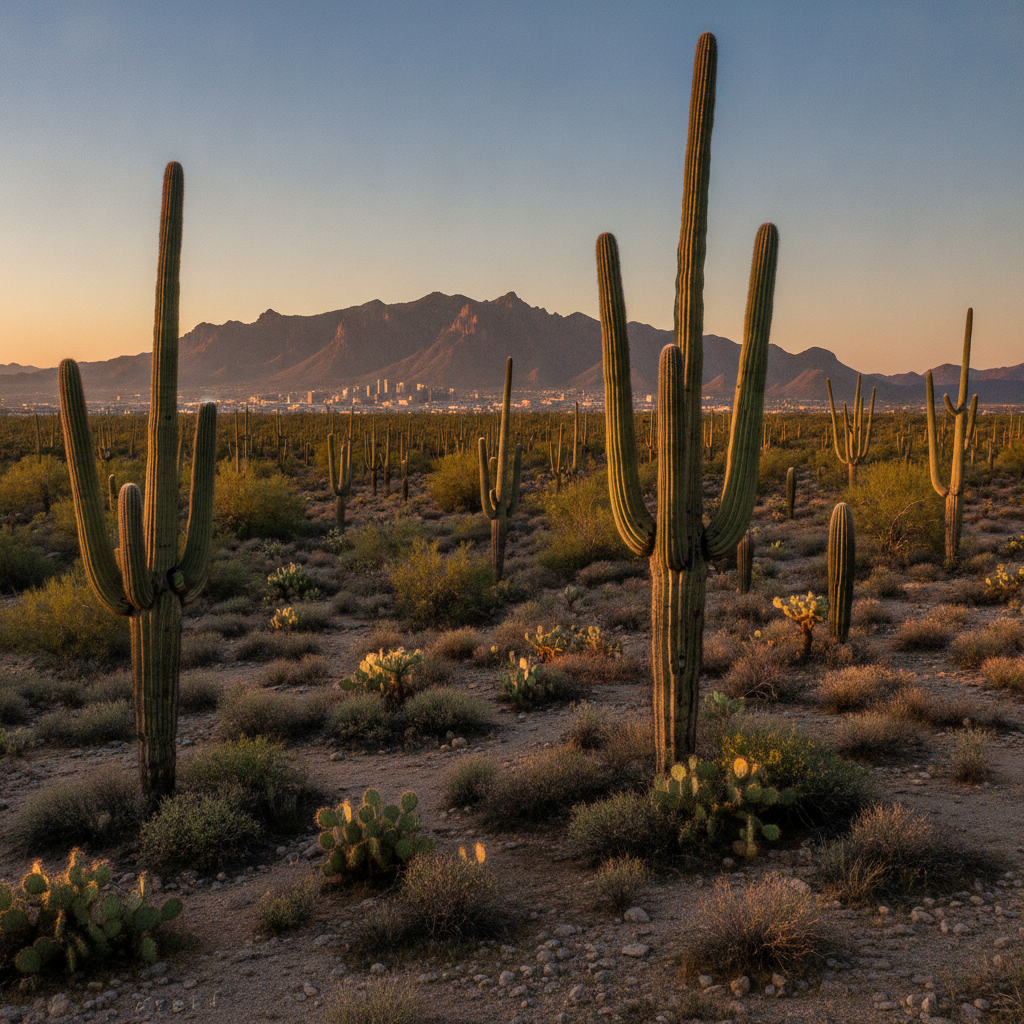
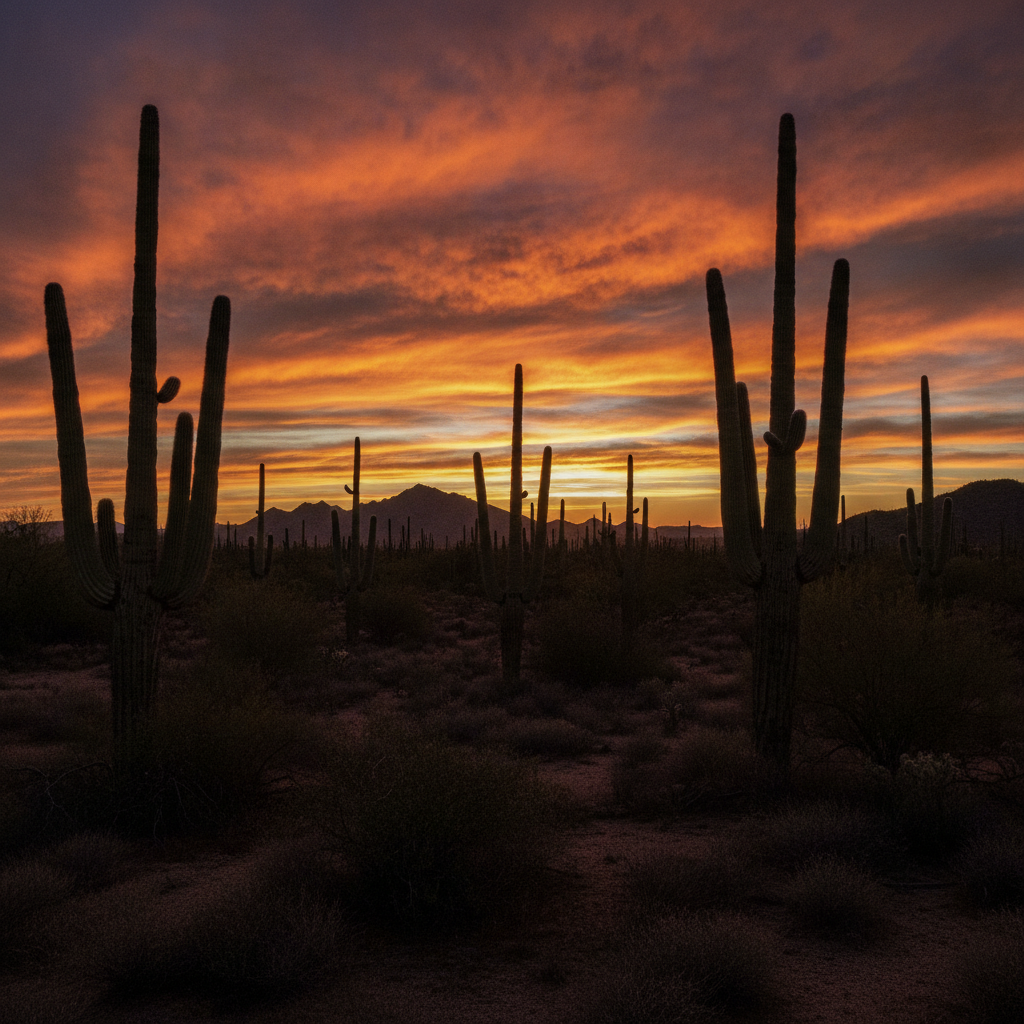
Saguaro National Park (two separate districts flanking Tucson: the Rincon Mountain District, 32 km east at 3693 South Old Spanish Trail, and the Tucson Mountain District, 25 km west at 2700 North Kinney Road, combined area 370 square km, established as a national monument 1933, redesignated as a national park October 14, 1994): the national park protecting the Sonoran Desert and its iconic saguaro cactus (Carnegiea gigantea) population on both flanks of the city of Tucson. The saguaro cactus: the columnar cactus that defines the Sonoran Desert aesthetic -- growing exclusively in the Sonoran Desert of southern Arizona, northwestern Sonora (Mexico), and a small area of California, reaching heights of 12-15 m, living 150-200 years, weighing up to 2,200 kg when fully hydrated (80-90% water), and developing the first arm only after 75 years of growth. A saguaro seedling that survives its first critical years under the nurse plant (typically a palo verde or ironwood tree that provides shade from the lethal midday sun) grows approximately 2.5 cm per year for the first decade. The saguaro ecosystem: 60+ wildlife species depend directly on the saguaro for food or shelter -- the Gila woodpecker (Melanerpes uropygialis) drills nest cavities in living saguaro trunks, which are later reused by elf owls (Micrathene whitneyi, the smallest owl in North America at 14 cm), American kestrels, and brown-crested flycatchers. The saguaro blossom (Carnegiea gigantea flower): the Arizona state flower, blooming May-June in white, cup-shaped flowers at the saguaro tips (each flower open for less than 24 hours and pollinated by lesser long-nosed bats -- Leptonycteris yerbabuenae -- whose migrations from Mexico time precisely with the saguaro bloom). The Rincon Mountain District: 165 km of trails from desert floor at 850 m to the Mica Mountain summit at 2,641 m, spanning five life zones.
- 2
The University of Arizona and Downtown Tucson Arts
The University of Arizona (main campus at 1401 East University Boulevard, Tucson, established by the first Arizona Territorial Legislature in 1885, the first institution of higher education in Arizona Territory -- 25 years before Arizona statehood in 1912, 3 years before the adjacent city of Tucson was incorporated as a municipality): the state flagship research university with 46,000 students, a Carnegie R1 research designation, and annual research expenditures of approximately USD 760M. The UA Steward Observatory and Lunar and Planetary Laboratory (at 933 North Cherry Avenue, Tucson): the home of some of the most significant space science in the American Southwest, including the telescopes of the Mount Graham International Observatory (the observatory complex at Mount Graham, 130 km northeast of Tucson, at 3,267 m, including the Vatican Advanced Technology Telescope and the Large Binocular Telescope -- the telescope with the largest aperture of any single-mount telescope in the world at 11.8 m effective aperture). The UA campus museums: the Arizona State Museum (at 1013 East University Boulevard, established 1893, the oldest and largest anthropology museum in the American Southwest, with the most comprehensive collection of Hohokam, Mogollon, and ancestral Pueblo material culture in the world), the Center for Creative Photography (at 1030 North Olive Road, the research museum holding the archives of Ansel Adams, Edward Weston, W. Eugene Smith, and 50+ other major 20th century photographers -- the most important photography archive in the United States after the Library of Congress), and the UA Museum of Art. Downtown Tucson arts: the 4th Avenue district (from University Boulevard to 9th Street) and the Arts District on Congress Street form the indie/arts corridor of Tucson, with the Rialto Theatre (at 318 East Congress Street, built 1920, capacity 1,400) as the primary live music venue.
- 3
Tohono O'odham Nation and the Sonoran Desert Peoples
The Tohono O'odham Nation (the federally recognized Native American nation with a reservation of 11,500 square km (2.8 million acres) in southern Arizona and a small area in Sonora, Mexico -- the second-largest reservation in the United States by area after the Navajo Nation, with a population of approximately 28,000 enrolled members, 11,000 of whom live on the reservation): the desert-adapted people who have inhabited the Sonoran Desert for thousands of years, developing a sophisticated agricultural and gathering culture based on the saguaro, the cholla cactus, ironwood seeds, mesquite pods, tepary beans, and the summer flash flood agriculture of the bajadas (desert slopes). The Tohono O'odham language (a Uto-Aztecan language closely related to the Akimel O'odham language of the Pima people): one of the more robust indigenous languages of the American Southwest, with approximately 8,000-10,000 speakers and active language revitalization programs. The Tohono O'odham Nation has jurisdiction over 75 miles of the US-Mexico border (more than any other Native nation or any US state except California, New Mexico, and Texas), making it a frontline community in the immigration and border security debate -- thousands of migrants cross the O'odham reservation annually, with hundreds dying of heat, thirst, and exposure in the extreme desert conditions. The Desert Diamond Casino (operated by the Tohono O'odham Gaming Enterprise, with locations in Tucson and Sahuarita): the primary economic enterprise of the nation, employing approximately 1,200 people. The San Xavier del Bac Mission (at 1950 West San Xavier Road, Tucson, 15 km south of downtown, built 1783-1797): the finest example of Spanish Colonial architecture in the United States -- the White Dove of the Desert -- built by the Tohono O'odham people under Franciscan direction and still an active parish serving the Tohono O'odham community.
- 4
San Xavier del Bac, the Spanish Missions, and Tumacacori
San Xavier del Bac (the mission church at 1950 West San Xavier Road, 15 km south of downtown Tucson, on the Tohono O'odham San Xavier Reservation): the best-preserved Spanish Colonial mission church in the United States, built 1783-1797 (the original mission was founded by Jesuit Father Eusebio Francisco Kino -- born August 10, 1645, Segno, Trentino, Austrian Empire; died March 15, 1711, Magdalena, Sonora -- in 1692, the same year Father Kino first visited the O'odham village of Bac and observed the native inhabitants living peacefully). The exterior: dazzling white lime plaster over fired brick with one completed bell tower and one unfinished tower (the legend that the completed tower would trigger a tax on the completed building is disputed by historians -- the most likely explanation is that funds ran out in 1797). The interior: the most complete collection of Spanish Colonial religious art in the United States, with the original polychrome sculpture, gilded altarpieces, and painted plaster decorations covering every surface of the nave and sanctuary -- an extraordinary survival of 18th century Franciscan Baroque art. The restoration: the mission underwent a major restoration by Polish and Tohono O'odham craftsmen from 1992-1997 (500 years after Kino's visit) using traditional lime plaster and natural pigment techniques. The Friday Mass: the mission still serves the Tohono O'odham community with regular Catholic services. Tumacacori National Historical Park (at 1891 East Frontage Road, Tumacacori, AZ, 80 km south of Tucson, established 1908): the ruins of three Spanish Colonial missions founded by Father Kino between 1691 and 1711, showing the adobe and fired-brick construction in various states of preservation -- the most complete mission ruin complex in the American Southwest.
- 5
Biosphere 2 and the Science of the Sonoran Desert
Biosphere 2 (at 32540 South Biosphere Road, Oracle, AZ, 50 km north of Tucson): the 1.27-hectare sealed glass and steel structure containing seven model ecosystems (tropical rainforest, ocean with coral reef, mangrove wetlands, savanna grassland, fog desert, agricultural area, and human habitat) that was the site of the most ambitious ecological experiment in history -- the two human crew missions of 1991-1993 (Biosphere 2 Mission 1: eight crew sealed inside September 26, 1991 for two years, emerging September 26, 1993; Mission 2: seven crew sealed March 6, 1994, experiment terminated September 6, 1994) designed to test whether a completely sealed, self-sustaining biosphere could support human life. The science: the oxygen in Biosphere 2 dropped unexpectedly from 21% to 14.5% (equivalent to breathing air at 4,100 m altitude) because the concrete in the structure absorbed CO2 and promoted microbial respiration in the soil -- a discovery that led to new understanding of how concrete infrastructure absorbs CO2. The morning glory vine (Ipomoea): overcame the agricultural biome and had to be manually removed by the crew, demonstrating the difficulty of controlling ecological succession in a closed system. Biosphere 2 is now operated by the University of Arizona as a research facility and public attraction (tours available), focusing on climate change simulation, the impacts of ocean acidification on coral reefs, and how different atmospheric CO2 concentrations affect plant growth. The Arizona-Sonora Desert Museum (at 2021 North Kinney Road, Tucson, adjacent to Saguaro National Park West, established 1952): the combination zoo, botanical garden, and natural history museum with 300 animal species and 1,200 plant species of the Sonoran Desert in an open-air walk-through habitat -- consistently rated among the top 10 zoos in the United States by TripAdvisor and travel publications.
- 6
Tucson Food, Art, Barrio Viejo, and the Border City Identity
Tucson as a UNESCO Creative City of Gastronomy (designated November 2015, the first city in the United States to receive the UNESCO Creative City of Gastronomy designation): the recognition of Tucson's 4,000-year-old food culture, based on the indigenous Sonoran Desert agriculture (tepary beans, cholla buds, saguaro fruit, mesquite pods, amaranth, and the heritage crops of the O'odham people) and the evolution of that agricultural tradition through Spanish Colonial, Mexican, and American periods into the distinctive Sonoran cuisine of southern Arizona. The Tucson food traditions: the Sonoran hot dog (the bacon-wrapped, mayo-mustard-tomato-bean hot dog of the Sonoran Desert) and the distinctive flour tortilla of southern Arizona (thinner and wider than Tex-Mex flour tortillas, made with manteca -- lard -- by hand: the tortilla de agua of the Sonoran tradition) are the two most distinctively Tucson food items. El Guero Canelo (at 5201 South 12th Avenue, Tucson, the original location, founded 1993 by Daniel Contreras): the most famous Sonoran hot dog restaurant in the United States, featured in the New York Times and voted the best hot dog in America by multiple food publications. The Mercado San Agustin (at 100 South Avenida del Convento, Tucson, the historic flour mill district converted to a marketplace): the farmers market, restaurant, and artisan hub in the Menlo Park neighborhood. Barrio Viejo (the historic neighborhood immediately south of downtown Tucson, between Stone Avenue and I-10, bounded by Broadway and 22nd Street): the most intact 19th century Mexican-American barrio in the United States, with Sonoran-style row houses (built directly on the sidewalk with interior courtyards) in original adobe with decorated gates and painted facades -- a neighborhood that was 80% demolished by urban renewal in the 1960s-70s (the Barrio Libre), with the surviving blocks the most authentic pre-American urban fabric in Arizona.
Walk this route with audio
Stories play automatically as you reach each stop — no tapping needed.
More in tucson

Tucson: Titan Missile Museum, Dark Skies, Hotel Congress, Neighborhoods, Kartchner Caverns, and Practical Info
Tucson: Mount Lemmon, Tombstone, Colossal Cave, the Border at Nogales, Bisbee, and the Desert Monsoon
Tucson: UNESCO Food Heritage, Cold War Missiles and Sky Island Summits
Tucson: Giant Cactus Wilderness, Desert Science and Sonoran Heritage
Tucson: Adobe Neighborhoods, Mission Ruins and 3,400 Stored Aircraft