Tripoli: Roman Arch, Ottoman Medina, Leptis Magna, and the Legacy of Gaddafi
Tripoli as the capital of Libya: the Arch of Marcus Aurelius as the only Roman monument in the city center; the Ottoman medina with the Gurgi Mosque and the Red Castle; Leptis Magna as the finest Roman city in Africa and birthplace of Emperor Septimius Severus; Sabratha and its extraordinary three-story Roman theatre; 42 years of Gaddafi and the Great Jamahiriya; and the fate of Libya and its UNESCO World Heritage sites after the 2011 revolution.
- 1
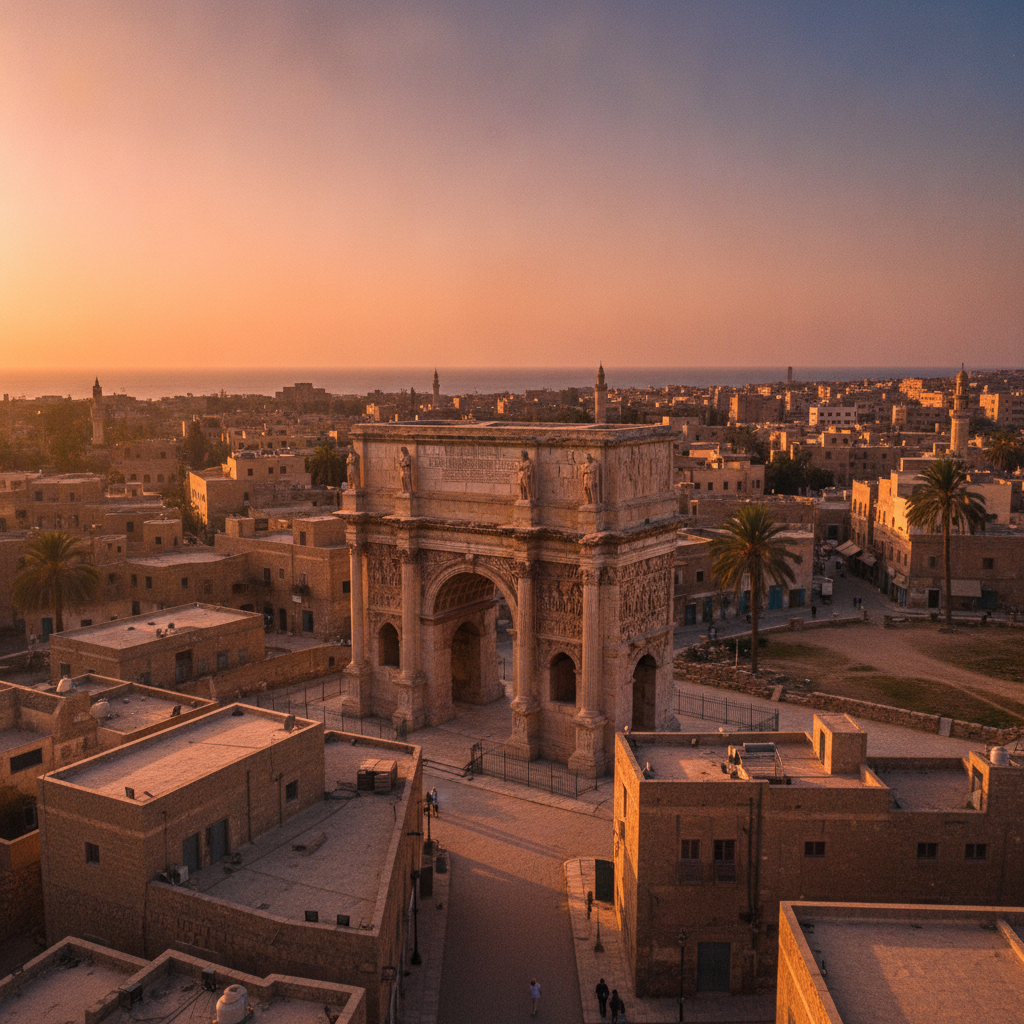
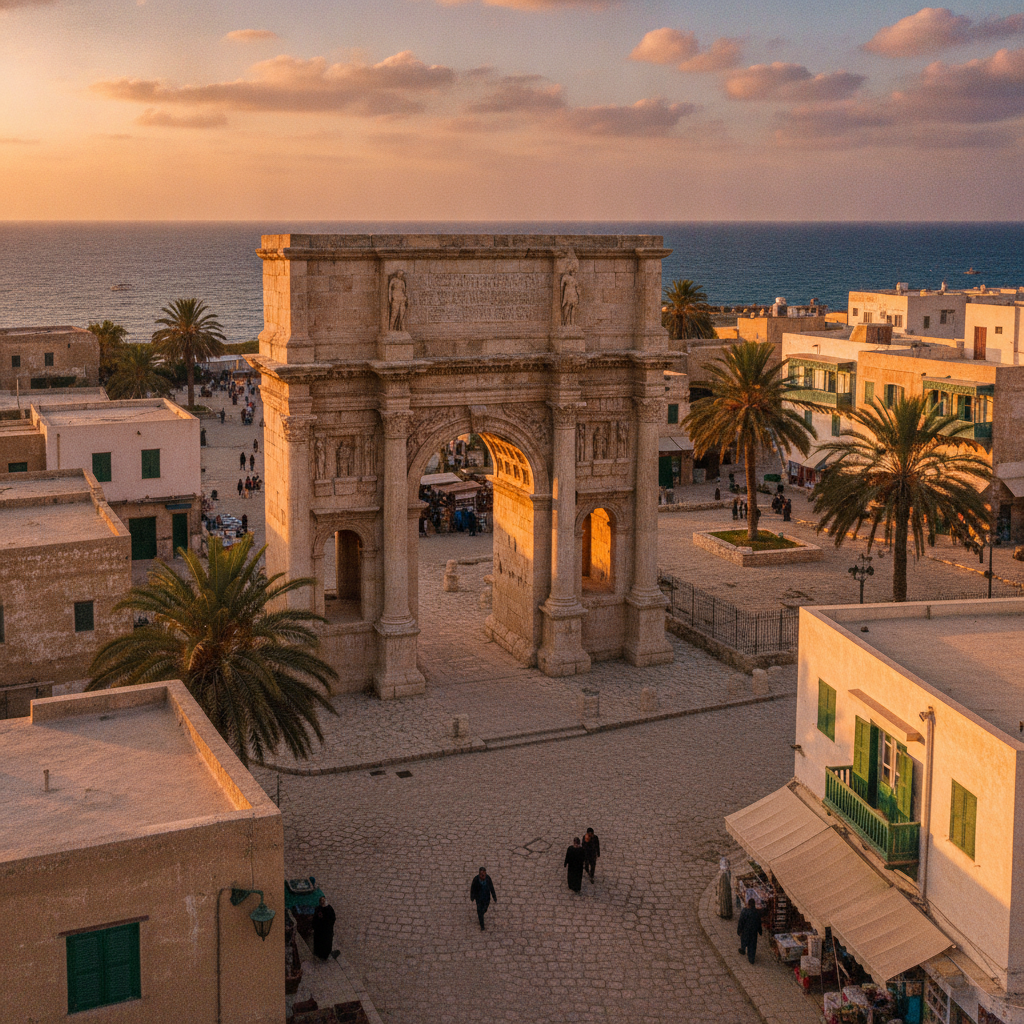
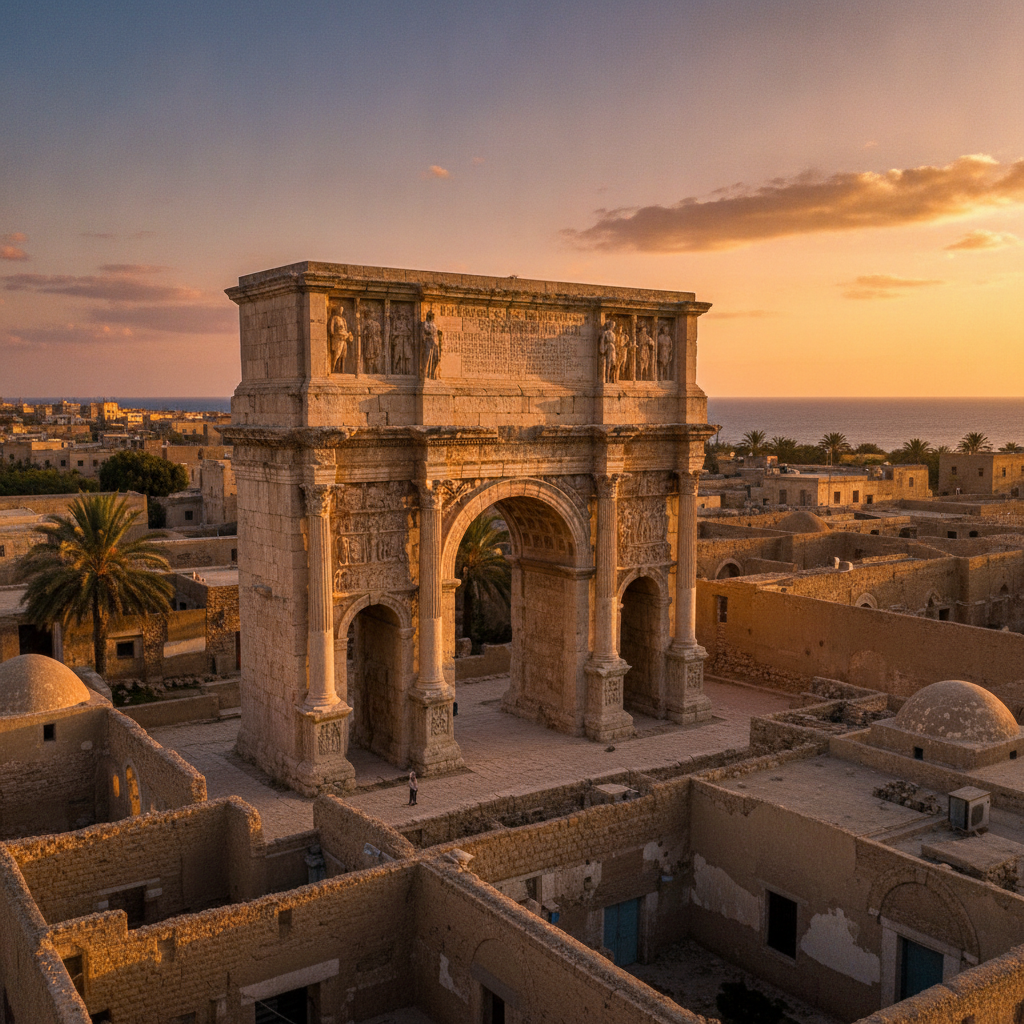
The Arch of Marcus Aurelius - The Only Roman Monument in Tripoli City Center
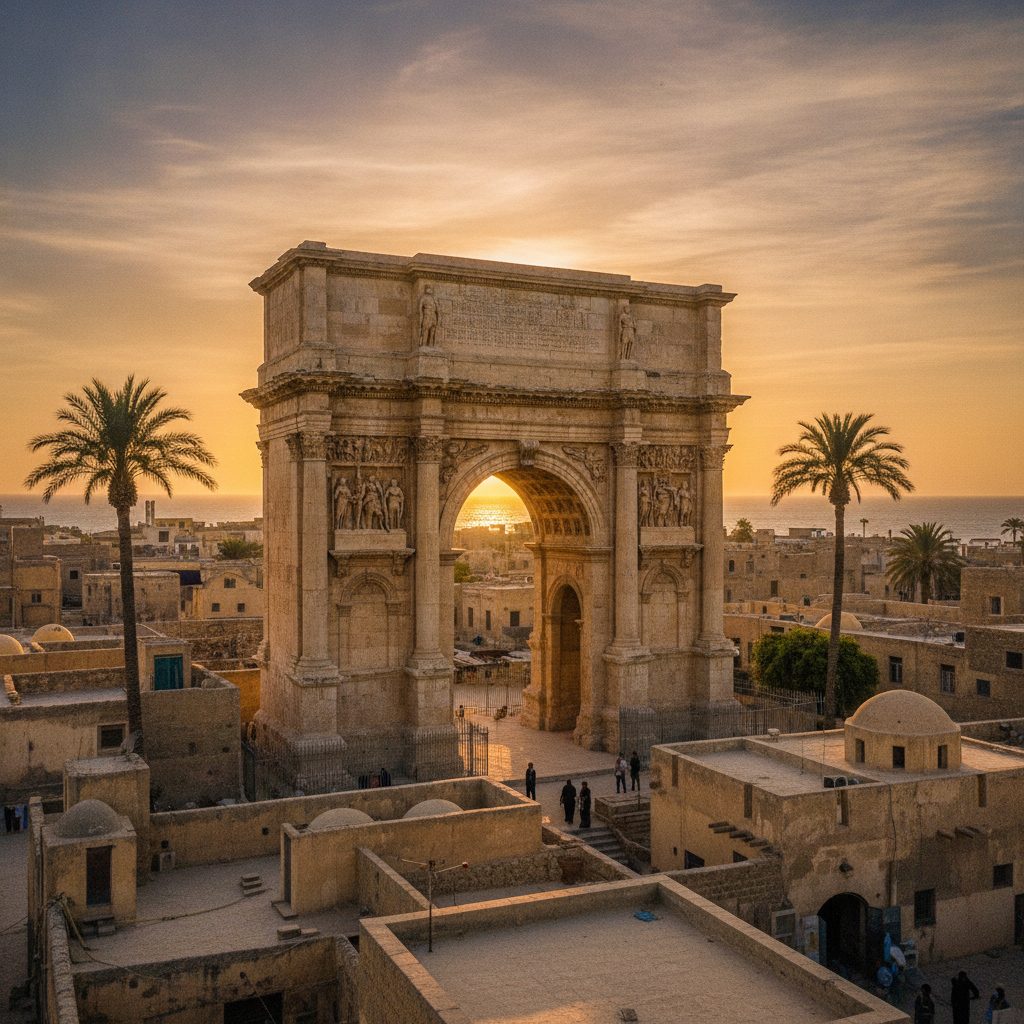
The Arch of Marcus Aurelius is the sole surviving Roman monument in Tripoli city center, erected in 163 CE to celebrate the visit of Emperor Marcus Aurelius and co-emperor Lucius Verus to Africa Proconsularis. The arch is a quadrifrons (four-sided triumphal arch) with Corinthian columns and a dedication inscription to both emperors. It stands at the original crossing of the decumanus maximus and cardo maximus of ancient Oea (the Roman name for Tripoli). While the arch survives, the rest of Roman Oea lies buried beneath the modern city. Oea was one of the three Phoenician-Carthaginian cities called Tripolis (Three Cities), the others being Leptis Magna and Sabratha; Tripoli takes its name from this ancient grouping. The arch is now surrounded by the buildings of the old medina and its Roman isolation makes it a striking anachronism.
- 2
The Medina of Tripoli - Ottoman Mosques and the Red Castle on the Waterfront
The Old City (Medina) of Tripoli contains significant Ottoman-era architecture built on Phoenician-Roman foundations. The city passed through Phoenician, Roman, Vandal, Byzantine, Arab, Fatimid, Zirid, Norman Sicilian, Hafsid, Spanish, and Ottoman hands before the Karamanli dynasty (1711-1835) and direct Ottoman rule (1835-1911). The finest Ottoman monument is the Gurgi Mosque (1833), built by Yusuf Gurgi with an extraordinary painted interior incorporating Andalusian-Moroccan tilework and Ottoman tile panels: one of the most beautiful mosque interiors in North Africa. The Karamanli Mosque (1738) and Ahmed Pasha Karamanli Mosque are also significant. The medina souks include the souk al-Turk, souk al-Attara (spice market), and souk al-Harir (silk market). The Red Castle (Assai al-Hamra, Saraya al-Hamra) is the massive waterfront fortress that has served as the seat of power in Tripoli across all periods of the city's history, now housing the Jamahiriya Museum with one of the finest collections of Roman, prehistoric, and Islamic art in North Africa.
- 3
Leptis Magna - The Greatest Roman City in Africa and Emperor Septimius Severus
Leptis Magna (Labdah) is a UNESCO World Heritage Site 130 km east of Tripoli and the finest and most completely preserved Roman city on the African continent. Originally a Phoenician trading post, it became a major Roman city whose greatest benefactor was the Emperor Septimius Severus (193-211 CE), the first African-born Roman Emperor, who was born in Leptis and lavished extraordinary building programs on his hometown. The Severan Forum and Basilica form the largest forum complex in Roman Africa, with massive marble columns and relief panels depicting the apotheosis of Septimius Severus. The Hadrianic Baths are the largest Roman bath complex in Africa. The theatre (2nd century CE) overlooks the sea. The Arch of Septimius Severus (203 CE) is one of the finest surviving Roman triumphal arches. The artificial harbour (whose silting killed the city's trade but also preserved the city under sand for centuries) is extraordinary. The Hunting Baths have exceptional painted ceilings with marine mosaics. Leptis is largely unvisited and in outstanding preservation: arguably the most important unvisited archaeological site in the world.
- 4
Sabratha - The Roman Theatre and the Trans-Saharan Trade City
Sabratha (Abrotonum) is a UNESCO World Heritage Phoenician-Roman city 70 km west of Tripoli, home to one of the finest Roman theatres in the Mediterranean world. The Theatre of Sabratha (built approximately 180-200 CE and reconstructed by Italian archaeologists 1927-1937) has a three-story scaenae frons with 84 columns in three tiers of Corinthian capitals and extraordinary carved relief panels depicting theatrical masks and mythological scenes: seating approximately 5,000-6,000 spectators. Sabratha was one of the three Phoenician-Carthaginian cities of the Tripolis and derived its wealth from the trans-Saharan trade: Garamantian routes brought gold, slaves, exotic animals, and ivory from Sub-Saharan Africa through the Fezzan desert to the Mediterranean. The Garamantes (the ancient Berber people of the Libyan Sahara) were expert desert navigators who maintained these trade routes using an extraordinary underground irrigation system (foggaras). Augustine of Hippo was tried before a Roman court in Sabratha in approximately 388 CE by the Manichaeans, before his episcopal career. The Sabratha museum holds Roman mosaics, sculpture, and artifacts from the site. Access from Tripoli is straightforward when security conditions permit.
- 5
Muammar Gaddafi and the Great Jamahiriya - 42 Years of Revolutionary Libya
Muammar Gaddafi (1942-2011) led Libya for 42 years after a bloodless coup on September 1, 1969, when the 27-year-old Colonel overthrew King Idris I while the king was abroad. Gaddafi nationalized the Libyan oil industry (1973) and expelled American and British military bases. His ideology (the Third International Theory, published in the Green Book 1975-1979) rejected both capitalism and Soviet communism, proposing direct democracy through Basic Popular Congresses, abolition of private ownership, and a novel social theory. He renamed the state the Great Socialist People's Libyan Arab Jamahiriya (a word he invented meaning state of the masses) in 1977. Libya has the largest proven oil reserves in Africa (approximately 48 billion barrels) and oil revenues funded free housing, education, and healthcare: the Libyan standard of living was among the highest in Africa. Gaddafi funded Palestinian, IRA, and African liberation movements; Libya was found responsible for the Lockerbie bombing (Pan Am Flight 103, December 21, 1988: 270 killed) and paid approximately USD 2.7 billion to victims in 2003. Gaddafi was captured and killed near Sirte on October 20, 2011, following a NATO-backed civil war. He remains one of the most polarizing figures in African and Arab political history.
- 6
Tripoli Legacy - Libya After Gaddafi and the UNESCO Sites Under Threat
Tripoli legacy: the Libyan capital after 2011 and the fate of the most important Roman archaeological sites in the world in an active conflict zone. The 2011 revolution began in Benghazi in February, triggered by the Arab Spring. NATO established a no-fly zone under UN Security Council Resolution 1973 and conducted air strikes on Gaddafi forces. Tripoli fell on August 20-28, 2011 and Gaddafi was killed on October 20. The post-Gaddafi transition quickly fragmented: the second civil war (2014-present) divided Libya between the Tripoli-based internationally recognized government and the Tobruk-Benghazi House of Representatives backed by Field Marshal Khalifa Haftar and the Libyan National Army. Haftar launched an offensive against Tripoli in 2019-2020 that was repelled with Turkish military support. Armed militias control different Tripoli districts. All five Libyan UNESCO World Heritage Sites (Leptis Magna, Sabratha, Cyrene, the Tadrart Acacus rock art, and the Old City of Ghadames) are considered at high risk from instability and absent conservation: Leptis Magna and Sabratha are among the most endangered UNESCO sites in the world. Libya holds the richest concentration of Roman archaeological sites in Africa and among the finest in the world. The resolution of the Libyan political conflict is an international cultural heritage imperative.
Walk this route with audio
Stories play automatically as you reach each stop — no tapping needed.
More in Tripoli
Tripoli: Cyrene, the Garamantes, Ghadames, and the Italian Colonization of Libya
Tripoli Complete Reference - Jamahiriya, Lockerbie, Roman Mosaics, and the Libyan Sahara
Tripoli Day Trips: Nafusa Mountains, Garian Underground Houses, Acacus Rock Art, and Practical Libya Guide
Tripoli: Omar Mukhtar, King Idris, the Oil Discovery, and Modern Libya