Royal Ontario Museum, University of Toronto & Bloor-Yorkville
The Bloor-Yorkville corridor — Toronto's most prestigious retail and cultural strip, running along Bloor Street West from the Royal Ontario Museum and the University of Toronto at its west end through the luxury boutiques of Yorkville to the eastern edge of the Annex neighbourhood — combines world-class museum collections, one of Canada's great universities, and the most concentrated luxury retail in Canada.
- 1
Royal Ontario Museum — Canada's Largest Museum
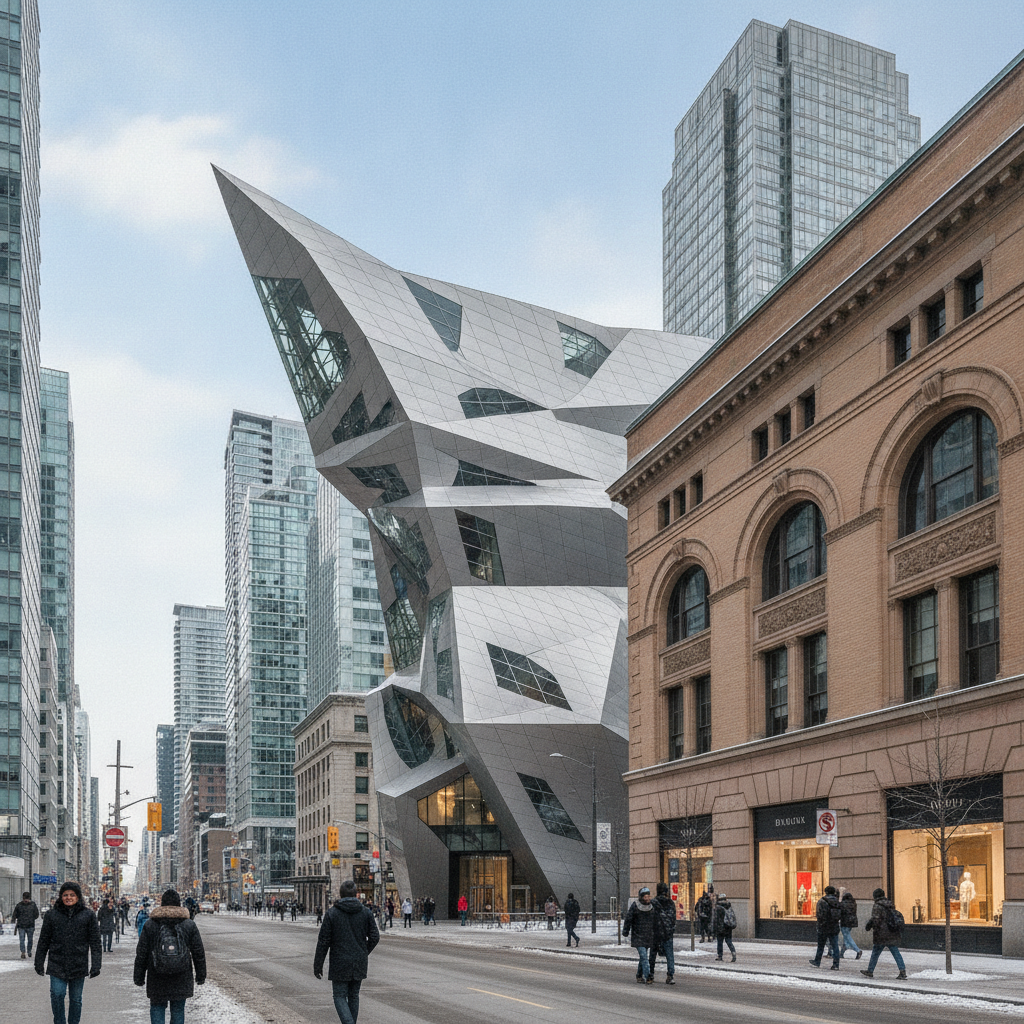
Royal Ontario Museum (100 Queens Park, Bloor Street West — Canada's largest museum and the fifth-largest in North America, founded 1914, with a collection of approximately 13 million items spanning art, world cultures, and natural history; expanded 2007 with the Michael Lee-Chin Crystal designed by Daniel Libeskind): the ROM's collections range from the Ancient Egyptian collection (with mummies and funerary objects) through the Greek and Roman galleries to the Chinese collection (one of the finest outside China, comprising more than 35,000 objects) and the Indigenous Canadian collection; the natural history collections include one of the most complete dinosaur halls in the world, featuring specimens from Canada's Dinosaur Provincial Park in Alberta; the Libeskind Crystal addition is one of the most controversial and celebrated pieces of institutional architecture in Canada — five interlocking metallic prismatic forms that jut from the corner of Bloor and Avenue Road at sharp angles.
- 2
University of Toronto — Canada's Leading Research University
University of Toronto (St. George Campus, bounded roughly by Bloor Street to the north, College Street to the south, Spadina Avenue to the west, and Bay Street to the east — the oldest and most research-intensive university in Canada, founded 1827 by royal charter): the St. George Campus is an extraordinary urban campus with Gothic Revival, Romanesque, Italianate, and Modernist architecture spanning 150 years of Canadian academic building; the most significant buildings include University College (1859, the original building of the university, one of the finest examples of Norman Romanesque architecture in North America), Hart House (1919, the student centre designed by Henry Sproatt in Gothic collegiate style, with the Hart House Theatre and the Gallery of Hart House), Trinity College (1851, modeled on Christ Church Oxford, with one of the finest quadrangles in Canada), and the Robarts Library (1973, the brutalist megastructure nicknamed 'Fort Book' that houses the largest research library collection in Canada).
- 3
Bloor-Yorkville — Toronto's Luxury Quarter
Bloor-Yorkville (Bloor Street West between Bay Street and Avenue Road, and the Village of Yorkville — the former bohemian artist colony and hippie haven of the 1960s, when Joni Mitchell, Neil Young, Gordon Lightfoot, and many others played the coffeehouses of Yorkville Avenue before their careers took off, subsequently gentrified into Toronto's most prestigious retail and dining district): Bloor Street between Bay and Avenue Road contains the Toronto flagship stores of Hermès, Louis Vuitton, Chanel, Gucci, Prada, Cartier, Tiffany & Co., Harry Rosen, and virtually every other major luxury brand; Yorkville Avenue and Hazelton Avenue (the two streets behind Bloor in the Yorkville neighbourhood) contain high-end independent boutiques, design galleries, and the finest restaurants in Toronto; the Four Seasons Hotel, the Hazelton Hotel, the Park Hyatt Toronto, and the Intercontinental Toronto Yorkville are all in this neighbourhood.
- 4
Gardiner Museum — Canadian Ceramics & Decorative Arts
Gardiner Museum (111 Queens Park, directly across from the ROM — the only museum in Canada dedicated entirely to ceramics, with a collection of 4,000 ceramic works from pre-Columbian Americas, ancient Japan, Renaissance Italy, 18th-century England and France, and contemporary Canadian and international ceramic art): the Gardiner is one of the finest specialized ceramics museums in the world; the collection includes the outstanding pre-Columbian collection (the ancient pottery of the Aztec, Maya, and other Mesoamerican cultures — one of the best such collections in North America), the Italian Maiolica collection (the richly coloured tin-glazed earthenware of Renaissance Italy, with pieces from the major production centres of Faenza, Deruta, Gubbio, and Urbino), and the delicate porcelain of 18th-century Dresden, Meissen, and Sèvres.
- 5
Annex & Harbord Village — Toronto's Academic Quarter
The Annex (the residential neighbourhood immediately north and west of the University of Toronto, bordered by Bloor Street to the south, Dupont Street to the north, Bathurst Street to the west, and Avenue Road to the east): the Annex was developed in the 1880s-1900s as an upper-middle-class residential area and is one of the best-preserved Victorian and Edwardian residential neighbourhoods in Canada — the broad streets are lined with three-storey Bay-and-Gable Victorian houses (the distinctive Toronto vernacular house type, with a front bay window and a high gabled roof), many of which now house professors, graduate students, artists, and the intellectual professional class of the University of Toronto community; Bloor Street through the Annex (from Spadina west to Bathurst) is Toronto's most concentrated independent bookstore street.
- 6
Casa Loma — Toronto's Gothic Revival Fantasy Castle
Casa Loma (1 Austin Terrace, Davenport — the 98-room Gothic Revival castle built 1911-1914 by financier Sir Henry Mill Pellatt at a cost of $3.5 million (approximately $85 million in 2023 dollars), the only castle of its type in North America): Casa Loma (Spanish for 'house on the hill') was the private residence of Pellatt and his wife until 1923, when Pellatt's financial ruin forced him to abandon the property; the castle was subsequently taken over by the city of Toronto and has operated as a tourist attraction since 1937; the castle contains 30 bathrooms, three bowling lanes, a 1,700-square-metre Great Hall, a 18-metre-high two-storey library, extensive stables (connected to the main castle by an 800-metre tunnel), secret passages, and towers offering panoramic views over the city to the south; Casa Loma has been used as a filming location for numerous Hollywood productions including 'X-Men' (2000).
Walk this route with audio
Stories play automatically as you reach each stop — no tapping needed.
More in toronto
Aga Khan Museum, North York & Toronto's Suburban Diversity
Toronto's Food Scene — Poutine, Butter Tarts, Peameal Bacon & Global Kitchens
Scarborough Bluffs, The Beaches & Toronto's East End
Kensington Market, Chinatown & the Distillery Historic District
Niagara Falls Day Trip — Horseshoe Falls & the Maid of the Mist