Roppongi Arts District & Tokyo Tower: World-Class Museums, Contemporary Architecture & the City's Most Iconic Silhouette
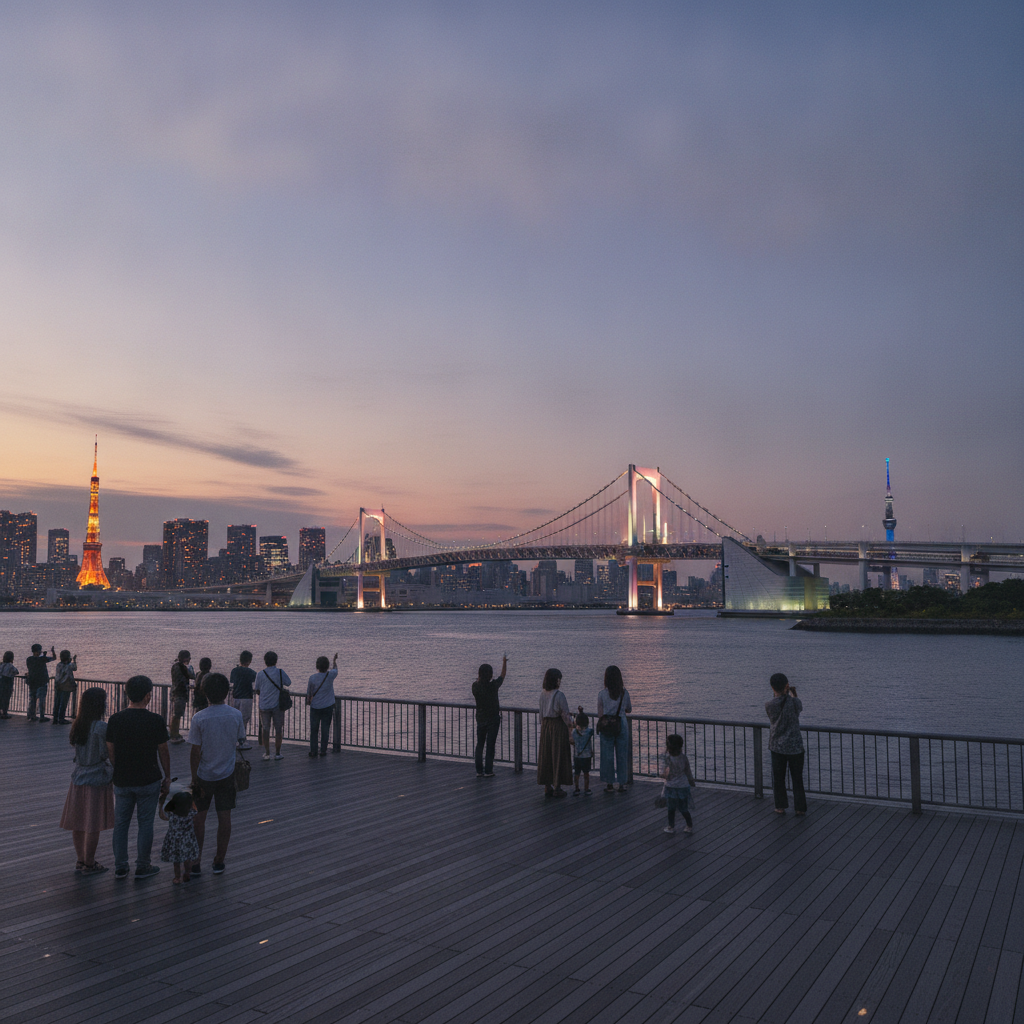
Roppongi has two distinct identities that occupy the same few square kilometers: the nightclub district (one of the most concentrated entertainment zones in Tokyo, with hundreds of clubs, bars and live music venues) and the arts district—specifically the 'Roppongi Art Triangle' formed by three world-class contemporary art and architecture institutions: Mori Art Museum (in Roppongi Hills), 21_21 Design Sight (in Tokyo Midtown), and the National Art Center. The route also passes Tokyo Tower—the 333-meter orange broadcast tower built in 1958, modeled on the Eiffel Tower but taller, which was the defining image of postwar Tokyo's economic miracle and remains the most romantic nighttime view in the city.
- 1
Roppongi Hills & Mori Art Museum — Tokyo's Vertical City
Roppongi Hills is a 27-building, 11-hectare mixed-use development completed in 2003 by developer Mori Building Company, which spent 17 years and ¥500 billion constructing it on the site of a dense low-rise residential neighborhood—a development process that was one of the most contested urban renewals in Tokyo's history. The centerpiece is Mori Tower (54 floors), which contains at its summit the Mori Art Museum (52nd floor, international contemporary art) and the Tokyo City View observation deck (52nd floor, with an additional 'Sky Deck' on the 56th floor roof, open-air). The museum—which has no permanent collection, presenting instead a continuously changing program of major international and Japanese contemporary art exhibitions (past exhibitions have included Takashi Murakami, Ai Weiwei, and major retrospectives of Japanese postwar art)—is open until 10 PM most nights (11 PM on Fridays and Saturdays), making it uniquely suited for evening visits. The complex also contains: Artelligent Gallery (a smaller contemporary gallery at the base of the complex), the Roppongi Hills Arena (an outdoor performance space), Toho Cinemas Roppongi Hills (13-screen cinema), and approximately 200 shops and restaurants.
- 2
Tokyo Midtown & 21_21 Design Sight — Where Architecture Becomes Art
Tokyo Midtown is a six-tower, 2-hectare mixed-use complex completed in 2007 on the former site of the Japan Defense Agency headquarters in Roppongi (the military connection being somewhat ironic given the area's Occupation-era nightlife history). The tallest tower (Midtown Tower, 248 meters) is the second tallest building in Tokyo. The complex contains the Suntory Museum of Art (Japanese and Asian decorative arts, ceramics, lacquerware, textiles and glass), a Ritz-Carlton hotel (30th–53rd floors of Midtown Tower), and numerous upmarket shops and restaurants. The defining element of the complex is 21_21 Design Sight: a design museum and exhibition space co-founded by fashion designer Issey Miyake and architect Tadao Ando (whose concrete-and-glass pavilion, partially underground, extends from a small reflecting pool in the Midtown Garden). The museum presents 3–4 major design exhibitions per year exploring the intersection of design, art, and everyday life (past exhibitions have explored concepts as varied as the design of sports equipment, the aesthetics of packaging, and the design philosophy of individual designers). Its neighbor, the Fujifilm Square gallery (free entry, rotating photography exhibitions), is also excellent.
- 3
National Art Center Tokyo — The Building That Became More Famous Than Its Contents
The National Art Center Tokyo (国立新美術館, Kokuritsu Shin-Bijutsukan), designed by Kisho Kurokawa and completed in 2007, is the largest exhibition space in Japan (14,000 square meters of gallery space) and one of the most architecturally distinctive museum buildings in the world: its undulating glass façade—14 panels of curved glass forming a sinuous wave across the building's 200-meter frontage—is a masterwork of Metabolism-influenced late modernism. The building has no permanent collection; it serves entirely as an exhibition venue for art society and public exhibitions (approximately 25 exhibitions per year). The building's interior is equally dramatic: the glass curtain wall floods the central atrium with natural light, and two inverted concrete cones—topped with restaurants (the Brasserie Paul Bocuse on the 3rd floor and the café Cezanne on the 2nd)—rise from the atrium floor. The bookshop in the basement level is one of the best art bookshops in Tokyo. Even if no exhibition interests you, the building is worth visiting for the architecture alone.
- 4
Tokyo Tower — The Symbol of Postwar Japan
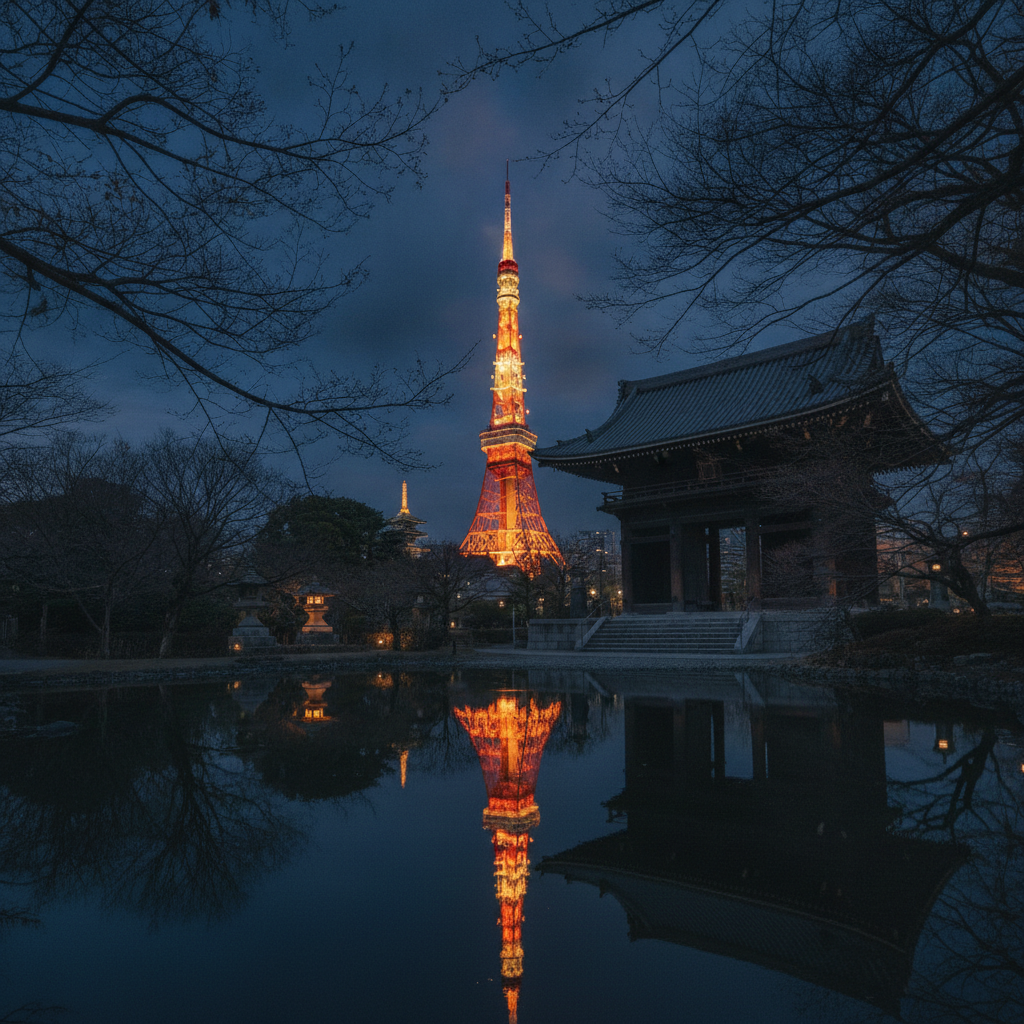
Tokyo Tower (東京タワー), completed in 1958, is a 333-meter self-supporting steel lattice tower in the Shiba-Koen district of Minato Ward, modeled on the Eiffel Tower (which it surpasses in height by 13 meters) and painted in orange and white in accordance with aviation safety regulations (the colors are also a reference to the tower's original function as a television broadcast antenna for Japan's first commercial TV stations, which began broadcasting in 1953). The tower weighs 4,000 tonnes (the Eiffel Tower weighs 7,300 tonnes despite being shorter). Two observation decks: the Main Deck at 150 meters (glass-floored sections), and the Top Deck at 250 meters. The tower is most famous for its nighttime illumination: lit orange against the dark sky, with the city spreading in every direction below, it is one of the most romantic night views in Tokyo. In 2012, its function as a broadcast antenna was transferred to the Tokyo Skytree; the tower now serves as a landmark and tourist attraction. The surrounding Shiba-Koen district contains Zojo-ji Temple (the Tokugawa family's funerary temple, where six of the fifteen Tokugawa shoguns are buried), with the tower visible above its main gate.
- 5
Zojo-ji Temple — The Shogun's Buddhist Temple
Zojo-ji (増上寺) is a Buddhist temple in Shiba-Koen, Minato Ward—one of the head temples of the Jodo (Pure Land) Buddhist sect and the mortuary temple of the Tokugawa shogunate (six of the fifteen Tokugawa shoguns are buried here, together with their wives and children). The temple was established in 1393 and relocated to its current site in 1598 by Tokugawa Ieyasu, who selected it as the family's principal temple immediately before establishing the Tokugawa shogunate. The main gate (Sangedatsumon, 1622, a 21-meter three-story gate in the traditional Karamon style) is the oldest surviving wooden structure in Tokyo and is one of only three such gates remaining in Japan. Most of the temple's structures were destroyed in the 1945 bombing; the main hall was rebuilt in 1974. The graveyard to the left of the main approach contains the graves of six shoguns (protected by a fence, visible from outside) and a remarkable array of Jizo statues (stone guardian figures for children who died young, dressed in red bibs and woolen hats by their parents and arranged in rows). The view from the approach path—looking along the temple's central axis toward Tokyo Tower—is one of the most photographed views in Tokyo.
- 6
Azabudai Hills — Tokyo's Newest Vertical Neighborhood
Azabudai Hills is a large-scale mixed-use development in Minato Ward completed in November 2023, designed by Heatherwick Studio and Pelli Clarke Pelli Architects: the first of its scale to be completed in Tokyo since Roppongi Hills in 2003. The central tower (Mori JP Tower, 330 meters, the tallest building in Japan) is surrounded by a low-rise landscape of planted terraces, gardens, and public spaces designed by Thomas Heatherwick's practice—the approach is to create the sense of a hillside village in the middle of the city. The complex contains the Azabudai Hills Gallery (contemporary art exhibitions curated by the Mori Art Museum), a Bulgari Hotel, numerous restaurants, and residential towers. Notable for the unusual scale of the low-rise public realm around the tower base (most Tokyo developments maximize building area at the expense of public space—Azabudai Hills does the reverse). Located a short walk from Roppongi and Toranomon stations.
Walk this route with audio
Stories play automatically as you reach each stop — no tapping needed.
More in tokyo
Asakusa & Tokyo Skytree: Ancient Temple, Nakamise Street & the World's Tallest Tower
Akihabara & Ueno: Electric Town, Japan's Greatest Museum Mile & Ameyoko Market
Shinjuku: Golden Gai, Kabukicho & the Garden at the Heart of the Neon City
Shibuya & Harajuku: Youth Culture, Sacred Forests & the World's Busiest Crossing
Tsukiji, Hamarikyu & Ginza: Dawn Seafood, the World's Most Expensive Shopping Street & a Garden by the Bay