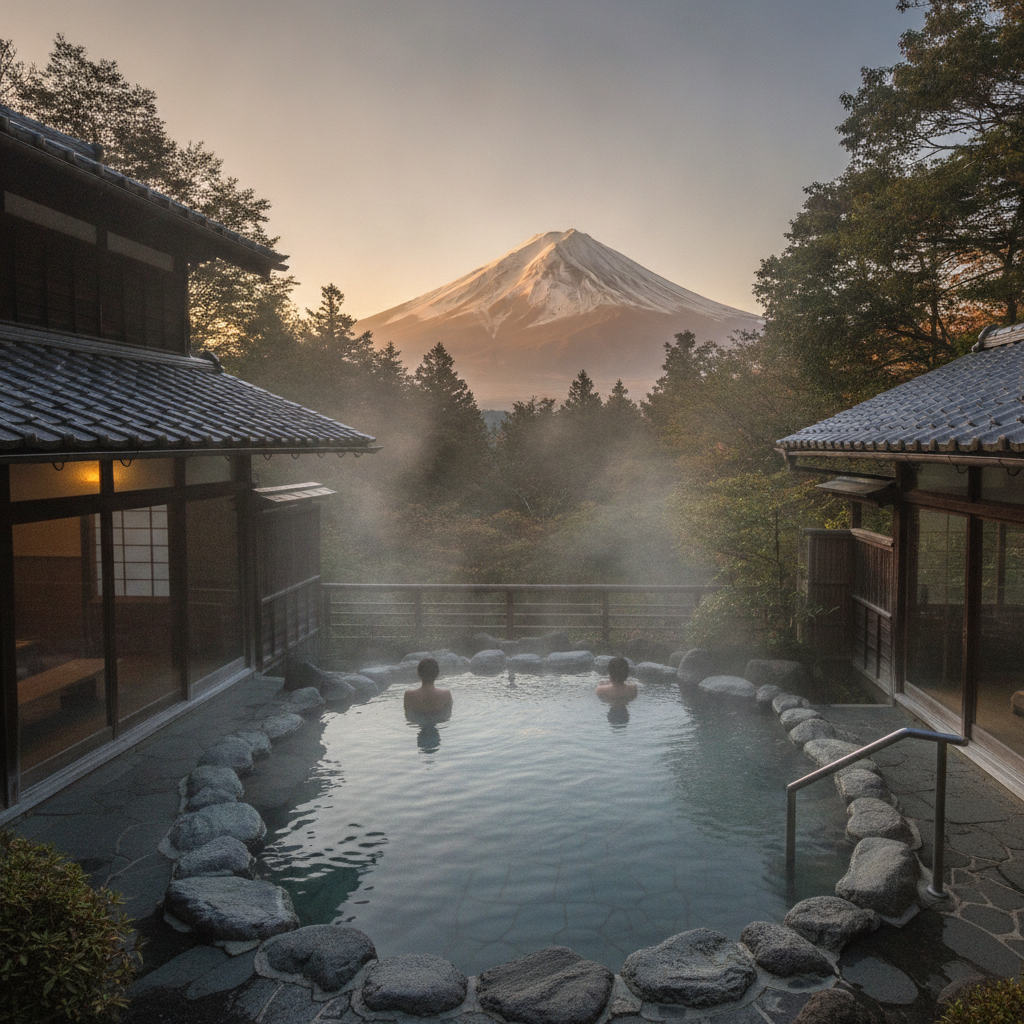
Fuji's Complete Picture: Bashō's Paradox That Fuji in the Mist is More Delightful Than Fuji Visible, the January Lake Ice That Lasts 10 Days Per Year & Fujisan-tsume the Plant That Grows Only Here Above 3,000 Metres
The Chureito Pagoda's late-April cherry blossom and mid-November maple composition as the two peak photography events of the year versus the flat-mirror Lake Motosu reflection requiring a windless dawn in winter; the Lake Kawaguchi partial ice formation lasting 5–10 days annually as the most competed-for photography event on the Fuji calendar; the midnight ascent's 'Fuji cough' at 2,700m and the headlamp chain visible from below as 200 simultaneous climbers become a single light-sculpture; the Fujisan-tsume cushion plant with the most restricted range of any vascular plant in Japan growing only between 3,000–3,700 metres; Aokigahara's 5 open lava tube caves and 20+ mapped underground passages in the 864 CE Jōgan lava field; and Bashō's 1694 haiku establishing that Fuji is most present in its absence—the ma aesthetic applied to Japan's most imposing mountain.
- 1
The Fuji Photography Guide – Getting the Best Shot
The Fuji photography circuit—the established series of viewpoints that produce the most compelling compositions of the mountain—has been codified by generations of Japanese photographers into a seasonal, time-of-day, and weather-dependent programme that maximises the probability of a dramatic image. The Chureito Pagoda (the Arakurayama Sengen Park pagoda above Fujiyoshida—the most internationally famous Fuji composition; accessed by 398 steps from the Shimoyoshida Station on the Fujikyu Railway; the spring cherry blossom composition (late April—the pagoda above the cherry blossom trees with Fuji behind) and the autumn colour composition (mid-November—red maple leaves instead of cherry) provide the two peak photography events). The Motosuko and Lake Motosu north shore (the flat water reflection view—the composition on the pre-1984 JPY 1,000 note; weather-dependent (requires calm, windless dawn to achieve the reflection); statistically most reliable in the winter months when the air is coldest and the lake surface is still). The Nakauda-hama (the 'panorama platform' above the south shore of Kawaguchiko—accessible by the Kachi Kachi Yama ropeway plus a 10-minute walk; the elevated view that includes both the lake and the mountain in the same frame without a telephoto lens compression). The Fuji-Hakone-Izu National Park viewpoints: the Owakudani sulfur vent area (the most unusual foreground for a Fuji photograph—the white sulfur steam in the foreground with the mountain behind); the Ashi-no-ko (Lake Ashi) Torii Gate (the red Torii gate standing in the lake with Fuji visible behind on clear days—the single most photographed Hakone image).
- 2
Fuji in Winter – The Hidden Season
The winter Fuji experience (December–February)—the least visited season but the period when the mountain is at its most photogenic and the surrounding landscape at its most dramatic—provides the complete set of uniquely-winter Fuji experiences unavailable in any other season. The snow: the Fuji Five Lakes area receives significant snowfall from January through February (the Kawaguchiko area averages 30–50 cm of snowfall per winter season—sufficient to transform the lake shores into a snow-covered landscape while Fuji's summit receives 1–3 metres of additional snow that increases the cap's visibility dramatically). The ice: the Lake Kawaguchi partial ice formation (the shallow northern areas of the lake occasionally freeze in the coldest January weeks—the surface ice and the Fuji reflection are available simultaneously for a maximum of 5–10 days per year; the most competed-for photography event on the Fuji calendar). The winter activities: ice fishing (the Lake Kawaguchi lake trout and smelt ice fishing season, operating from a dedicated ice fishing event on Lake Yamanakako; the most unusual winter activity in the Fuji area—renting a heated fishing hut on the ice and lowering a line through a hole in the frozen surface); cross-country skiing (the Funariyama and Asagiri Highlands cross-country ski areas at the base of Fuji). The access: the winter Fuji Five Lakes bus services operate on a reduced schedule; self-driving (with snow tires—mandatory from November in the Fuji area) is the most flexible winter access option.
- 3
The Yoshida Trail Midnight Ascent – Fuji from Below & Above
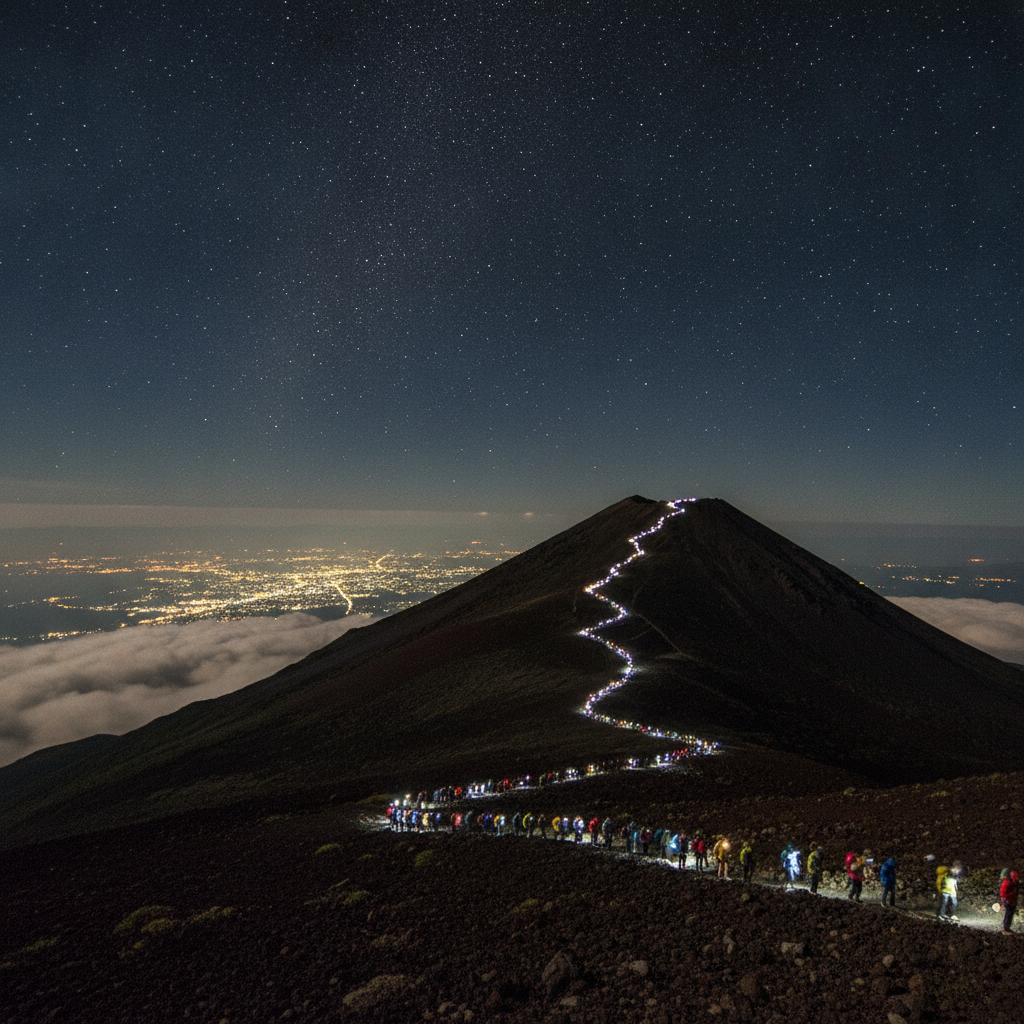
The midnight Fuji ascent (the traditional approach—departing the Yoshida 5th Station at 22:00–23:00 to arrive at the summit for the goraiko sunrise at approximately 04:45 in July, 05:15 in August): the experience that produces the most lasting Fuji memory—the darkness of the ascent (the headlamps of 200+ simultaneous climbers visible as a chain of lights ascending the dark mountain), the 3 AM mountain hut stop for noodles, the final push to the summit in the pre-dawn darkness, and the goraiko (the Japanese word for the sunrise as seen from the summit of Fuji—a specific cultural concept, not just a sunrise, but the 'coming of light' as witnessed from the mountain's highest point). The darkness experience: the Fuji night ascent in the area between the 6th and 7th Stations (approximately 2,700–3,000 metres) is where the altitude begins to affect unacclimatised climbers—the 'Fuji cough' (the dry, cold air irritating the respiratory tract above 2,500 metres) and the mild altitude effects (slower thinking, mild headache) are normal experiences at this elevation for visitors ascending from sea level in one day. The summit in the dark: the area above the 8th Station (approximately 3,400 metres) in the pre-dawn darkness—the other climbers' headlamps visible as a vertical line ascending into the sky, the stars unobstructed by light pollution at this altitude, and the distant city lights of the Kantō Plain visible through the clouds below—provides the most surreal visual experience available on the Fuji climb.
- 4
The Fuji Ecological Science – Biodiversity at 3,776 Metres
The ecological science of Mount Fuji—the natural history of a volcanic island in the sky, isolated from surrounding ecosystems by the lava and ash slopes—is the least-discussed aspect of the mountain in the tourism literature and the most scientifically significant aspect of the Fuji area beyond its geology. The biodiversity gradient: from the base of the mountain (the sub-tropical mixed forest of the Aokigahara area at 900 metres—cedar, hemlock, and Japanese black pine) through the subalpine zone (the Fuji windswept belt of 5-needle pine (Pinus parviflora) and Japanese larch (Larix kaempferi) at 2,000–2,400 metres—the zone through which the Yoshida trail's forested section ascends) to the alpine zone (above 2,400 metres—the sparse cushion plants (Poa fauriei, Juncus triglumis) in the volcanic ash) and the barren summit (above 3,500 metres—essentially no vascular plants; the summit soil surface is too unstable and too cold for plant survival). The endemic species: the Fuji endemic plants (species found only on Mount Fuji): the Fujisan-tsume (Arenaria fujisanensis—a tiny cushion plant growing at 3,000–3,700 metres, the highest-altitude vascular plant in Japan and the most restricted-range plant in the country). The bird observatory: the Fuji Five Lakes bird observatory at Lake Saiko (the autumn hawk migration observation—October–November, when honey buzzards, black kites, and the Eastern buzzard migrate south above the lake, counted annually by the volunteers of the Japan Wild Bird Society).
- 5
Fuji's Lava Flows – Walking on Volcanic History
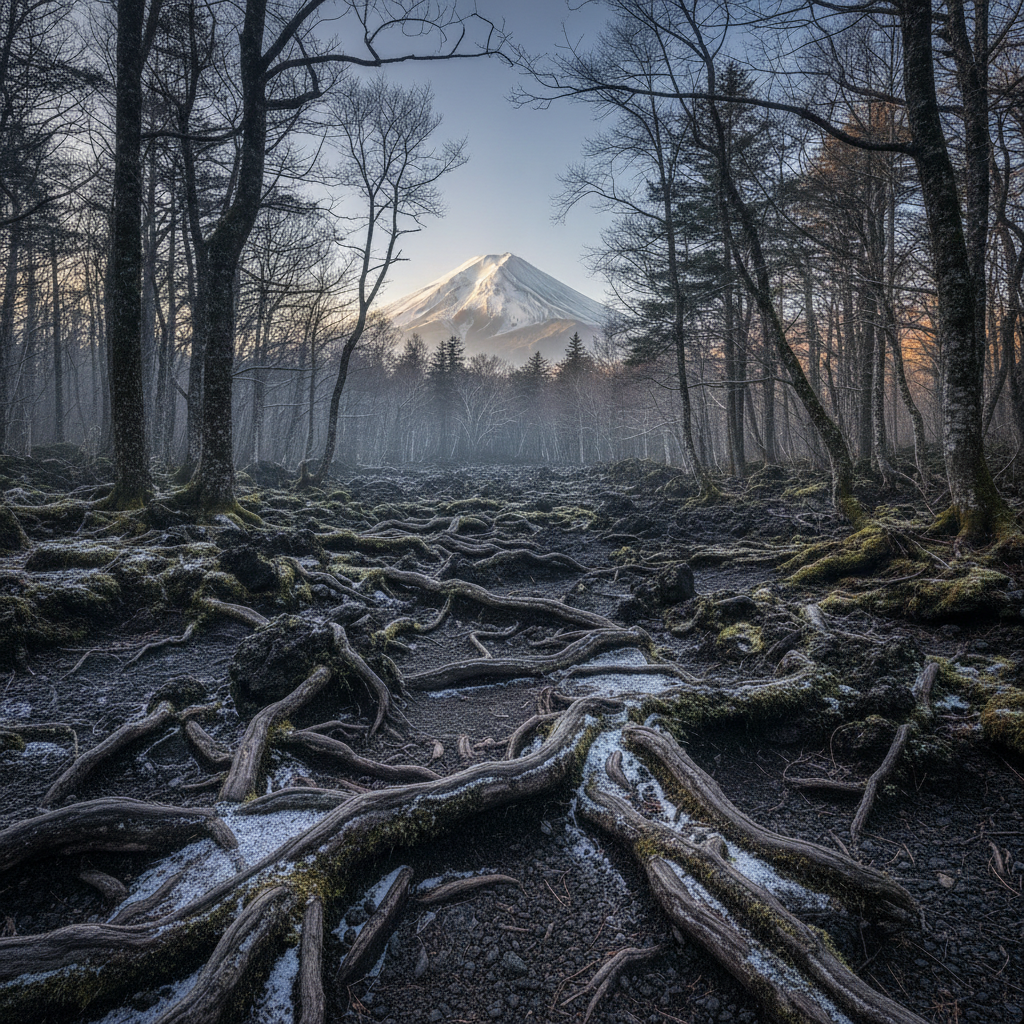
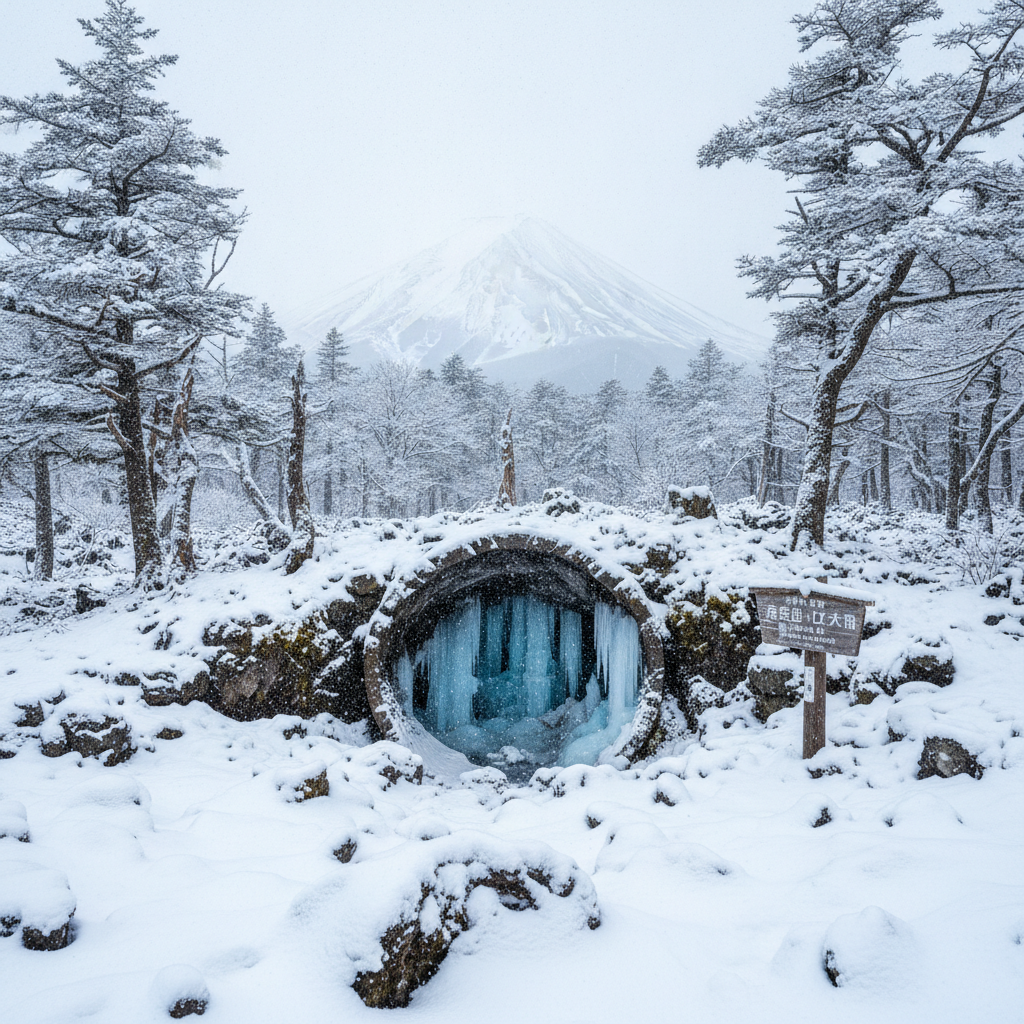
The lava landscapes surrounding Mount Fuji—the most accessible recent volcanic geological exhibit in Japan—can be walked through on several trail systems that provide direct contact with the volcanic material of successive Fuji eruptions spanning the past 5,000 years. The Aokigahara Jukai trail system: the interior trail network of the Aokigahara forest (the Narusawa Ice Cave trail, the Fugaku Wind Cave trail, and the longer Sai River trail) walks through the Jōgan lava field (864 CE) with the forest growing directly from cracks in the ancient lava surface. The Oshino Fuji Lava Road: the foot and cycling path through the Oshino Hakkai spring area crosses several lava channels from the Hōei eruption (1707) that created the most recent major lava flow on the southeastern flank. The Asagiri Highlands lava plateau (the high plain at 1,000 metres elevation on the southwestern Fuji flank, between Fujinomiya and Shizuoka; accessible by the Fujikyūkō bus from Fujinomiya Station): the most extensive area of open lava surface accessible without trail equipment—the Asagiri Highlands paragliding site (the most popular paragliding location in Japan, with Fuji directly ahead during the glide) operates from the plateau's volcanic surface. The lava tube caves: in addition to the Aokigahara ice and wind caves, the Fuji Five Lakes area contains 20+ mapped lava tube caves, of which 5 are open for public exploration (the longest accessible tube is the Fugaku Wind Cave at 201 metres length).
- 6
Fuji's Literary & Musical Legacy – Inspiration at 3,776 Metres
The Mount Fuji literary and musical legacy—the body of creative work inspired by the mountain, from the 8th-century poetry of the Manyōshū to the contemporary Japanese pop culture that uses Fuji as a universal symbol—is the broadest single-location creative inspiration in Asian cultural history. The Manyōshū: the Man'yōshū (the oldest existing collection of Japanese poetry, compiled approximately 759 CE) contains 18 poems about Mount Fuji—the earliest literature of the mountain, establishing the visual and emotional vocabulary that all subsequent Japanese Fuji writing has used (the combination of fire and snow on the summit, the unseasonal snow falling in summer, and the mountain's refusal to be contained by language). Matsuo Bashō: the haiku master Matsuo Bashō (1644–1694) visited the Fuji area on his Tōkai-dō journey and wrote the most famous Fuji haiku (霧しぐれ 富士を見ぬ日ぞ おもしろき—'Misty rain / not seeing Fuji / is also delightful'—the paradox of Fuji being most present in its absence, the Japanese aesthetic concept of ma (negative space) applied to the most imposing mountain in Japan). The contemporary music: 'Fuji' appears in the title or lyrics of approximately 300 Japanese pop and rock songs (the most statistically frequent mountain in Japanese popular music—more than twice the frequency of the second-ranked Aso); the most internationally known Fuji musical reference is the Fuji Rock Festival (the largest outdoor music festival in Japan, held annually at the Naeba Ski Resort in Niigata—not actually near Mount Fuji, but using the name for its cultural resonance).
Walk this route with audio
Stories play automatically as you reach each stop — no tapping needed.
More in Tokyo-Fuji
Fuji's Cultural Detail: Yoshida Udon's 70 Private-House Restaurants Open Only at Lunch, the Yoshida Fire Festival's 72 Cedar Torches Burning Simultaneously on 26 August & the 80-Year Snowmelt Springs of Oshino Hakkai
Fuji & Tokyo: The 3,776m Sacred Volcano Visible from Shinjuku on Clear Mornings, the 4,000 Climbers Per Day That Prompted a Physical Trail Barrier in 2024 & the Ryokan With Private Onsen Facing the Summit
Bashō's Paradox, the 10-Day Ice Window & the Plant That Grows Only on Fuji Above 3,000 Metres
Mount Fuji's Layers: Hokusai's Great Wave Van Gogh Traced, Aokigahara's Compass-Distorting Iron Lava & the 800 Edo-Period Fujikō Confraternities That Created Modern Mountain Pilgrimage Culture