Mount Fuji's Layers: Hokusai's Great Wave Van Gogh Traced, Aokigahara's Compass-Distorting Iron Lava & the 800 Edo-Period Fujikō Confraternities That Created Modern Mountain Pilgrimage Culture
The Great Wave's provenance as the opening print of the Thirty-Six Views—the image Van Gogh traced, Debussy's La Mer, and 1 billion consumer products worldwide from the same Kanagawa viewpoint; Aokigahara's actual identity as a lava tube ice cave system and unique ecological forest rather than the single-aspect reductive international media characterisation; the Subashiri trail's forested lower section absent on the Yoshida trail and the Gotemba Premium Outlets as the most extraordinary juxtaposition of luxury retail and sacred mountain in Japan; Konohanasakuya-hime's Sengen shrine technically owning the summit as the Inner Shrine's pilgrimage goal in white garments; the koyo-plus-first-snow October combination as the most photographed ground-level Fuji season; and the Shimizu tuna auction at the port below Fuji's southern face.
- 1
The Fuji Artistic Legacy – Hokusai, Hiroshige & the 36 Views
The artistic legacy of Mount Fuji—the single landscape feature that has inspired more significant works of Japanese art than any other—is best understood through the two defining series of the ukiyo-e (floating world woodblock print) tradition: Katsushika Hokusai's 'Thirty-Six Views of Mount Fuji' (Fugaku Sanjūrokkei, published 1830–1833) and Utagawa Hiroshige's 'One Hundred Views of Mount Fuji' (Fugaku Hyakkei, published 1834–1849). Hokusai's Great Wave: 'Kanagawa oki nami ura' ('The Great Wave off Kanagawa'—the opening print of the Thirty-Six Views series; the image of the breaking wave in the foreground with Mount Fuji in the background) is the most widely reproduced Japanese image in history—the print that Van Gogh traced, that influenced Debussy's 'La Mer', that appeared on Hokusai's own calling card, and that has been reproduced on approximately 1 billion consumer products worldwide. The artistic pilgrimage: the viewpoints from which Hokusai drew his Fuji images—documented by the print compositions and verified by topographic analysis—include the Umezawa Residence in Kanagawa (the Great Wave), the Yoshida town in Yamanashi (the 'Red Fuji'—Gaifū kaisei, or 'South Wind, Clear Sky', the image of Fuji in orange-red morning light), and the Mishima Pass in Shizuoka (the 'Mishima Pass in Kai Province'—Fuji through a giant cedar tree). The British Museum collection: the British Museum holds the most complete collection of Hokusai's Thirty-Six Views outside Japan (approximately 32 of the 46 prints—the series expanded from 36 to 46 during publication due to demand).
- 2
Aokigahara – The Sea of Trees
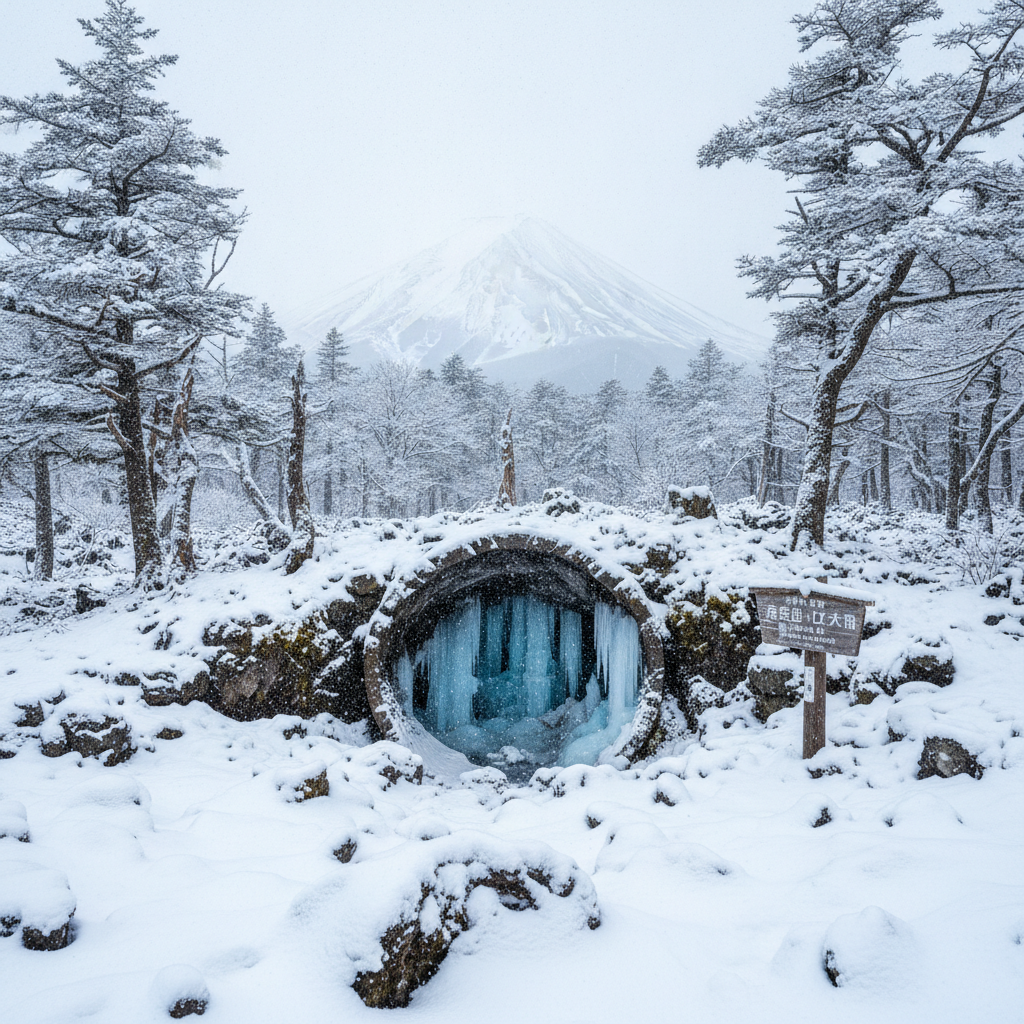
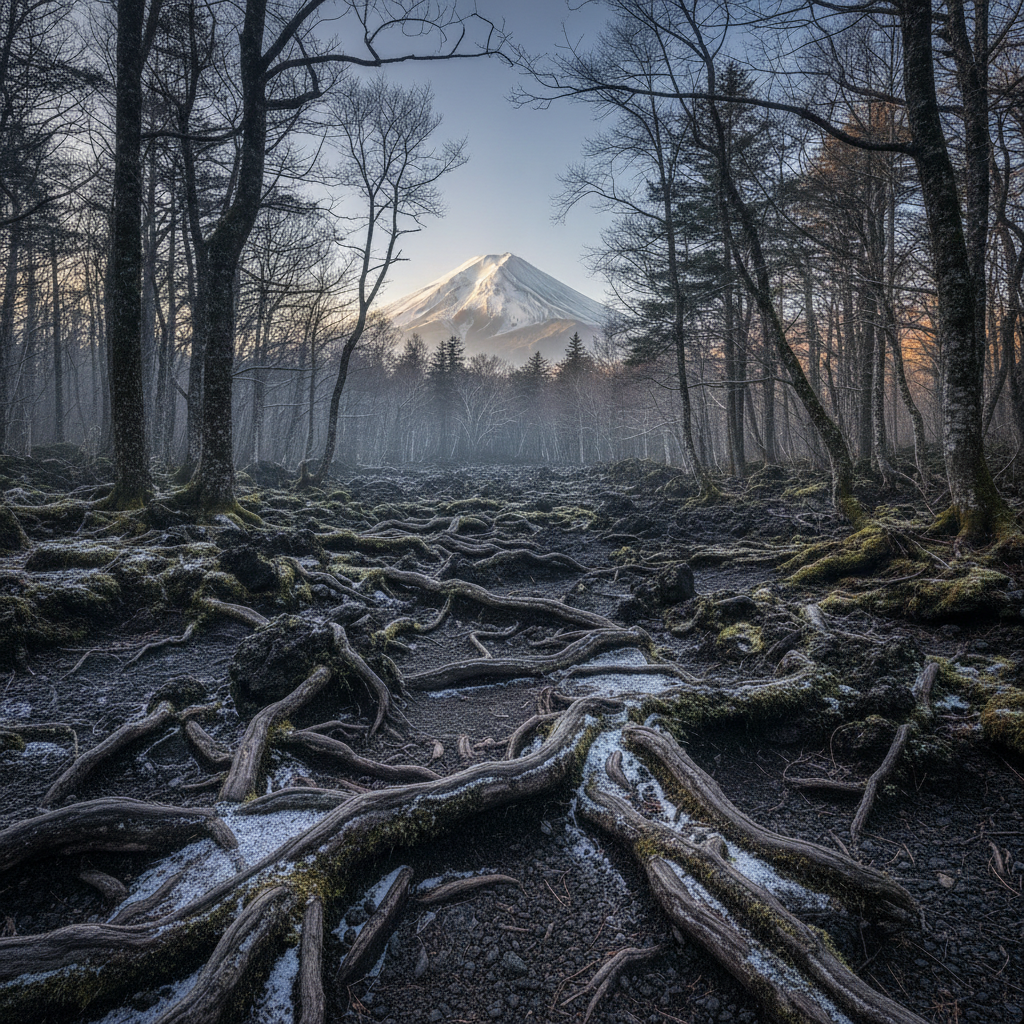
Aokigahara (the Aokigahara Jukai—'Sea of Trees'; the 35-km² forest at the northwestern base of Mount Fuji, between the western shore of Lake Kawaguchi and Lake Sai; formed on the lava fields of the 864 Jōgan eruption of Fuji): the most discussed and most misrepresented forest in Japan—simultaneously a genuinely extraordinary geological and ecological environment (the lava forest, the ice caves, the wind caves) and the location most frequently associated in international media with suicide in Japan (a reductive and inaccurate characterisation of a landscape with a complex historical and ecological identity). The geology: the Jōgan lava field (the 864–866 CE lava flow that buried the former Lake Senoumi and created the Aokigahara forest floor) produces a landscape where the ancient lava surface is covered by a thin layer of soil and dense vegetation; the compass distortion (the magnetic iron content of the basaltic lava interfering with compass needles) is real and contributed to the forest's historical reputation for disorientation. The ice caves: the Narusawa Ice Cave (Narusawa Hyōketsu—year-round ice inside a lava tube cave within the Aokigahara forest; ice stalactites visible even in summer) and the Fugaku Wind Cave (Fugaku Fūketsu—lava tube cave with permanent ice, used historically as a natural refrigerator by silk farmers to preserve silkworm eggs). The correct framing: Aokigahara is a remarkable natural environment—the lava tube cave system, the unique forest ecology, and the historical significance as a pilgrimage route are the reasons to visit; the international media fixation on one aspect of the forest's history provides no useful preparation for the experience of walking through a genuinely unusual Japanese natural landscape.
- 3
The Fuji Subashiri Trail – The Less Travelled Route
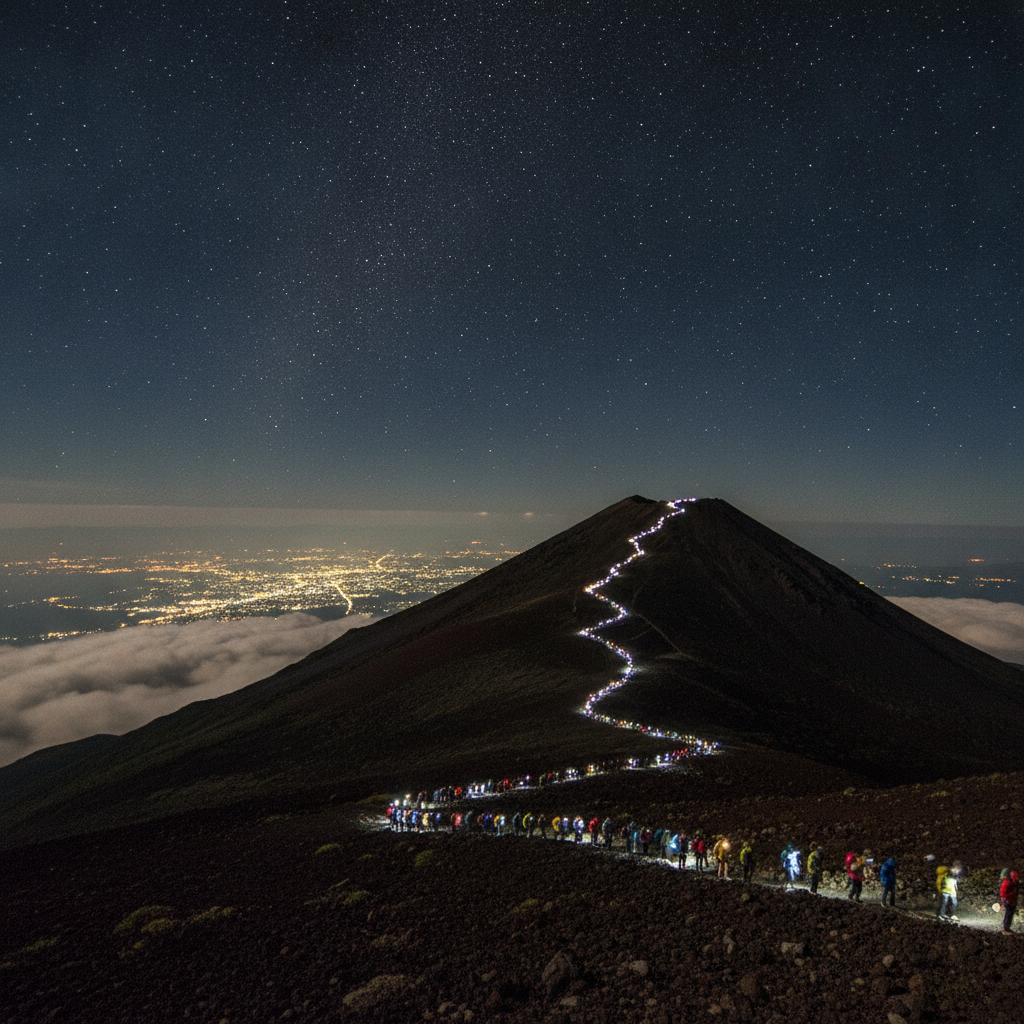
The Subashiri Trail (the eastern Fuji climbing route—the 5th Station at 2,000 metres, accessible by bus from Gotemba Station on the JR Gotemba Line; the second-most used Fuji trail after the Yoshida; the trail that descends through the Subashiri 8th Station's fine volcanic ash runs—the most pleasant descent route on Fuji): the recommended trail for visitors who want a less crowded Fuji climbing experience than the Yoshida trail provides. The trail character: the Subashiri trail ascends through the Fuji subalpine forest from the 5th Station to the treeline (approximately 7th Station level), then through the open volcanic rock and ash zone to the summit; the forested lower section (absent on the Yoshida trail which begins above the treeline) provides the most varied botanical experience of the Fuji ascent. The Gotemba detour: the Gotemba Premium Outlets (the largest outlet shopping complex in Asia, visible from the Fuji Subashiri 5th Station at the base of the trail—the extraordinary juxtaposition of the luxury goods retail complex and the sacred mountain's eastern approach) is a practical stopping point for self-driving visitors combining the outlet shopping with the Fuji climb. The combined circuit: the Kawaguchiko base (for the 5 Lakes and the Yoshida trail overnight accommodation) + the Subashiri descent (descending the east side to Gotemba Station after summitting from the Yoshida) + the Gotemba Outlets (for the return to Tokyo by JR Gotemba Line train to Matsuda then Odakyu to Shinjuku) = the most varied single-day post-summit circuit available on the mountain.
- 4
Fuji's Shinto Heritage – Sacred Mountain & Pilgrimage Tradition
The Shinto religious significance of Mount Fuji—the oldest and deepest dimension of the mountain's meaning in Japanese culture—predates the artistic tradition by at least 1,000 years: the mountain has been regarded as a sacred site in the Shinto tradition since at least the 8th century CE, when the first literary references to the mountain's deity (the goddess Konohanasakuya-hime—the daughter of the Mountain God, whose name means 'the flower that makes the mountain shine') appear in the Manyōshū poetry anthology. The Sengen shrines: the Fujisan Hongu Sengen Taisha (the head shrine of the Sengen shrine network—located at the base of Fuji in Fujinomiya city; the main shrine of the goddess Konohanasakuya-hime; the spiritual authority over the mountain, including the summit and the climbing trails—the trails are technically the precincts of the shrine): the most architecturally significant shrine complex on the Fuji periphery. The summit shrine: the Okumiya (the Inner Shrine on the summit of Fuji—the Sengen shrine's upper sanctuary, manned only during the July–August climbing season): the goal of the traditional pilgrimage that required climbing the mountain in white garments and chanting the pilgrimage mantra. The Fujikō: the Fujikō (the confraternities of Fuji worshippers—lay religious organisations active from the 16th century, whose members made regular pilgrimages to the summit as acts of devotion): the Edo-period Fujikō movement (at its peak in the 18th century, when several hundred thousand Edo residents belonged to the 800+ Fujikō chapters) created the mass pilgrimage culture that shaped the modern climbing tradition.
- 5
Fuji's Changing Seasons – Cherry Blossoms to First Snow
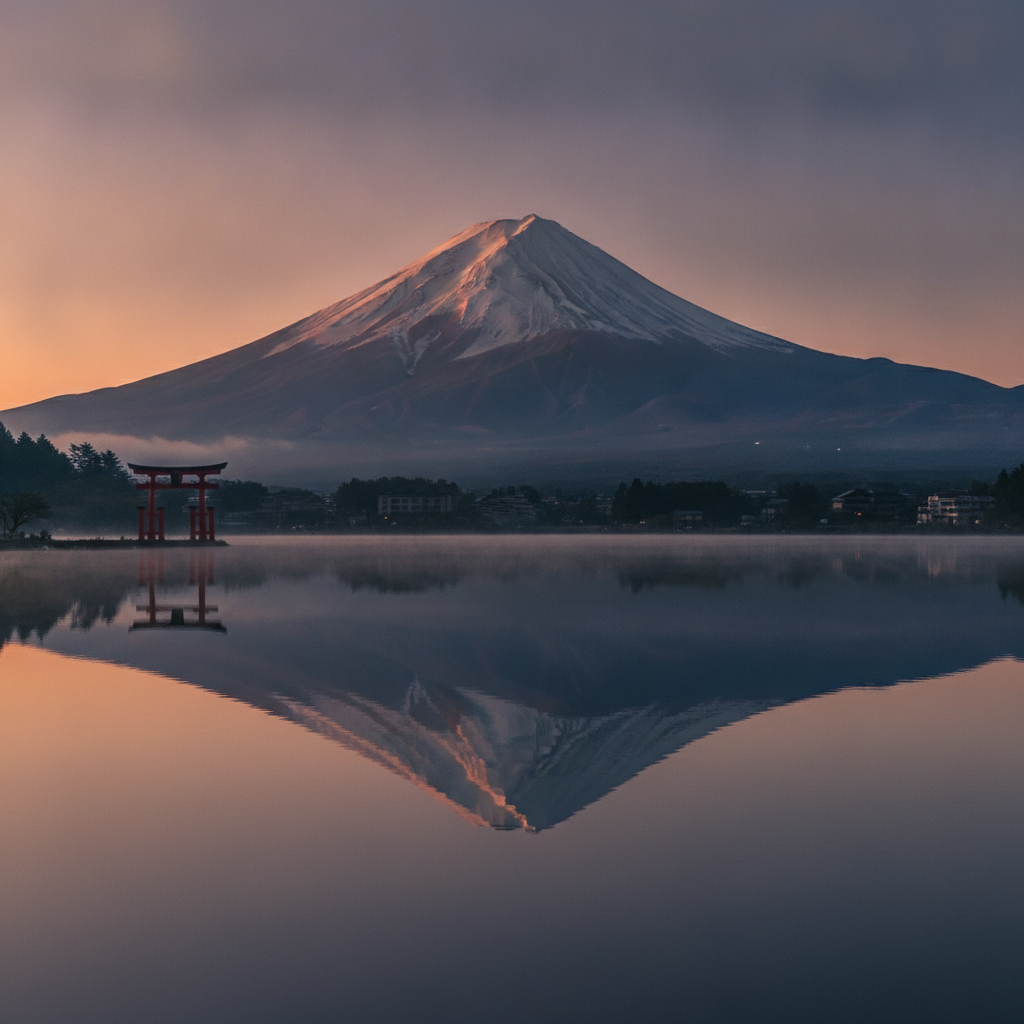
The Mount Fuji seasonal cycle—one of the most photographed annual progressions in Japan—is structured by the interplay between the mountain's permanent snow cap (which recedes in summer, allowing climbing, and returns in autumn) and the surrounding landscape's deciduous vegetation cycle. Spring (late March–May): the cherry blossom season at the Fuji Five Lakes (the kawazuzakura at Lake Kawaguchi blooming from late March; the standard Yoshino cherry at the Chureito Pagoda in late April—the most internationally famous cherry blossom and Fuji combination); the mountain is still snow-capped, providing the clearest contrast between the white peak and the blue sky. Summer (July–September): the climbing season; the summit snow has partially receded; the mountain is accessible for the first time; the surrounding lakes are green and the mountain is at its least photogenic (the snow cover reduced, the atmospheric haze at its highest). Autumn (October–November): the koyo (autumn leaf colour) season at the Fuji Five Lakes; the first snow returning to the summit (typically in late October); the combination of the autumn foliage and the new snow cap is the most photographed Fuji season from the ground-level viewpoints. Winter (December–February): the snow cap at its most dramatic; the air clarity at its maximum (the cold, dry winter air); the mountain is visible from Tokyo most frequently in this season; the Fuji cherry blossoms of winter (the Kawazu cherry blossoms at Kawaguchiko beginning in February) create the earliest spring Fuji combination photography.
- 6
Beyond Fuji – Izu Peninsula & the Shizuoka Coast
The Izu Peninsula (the volcanic peninsula extending south from the Fuji-Hakone area into the Pacific Ocean; accessible by the Tokaido Shinkansen to Atami (50 minutes from Tokyo) and then the Izu Kyūkō Railway along the coast—the most scenic coastal railway in Japan): the complement to the Fuji inland experience, providing the Pacific-facing coastal landscape that completes the understanding of the volcanic landscape of which Fuji is the highest expression. The Izu geology: the Izu Peninsula (and the Izu-Ogasawara volcanic arc that extends south from Izu to the Bonin Islands and the Mariana Trench) is geologically the most active volcanic zone in Japan—the Izu peninsula has 7 calderas and 18 cones in an area of 500 km², creating the most varied volcanic landscape in Japan accessible by conventional transport. The Izu coast: the west Izu coast (between Heda and Toi—accessible by bus from Shuzenji Station; the least developed section of the Izu coastline; the combination of the Pacific views, the hot spring onsen (the Toi area hot springs), and the wasabi cultivation (the Izu Peninsula is the largest wasabi-producing region in Japan, using the cold clear spring water of the volcanic mountains)) is the most rewarding day extension from the Hakone–Fuji circuit. The Shimizu Tuna: the Shimizu district of Shizuoka city (the port city at the foot of Fuji's southern side—accessible by Shinkansen to Shin-Fuji then local train) hosts the most important tuna auction after Toyosu, with the Pacific tuna fleet delivering directly to the Shimizu port fish market (open for pre-dawn visitor observation on certain days).
Walk this route with audio
Stories play automatically as you reach each stop — no tapping needed.
More in Tokyo-Fuji
Fuji's Complete Picture: Bashō's Paradox That Fuji in the Mist is More Delightful Than Fuji Visible, the January Lake Ice That Lasts 10 Days Per Year & Fujisan-tsume the Plant That Grows Only Here Above 3,000 Metres
Fuji's Cultural Detail: Yoshida Udon's 70 Private-House Restaurants Open Only at Lunch, the Yoshida Fire Festival's 72 Cedar Torches Burning Simultaneously on 26 August & the 80-Year Snowmelt Springs of Oshino Hakkai
Fuji & Tokyo: The 3,776m Sacred Volcano Visible from Shinjuku on Clear Mornings, the 4,000 Climbers Per Day That Prompted a Physical Trail Barrier in 2024 & the Ryokan With Private Onsen Facing the Summit
Bashō's Paradox, the 10-Day Ice Window & the Plant That Grows Only on Fuji Above 3,000 Metres