Thessaloniki Byzantine Monuments — UNESCO Sites, Mosaics & the Archaeological Museum
Thessaloniki's 15 UNESCO-inscribed Early Christian and Byzantine monuments (inscribed collectively in 1988 as a single serial property, the most numerous UNESCO monument cluster in a single city after Rome and Athens) span six centuries of Byzantine civilization from the 4th to the 15th century.
- 1
Agios Dimitrios — the Patron Saint's Basilica
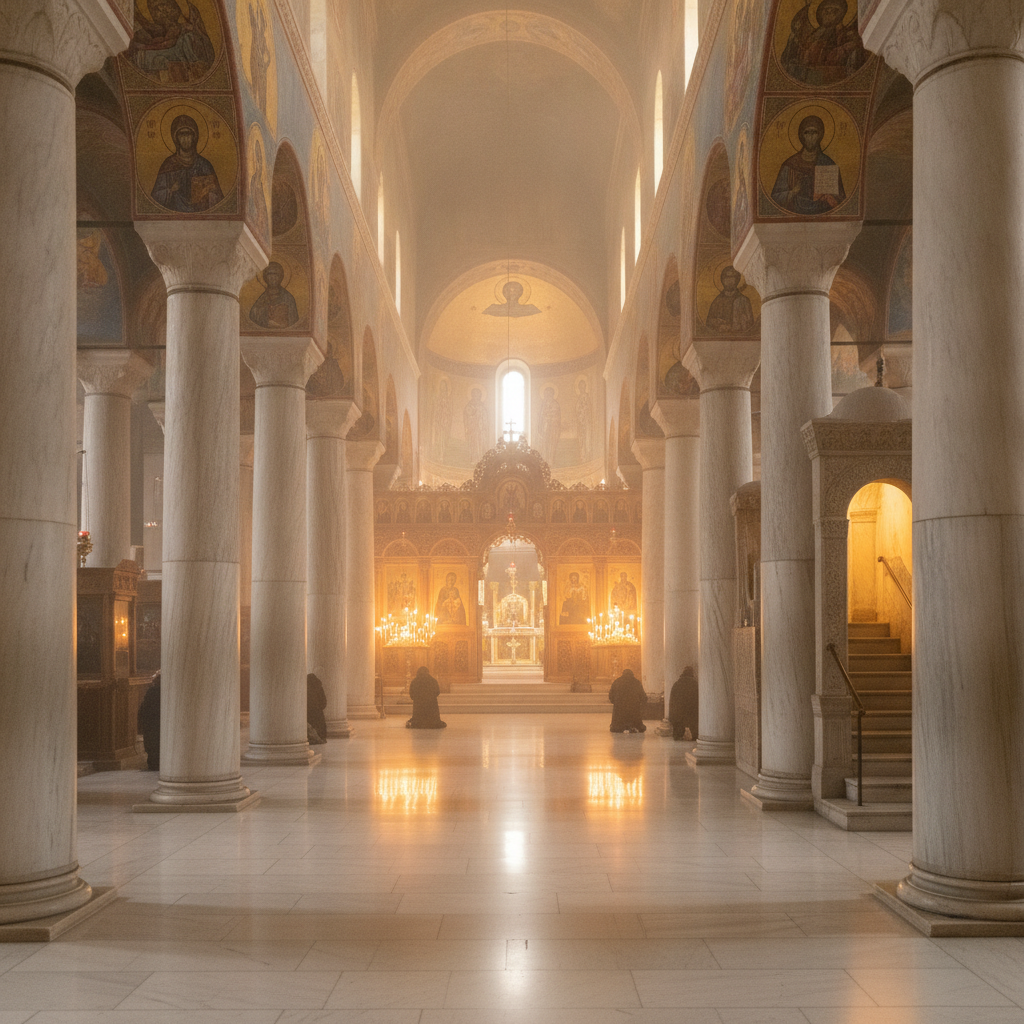
The Basilica of Agios Dimitrios (the most important church in Thessaloniki, the largest basilica in Greece, the patron saint of Thessaloniki — Saint Demetrius, a Roman officer martyred for his Christian faith in 306 CE — venerated here continuously for 1,700 years, the current 5th-century building the third basilica on the site after two earlier churches were destroyed by fire, the church damaged again by fire in 1917 but substantially rebuilt, the marble-clad five-aisled interior with the surviving original 5th-7th century votive mosaics in the nave pillars — the earliest surviving votive mosaics in the world, depicting the saint with donors and supplicants, free, open daily 8am-8pm) is the essential Thessaloniki church visit. The crypt (the underground space below the apse, originally the Roman bath where Demetrius was imprisoned and martyred, accessed from the right aisle, the silver reliquary containing the supposed remains of the saint in the centre of the crypt, the carved Roman architectural fragments lining the walls, the most atmospheric Byzantine underground space in Greece outside Istanbul).
- 2
The Rotunda — from Mausoleum to Church to Mosque
The Rotunda of Galerius (the circular drum mausoleum built for Emperor Galerius approximately 306 CE, the largest Roman monument in Thessaloniki, 25m in diameter with 6m-thick walls, converted to a Christian church under the Emperor Theodosius around 380 CE — the Christian conversion adding the apse, the narthex, and the magnificent mosaic programme covering the interior surface — then converted to a mosque by the Ottomans in 1591 who added the minaret, still standing as the only minaret in Thessaloniki, the building converted to a museum after Greek independence and the 1913 incorporation of Thessaloniki into Greece, free, Tuesday-Sunday 8am-3pm) retains the fragmentary 4th-century CE Christian mosaics (the saints and martyrs in gold mosaic ground around the drum, the most important 4th-century mosaics in Europe after those of Ravenna, the figures standing in architectural niches rendered in the transition style between the flat late antique and the more volumetric early Byzantine — the Rotunda mosaics are the earliest surviving examples of what became the definitive Byzantine artistic style).
- 3
The Archaeological Museum — the Derveni Krater
The Archaeological Museum of Thessaloniki (6 Manolis Andronikos, €8 adults, Tuesday-Sunday 8am-8pm, Monday 10am-6pm, the museum built 1962, the collection reorganized 2012, the most important archaeological collection in northern Greece) holds the three essential objects: the Derveni Krater (the 4th-century BCE bronze volute-krater, 91cm tall, 40kg, discovered in 1962 in a tomb at Derveni 12km northeast of Thessaloniki, the surface covered with relief figures of the Dionysiac thiassos — Dionysus reclining with Ariadne, maenads and satyrs in various states of ecstasy — rendered in a level of technical mastery never again achieved in ancient metalwork, the inscription 'of Astion son of Anaxagoras from Larissa' identifying the owner, the object considered the masterpiece of ancient Greek metalwork), the Vergina gold (the burial goods from Philip II of Macedon's tomb including the gold larnax with the star of Vergina, the golden wreath of oak leaves, the iron helmet and cuirass), and the Thessaloniki prehistoric collection (the Neolithic and Bronze Age objects from Macedonia, including the Neolithic painted pottery from Nea Nikomedeia — the oldest pottery found in Europe).
- 4
Osios David and the Hidden Mosaic
Hosios David (the Monastery of Latomou, now the church of Hosios David, in the Ano Poli neighbourhood, the oldest surviving Byzantine building in Thessaloniki, the original 5th-century chapel converted to a monastery in the 8th century and subsequently to a mosque in the Ottoman period, returned to use as a Greek Orthodox church after 1913, free, open daily 8am-noon and 5pm-8pm) contains the most important early Christian mosaic in Thessaloniki — the apse mosaic of the Vision of Ezekiel (the 5th-century CE mosaic depicting Christ in a mandorla surrounded by the four evangelical symbols — the eagle, the lion, the ox, and the winged man — with the prophets Ezekiel and Habakkuk at the sides, the mosaic preserved by its conversion into a fresco painting during the Ottoman period and only revealed when the church was reconverted after 1913, the gold mosaic ground partially surviving beneath the painted plaster, the Ezekiel figure particularly well preserved). The approach to Hosios David (the 20-minute walk uphill through the Ano Poli lanes from the Rotunda, the walk passing the surviving Byzantine tower of the Ano Poli walls) constitutes the beginning of the Ano Poli walking tour.
- 5
Vergina — the Royal Macedonian Tombs
Vergina (the site of the Macedonian royal city of Aigai, 70km west of Thessaloniki, accessible by bus from Thessaloniki in 1.5 hours or by organized tour, UNESCO World Heritage Site, the Great Tumulus containing the unlooted tombs of Philip II of Macedon — the father of Alexander the Great — and Alexander IV — Alexander the Great's son — excavated in 1977-78 by Manolis Andronikos, €12 adults, Tuesday-Sunday 8am-8pm) houses the most important archaeological discovery in Greece since the discovery of Mycenae. The underground museum (built within the Great Tumulus itself, the visitor entering the tumulus to see the four royal Macedonian tombs in situ, the facades of the painted tombs visible through glass, the burial goods — including Philip II's gold larnax, his golden oak wreath, his iron helmet with gold overlay, and his bones — displayed in the cases beside the tombs) creates an encounter with Alexander's dynasty unlike any other museum experience in the world. The day trip from Thessaloniki (bus from the Makedonia bus station on Monastiriou Street to Vergina village, 1.5 hours, €7 each way, the museum accessible from the bus stop in 10 minutes walk) is the correct excursion from the city.
- 6
Thessaloniki Museum of Byzantine Culture
The Museum of Byzantine Culture (Stratou 2, adjacent to the Archaeological Museum, €8 adults, Tuesday-Sunday 8am-8pm, Monday 10am-6pm, the purpose-built museum opened 1994, the most complete Byzantine art collection in Greece and one of the most important in the world) presents the full arc of Byzantine civilization in Thessaloniki from the 4th to the 15th century. The permanent collection organized in 11 rooms: the early Christian period (the 4th-5th century funerary art, the baptismal fonts, the catacomb paintings), the middle Byzantine period (the 9th-12th century icons, the gold metalwork, the illuminated manuscripts), and the late Byzantine period (the 13th-14th century Thessaloniki school of painting — the most important regional Byzantine art school, the paintings of the Macedonian school representing the final flowering of Byzantine artistic achievement before the Ottoman conquest of 1430). The two essential objects: the Thessaloniki Sindon (the 4th-century CE burial cloth with gold thread woven into the shroud, the earliest surviving Byzantine luxury textile) and the painted icon of the Transfiguration (14th century, Thessaloniki school, the gold ground and the white radiance of the transfigured Christ rendered with a physicality that anticipates El Greco's later development of the same theme).
Walk this route with audio
Stories play automatically as you reach each stop — no tapping needed.
More in thessaloniki
Thessaloniki Ottoman & Jewish Heritage — Hamams, the Bezesteni & the Multicultural City
Thessaloniki Food — Markets, Bougatsa, Mezedes & the Greek Food Capital
Thessaloniki Waterfront & Roman Legacy — the White Tower, Galerius Complex & Byzantine Walls
Thessaloniki Ano Poli — the Ottoman Upper Town, Byzantine Walls & the View Over the Gulf