The Cotton Monoculture That Emptied the World's 4th Largest Lake, the Rusting Ship Fleet Stranded 100 km From the Sea & the Suzani Embroidered Collectively by Every Woman in the Bride's Family
The Soviet cotton irrigation diversion reducing the Aral Sea from 68,000 km² to near-zero; the Moynaq fishing fleet rusting in salt desert 100km from the former coastline; the suzani embroidered collectively by the bride's female relatives as the most significant dowry element; the Yodgorlik Factory as the last authentic ikat hand-loom operation in Central Asia; the Plov Centre's daily kazan sold out by noon requiring pre-noon arrival; and Tashkent as the hub for the 2h10m Afrosiyob express circuit to Samarkand and Bukhara.
- 1
The Fergana Valley – Silk Road Heartland
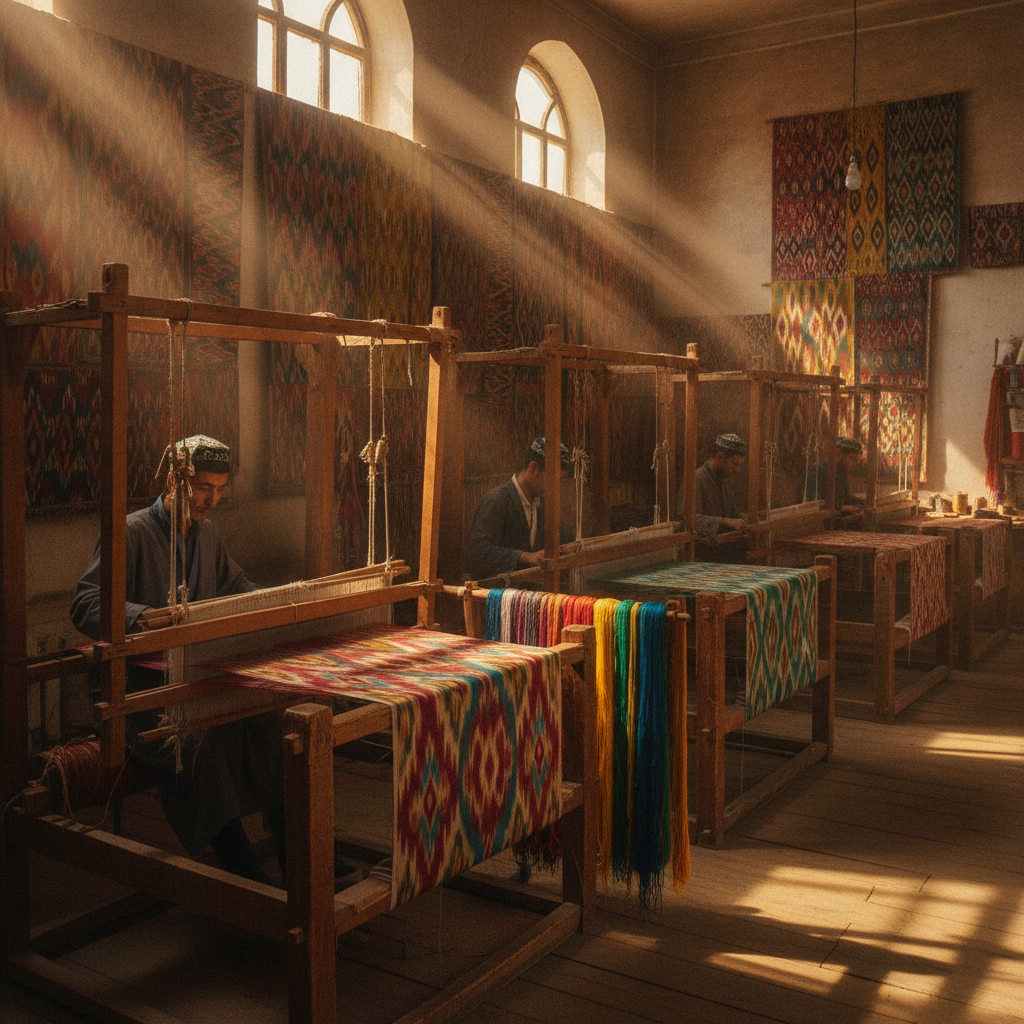
The Fergana Valley (Фарғона водийси): the most fertile and historically significant agricultural valley in Central Asia—the region that produced the finest silk in the medieval Silk Road network and that remains the most economically productive agricultural area of Uzbekistan. The geography (the Fergana Valley is a 300 × 100 km depression at 500m elevation, surrounded on three sides by the Tian Shan and Pamir-Alay mountain ranges—the valley is shared between Uzbekistan (the dominant part), Tajikistan, and Kyrgyzstan—the most politically fragmented fertile region in Asia, with borders crossing the valley that have created enclaves and border disputes since Soviet delimitation in 1924): the silk (the Fergana Valley has produced raw silk since at least the 2nd century BCE—the most famous production center is Margilan (Марғилон—the silk capital of Uzbekistan): the Yodgorlik Silk Factory (Ёдгорлик ипак фабрикаси—the surviving artisan silk workshop in Margilan where the traditional ikat (adras—the silk warp-dyed fabric with the characteristic blurred pattern) is produced by hand on wooden looms—the most technically authentic silk weaving in Central Asia): the Fergana from Tashkent (Tashkent to Fergana by road: 3h30m (315 km); Tashkent to Andijan (the main Fergana Valley city) by train: 6h30m by regular train).
- 2
Tashkent's Museum Circuit
The Tashkent museum circuit (the 5 most significant museum collections in the Uzbek capital): the museum guide. The State Museum of History of Uzbekistan (Ўзбекистон Давлат тарих музейи—the primary historical museum of Uzbekistan): the collection (250,000+ objects from the Neolithic to the present—the most important single exhibits: the Afrasiab murals (7th-century Sogdian palace murals from the ancient city of Afrasiab at Samarkand—depicting the Tang Chinese ambassador's mission to the Sogdian court): the Zoroastrian ossuary collection (the bone containers (ossuaries) used by Zoroastrian communities to store the bones of the dead after the body was exposed on a tower of silence—the largest collection of Zoroastrian ossuaries in Central Asia). The Applied Arts Museum (Амалий санъат давлат музейи—the museum in the restored 19th-century mansion of a Russian diplomat): the collection (the most comprehensive collection of traditional Uzbek crafts in any single museum: suzani embroidery, ceramic ware, woodcarving, silk ikat, and jewelry). The Fine Arts Museum (Ўзбекистон давлат санъат музейи): the Soviet-era painting collection (the Socialist Realist paintings commissioned from Uzbek artists by the Soviet government—including the works of Ural Tansiqboyev (Урал Тансиқбоев)—the most acclaimed Uzbek landscape painter of the Soviet period).
- 3
Uzbek Crafts – Suzani, Ikat & Woodcarving
The craft traditions of Uzbekistan (the textile and decorative art traditions that are the most internationally traded Uzbek cultural products and that are available in their highest quality and variety in Tashkent): the craft guide. Suzani (сузани—the large embroidered textile): the most celebrated Uzbek textile—the hand-embroidered panels made by women as part of the trousseau for marriage (the suzani was embroidered collectively by the women of the bride's family in the months before the wedding and presented to the groom's family as the most significant dowry element): the motifs (the suzani motifs are predominantly sun and moon circles (the primary symbols), pomegranate (for fertility), and stylized flowers—the motif system is regionally distinctive (the Bukhara suzani has bolder designs with larger medallion forms; the Samarkand suzani has more delicate floral patterns; the Tashkent suzani has the finest silk thread work)). Ikat (ikkat—the warp-dyed silk or cotton-silk fabric with the characteristic blurred pattern—the pattern is created by binding sections of the warp threads before dyeing to create the dye-resist pattern): the most sophisticated ikat in Uzbekistan is produced in Margilan and Kokand in the Fergana Valley. Woodcarving (the carved wooden doors, screens, and panels of traditional Uzbek architecture—the woodcarving tradition is concentrated in Samarkand (the walnut-wood carving) and Khiva (the poplar-wood carving)—the highest quality contemporary woodcarving in Tashkent is available at the Applied Arts Museum gift shop).
- 4
The Aral Sea Disaster – Uzbekistan's Environmental Crisis
The Aral Sea crisis (the most severe human-caused environmental disaster in Central Asian history): the context that informs every conversation about Uzbek water and agriculture. The history (the Aral Sea (Орал денгизи) was the world's 4th largest lake by surface area in 1960 (68,000 km²)): the Soviet irrigation diversion (the Soviet agricultural policy of the 1960s–1980s diverted the Amu Darya and Syr Darya rivers (the 2 rivers feeding the Aral Sea) into the Karakum Canal to irrigate the cotton fields of Uzbekistan and Turkmenistan—the Aral Sea began losing volume in the 1960s and by 2000 had lost 75% of its original volume): the current situation (the Aral Sea in 2024: the South Aral Sea (on the Uzbekistan side) is almost completely dry—the satellite images show the former seabed as salt desert): the environmental impact (the former seabed is covered in 100+ million tonnes of salt and agricultural chemical residue (the Soviet cotton monoculture used heavy pesticide and herbicide applications)—the salt storms carry the residue across the region and deposit it on cropland, reducing agricultural yields by 10–30%): the Uzbekistan access (the Moynaq (Мўйноқ) ghost town—the former Aral Sea fishing port now 100+ km from the current coastline, with the rusting hulks of the former fishing fleet stranded in the salt desert—the most visited environmental disaster site in Central Asia).
- 5
Tashkent's Soviet-Era Cuisine & Contemporary Food
The Uzbek culinary scene in Tashkent (the full range of Uzbek and Soviet-era food culture in the city with the most developed restaurant scene in Central Asia): the comprehensive food guide. The Soviet legacy dishes (the Soviet-era Uzbek menu that persists in the older restaurants and the state-run cafeterias: manpar (a rich lamb soup with hand-torn dough pieces); solyanka (Soviet sour meat soup introduced from Russian cuisine); kotlety (breaded fried meat patties from the Russian cafeteria tradition)): the Uzbek classics (plov (the primary national dish); lagman (лагман—the hand-pulled noodle soup with lamb, vegetables, and chili—the dish shared between Uzbek, Uyghur, and Chinese culinary traditions, reflecting the Silk Road food exchange); samsa (самса—the baked triangular pastry filled with lamb and onion (the Uzbek version of the samosa))): the dimlama (димлама—the Uzbek slow-cooked lamb and vegetable stew—the dish that is the most direct expression of the Uzbek approach to cooking: large quantities of lamb, onion, carrot, potato, and pepper layered raw in the kazan and cooked over low heat until the vegetables release all their moisture—the dish requires no added water or stock): the shashlik (шашлык—the Central Asian grilled meat skewer—the lamb shashlik from the Old City restaurants near the Chorsu is considered the best in Tashkent): the wine (Uzbekistan has produced wine since at least the 10th century BCE—the Soviet-era Uzbek wine production (the Samarkand winery produces the Shirini (sweet) and Muscat wine)—the most accessible Uzbek wine is the Tashkent winery Chateau Hamkor brand).
- 6
Tashkent Itinerary – 2 Days & Week Extension
The Tashkent itinerary guide: 2-Day Tashkent Itinerary: Day 1 (Old City + Market): morning Khast Imam Complex (09:00—the Othman Quran, the Muyi Muborak Library): Chorsu Bazaar (10:30—1 hour for the spice section and the lepeshka bakeries): Old City mahalla walk (noon—the narrow lanes and choyxona): Plov Centre lunch (50 Beruni Street—arrive before 12:00 for the fresh plov): Tashkent Metro exploration (the Kosmonavtlar, Alisher Navoi, and Pakhtakor station art circuit—approximately 45 minutes riding between the 3 most decorated stations): Independence Square and the Globe Building. Day 2 (Museums + Culture): State Museum of History of Uzbekistan (morning): Applied Arts Museum (the 19th-century diplomat's mansion): Alisher Navoi Opera Theatre (exterior): Amir Timur Museum (Амир Темур музейи—the museum dedicated to the Timurid ruler, built in 1996 in the rotunda style of the Timurid mausoleums): afternoon: Beshyog'och Choyxona (the tea house for the traditional afternoon tea experience): evening: Silk Road restaurant dinner. Silk Road extension (Tashkent as the hub for the Uzbekistan Silk Road circuit): Day 3: Afrosiyob express to Samarkand (2h10m): 3 days in Samarkand and Bukhara: return to Tashkent by the evening Afrosiyob (Day 6): Day 7: Fergana Valley day trip or departure.
Walk this route with audio
Stories play automatically as you reach each stop — no tapping needed.
More in Tashkent
The Unauthorized Military Conquest Ratified Because the Tsar Couldn't Undo It, the Cotton Boycott by 250 International Brands & the IT Park Targeting USD 5 Billion in Exports From a USD 300 Million Base
The Battle of Ankara Where Timur Captured the Ottoman Sultan, the Solar Furnace That Reaches 3,000°C Using Only Mirrors & the Hashar Community Labor Tradition Where Neighbors Build Your House Together
The Quran Stained With the Caliph's Blood Returned by Lenin, the Earthquake That Killed 10 People While Destroying 100,000 Homes & the Metro Banned From Photography for 40 Years Due to Nuclear Shelter Function
The 2,500-Year Jewish Community Now Mostly in Queens New York, the Fedchenko Glacier Retreating 1.3 km Since 1990 & the Authentication Trick of Turning the Suzani Over to Check the Back