Darling Harbour, Chinatown & Barangaroo: Sydney's Western Waterfront
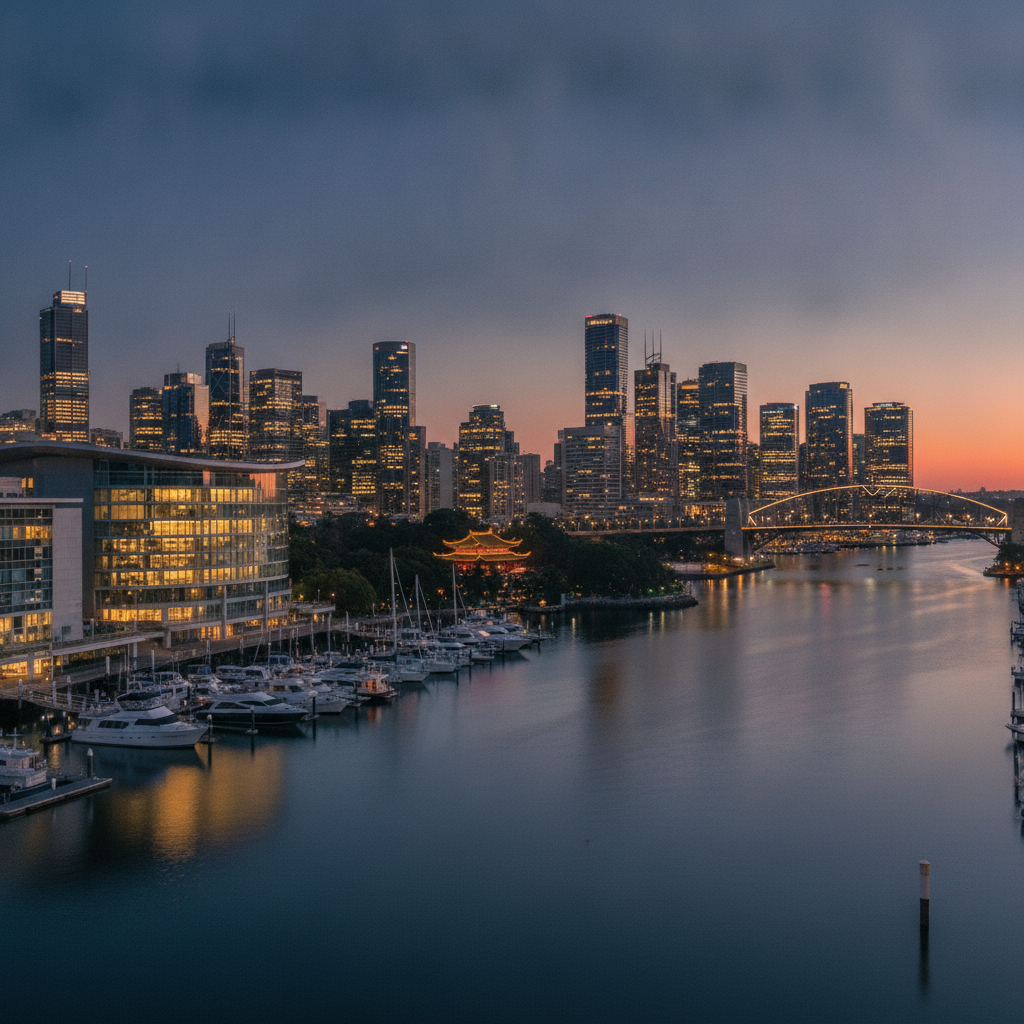
The western waterfront of Sydney's CBD — Darling Harbour, Chinatown, and Barangaroo — represents the city's most dramatic urban renewal, transforming redundant industrial docklands into a continuous public waterfront of museums, entertainment venues, restaurants, parkland, and the financial district extension that is now home to Crown Sydney and the Barangaroo Reserve Indigenous cultural landscape.
- 1
SEA LIFE Sydney Aquarium & Australian National Maritime Museum
SEA LIFE Sydney Aquarium (Darling Harbour, opened 1988, one of the largest aquariums in the world: 14 themed zones, 700 species, 13,000 animals, the most visited paid attraction in Australia) — features the Great Barrier Reef (the largest Great Barrier Reef display outside Queensland), the shark tunnel (a 160-meter walkthrough acrylic tunnel with 6-meter great white shark models and live sand tiger sharks), and a dugong display (one of only two dugong displays in the world outside Southeast Asia). The Australian National Maritime Museum (2 Murray Street, Darling Harbour, opened 1991, designed by Philip Cox) — Australia's largest museum dedicated to maritime heritage — holds the HMB Endeavour replica (a full-scale replica of Captain Cook's 1768 vessel, the finest replica of a 18th-century British Royal Navy vessel in the world, available for guided tours), the submarine HMAS Onslow (a 1968 Oberon-class submarine, the last surviving example of this class in Australia), the destroyer HMAS Vampire (1959, the largest vessel ever preserved in the Southern Hemisphere for public display), the Duyfken (the oldest replica tall ship in Australia, based on the 1606 Dutch vessel that made the first documented European contact with the Australian continent) and the America's Cup yacht Australia II (which ended the longest winning streak in sports history when it defeated the USA in 1983 after 132 years of American dominance).
- 2
Powerhouse Museum (1988/2024) & Ultimo
The Powerhouse Museum (500 Harris Street, Ultimo, the industrial suburb immediately south of Darling Harbour; the museum opened in 1988 in the former 1899 Ultimo Power Station, the first electric power station in the southern hemisphere, which supplied power to Sydney's tram network) — Australia's most visited museum (1.3 million visitors per year before 2022 closure for redevelopment), with a collection of 500,000 objects spanning applied arts, science, technology, transport, and design — contains several objects considered the most significant of their type in the world: the Boulton and Watt 1785 steam engine (the oldest working steam engine in the world, still demonstrable, the object that drove the Industrial Revolution), the Catalina flying boat (WWII, the largest surviving example of a type that patrolled the entire Pacific theater), and the 1855 Paris Exhibition locomotive (the most important surviving early steam locomotive in Australia). The Powerhouse is being relocated to Parramatta (completion 2025-2026); a new museum of design and fashion is planned for the Ultimo site.
- 3
Chinese Garden of Friendship (1988) & Chinatown
The Chinese Garden of Friendship (Darling Drive, Darling Harbour, a 1-hectare traditional Chinese garden designed by landscape architects from Guangdong Province, China, inaugurated in 1988 as a bicentennial gift to celebrate the sister-city relationship between New South Wales and Guangdong Province) — the largest traditional Chinese garden in the Southern Hemisphere — was built using Chinese building materials and follows the Song Dynasty garden design principles of 'borrowing scenery' (borrowed views of the CBD towers through the garden's moon gates and weeping willows create a dialogue between the old and new). Chinatown (Dixon Street and surrounds, Haymarket, Sydney's Chinatown established 1898, one of the oldest Chinatowns in Australia) — the cultural and commercial heart of Australia's Chinese-Australian community — Dixon Street (the pedestrianized main street, decorated with traditional Chinese gates, lanterns, and lion statues) contains the broadest concentration of Cantonese, Sichuan, and Shanghainese restaurants in Sydney, the Golden Water Mouth restaurant (opened 1958, the oldest continuously operating Chinese restaurant in Sydney), and the Market City shopping complex (the former Haymarket fruit and vegetable market, converted in 1996).
- 4
International Convention Centre Sydney (2016) & Tumbalong Park
The International Convention Centre Sydney (ICC Sydney, 14 Darling Drive, opened 2016, designed by Hassell and Populous, the largest convention, exhibition, and entertainment venue in Australia: 35,000 sq m exhibition space, seating for 8,000 in the main arena) — occupies the former site of the Sydney Entertainment Centre (1983-2015, the main entertainment venue in Sydney for 32 years, demolished to make way for ICC Sydney) — is operated in combination with the adjacent Darling Quarter (2011) and Tumbalong Park (the 1.5-hectare public park between ICC Sydney and Chinatown, designed by TCL landscape architects, featuring the Tumbalong Park playground — one of the most extensively designed children's playgrounds in Australia, with water play, climbing structures, and interactive installations — and the Tumbalong Park Amphitheatre, a 5,000-person outdoor venue that hosts free concerts during the Sydney Festival and Chinese New Year celebrations).
- 5
Barangaroo Reserve & Barangaroo South
Barangaroo (the 22-hectare urban renewal precinct on the western edge of the CBD, on the former Hungry Mile — a kilometre-long stretch of waterfront wharves where unemployed workers queued daily during the Great Depression, hoping for work unloading ships) — divided into three precincts: Barangaroo Reserve (the 6-hectare headland park at the northern end, designed by PWP Landscape Architecture with 75,000 native sandstone rocks and 10,000 plants to recreate the pre-European shoreline of Sydney Harbour, including the re-creation of the original Memel headland that was demolished for docklands in 1836; contains the Cutaway, a large underground events space carved into the sandstone headland); Barangaroo South (the financial and residential precinct, containing the IAG, KPMG, and Commonwealth Bank headquarters, and Crown Sydney — the $2.2 billion mixed-use tower completed in 2020, with 349 hotel rooms, 82 residential apartments from A$10 million, and a casino that operates only for international guests); and Barangaroo Central (the mid-section, currently under development as a cultural and retail precinct).
- 6
Pyrmont Bridge (1902) & Cockle Bay Wharf
Pyrmont Bridge (the 1902 electrically-operated swing bridge connecting Darling Harbour to the Pyrmont peninsula, the world's first electrically-operated swing bridge, and the oldest surviving electrically-operated bridge in the world) — swings 90 degrees on a central pivot to allow tall-masted vessels through the harbour — is still operated several times per year for heritage demonstrations and carries pedestrian and light rail traffic. Cockle Bay Wharf (the eastern side of Darling Harbour, a restaurant and entertainment complex built in 1996 on the former Darling Harbour industrial wharves) and the adjacent Darling Square (2018-2020, a new residential, retail, and food precinct built on a formerly surface car park, designed by Kengo Kuma — the Japanese architect responsible for the main stadium for the 2020 Tokyo Olympics — the Kuma-designed MIRO building at Darling Square is Australia's first building by a Pritzker Prize winner built specifically as a residential building) complete the harbour precinct east of the pedestrian bridge.
Walk this route with audio
Stories play automatically as you reach each stop — no tapping needed.
More in sydney
Manly Ferry, North Head & Scenic Headland: The World's Most Beautiful Ferry Crossing
Blue Mountains, Katoomba & Jenolan Caves: A World Heritage Day Trip from Sydney
Sydney Opera House, Circular Quay & The Rocks: The Iconic Harbour Foreshore
Newtown, Surry Hills & Paddington: Sydney's Inner City Cultural Corridor
Bondi to Coogee: Australia's Most Famous Coastal Walk