Little India and Kampong Glam: Singapore's Indian and Malay Quarters
Little India and Kampong Glam are two of Singapore's four historic ethnic quarters (the others being Chinatown and the Colonial District), each representing a distinct strand of Singapore's multicultural founding. Little India — centered on Serangoon Road, which has been the hub of Singapore's Indian community since the 19th century — is the commercial and cultural heart of Singapore's Tamil, Punjabi, and Bengali communities, known for its flower garland sellers, sari shops, spice merchants, and the extraordinary Sri Veeramakaliamman Temple. Kampong Glam, immediately east of Little India across the Rochor Canal, is the historic center of Singapore's Malay and Muslim community, established when Raffles set aside the area for Sultan Hussein Shah (the Malay ruler who signed the 1819 treaty ceding Singapore to the British) and the Arab traders who settled alongside him — today defined by the Sultan Mosque, the colourful Arab Street shophouses, and the street art and independent boutique culture of Haji Lane.
- 1
Sri Veeramakaliamman Temple — The Ferocious Mother Goddess
Sri Veeramakaliamman Temple, the most important Hindu temple in Singapore's Little India district (founded 1838, current structure 1881, most recent renovation 2000), is dedicated to Kali — the ferocious form of the Hindu goddess Parvati, destroyer of evil and protector of the faithful, typically depicted with dark blue skin, four arms holding weapons, a garland of severed heads, and a tongue extended in the act of consuming a demon. The temple's elaborate gopuram (entrance tower), covered in over 100 brightly painted figures of Kali and her mythological story, is the visual anchor of Serangoon Road. Inside: the main shrine to Kali in full warrior regalia, flanked by shrines to her sons Ganesha (the elephant-headed god of beginnings) and Murugan (the god of war, particularly venerated by Tamil Hindus). The temple is the focal point of Thaipusam, Singapore's most dramatic Hindu festival, in which devotees carry kavadi (metal frames with hooks pierced through their skin) in procession from Little India to the Sri Thendayuthapani Temple in Tank Road — a practice of voluntary physical mortification in thanksgiving to the god Murugan.
- 2
Mustafa Centre — The 24-Hour Department Store
Mustafa Centre, a sprawling 24-hour department store on Syed Alwi Road in Little India (three connected buildings totaling approximately 35,000 square metres of retail floor space), is one of Singapore's most distinctive shopping institutions: a labyrinthine, perpetually crowded emporium open 24 hours a day, 365 days a year, selling everything from gold jewellery and electronics to saris, Bollywood DVDs, Ayurvedic medicines, halal food products, and foreign currency at highly competitive exchange rates. The store is simultaneously a tourist attraction (it appears in every Singapore guidebook as a one-of-a-kind experience), a practical resource for Singapore's South Asian community (the grocery section stocks ingredients from across South and Southeast Asia at prices well below supermarket rates), and a functioning department store serving the local neighborhood. The gold section on the first floor — where pure 22-karat and 24-karat gold jewellery is sold by weight at prices determined by the morning spot gold price, with craftwork charged separately — is one of the best places to buy gold in Southeast Asia.
- 3
Sultan Mosque — The Golden Dome of Kampong Glam
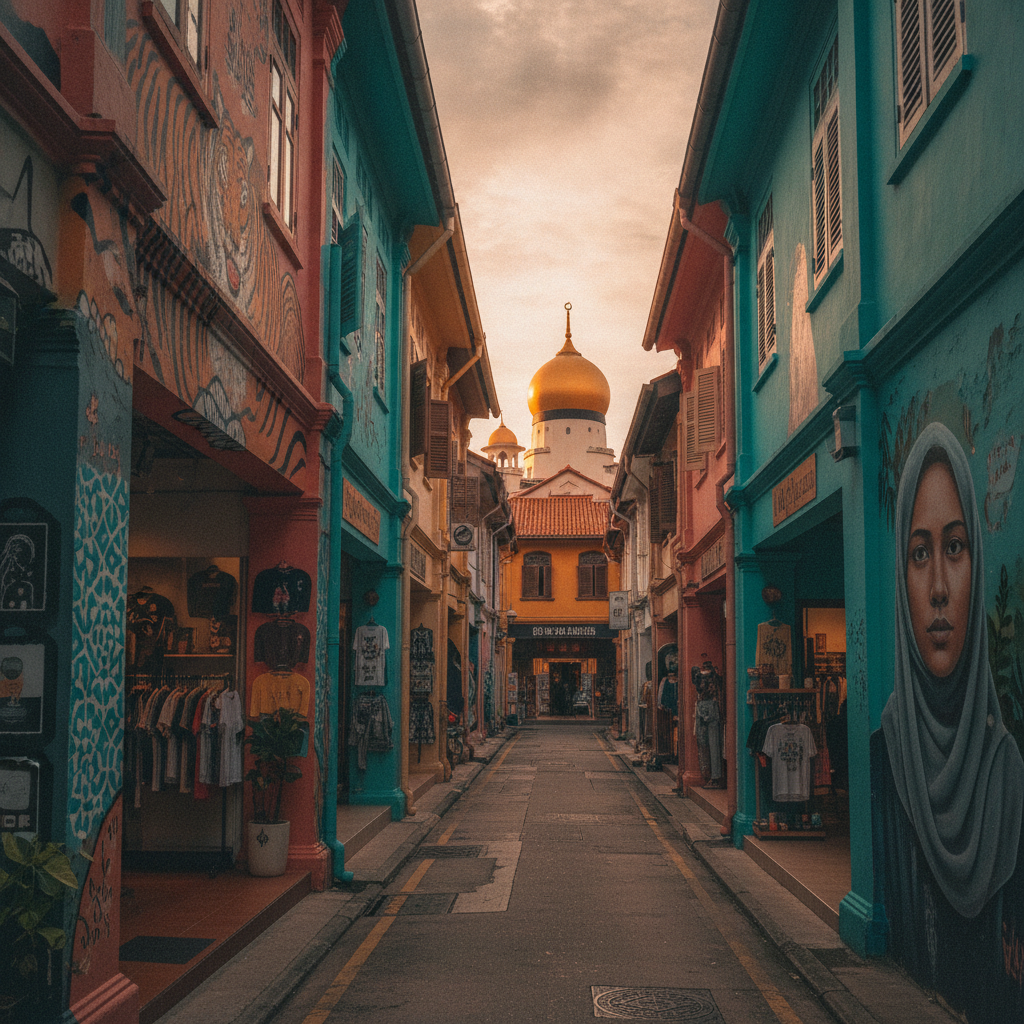
Sultan Mosque (Masjid Sultan), Singapore's most important and most beautiful mosque, stands at the corner of North Bridge Road and Muscat Street in the heart of Kampong Glam. The current structure — a 1928 design by the Irish architect Denis Santry in Indo-Saracenic style, combining Mughal domes with Renaissance columns and Malay decorative motifs — was built to replace a smaller mosque originally constructed in 1824 with funding from the British East India Company as a concession to Sultan Hussein Shah in the 1819 treaty. The mosque's two large golden domes (the color achieved with glass bottle bottoms — a tradition attributed to poor donors who contributed their glass bottles to the construction fund, which were embedded in the dome's base to create the amber color) and four minarets are visible from across the Rochor Canal and define the Kampong Glam skyline. The mosque is active (prayer times restrict non-Muslim visitor access), accommodates 5,000 worshippers, and is the site of Eid al-Fitr and Eid al-Adha prayers for much of Singapore's Muslim community.
- 4
Haji Lane — Street Art and Independent Culture
Haji Lane, a narrow pedestrian alley behind Arab Street running parallel to Beach Road, is Singapore's most famous street art and independent boutique destination: a 200-meter alley of three-storey Malay shophouses (built in the 1920s and 1930s, when the area was a residential quarter for Malay, Arab, and Javanese Muslim communities) whose party walls and facade plasters are covered in constantly rotating commissioned street murals by local and international artists, and whose ground floors host a rotating cast of small-format independent retailers selling vintage clothing, locally-designed streetwear, artisan accessories, and specialty coffee. The street's transformation from a quiet residential alley to a cultural destination began in the early 2000s, driven by the same dynamics that transformed similar streets in Shoreditch (London) and Williamsburg (New York): low rents enabling experimental retail, the photogenic qualities of colonial architecture + street art, and proximity to a university population.
- 5
Arab Street and the Textile Quarter
Arab Street, the main commercial street of Kampong Glam running from Beach Road to the Sultan Mosque, was historically Singapore's center of the textile and fabric trade: a street of shop-houses selling bolts of silk, batik, and songket (gold-threaded Malay fabric used for wedding garments and formal dress) to the Malay, Indonesian, and Arab communities who settled in Kampong Glam. The fabric shops still occupy much of the street (alongside carpet sellers, rattan goods merchants, and perfume sellers offering Arabic oud and attar), though the customer base has shifted from the community to tourists and textile professionals. The surrounding streets — Bussorah Street, Muscat Street, Baghdad Street — retain their historic names (all named for cities in the Muslim world) and their conservation shophouses, now mostly housing restaurants serving Malay, Middle Eastern, and North African food in the shaded five-foot-ways.
- 6
Tekka Centre — The Wet Market and Hawker Hall
Tekka Centre (also called Zhujiao Market, its original name in Hokkien), a large two-storey market building on the corner of Serangoon Road and Buffalo Road at the southern end of Little India, contains what is arguably the best wet market and hawker center combination in Singapore: a ground-floor wet market selling fresh fish, meat, poultry, and vegetables sourced primarily from Malaysia and Indonesia (the fish section is particularly comprehensive, with 20+ species of live and fresh fish laid out on ice, plus live crabs and prawns in water tanks), and a first-floor hawker center of approximately 80 stalls specializing in South Indian Muslim cuisine — biryani, fish curry, roti prata (flaky griddle bread served with curry), mee goreng (spicy stir-fried noodles), and teh tarik ('pulled tea', a frothy hot tea made by pouring the milky brew between two containers from a height to create a foam). The best roti prata in Singapore is contested between approximately six stalls in the Tekka Centre hawker hall, each with its devoted regulars.
Walk this route with audio
Stories play automatically as you reach each stop — no tapping needed.
More in singapore
Sentosa Island: Singapore's Pleasure Island
East Coast and Katong: Peranakan Heritage and Seaside Singapore
Marina Bay: Singapore's Futurist Waterfront
Orchard Road and the Botanic Gardens: Shopping and Green Sanctuary
Colonial Civic District: The Architecture of Empire