East Coast and Katong: Peranakan Heritage and Seaside Singapore
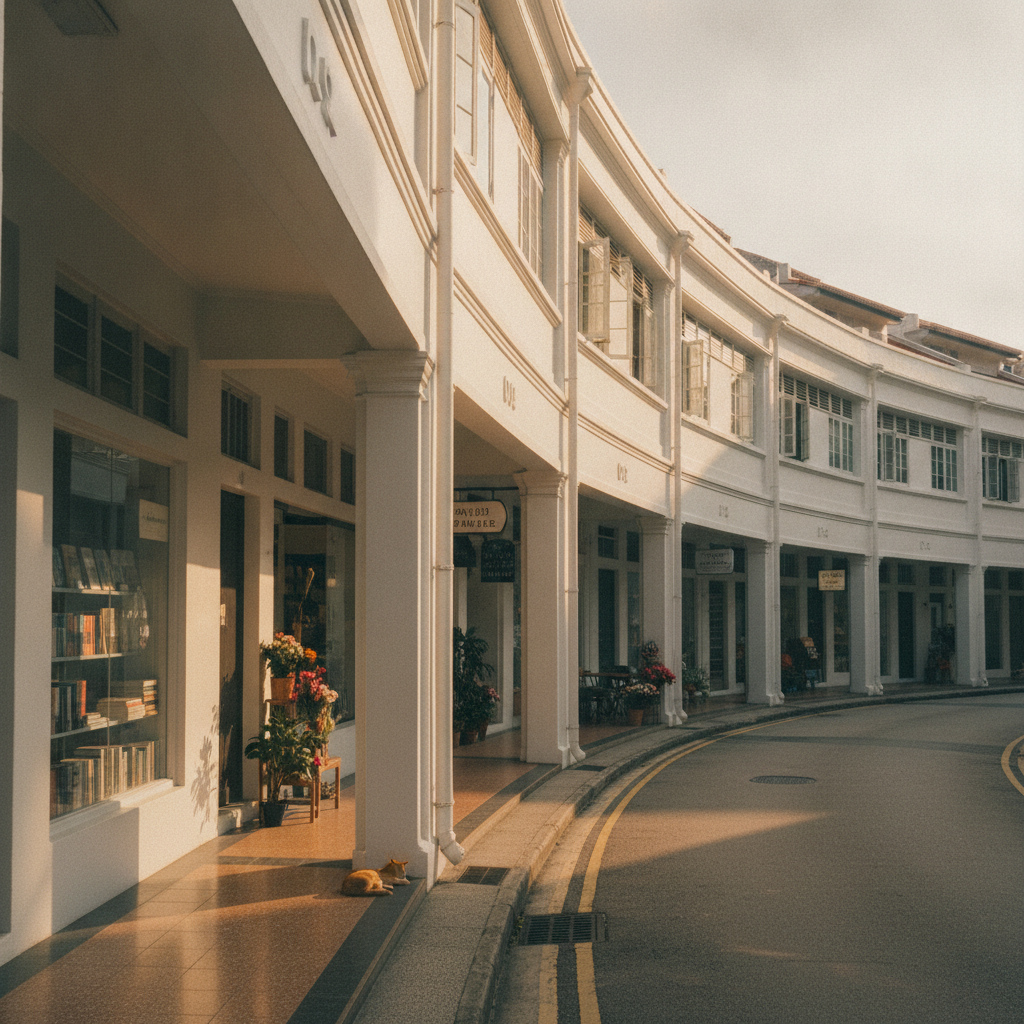
Katong and Joo Chiat, adjacent neighborhoods in Singapore's East Coast district, constitute Singapore's most important Peranakan (Straits Chinese) heritage quarter: a residential area that developed from the 1900s to the 1940s as a prosperous suburb of wealthy Baba-Nyonya Chinese families (the Peranakan community — Chinese men who intermarried with Malay women in the 15th–19th centuries, creating a distinct hybrid culture of Chinese-Malay cuisine, fashion, language, and architecture). The neighborhood's physical legacy is the finest intact collection of Peranakan shophouse architecture in the world: Koon Seng Road, East Coast Road, and Joo Chiat Road all contain long terraces of pre-war shophouses decorated with the characteristic Peranakan combination of Chinese motifs (phoenix, crane, bamboo), European architectural elements (Corinthian pilasters, arched windows), and Malay decorative tiles (encaustic tiles in floral patterns set into facades). East Coast Park, immediately south of the neighborhood running along 15 kilometers of reclaimed coastline, is Singapore's most-used outdoor recreation space.
- 1
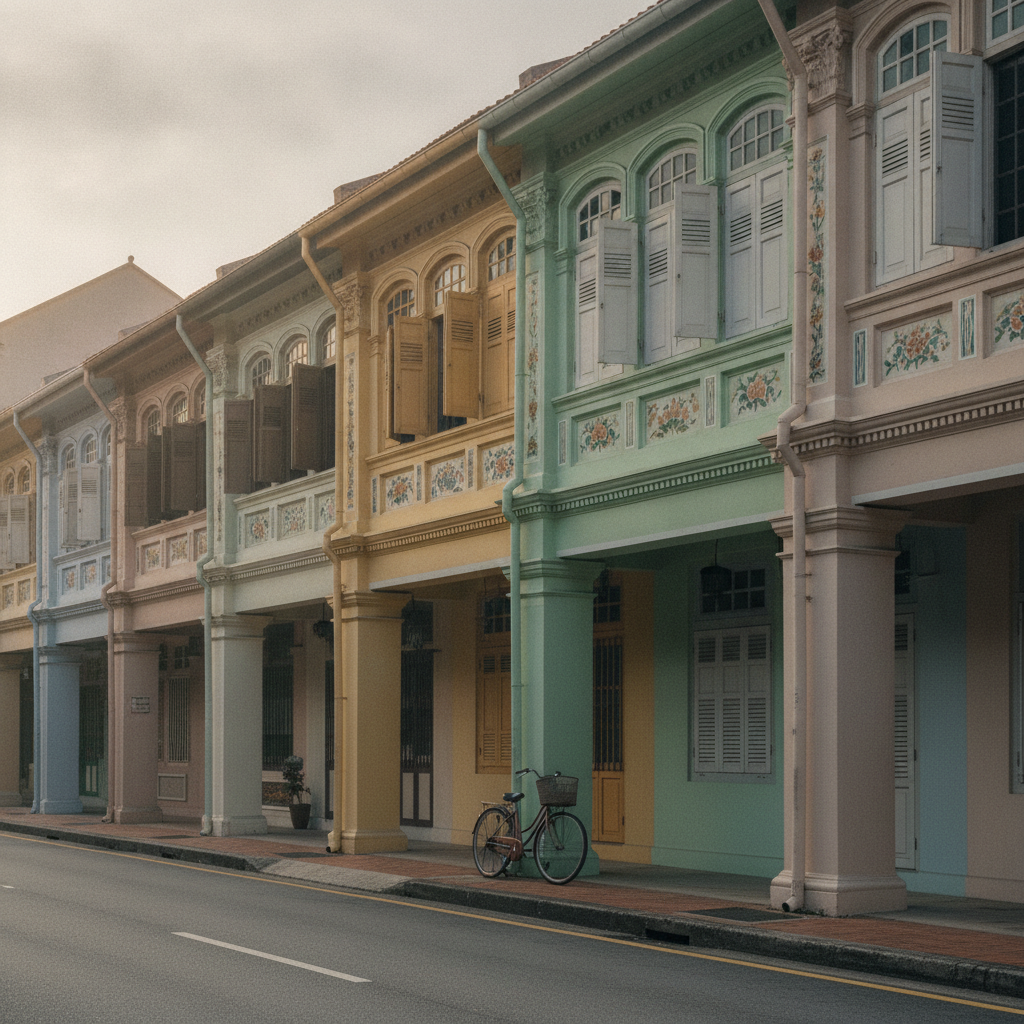
Koon Seng Road — The Most Photographed Peranakan Street
Koon Seng Road, a short residential terrace street running off Joo Chiat Road, is the most photographed block of Peranakan architecture in Singapore: a terrace of approximately 40 pre-war shophouses (built approximately 1920s–1930s) arranged in matching pairs facing each other across the street, each house painted in a distinct pastel color (the famous candy-colored facade palette — mint, sage, dusty rose, butter yellow, powder blue) and decorated with elaborate plasterwork in the characteristic Peranakan style that mixes Chinese motifs (bats for luck, phoenixes for prosperity, bamboo for longevity), European baroque architectural elements (pilasters, friezes, arched fanlights), and Malay decorative tiles. The street represents the architectural peak of the Peranakan community's prosperity in the first half of the 20th century — these houses were built by Baba (Peranakan Chinese men) merchants who had accumulated significant wealth from trade and money-lending, and spent it on elaborately decorated homes that demonstrated both their Chinese heritage and their assimilation of European colonial fashions.
- 2
Katong Laksa — The Original Recipe Dispute
Katong is synonymous with Katong Laksa — a variant of Singapore laksa (the iconic Nonya curry noodle soup that is itself one of the national dishes of Singapore, made with rice vermicelli in a rich coconut milk broth flavored with dried shrimp paste, lemongrass, galangal, and fresh laksa leaves) in which the noodles are pre-cut into short segments so the entire bowl can be eaten with just a spoon rather than chopsticks and a spoon. The East Coast Road strip from Marine Parade Road to Joo Chiat Road contains approximately five competing Katong Laksa establishments, each claiming to be the 'original' inventor of the cut-noodle version (a dispute that went to Singapore's courts in the 1990s when one stall sued another over the use of the name). The Gordon Ramsay endorsement of one stall and Anthony Bourdain's patronage of another have only intensified the debate. Katong Laksa, Char Kway Teow, and Oyster Omelette are the three dishes most closely associated with Katong's food identity.
- 3
Joo Chiat Road — Living Heritage and Changing Character
Joo Chiat Road, the main commercial street of the Katong-Joo Chiat heritage district (running approximately 2 kilometers from Geylang Road to East Coast Road), is the most intact traditional commercial street in Singapore: a continuous run of shophouses of the 1920s–1940s (many with original tile facades, timber shutters, and five-foot-way pillars intact) housing an extremely varied mix of businesses — traditional Peranakan kueh (cake) makers, Vietnamese pho restaurants, Thai massage parlors, independent coffeeshops serving kopi and kaya toast, fabric shops, bridal studios, medical halls, bars, and art galleries. The street's mix of heritage architecture and contemporary use is what Singapore's Heritage Board calls 'living heritage' — a community that continues to live and work in its historic built environment rather than treating it as a museum.
- 4
East Coast Park — Singapore's Seaside Recreation Corridor
East Coast Park, a 15-kilometer linear park running along reclaimed coastline between the East Coast Expressway and the South China Sea, is Singapore's most visited public park and the primary outdoor recreation space for the city's East and South districts: 185 hectares of park space containing a 15-kilometer cycling and running path (part of Singapore's broader Park Connector Network), multiple beaches (East Coast Beach, the longest publicly accessible beach in Singapore), the East Coast Seafood Centre (a cluster of 10 large seafood restaurants serving chili crab and black pepper crab in a breezy seaside setting — chili crab is Singapore's national dish, and East Coast Seafood Centre is the best-known place to eat it), barbecue pits, bicycle rental, roller-skating facilities, and a beachside lagoon. The park's eastern end looks out toward the container terminal at Pasir Panjang and the islands of Batam and Bintan in Indonesia on the horizon.
- 5
Geylang — Singapore's Most Honest Neighborhood
Geylang, the neighborhood immediately west of Katong (running from Kallang River to Paya Lebar Road), is simultaneously Singapore's most morally complex and most gastronomically interesting neighborhood: a red-light district (officially tolerated in designated lorongs, the odd-numbered side streets off Geylang Road) that operates openly alongside some of Singapore's most celebrated late-night hawker food — particularly the durian stalls that line Geylang Road from dusk to 2am, selling the notoriously pungent, divisive tropical fruit in every variety (Mao Shan Wang, D24, Black Gold, Red Prawn) at prices from S$15 to S$50 per kilogram. Geylang's food reputation extends well beyond durian: the neighborhood's cze char (Chinese cooking-to-order) restaurants, frog porridge stalls, and Malay Muslim hawker food at Geylang Serai Market are considered by many Singaporean food writers to be the most authentic and least tourist-oriented in the city.
- 6
Changi Village and the Far East
Changi Village, at the extreme northeast tip of Singapore (accessible by public bus from the city center in approximately 60 minutes), is the furthest from the urban center of Singapore's populated neighborhoods: a small low-rise village of Malay and Chinese shophouses, a hawker center (Changi Village Hawker Centre, famous for its nasi lemak — coconut rice with sambal, fried chicken, and anchovies), and a small ferry terminal from which bumboats cross to Pulau Ubin (the last island off Singapore's coast that retains a kampong character). The area was formerly the location of the Changi Prison complex (built by the British in 1936, used by the Japanese to imprison Allied prisoners of war 1942-1945; the Changi Museum nearby documents this history). Changi Beach, the beach adjacent to the village, is where the Japanese executed approximately 400 Chinese civilians on one night in February 1942 — a site still marked by a small memorial.
Walk this route with audio
Stories play automatically as you reach each stop — no tapping needed.
More in singapore
Sentosa Island: Singapore's Pleasure Island
Marina Bay: Singapore's Futurist Waterfront
Little India and Kampong Glam: Singapore's Indian and Malay Quarters
Orchard Road and the Botanic Gardens: Shopping and Green Sanctuary
Colonial Civic District: The Architecture of Empire