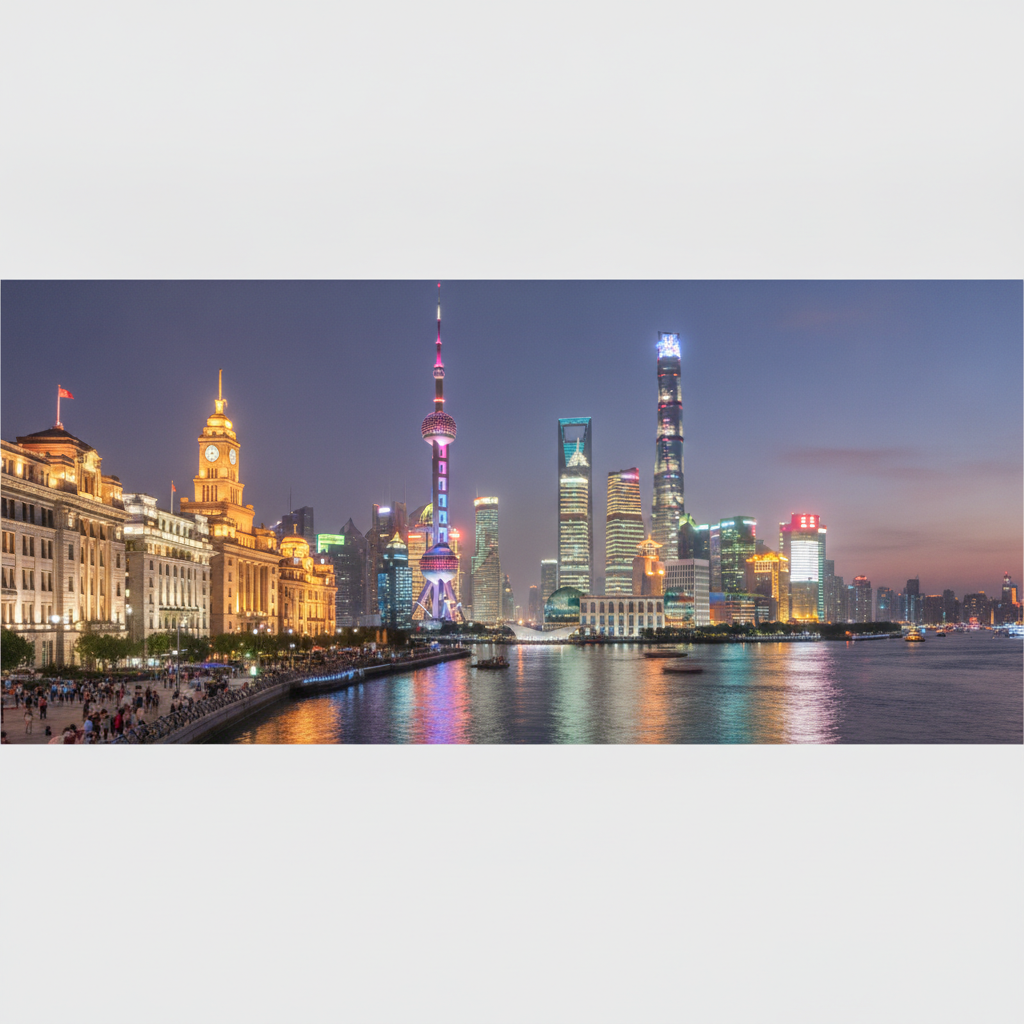
The Bund, Pudong & the Shanghai Skyline — East Meets West
Shanghai (上海 — 'Upon the Sea' — the largest city in China by population (approximately 24-25 million in the urban area), the world's busiest container port, and the financial and commercial capital of the People's Republic of China): the confrontation across the Huangpu River between the Bund (the 1920s-1930s European colonial banking and trading district on the west bank) and Pudong (the ultra-modern financial district that rose from farmland between 1990 and the present on the east bank) is the defining image of Shanghai and one of the most dramatic urban spectacles in the world.
- 1
The Bund — Shanghai's European Colonial Waterfront
The Bund (外滩 — Wàitān — the 1.5 km waterfront promenade along the western (Puxi) bank of the Huangpu River in the heart of old Shanghai, between Suzhou Creek (苏州河) in the north and Yan'an Road (延安路) in the south — the most iconic street in China and the symbol of Shanghai's colonial and financial heritage): the Bund was developed from the 1840s (following the Treaty of Nanking (1842) that ended the First Opium War and opened Shanghai as a treaty port) through the 1930s into the financial and commercial centre of Asia, with the headquarters of the major international banks, trading companies, and consulates occupying the grand neoclassical, Art Deco, and eclectic European-style buildings that still line the waterfront today; the most significant buildings include: the Customs House (海关大楼 — Hǎiguān Dàlóu — built 1927, the neoclassical headquarters of the Chinese Imperial Maritime Customs, with the distinctive clock tower (known as 'Big Ching' by analogy with Big Ben), the most iconic building on the Bund), the HSBC Building (汇丰银行大楼 — the domed neoclassical 1923 headquarters of the Hong Kong and Shanghai Banking Corporation, now the Shanghai Pudong Development Bank), and the Peace Hotel (和平饭店 — Hépíng Fàndiàn — the 1929 Art Deco Sassoon House, once 'the finest hotel east of Suez', now a luxury hotel with the famous Jazz Bar where the same band has played nightly since the 1980s).
- 2
Pudong — The World's Most Dramatic Urban Transformation
Pudong New Area (浦东新区 — Pǔdōng Xīnqū — the administrative district on the east bank of the Huangpu River, directly across from the Bund — the most extraordinary urban development in modern history): in 1990 Pudong was designated a Special Economic Zone by Deng Xiaoping, at which point the area consisted almost entirely of farmland and small villages (the few existing structures included a small industrial port and some warehouses); between 1990 and the present, Pudong has been transformed into one of the world's premier financial districts, with the Lujiazui Finance and Trade Zone (陆家嘴金融贸易区 — the cluster of skyscrapers directly opposite the Bund) including the Oriental Pearl Tower (东方明珠广播电视塔 — 468 metres, the distinctive 'twin-sphere-on-a-column' design, built 1991-1994 as the first and most recognizable landmark of the new Pudong), the Jin Mao Tower (金茂大厦 — 420 metres, the 1999 pagoda-inspired skyscraper designed by Skidmore, Owings & Merrill (SOM)), the Shanghai World Financial Center (上海环球金融中心 — 492 metres, the 2008 'bottle opener' tower with the 100-metre-wide square aperture at the crown, designed by Kohn Pedersen Fox), and the Shanghai Tower (上海中心大厦 — 632 metres, the tallest building in China and the second tallest in the world (after the Burj Khalifa), completed 2015, designed by Gensler with the distinctive anti-clockwise twisted tapering form that reduces wind load by 24%).
- 3
The Huangpu River & Shanghai's Waterways
The Huangpu River (黄浦江 — the 113 km river that flows north through Shanghai to join the Yangtze River (长江) at the Wusong confluence — the defining geographic feature of Shanghai): the Huangpu (the river that gives Shanghai its characteristic flat, riverine urban landscape, and the artery through which virtually all trade and goods flowing into and out of Shanghai have moved since the city's foundation) is crossed by four major tunnels and bridges within the urban area (the Yangpu Bridge (杨浦大桥), the Nanpu Bridge (南浦大桥), and the Lupu Bridge (卢浦大桥) to the south — the Lupu Bridge (completed 2003, 3,900 metres total length) was the world's longest steel arch bridge at the time of completion); the Bund ferry (the small passenger ferry across the Huangpu from the Bund to Pudong) and the Bund sightseeing tunnel (the tourist tunnel under the river with the psychedelic light show, a distinctly Shanghai kitsch experience) are the most popular ways to cross; the river cruises on the Huangpu (evening cruises from Shiliupu Wharf (十六铺码头) and from the Bund, offering views of both the Bund buildings and the Pudong skyline illuminated at night) are the finest way to see the contrast between the two waterfronts.
- 4
The Peace Hotel & the Golden Age of Shanghai Jazz
The Peace Hotel (和平饭店 — Hépíng Fàndiàn — the green-roofed Art Deco tower at the corner of the Bund and Nanjing Road East, built in 1929 by the Sassoon real estate empire as 'Sassoon House' (沙逊大厦) and operated as the Cathay Hotel — the finest hotel in Asia during the 1930s-1940s, the preferred address of celebrities, dignitaries, and the Shanghai elite during the city's 'golden age' as the 'Paris of the East'): the Peace Hotel Jazz Bar (the ground-floor bar where the 'Old Jazz Band' (老年爵士乐队 — an ensemble of Chinese musicians in their 70s-80s (in the 2000s-2010s) playing 1930s American jazz standards in tuxedos, the original band members dating their service back to before 1949) has performed nightly since the 1980s — the most famous bar in China and one of the most storied in Asia) is the essential Shanghai evening experience; the 1930s interior of the hotel (the eight themed dining rooms, each decorated in the national style of a different country that had a concession in colonial Shanghai — the British Room, the French Room, the American Room, the Indian Room, the Italian Room, the Chinese Room, the German Room, the Japanese Room — a unique survival of Art Deco interior design in the original 1929 state) is the finest surviving Art Deco hotel interior in Asia.
- 5
Nanjing Road — China's Premier Shopping Street
Nanjing Road (南京路 — Nánjīng Lù — the main east-west commercial street of Shanghai, running 5.5 km from the Bund in the east to Jing'an District in the west — the most famous shopping street in China and historically the most important commercial street in Asia): Nanjing Road East (南京东路 — the 1.2 km pedestrianized eastern section from the Bund to People's Square — the most heavily visited commercial street in China, with an estimated 1 million pedestrians per day on peak days) is lined with the department stores and flagship retail units of both Chinese and international brands; the historic department stores (the No. 1 Department Store (第一百货 — the state-owned flagship department store established 1936 as the 'Sun Company' (大新公司), the largest department store in Asia at the time of its completion, built in the Art Deco style by Chinese architect Kwan & Associates), the Shanghai No. 1 Department Store (上海市第一百货商店)) represent the department store tradition of Nanjing Road that dates to the 1910s; the traditional food shops on Nanjing Road East (the Shao Xing Shan Ye (邵万生) preserved foods shop, the Wang Jia Sha (王家沙) dim sum restaurant, and the Shen Dacheng (沈大成) pastry shop) are among the oldest surviving commercial establishments in Shanghai.
- 6
Shanghai Tower Observatory — Above the Clouds
Shanghai Tower (上海中心大厦 — Shànghǎi Zhōngxīn Dàshà — the 632-metre twisted-form skyscraper in the Lujiazui finance district of Pudong, completed 2015 — the tallest building in China and the second tallest in the world): the observatory (位于第118层 — the observation deck at the 118th floor of the Shanghai Tower, at 546 metres above ground — the highest observation deck in China and the third highest in the world) offers a 360-degree panoramic view encompassing the Bund waterfront, the full extent of the Shanghai urban area (extending to the horizon in all directions — the flat Yangtze delta plain on which Shanghai sits, with no topographic features to interrupt the view for 50+ km in most directions), the Oriental Pearl Tower, Jin Mao Tower, and World Financial Center visible at eye level and below; the view from the Shanghai Tower at night (the entire city illuminated, the Huangpu River a dark ribbon with the necklace of lighted bridges spanning it, the Bund buildings lit up in gold and white, the Pudong towers surrounding the observatory in a forest of light) is the finest city view in China.
Walk this route with audio
Stories play automatically as you reach each stop — no tapping needed.
More in shanghai
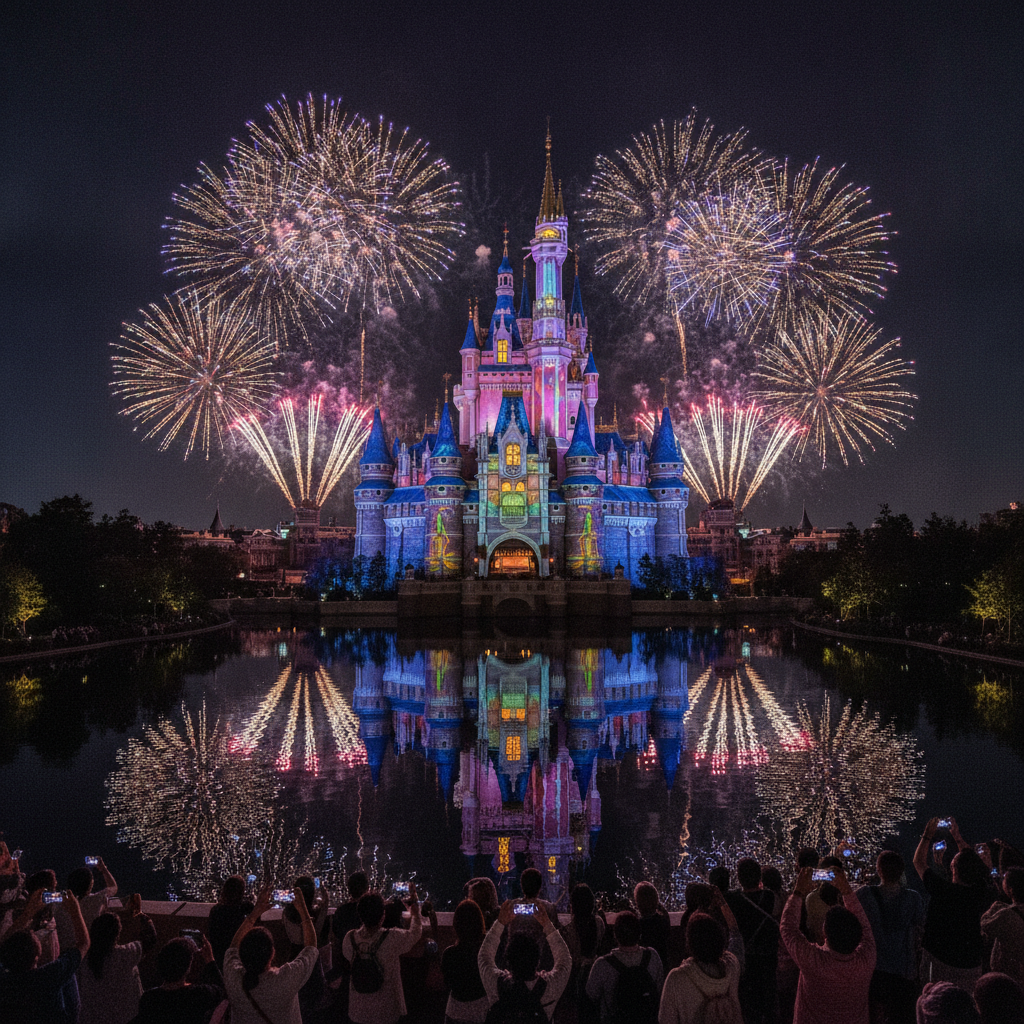
Shanghai Disneyland, Century Park & the New Eastern Shanghai
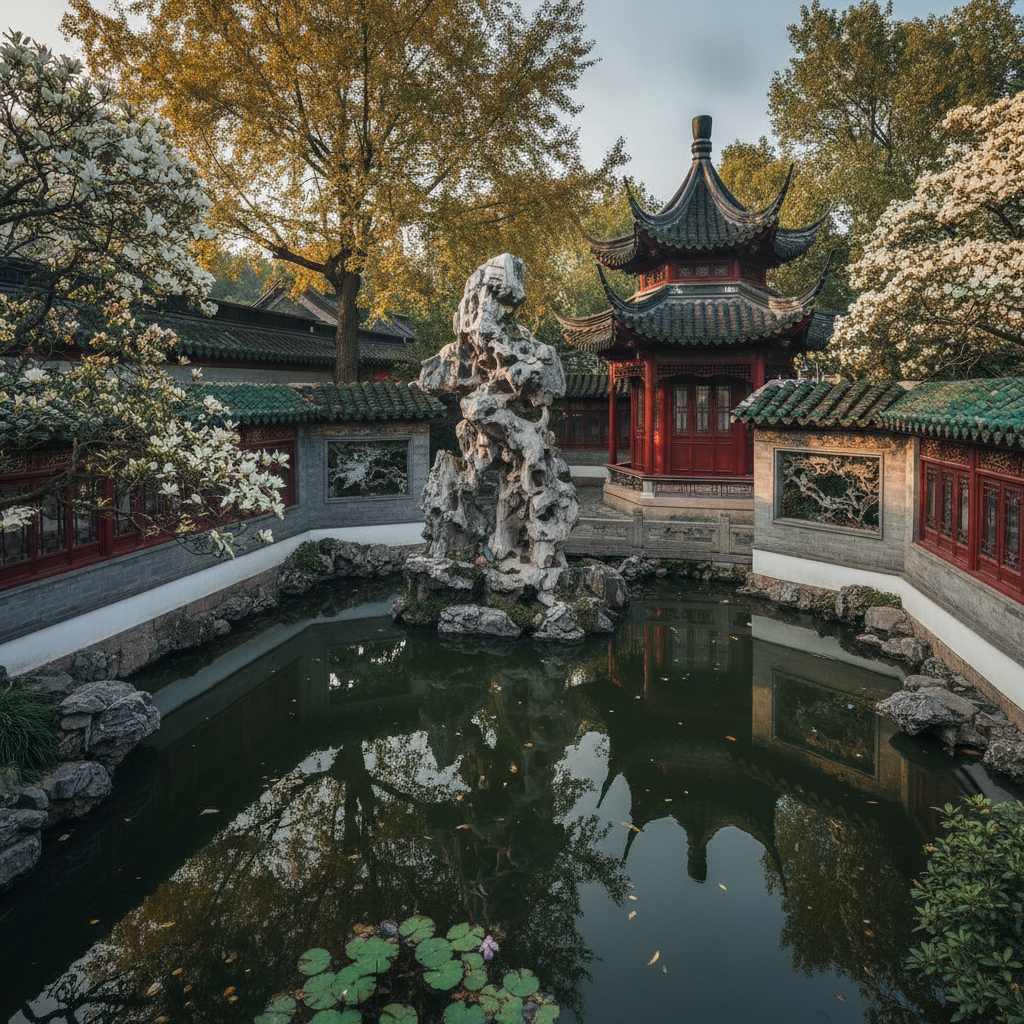
Yu Garden, Old Town & City God Temple — Ming Shanghai
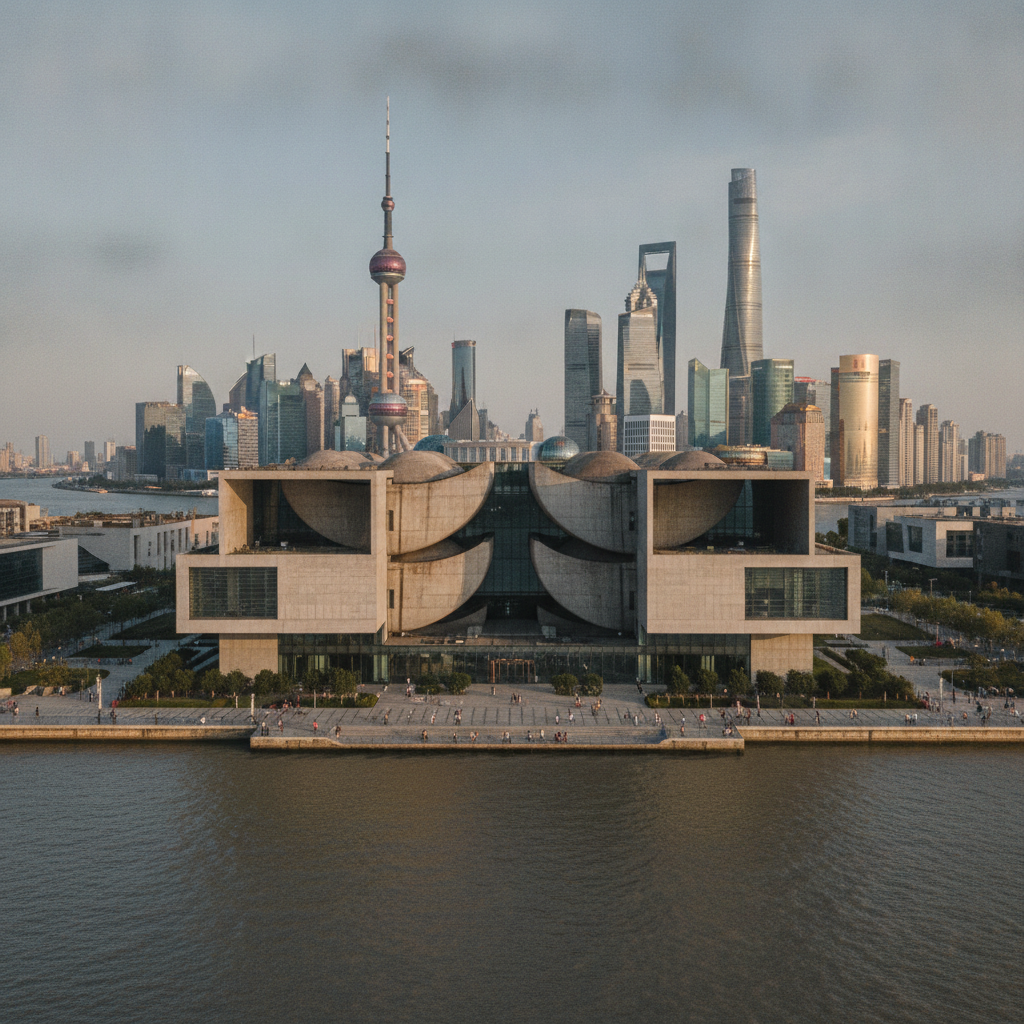
West Bund, M50 & Shanghai's World-Class Art Scene
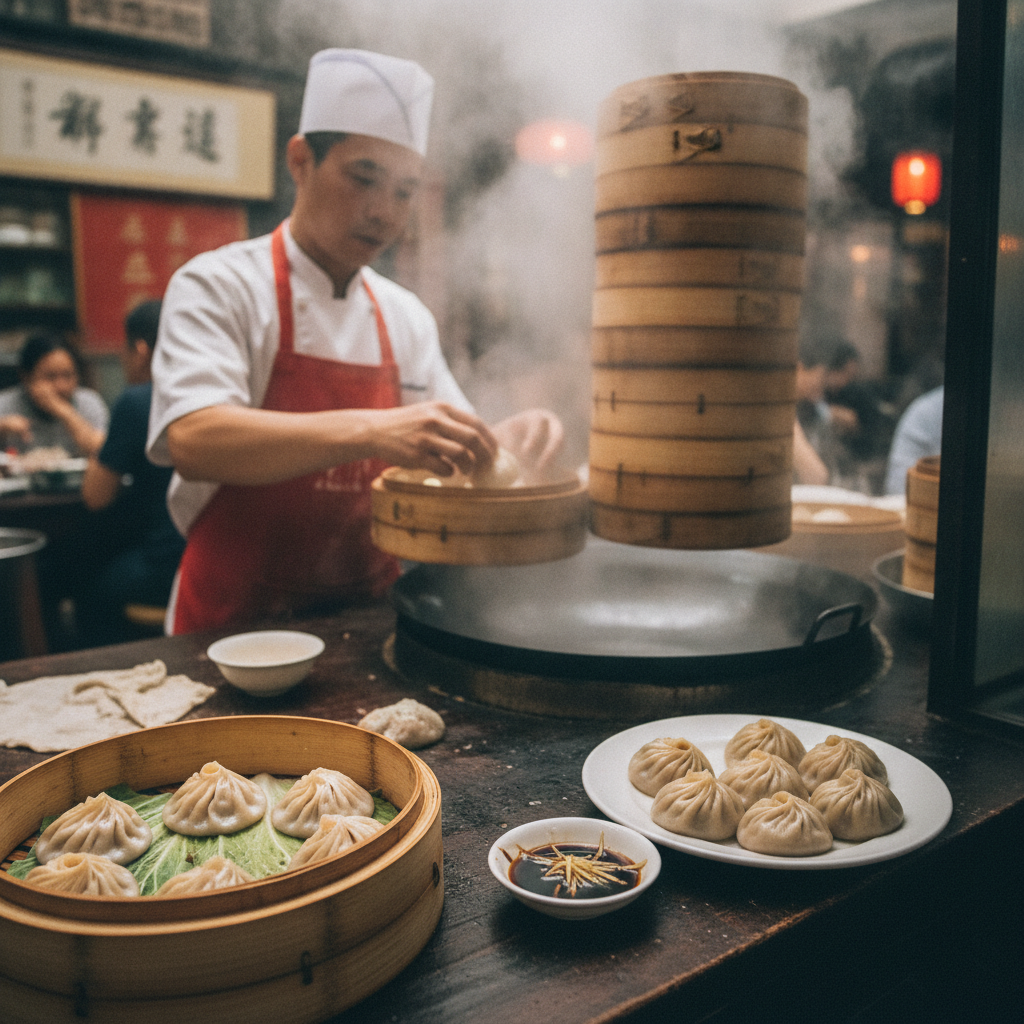
Shanghai Cuisine — Hairy Crab, Red-Cooked Pork & the Art of Xiaolongbao
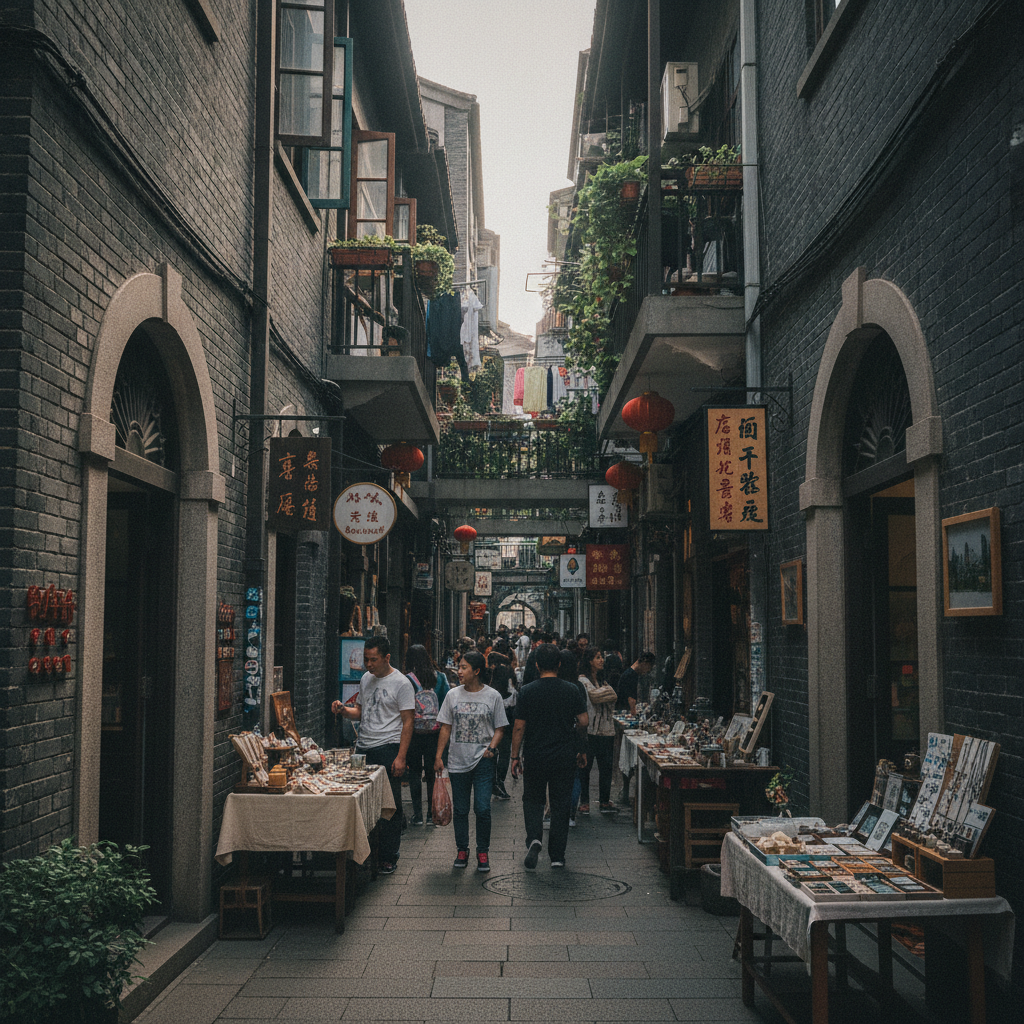
French Concession, Tianzifang & Xintiandi — Old Shanghai's Soul