Real Alcázar, Seville Cathedral & the Giralda Tower
Seville's UNESCO World Heritage Site (designated 1987 — the three monuments: the Real Alcázar de Sevilla, the Catedral de Sevilla, and the Archivo General de Indias): the Alcázar (the Royal Palace of Seville — the Mudéjar palace begun in 913 CE and rebuilt in its current form by King Pedro I of Castile in 1364, the finest Mudéjar architecture in Spain), the Cathedral (the Gothic cathedral begun in 1402 on the site of the Great Mosque of Seville, the largest Gothic cathedral in the world and the third largest church in the world), and the Giralda (the 12th-century Almohad minaret converted to a cathedral bell tower) — together the supreme expression of Seville's layered Islamic and Christian heritage.
- 1
Real Alcázar de Sevilla — The Finest Mudéjar Palace in Spain
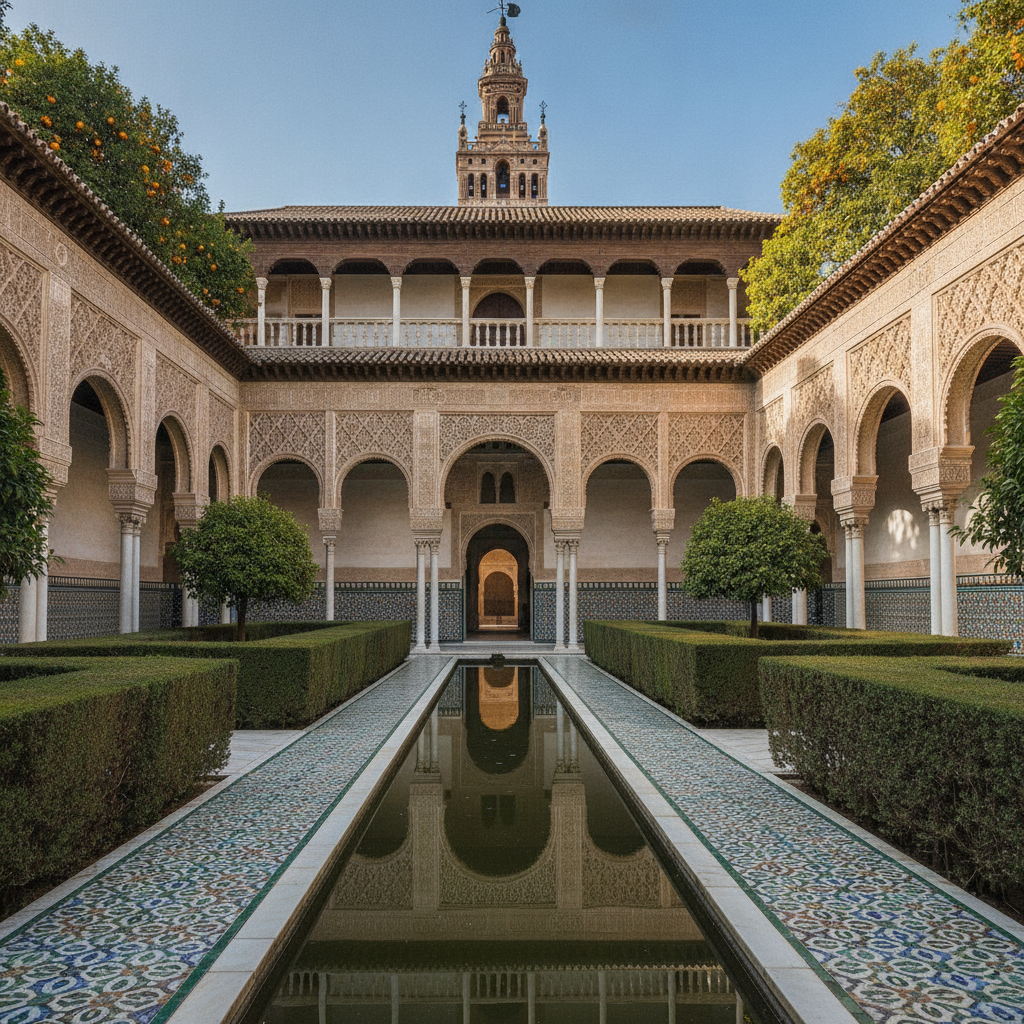
The Real Alcázar de Sevilla (the 'Royal Palace of Seville' — the royal palace at the Plaza del Triunfo in the Santa Cruz neighbourhood of Seville, the palace that has been the residence of the Spanish royal family in Seville from the 10th century to the present (the Spanish royal family still uses the upper floors of the Alcázar as the official Seville residence during the Feria de Abril and other Seville events)): the Mudéjar architecture (the Mudéjar architectural style — the style developed in the Iberian Peninsula in the 11th-15th centuries in which Muslim artisans applied Islamic decorative techniques (the geometric tile work, the carved plasterwork, the elaborately decorated wooden ceilings — the 'artesonado' ceilings) to Christian buildings, creating the most distinctive and most beautiful architectural style of medieval Iberia): the Patio de las Doncellas (the 'Courtyard of the Maidens' — the central patio of the Palacio del Rey Don Pedro (the 14th-century palace built for King Pedro I of Castile ('Pedro the Cruel') in 1364 by Muslim artisans from Granada and Toledo — the patio with the long rectangular reflecting pool (4 metres wide and 34 metres long), the sunken garden beds around the pool planted with the orange trees and the myrtles, the elaborately carved plasterwork arches ('arquerías') on all four sides of the patio, and the upper storey added by the Habsburg Emperor Charles V in the 16th century): the Patio de las Muñecas (the 'Courtyard of the Dolls' — the private inner patio of the Palacio del Rey Don Pedro, the smallest and the most intimate of the Alcázar patios, the patio with the delicate marble columns and the intricate carved plasterwork that represents the finest craftsmanship of the Mudéjar style): the Salón de Embajadores (the 'Hall of Ambassadors' — the throne room of the Alcázar, the most magnificent room in the palace: the square room covered by the extraordinary wooden dome (the 'Media Naranja' — the 'half orange' dome of carved and gilded cedar wood with the interlocking star pattern), the gilded plasterwork arches, and the azulejo tile dado on all four walls).
- 2
Catedral de Sevilla — The Largest Gothic Cathedral in the World
The Catedral de Sevilla (the 'Cathedral of Seville' — the largest Gothic cathedral in the world (the largest cathedral measured by interior area), the third largest church building in the world (after St Peter's Basilica in Rome and St Paul's Cathedral in London), begun in 1402 and completed in 1506 on the site of the Great Mosque of Seville (the 'Aljama Mosque' — the great mosque of Almohad Seville, built 1172-1198, of which only the Giralda minaret and the Patio de los Naranjos survive)): the dimensions (the Catedral de Sevilla — the cathedral that is 135 metres (443 feet) long, 100 metres (328 feet) wide, and 40 metres (131 feet) to the roof vault at the nave, the cathedral that covers an area of 11,520 square metres (124,000 sq ft)): the Capilla Mayor (the 'Main Chapel' — the central chapel of the Seville Cathedral containing the largest altarpiece ('retablo') in the world: the 'Retablo Mayor' of the Seville Cathedral — the 80-panel gilded wooden altarpiece covering the entire east end of the Capilla Mayor, begun in 1482 by the Flemish sculptor Pieter Dancart and completed in 1564, depicting 45 scenes from the life of Christ and the Virgin Mary in the highly detailed Late Gothic and early Renaissance style): the tomb of Christopher Columbus (the 'Sepulcro de Cristóbal Colón' — the tomb of Christopher Columbus (1451-1506) in the south transept of the Seville Cathedral, the elaborate bronze and stone monument (installed in 1902) depicting four heralds — the kings of Castile, León, Aragón, and Navarra — carrying the coffin of Columbus on their shoulders): the Sacristía Mayor (the 'Main Sacristy' — the Renaissance sacristy of the Seville Cathedral, housing the cathedral treasury including the 'Custodia Procesional' (the processional monstrance of Juan de Arfe (1587), the 475 kg silver monstrance carried in the Corpus Christi procession through the streets of Seville)).
- 3
La Giralda — Seville's Moorish Bell Tower
The Giralda (the 'weather vane' — the bell tower of the Seville Cathedral, the most recognizable landmark of Seville and the symbol of the city): the history (the Giralda — originally the minaret of the Great Mosque of Seville (the 'Aljama Mosque'), built 1184-1198 under the Almohad caliph Yaʻqūb al-Manṣūr (the 'Mansur' — the 'victorious') as the tallest building in the world at the time of its completion): the architecture (the Giralda minaret — the 70-metre (230-foot) tall square tower of the original Almohad minaret (now forming the lower 3/4 of the Giralda), built in the Almohad style (the 'sebka' — the diamond-shaped lattice ornament of plasterwork on the upper section of the tower, the arch-and-panel decoration on the lower section, and the small double-arched windows set in the blind arches of the four faces)): the Christian additions (the Renaissance bell tower added to the top of the Almohad minaret in 1558 by the architect Hernán Ruiz the Younger — the four-storey Renaissance belfry (adding 30 metres to the tower height), the 24 bells of the cathedral, and the 'Giraldillo' (the bronze weathervane figure at the top of the tower — the 4-metre (13-foot) tall bronze figure of 'Faith' (the female figure holding the palm branch and the flag of the city) that has been the weather vane of the Giralda since 1568 and that gives the tower its name ('Giralda' — 'the one that turns'))): the climb (the ascent of the Giralda — the 35 ramps (not stairs) inside the Giralda leading to the belfry level, the ramps wide enough for two horses to pass abreast (the original purpose of the ramps was to allow the muezzin to ascend the minaret on horseback to call the faithful to prayer)).
- 4
Barrio de Santa Cruz — Seville's Old Jewish Quarter
The Barrio de Santa Cruz (the 'Holy Cross Quarter' — the old Jewish quarter of Seville, the most visited neighbourhood in Seville, the neighbourhood immediately east of the Alcázar): the history (the Barrio de Santa Cruz — the 'Judería' (the Jewish quarter) of medieval Seville, the quarter where the Jewish community of Seville lived from the Moorish period (the Islamic conquest of Hispania in 711 CE) until the pogrom of 1391 (the anti-Jewish massacre of 1391 in Seville — the violence that destroyed the Jewish community of Seville and that was the precursor of the mass forced conversion of 1391-1415 that created the 'converso' (New Christian) community of Spain) and the final Expulsion of the Jews from Spain in 1492): the neighbourhood (the Barrio de Santa Cruz — the labyrinthine neighbourhood of narrow whitewashed streets ('callejuelas'), hidden plazas ('plazas escondidas'), orange trees, and wrought-iron window grilles ('rejas') that is the quintessential image of Andalusian urban life): the Plaza de Santa Cruz (the 'Santa Cruz Square' — the main square of the Barrio de Santa Cruz, the small square with the 17th-century iron cross ('Cruz de la Cerrajería') in the centre): the Casa de Murillo (the house where the Baroque painter Bartolomé Esteban Murillo (1617-1682) — the most beloved painter of 17th-century Seville and the painter most associated with the 'Seville School' of Golden Age painting — lived in the Barrio de Santa Cruz until his death): the tapas bars (the tapas bars and restaurants of the Barrio de Santa Cruz — the restaurants on the Plaza de Doña Elvira, the Callejón del Agua, and the Calle Mateos Gago that are the most popular dining spots in Seville).
- 5
Archivo General de Indias — Archive of Spain's American Empire
The Archivo General de Indias (the 'General Archive of the Indies' — the archive at the Plaza del Triunfo in Seville, adjacent to the Cathedral and the Alcázar, the UNESCO World Heritage Site that houses the most complete documentary archive of the Spanish colonial empire in the Americas): the building (the Archivo General de Indias — the Renaissance 'Lonja de Mercaderes' (the 'Merchants' Exchange') designed by the architect Juan de Herrera (1530-1597) and built 1584-1598 on the order of King Philip II of Spain (who wanted a building worthy of the great commercial capital of the Spanish Empire): the archive (the 43,000 legajos (the bound bundles of documents) housed in the Archivo General de Indias — the collection that encompasses the complete documentary record of the Spanish conquest and colonization of the Americas and the Philippines from 1492 to the 19th century (the documents of Columbus's four voyages (1492-1504), the letters of Hernán Cortés describing the conquest of Mexico (1519-1521), the documents of Francisco Pizarro's conquest of Peru (1532-1572), the maps of the Americas produced by the Spanish cartographers, and the administrative records of the Spanish colonial government in the Indies)): the significance (the Archivo General de Indias — the most important archive for the history of Spain's American empire, the archive that is the primary source for historians of Latin America, the Philippines, and the early modern Spanish Empire).
- 6
Plaza del Triunfo & Seville's Historic Centre Core
The Plaza del Triunfo (the 'Triumph Square' — the square at the heart of the Seville UNESCO World Heritage Site complex, the square between the Seville Cathedral, the Real Alcázar, and the Archivo General de Indias): the square (the Plaza del Triunfo — the paved square with the 18th-century column of the 'Triunfo de la Inmaculada' (the 'Triumph of the Immaculate Conception' — the Baroque column erected in 1765 to commemorate the survival of Seville from the Lisbon earthquake of 1755 (which was felt as far as Seville) and to celebrate the Immaculate Conception of the Virgin Mary, the Marian doctrine that Seville had championed in the 17th-century theological controversy with Madrid and Toledo)): the orange trees (the orange trees of the Plaza del Triunfo — the bitter Seville orange trees ('Citrus aurantium') that are the most characteristic feature of the Seville public spaces, the trees that line the streets and the plazas of Seville and fill the city with the scent of the orange blossom in the spring): the Patio de los Naranjos (the 'Orange Tree Courtyard' — the courtyard of the Seville Cathedral, the former ablutions court of the Great Mosque of Seville (the 'sahn' — the mosque courtyard), planted with the orange trees in 1172 in the Muslim period and maintained as the orange tree garden of the Cathedral since the reconquest, the courtyard entered from the Plaza del Triunfo through the 'Puerta del Perdón' (the 'Gate of Pardon' — the original gateway of the Great Mosque, preserved as the north entrance to the Cathedral complex)).
Walk this route with audio
Stories play automatically as you reach each stop — no tapping needed.
More in seville
Guadalquivir River, Torre del Oro & Seville's Waterfront
Calle Sierpes, Mantillas & Seville's Shopping Traditions
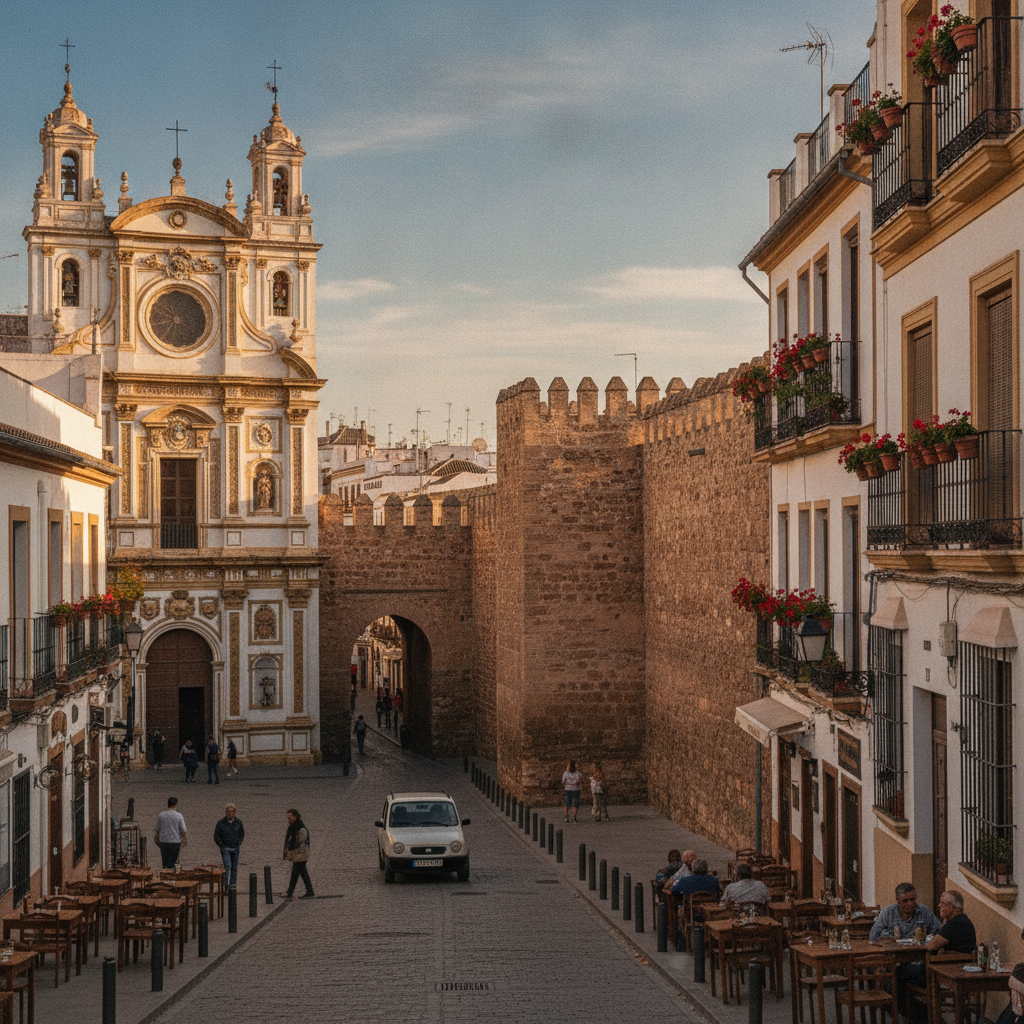
La Macarena, La Alameda & Seville's Working-Class Soul
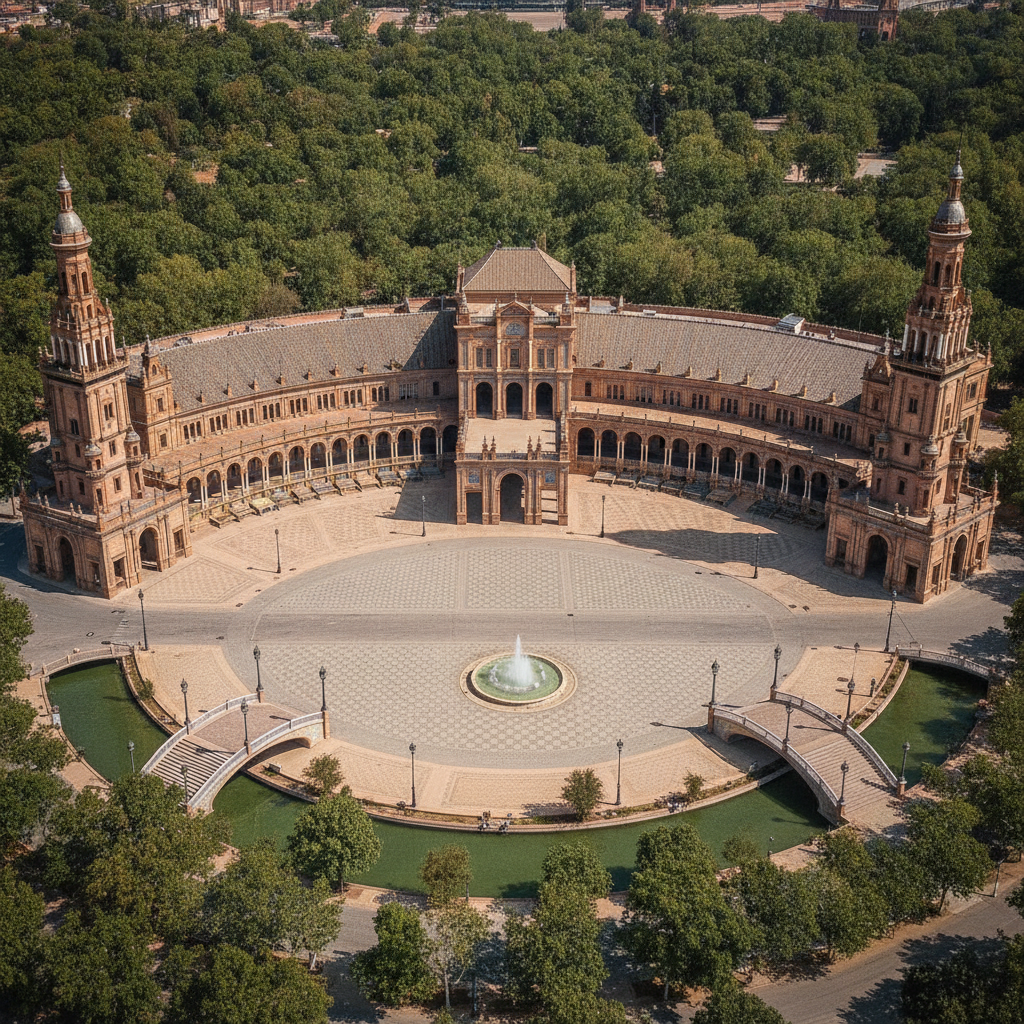
1929 Exposition, Park Architecture & Seville's Modernist Legacy
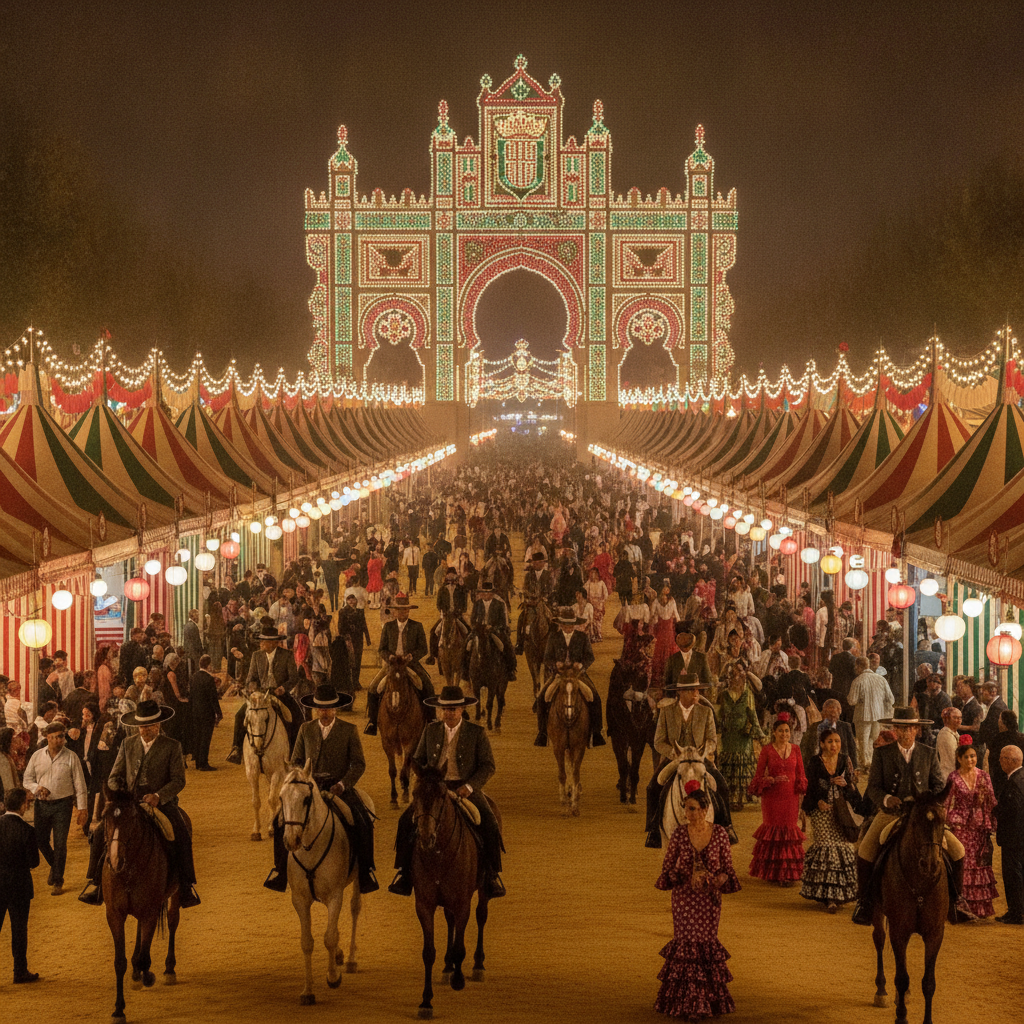
Feria de Abril, Semana Santa & Seville's Great Festivals