Grunge, Jimi Hendrix & Seattle's Music Legacy
Seattle has produced a disproportionate share of the most influential musicians in the history of American popular music — Jimi Hendrix (the greatest rock guitarist in history, born in Seattle's Central District in 1942), Kurt Cobain (the Nirvana frontman who defined the sound of the 1990s, born in Aberdeen, WA), Eddie Vedder, Chris Cornell, Layne Staley — and the city's music culture is inseparable from its identity.
- 1
The Grunge Movement — Nirvana, Pearl Jam & the Seattle Sound
The Seattle grunge movement (the genre of rock music that originated in Seattle in the mid-1980s and achieved worldwide commercial success in the early 1990s, defined by a heavy, distorted guitar sound (the 'Seattle sound') combining elements of punk rock (the aggressiveness, the DIY ethos, the distorted electric guitar) with heavy metal (the slow tempos, the heavy riffs, the massive dynamic range) and alternative rock (the introspective lyrics, the anti-commercial attitude, the flannel-and-jeans aesthetic)): the four bands that defined grunge (the 'Big Four' of Seattle grunge): Nirvana (formed 1987 in Aberdeen, Washington by Kurt Cobain (1967-1994) and Krist Novoselic — the band whose album 'Nevermind' (1991, DGC Records), reaching #1 on the Billboard 200 chart in January 1992 and selling approximately 30 million copies worldwide, is the single album most credited with bringing grunge rock to mainstream global consciousness); Pearl Jam (formed 1990 in Seattle by Eddie Vedder, Stone Gossard, Jeff Ament, Mike McCready, and Dave Krusen — the band whose debut album 'Ten' (1991, Epic Records) sold approximately 13 million copies in the United States alone (the best-selling album by a Seattle band in US history)); Soundgarden (formed 1984 in Seattle by Chris Cornell (1964-2017), Kim Thayil, Hiro Yamamoto, and Matt Cameron — the band that pioneered the 'Seattle sound' before any other grunge band achieved mainstream success); Alice in Chains (formed 1987 in Seattle by Layne Staley (1967-2002) and Jerry Cantrell — the band that most successfully fused heavy metal with the grunge aesthetic, creating a darker and more melodically complex sound than any other grunge act).
- 2
Museum of Pop Culture (MoPOP) — The Temple of Rock
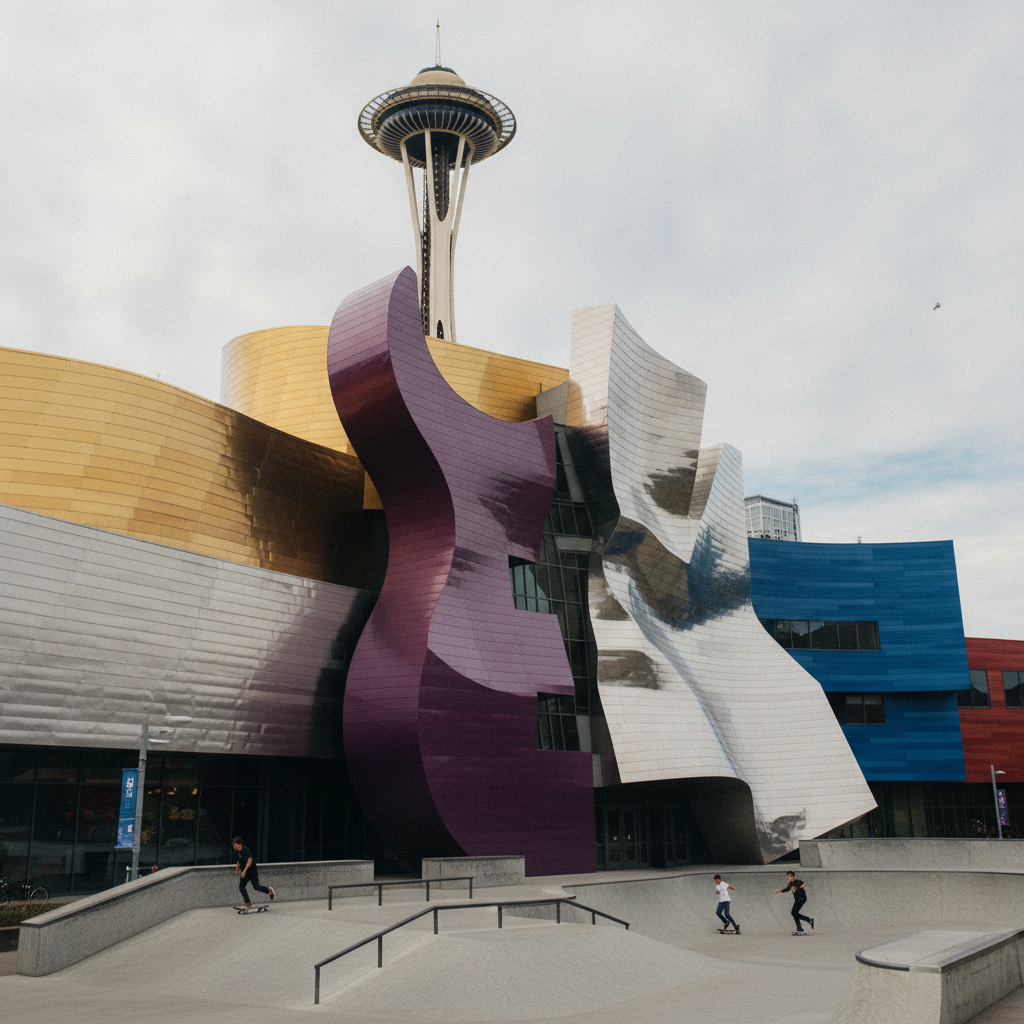
Museum of Pop Culture (MoPOP — 325 5th Avenue N, Seattle Center — the museum of popular music and popular culture designed by Frank Gehry and opened June 23, 2000 as the 'Experience Music Project' (EMP Museum) — the $240 million (cost) monument to popular music commissioned by Microsoft co-founder Paul Allen (1953-2018), one of the greatest patrons of popular culture institutions in American history): the MoPOP building (the most architecturally distinctive museum building in Seattle — Gehry's concept was to design a building that looks like a 'shattered guitar', with the undulating metallic-clad forms (in gold, silver, blue, and purple painted steel) representing the broken pieces of an electric guitar scattered on the ground after being smashed on stage): the permanent collections of MoPOP include: the 'Infinite Worlds of Science Fiction' exhibition (the science fiction collection — one of the most comprehensive in the world), the 'Fantasy: Worlds of Myth and Magic' exhibition, the Guitar Gallery (the collection of historic guitars including Jimi Hendrix's guitars and Kurt Cobain's Fender Mustang used at the 1993 Nirvana MTV Unplugged taping), and the Sky Church (the 854 sq metre (9,200 sq ft) indoor venue with the 14 x 20 metre (45 x 65 foot) LED video screen — the largest LED screen in any venue in the Pacific Northwest, used for concerts and events within the museum).
- 3
Jimi Hendrix — Seattle's Greatest Musical Son
Jimi Hendrix (James Marshall Hendrix — born November 27, 1942 in Seattle's Central District neighbourhood, the son of Al Hendrix (an African-American Seattle native) and Lucille Jeter (a Native American-African-American from Seattle) — widely considered the greatest electric guitarist in the history of rock music, and the most influential instrumentalist in the history of American popular music): the Seattle connection (the city that is proudest of Hendrix, the city where he was born, attended Leschi Elementary School and Garfield High School (the historically African-American high school in the Central District that also produced the jazz musician Quincy Jones and the basketball player Gary Payton), and where he first learned to play guitar): the Jimi Hendrix Memorial at Greenwood Memorial Park (the Hendrix family grave at Greenwood Memorial Park (415 Monroe Avenue NE, Renton, Washington — a Seattle suburb) where Jimi Hendrix is buried, along with his father Al Hendrix (1919-2002) and other family members, the grave marked with a large granite monument); the Jimi Hendrix Park (the 2.4-acre (1.0-hectare) park at 2400 S Massachusetts Street in the Central District, adjacent to the Northwest African American Museum (NAAM), dedicated to Hendrix in 2017 — the first public park named for Hendrix in his hometown): the MoPOP Jimi Hendrix Gallery (the permanent gallery within MoPOP dedicated to Hendrix, containing the most significant collection of Hendrix artefacts in Seattle — his guitars, stage costumes, handwritten lyrics, and personal items).
- 4
Sub Pop Records & the Music Industry That Built Grunge
Sub Pop Records (the independent record label founded in Seattle in 1988 by Bruce Pavitt and Jonathan Poneman — the label that signed and released the early recordings of Nirvana (the 'Bleach' album (1989)), Soundgarden (the 'Ultramega OK' album (1988)), Mudhoney (the 'Superfuzz Bigmuff' EP (1988) — the recording most credited with defining the sonic template of grunge), Green River (the precursor band to Pearl Jam and Mudhoney, featuring Stone Gossard and Jeff Ament who would later form Pearl Jam), and L7 — the label that effectively invented the global grunge phenomenon by releasing the music that defined the Seattle Sound before any major label recognized its commercial potential): the Sub Pop Building (the Sub Pop Records headquarters at 2013 4th Avenue in downtown Seattle — the label's offices, now occupying a mid-century commercial building in the Belltown neighbourhood north of Pike Place Market); the Sub Pop Mega Mart (the retail store within the Sub Pop offices — the most important single independent record store location in the history of American rock music): the Sub Pop/grunge pilgrimage sites in Seattle (the venues that hosted the formative shows of the grunge era: the Central Tavern (208 1st Avenue S — the Pioneer Square dive bar where Mudhoney, Nirvana, and Soundgarden played early Seattle shows), the Vogue (formerly at 2018 1st Avenue in Belltown), and the Motor Sports International Garage (the car dealership that hosted the historic 'Lolapalooza-precursor' Sub Pop Lamefest on June 9, 1989, featuring Mudhoney, Nirvana, and TAD — the show that Sub Pop's own press release described as the band lineup that would 'destroy the world').
- 5
Seattle's Music Venues — From the Crocodile to Benaroya Hall
Seattle's music venue landscape (the most diverse and most productive music venue ecosystem of any American city outside of New York and Los Angeles — the city that produced not just grunge but also jazz (the Seattle jazz scene, centred on the Central District's jazz clubs from the 1920s-1960s, which produced Ray Charles (who lived in Seattle 1947-1950 and recorded his first commercial recordings at Swingtime Records), Quincy Jones (born 1933 in Chicago but raised in Seattle's Central District, educated at Garfield High School), and the pianist Ernestine Anderson), folk and indie rock (the J.P. Patches era Seattle folk and country scene), and the contemporary hip-hop scene (the Seattle hip-hop community that produced Macklemore & Ryan Lewis (the first independent hip-hop act to debut at #1 on the Billboard 200 since 1994), Sir Mix-A-Lot, Shabazz Palaces, and numerous other nationally recognized acts)): the key music venues (the Crocodile (2200 2nd Avenue, Belltown — the club that served as the unofficial home of the grunge scene in the early 1990s), Benaroya Hall (200 University Street — the 2,500-seat concert hall of the Seattle Symphony, designed by LMN Architects and opened in 1998 — the finest concert hall in the Pacific Northwest), the Paramount Theatre (911 Pine Street — the 2,807-seat 1928 Spanish Gothic Revival movie palace that serves as the primary mid-size concert venue in downtown Seattle), and the WaMu Theater (now the Lumen Field Event Center — the 7,000-capacity arena adjacent to Lumen Field (formerly CenturyLink Field), the home of the Seattle Seahawks and Seattle Sounders)).
- 6
Seattle Neighbourhoods — Fremont, Ballard & the Eclectic City
Fremont (the neighbourhood in north-central Seattle, on the north shore of the Lake Washington Ship Canal between Wallingford and Ballard — the 'Center of the Universe' (the Fremont neighbourhood's self-proclaimed title, marked by a series of fanciful signs at the centre of the neighbourhood) and the most eccentric and most creatively independent neighbourhood in Seattle): the Fremont public art (the neighbourhood's collection of prominent public artworks, the densest concentration of public sculpture in Seattle: the Fremont Troll (the 5-metre (16-foot) concrete sculpture of a troll emerging from under the north end of the Aurora Bridge (George Washington Memorial Bridge) clutching a real Volkswagen Beetle in his hand — the most photographed public sculpture in Seattle), the 'Waiting for the Interurban' (the 1979 Richard Beyer sculpture of a group of commuters waiting for a bus (the former Interurban Railway stop in Fremont) — the public sculpture most frequently decorated by neighbourhood residents with yarn, hats, costumes, and other adornments as an ongoing participatory art project), and the Fremont Rocket (the decommissioned Rocketdyne rocket engine mounted on a building at the corner of Fremont Place N and N 35th Street)); Ballard (the neighbourhood west of Fremont along the Ship Canal — the historic Scandinavian-American fishing community of Seattle, now transformed into the most dynamic nightlife and restaurant district in Seattle outside of Capitol Hill).
Walk this route with audio
Stories play automatically as you reach each stop — no tapping needed.
More in seattle
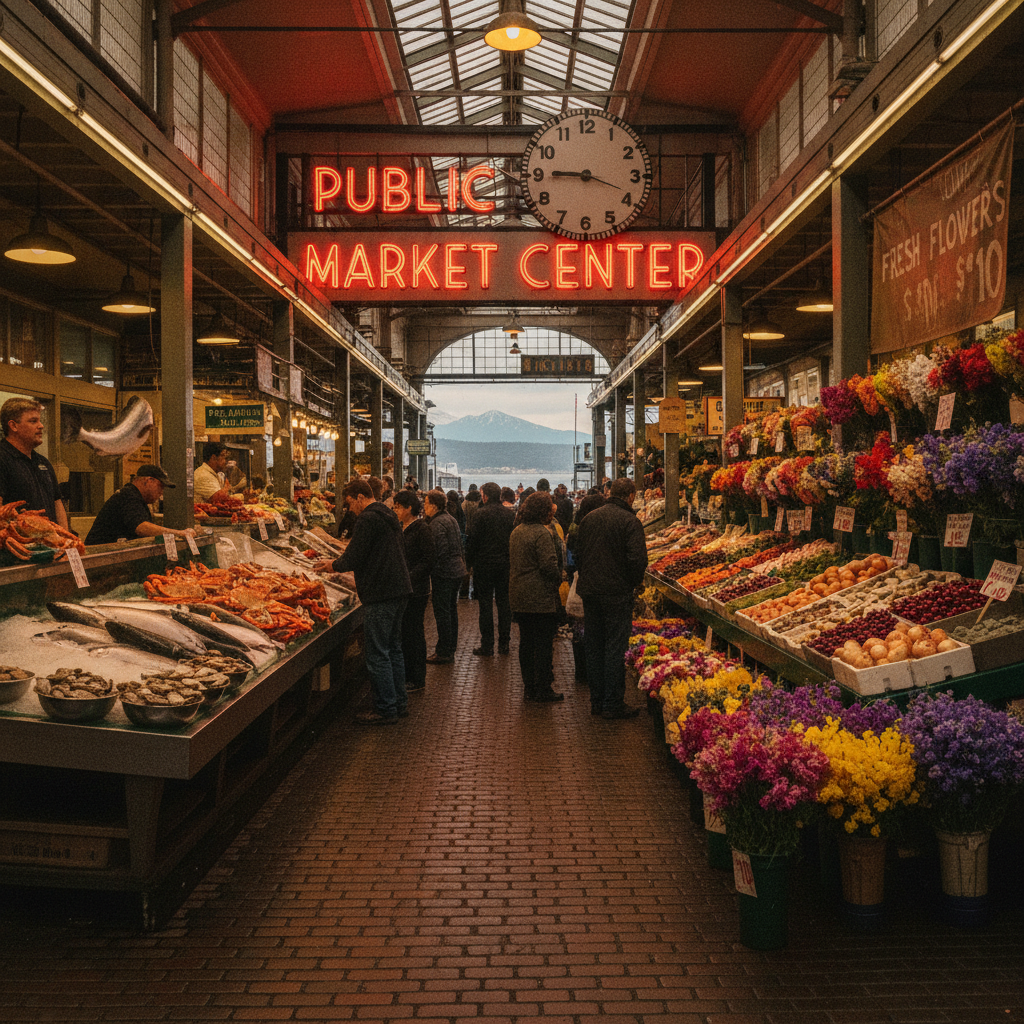
Pike Place Market, Elliott Bay & Seattle's Waterfront Soul
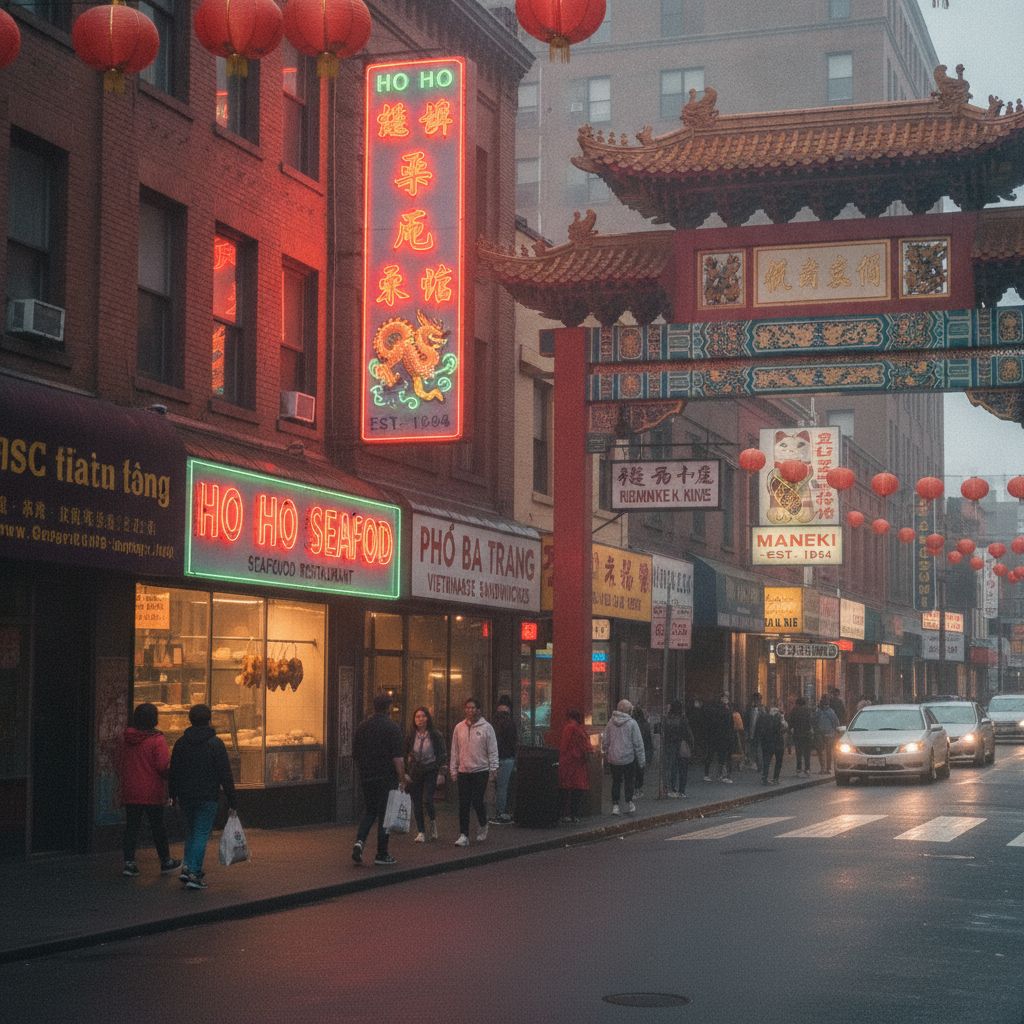
Chinatown-International District & Seattle's Asian-American Heritage
Pioneer Square, the Underground & Seattle's Gold Rush History
Seattle Food Scene — Pacific Seafood, Craft Beer & Farm-to-Table
Boeing, the Museum of Flight & Seattle's Aviation Heritage