São Paulo's Architecture — Modernism, Niemeyer & the Concrete Jungle
São Paulo's architecture (the built environment of the city that is the largest and most architecturally complex urban area in the Southern Hemisphere — the city of Oscar Niemeyer (1907-2012) (the most celebrated architect in the history of Latin America, the architect of Brasília, the co-designer of the United Nations Headquarters, and the designer of dozens of the finest public buildings in São Paulo), Lina Bo Bardi (1914-1992) (the Italian-Brazilian architect who designed the MASP and the SESC Pompeia — the two buildings that are the most important works of architecture in São Paulo), and the anonymous concrete jungle of the paulistano urban fabric): São Paulo is the modernist architecture capital of Latin America.
- 1
Oscar Niemeyer's São Paulo — COPAN, Memorial & Ibirapuera
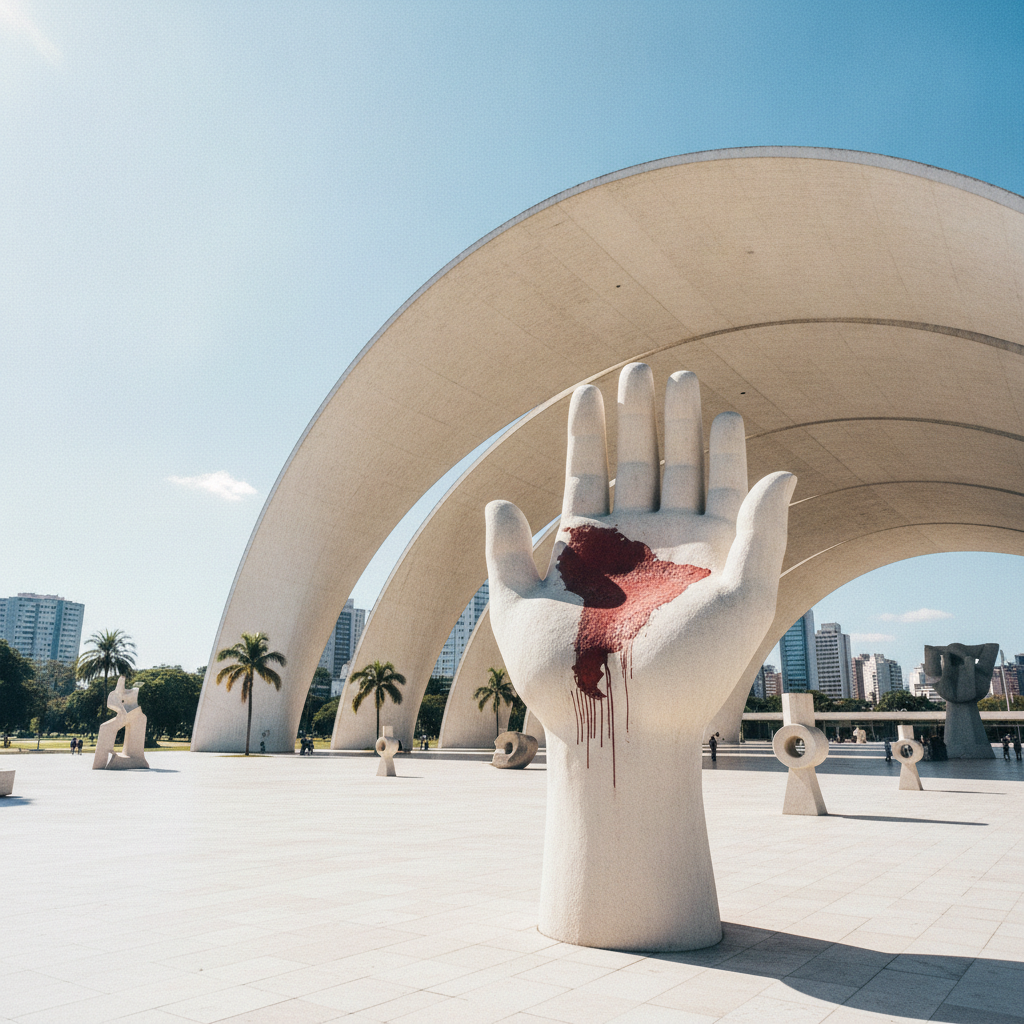
Oscar Niemeyer (1907-2012) in São Paulo (the buildings that the most celebrated architect in the history of Latin America designed for the largest city in Brazil): the Edifício Copan (Avenida Ipiranga 200, Centro — the residential skyscraper designed by Niemeyer and constructed 1952-1966 — the most iconic building in São Paulo and the most famous residential building in Brazil): the Copan (the 'S-curve' building — the 38-storey, 140-metre (460-foot) tower with the distinctive undulating concrete facade (the sinusoidal 'S' curve of the building's plan, which allows the apartments on both sides of the building to face in different directions and the building as a whole to turn in the direction of the street while remaining perpendicular to the sun)): the Copan residents (the approximately 5,000 people who live in the 1,160 apartments of the Copan, making it the largest apartment building by number of residents in Brazil): the Memorial da América Latina (Avenida Auro Soares de Moura Andrade 664, Barra Funda — the cultural and political complex inaugurated 1989, commissioned by Governor Orestes Quércia and designed by Niemeyer as his personal statement on the unity and identity of Latin America): the Ibirapuera Park pavilions (the cluster of Niemeyer-designed buildings in Ibirapuera Park (the Pavilhão Lucas Nogueira Garcez ('Oca'), the Grande Marquise, the MAM, and the Auditório Ibirapuera) that together constitute the most important public architectural ensemble in São Paulo).
- 2
Lina Bo Bardi — MASP & SESC Pompeia
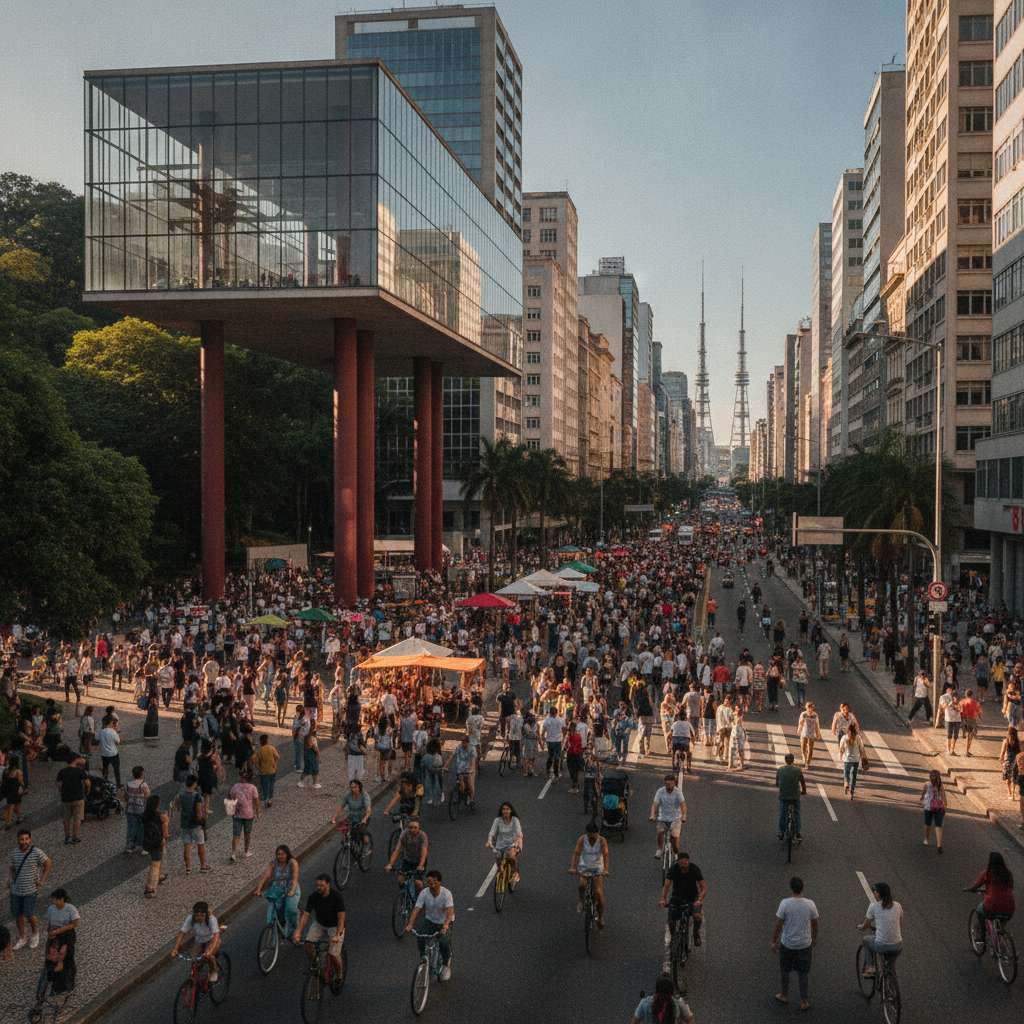
Lina Bo Bardi (1914-1992) in São Paulo (the work of the Italian-Brazilian architect who is the most celebrated woman architect in the history of Latin America, the architect whose two masterworks in São Paulo (the MASP and the SESC Pompeia) are the two most important individual buildings in the city): the MASP (Museu de Arte de São Paulo — Avenida Paulista 1578 — the building (1968) that straddles Avenida Paulista on four red concrete pilotis — the building whose most celebrated feature is the 'Belvedere' (the 74-metre / 243-foot free-span space under the building, the largest free-span concrete space in the world at the time of construction)): the SESC Pompeia (Rua Clélia 93, in the Pompeia neighbourhood of São Paulo — the cultural and sports centre (the 'SESC Fábrica de Pompeia') created by Lina Bo Bardi in the former factory buildings of the Pompeia drum factory (the factory built 1938 for the production of petroleum drums): the SESC Pompeia design (the most important work of adaptive reuse architecture in the history of Latin America — Bo Bardi's transformation of the industrial factory buildings into a cultural centre that retains the character of the original factory while adding the dramatic new elements (the two concrete 'towers' — the sports tower and the shower tower — connected to each other and to the renovated factory buildings by the 'bridges' (the elevated walkways) at the 4th, 6th, and 8th floors)): the SESC Pompeia cultural programme (the centre that hosts theatre, cinema, music, visual art, and sports facilities, and the Sunday Feira (the Sunday market in the courtyards of the factory buildings) — the most beloved cultural space in São Paulo.
- 3
Paulistano Modernism — The 'Escola Paulista' of Architecture
The 'Escola Paulista' (the 'São Paulo School' of architecture — the architectural movement that emerged in São Paulo in the 1950s-1970s around the Faculty of Architecture and Urbanism of the University of São Paulo (FAU-USP) and that produced the distinctive brutalist-influenced concrete architecture that defines the built character of São Paulo): the FAU-USP building (Rua do Lago 876, Cidade Universitária — the Faculty of Architecture and Urbanism of the University of São Paulo, designed by João Vilanova Artigas (1915-1985) and completed 1969 — the building that is the most important work of the Escola Paulista, the building that Artigas considered his masterpiece: the building (the FAU-USP is a single enormous building — a 4-storey concrete structure whose entire interior is organized around a single central void (the 'vazio central') — the open atrium that runs the full height of the building, with the studio spaces and classrooms arranged on the mezzanines and terraces around the central void, the entire interior accessible without walls or doors between the spaces — the architectural expression of Artigas's socialist conviction that education should be a completely open and non-hierarchical activity)): the Escola Paulista buildings (the buildings designed by the architects of the Escola Paulista (Artigas, Paulo Mendes da Rocha (the Pritzker Prize winner in 2006), Carlos Cascaldi, and others) that define the character of the University of São Paulo campus, the public parks of São Paulo, and the Ibirapuera Park cultural complex).
- 4
São Paulo's Skyline & Urban Scale
São Paulo's urban scale (the scale of a city that is 1,521 km² (587 sq miles) in area — larger than the cities of Paris, London, and New York combined — and that has a skyline of approximately 50,000 high-rise buildings (the largest concentration of high-rise buildings in the Southern Hemisphere, the second largest in the world after New York City)): the São Paulo skyline districts (the downtown Centro Histórico (the historic centre with the 1960s-1980s commercial towers that replaced the late 19th century and early 20th century commercial buildings), the Paulista district (the Avenida Paulista corridor with the modernist office towers of the 1970s-1990s that house the headquarters of the Brazilian banks and corporations), the Faria Lima district (the 'Brazilian Wall Street' — the financial district along Avenida Faria Lima and the adjacent Avenida Brigadeiro Luís Antônio — the district of the glass and steel towers of the 1990s-2020s that house the investment banks, private equity firms, and technology companies of the paulistano financial sector), and the Vila Olímpia and Itaim Bibi neighbourhoods (the upscale business and residential districts in the southwestern zone, with the Ponte Estaiada (the Octávio Frias de Oliveira Bridge — the cable-stayed bridge with the distinctive 'X' tower structure, the most photographed structure in São Paulo, the bridge that appears in the skyline photographs of São Paulo as the most distinctive silhouette)): the helicopter culture (São Paulo has the largest urban helicopter fleet in the world — approximately 600 helicopters operate in the São Paulo metropolitan area, the largest urban helicopter traffic of any city in the world, used by São Paulo's wealthiest residents to avoid the legendary traffic congestion of the city's street network).
- 5
São Paulo Metro & Urban Mobility
The São Paulo Metro (the 'Metrô de São Paulo' — the urban rail transit system of the city of São Paulo, the largest metro system in Brazil and the second largest in Latin America (after Mexico City), with 6 lines, 91 stations, and approximately 5 million daily passengers): the Metro system (the 6 lines of the São Paulo Metro: Line 1 (the Blue Line — the original metro line opened 1974, running north-south through the city centre from Tucuruvi in the north to Jabaquara in the south), Line 2 (the Green Line — running east-west through the Paulista and Consolação neighbourhoods), Line 3 (the Red Line — running east-west through the Centro Histórico), Line 4 (the Yellow Line — the private concession line running from the Luz station (the Estação da Luz railway terminal) in the Centro Histórico to the Vila Sônia neighbourhood in the western zone), Line 5 (the Lilac Line — running north-south through the southern zone), and the CPTM commuter rail lines (Lines 7, 8, 9, 10, 11, 12, and 13) that extend the metro network to the outer municipalities of the São Paulo metropolitan area): the São Paulo traffic (the legendary traffic congestion of São Paulo — the city that regularly produces the longest traffic jams in the world, the 'congestionamento' (the traffic jam) that is the defining quality-of-life challenge of the paulistano (the resident of São Paulo)): the 'Marginal' (the Marginal Tietê and the Marginal Pinheiros — the two express highways that run along the Tietê and Pinheiros Rivers through the urban area of São Paulo, the two highways that are the primary north-south arteries of the city, and the two highways that produce the most spectacular traffic jams in the world during rush hour).
- 6
Consolação & Higienópolis — São Paulo's Cultural Neighbourhoods
Consolação (the neighbourhood immediately west of the Paulista corridor — the neighbourhood centred on the Rua Augusta (the 'Rua Augusta' — the street that runs from Avenida Paulista south through the Consolação and Jardim Paulista neighbourhoods, the street that is the centre of São Paulo's alternative culture, LGBTQ+ community, and nightlife): the Rua Augusta clubs and bars (the street that houses the most concentrated collection of nightclubs, underground bars, and alternative culture venues in São Paulo — the Cine Jóia (the former cinema converted to one of the most important music venues in São Paulo), the Bar Número (the neighbourhood bar that is the social heart of the Consolação alternative scene), and the dozens of underground venues that make the Rua Augusta the axis of São Paulo's alternative nightlife): Higienópolis (the neighbourhood north of Avenida Paulista, centred on Avenida Higienópolis — the neighbourhood that was the most fashionable residential area in São Paulo in the early 20th century (the 1900s-1930s), when the mansions of the coffee fazendeiros (the wealthy coffee plantation owners of the São Paulo interior) lined the broad avenues of Higienópolis, the neighbourhood that retains the most intact collection of early 20th century Eclectic and Art Nouveau residential architecture in São Paulo, including the Palacete das Indústrias (the former Palace of Industries, now the cultural centre of the Instituto Brasileiro de Arte e Cultura)): the Shopping Higienópolis (the upscale indoor shopping mall in the heart of the neighbourhood, the mall that is the preferred shopping destination of the Higienópolis upper-middle class).
Walk this route with audio
Stories play automatically as you reach each stop — no tapping needed.
More in sao-paulo
Pinheiros, Vila Madalena & São Paulo's Legendary Nightlife
Avenida Paulista, MASP & São Paulo's Cultural Heart
Samba, Carnaval & São Paulo's African-Brazilian Cultural Heritage
SP-Arte, Museums & São Paulo's World-Class Cultural Scene
Liberdade, the Japanese Community & São Paulo's Asian Soul