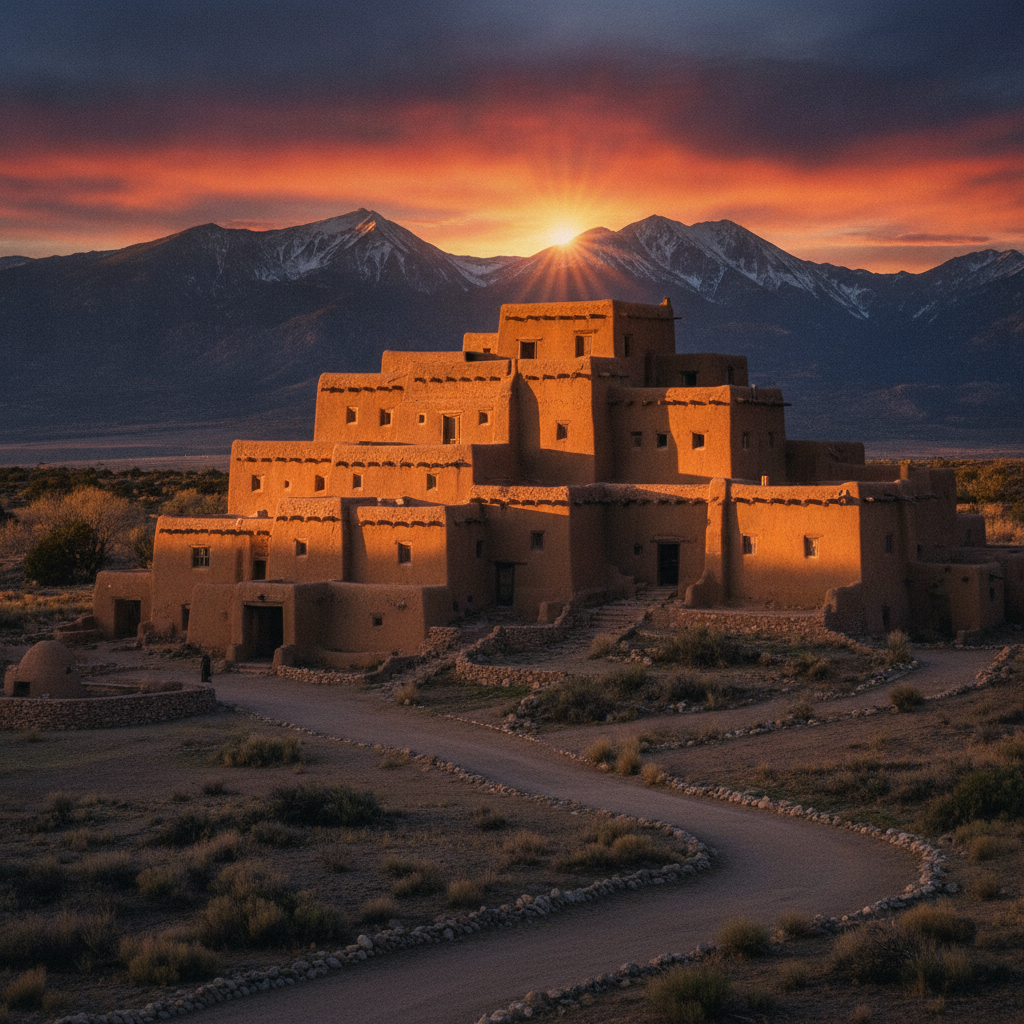
Santa Fe: Literary Colony, Museum of Art, Chimayo Weaving, Railyard District, Mountain Life, and Practical Tips
Santa Fe: literary colony (Willa Cather Death Comes for the Archbishop 1927 set Santa Fe based on Archbishop Lamy vicar Machebeuf only place I felt I left US, D.H. Lawrence 1885-1930 Taos 1922-25 at invitation Mabel Dodge Luhan wrote Mornings in Mexico St. Mawr, Oliver La Farge Pulitzer 1930 Laughing Boy Navajo), Museum of Art (107 West Palace 1917 oldest NM museum Pueblo Revival founding monument, 20,000 works Taos Society Artists Blumenschein Sharp Phillips, Fechin House Taos 1927-1933 every surface hand-carved fusion Russian folk Pueblo tradition Fechin fled Revolution 1923, Harwood Museum Taos 1923 Agnes Martin six paintings donated), Chimayo weaving (Ortega family workshop 1900 oldest continuously operating NM, Trujillo Centinela Traditional Arts NM-76 Churro wool Onate introduced 1598 Navajo Long Walk survived, Rio Grande diamond barley corn saltillo stripes pattern vocabulary, museum-quality piece USD 800-5,000 village USD 3,000-15,000 Santa Fe galleries), Railyard (50 acres former AT&SF freight yard transformed 2008-2012, Farmers Market Pavilion architect Edward Mazria Architecture 2030, El Museo Cultural Hispanic nuevomexicano programming, Meow Wolf 2016 135 artists 20,000sqft bowling alley Victorian house fractal multiverse USD 1M tickets year one 500,000 visitors 2018), outdoor life (Dale Ball Trails 19km within city limits 10 minutes plaza, Ski Santa Fe 3,560m highest base Southwest 175cm snowfall, Hyde Park 2,780m aspens Ponderosa Winsor Trail, Rio Grande Gorge Bridge 184m 10th-highest US), practical (no commercial air SAF limited Denver, Rail Runner Albuquerque 90 minutes USD 9-11, La Fonda 1607 site USD 200-400, Christmas Eve luminaria farolitos paper bags candle sand walls rooftops most beautiful US Christmas tradition, winter 50-60% off peak).
- 1
Willa Cather, D.H. Lawrence, and the Santa Fe Literary Colony
Santa Fe and northern New Mexico as literary magnet: the combination of exotic landscape, ancient cultures, cheap living costs, and physical remoteness from the East Coast literary establishment made Santa Fe and Taos the most significant literary colony in the American interior between approximately 1915 and 1945. Willa Cather (born December 7, 1873, Back Creek Valley, Virginia; died April 24, 1947, New York City): the author of Death Comes for the Archbishop (1927), widely regarded as her masterpiece, set in Santa Fe and northern New Mexico and based on the lives of Archbishop Jean-Baptiste Lamy and his vicar Joseph Machebeuf -- a novel that is simultaneously a meditation on landscape, faith, and the encounter between European civilization and the ancient Pueblo world. Cather visited New Mexico first in 1912 and returned repeatedly, calling it the only place I ever felt I left the United States. D.H. Lawrence (born September 11, 1885, Eastwood, Nottinghamshire, England; died March 2, 1930, Vence, France): the British novelist (Sons and Lovers, Women in Love, Lady Chatterley's Lover) who spent three periods in Taos (1922-23, 1924, 1925) at the invitation of Mabel Dodge Luhan (born February 26, 1879, Buffalo, NY; died August 13, 1962, Taos), writing Mornings in Mexico (1927) and St. Mawr (1925) in New Mexico. The D.H. Lawrence Ranch (Kiowa Ranch, at 17 km north of Taos on NM-522): donated to the University of New Mexico by Lawrence's widow Frieda. Oliver La Farge (born December 19, 1901, New York; died August 2, 1963, Santa Fe): the Harvard-trained anthropologist who won the Pulitzer Prize for Fiction in 1930 for Laughing Boy, set among the Navajo, and who lived in Santa Fe from 1941 until his death.
- 2
The New Mexico Museum of Art and the Pueblo Revival Arts
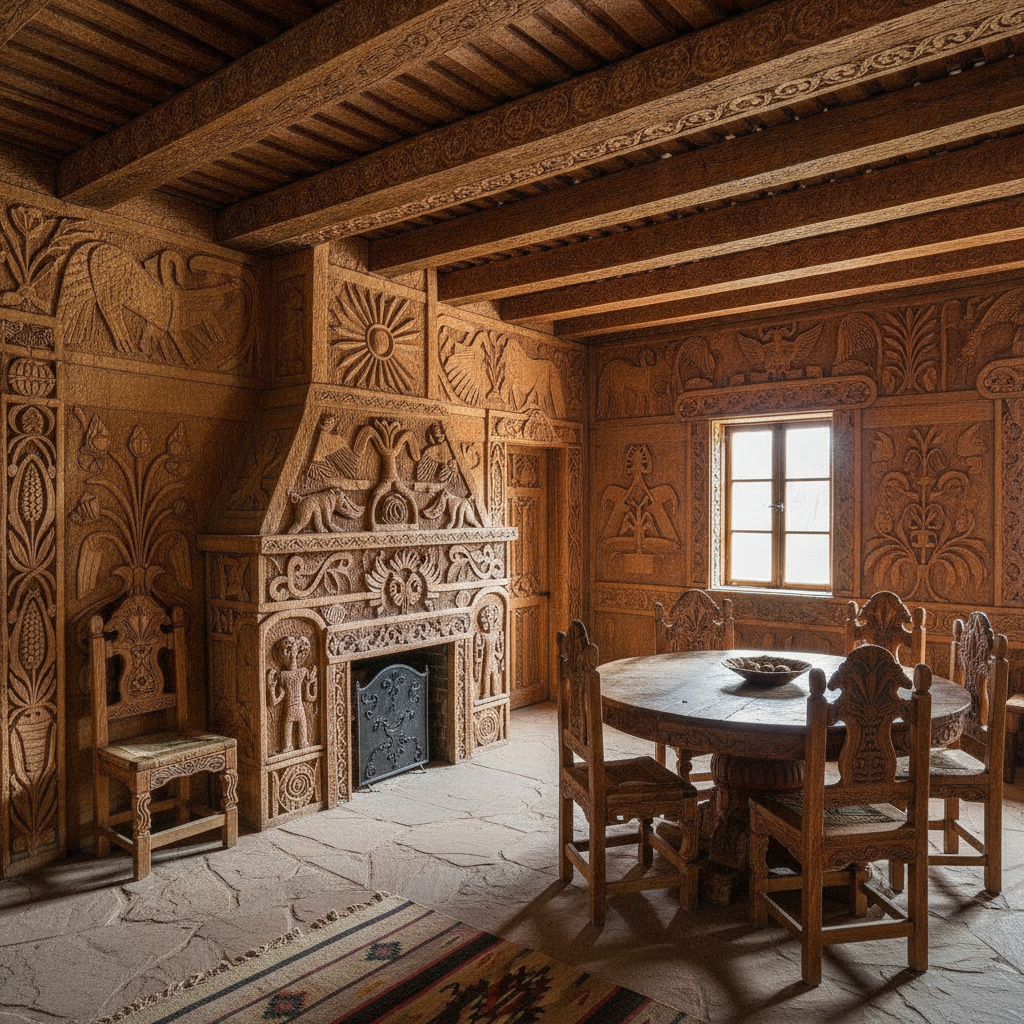
The New Mexico Museum of Art (at 107 West Palace Avenue, on the northwest corner of the Santa Fe Plaza, opened November 26, 1917): the oldest art museum in New Mexico and one of the oldest purpose-built museums in the American Southwest, housed in a building designed by architects I.H. and W.M. Rapp as a synthesis of Pueblo mission architecture -- specifically incorporating elements from the missions at Acoma, Laguna, and San Felipe Pueblos. The New Mexico Museum of Art building is considered the founding monument of Pueblo Revival architecture, predating John Gaw Meem's work at UNM by nearly two decades. The collection: approximately 20,000 works with a focus on New Mexico and the American Southwest from 1880 to the present -- including the largest collection of the Taos Society of Artists (Ernest Blumenschein, Joseph Henry Sharp, Bert Geer Phillips, and colleagues), the Santa Fe art colony, and contemporary New Mexico artists. The Fechin House (at 227 Pueblo Norte, Taos, NM, 100 km north of Santa Fe, built and carved 1927-1933 by Russian-born painter Nicolai Fechin -- born November 26, 1881, Kazan, Russia; died October 5, 1955, Santa Monica, CA): the most extraordinary private arts-and-crafts interior in New Mexico, where every surface (walls, doors, furniture, ceiling beams) was hand-carved by Fechin himself in a fusion of Russian folk art and Pueblo decorative traditions. Fechin fled the Russian Revolution to New York in 1923 and moved to Taos in 1927 for health reasons (tuberculosis). The Harwood Museum of Art (at 238 Ledoux Street, Taos, NM, established 1923): the oldest museum in Taos, part of the University of New Mexico museum system, with the definitive collection of the Taos art colony and the six Agnes Martin minimalist paintings donated by the artist (who lived and died in Taos).
- 3
Chimayo and the Weaving Traditions of the Rio Grande
The Rio Grande weaving tradition (the textile art form brought to New Mexico by Spanish Colonial settlers in the late 17th and 18th centuries, derived from both Spanish-Moorish tapestry weaving and Native American fiber arts, surviving in the villages of northern New Mexico in an unbroken lineage from the 18th century to the present): the most historically continuous handcraft tradition in the United States, with specific family weaving lineages (the Ortegas, the Trujillos, the Vigils) traceable to the early Spanish Colonial period. The Ortega family weaving tradition: Irvin Ortega began weaving in Chimayo in the early 20th century; his descendants Eulogio Ortega, David Ortega, and Robert Ortega have continued the family workshop (Ortega's Weaving Shop, at 53 Plaza del Cerro, Chimayo, established 1900, the oldest continuously operating family weaving business in New Mexico). The Trujillo family weaving tradition: Jacobo Trujillo and his descendants at Centinela Traditional Arts (at 946 NM-76, Chimayo) have maintained the traditional warp-faced tapestry technique using Churro wool (from the Spanish Churra breed of sheep introduced to New Mexico by Juan de Onate in 1598, the breed that survived the Navajo Long Walk and returned with the Navajo to become the foundation of the Navajo weaving tradition as well as the Chimayo weaving tradition). The Chimayo weaving pattern vocabulary: the Rio Grande diamond, the barley corn, the saltillo serape stripes, and the Chimayo zig-zag are the defining geometric motifs of the northern New Mexico weaving tradition, executed in natural and synthetically dyed Churro wool. A museum-quality Chimayo weaving (40 x 60 inches) by a master weaver sells for USD 800-5,000 in the Chimayo village shops and USD 3,000-15,000 in Santa Fe galleries.
- 4
The Santa Fe Railyard District and the Contemporary City
The Railyard District (the 50-acre former Atchison, Topeka and Santa Fe Railway freight yard at Guadalupe Street and Cerrillos Road, transformed into a mixed-use public space 2008-2012, with the Santa Fe Farmers Market Pavilion, SITE Santa Fe, El Museo Cultural de Santa Fe, and the Warehouse 21 youth arts center): the most successful urban redevelopment project in Santa Fe history, converting an industrial brownfield into the primary public gathering space for non-tourist Santa Fe. The Santa Fe Farmers Market Pavilion (at 1607 Paseo de Peralta, the Railyard, designed by Edward Mazria -- the architect and climate activist who founded Architecture 2030, the advocacy organization that has set the goal of carbon-neutral buildings by 2030): the year-round covered market structure that is simultaneously a farmers market and event space, hosting 150+ vendors on Tuesdays and Saturdays. El Museo Cultural de Santa Fe (at 555 Camino de la Familia, the Railyard): the museum and performance space presenting the living culture of Hispanic New Mexico, with traditional dance, music, and visual arts programming year-round -- the primary institutional voice of the Chicano and nuevomexicano cultural community in Santa Fe. The Meow Wolf House of Eternal Return (at 1352 Rufina Circle, 2 km from the Railyard, Santa Fe, opened March 17, 2016, 20,000 square feet, created by 135 Santa Fe artists working collectively): the immersive art installation housed in a former bowling alley, presenting a Victorian house with a dysfunctional dryer that opens into a fractal multiverse -- 70+ artist-designed rooms accessible through unconventional entry points (refrigerators, fireplaces, washing machines). Meow Wolf sold USD 1M in tickets in its first year and had attracted 500,000 visitors by 2018, making it the highest-grossing single-site art attraction in New Mexico history and leading to expansion in Las Vegas, Denver, and beyond.
- 5
Hiking, Skiing, and the Santa Fe Mountain Life
The Santa Fe outdoor life: the city's location at 2,194 m at the base of the Sangre de Cristo Mountains provides access to outdoor recreation that is extraordinary for a city of 85,000 -- from the ski area 9 km from downtown (Ski Santa Fe, at 3,560 m, the highest ski area base in the American Southwest) to the Pecos Wilderness (one of the most beautiful wilderness areas in the Rocky Mountains) to the Rio Grande Gorge (at Taos, 100 km north, the 240-m-deep basalt gorge crossed by the Rio Grande Gorge Bridge, the 10th-highest bridge in the United States at 184 m above the river). The Dale Ball Trails (19 km of single-track mountain biking and hiking trails within the city limits of Santa Fe, in the foothills above the Fort Marcy Park): the most accessible wilderness trail system of any state capital in the United States, with trailheads within 10 minutes of the Santa Fe Plaza and terrain ranging from gentle arroyos to 2,500-m ridge walks. The Santa Fe ski season: Ski Santa Fe (at 3,560 m on the north face of Santa Fe Baldy, 9 km from the plaza, 650 m of vertical drop, 77 trails, 7 lifts, average snowfall 175 cm per year): the highest-base ski area in New Mexico and one of the highest in the American Southwest, with a season typically running mid-December through late March. The Hyde State Park (on NM-475, 12 km north of Santa Fe, at 2,780 m): the state park with aspen groves, Ponderosa pine forest, and connections to the Winsor Trail into the Pecos Wilderness -- one of the finest half-day hikes within 30 minutes of Santa Fe. The New Mexico winter: the high altitude means that Santa Fe temperatures can drop to -15C in December and January at night, while daytime temperatures in the same weeks may reach 10-12C in full sunshine -- the dramatic diurnal range of a high-altitude continental climate.
- 6
Santa Fe Practical - Visiting, Accommodation, and Seasonal Tips
Getting to Santa Fe: Santa Fe has no commercial airline service -- the nearest airports are the Albuquerque International Sunport (ABQ, 100 km south by US-25 or the Turquoise Trail, approximately 80 minutes by car) and the Santa Fe Municipal Airport (SAF, 8 km southwest of downtown, with limited daily service by United Airlines from Denver). The New Mexico Rail Runner Express (the commuter rail system operated by the Mid-Region Council of Governments, running from Belen 120 km south to Santa Fe, with service via Albuquerque): the rail connection between Albuquerque and Santa Fe (18 daily trains each direction, USD 9-11 one-way, approximately 90 minutes), enabling a car-free visit combining the two cities. Santa Fe accommodation: the La Fonda on the Plaza (at 100 East San Francisco Street, 180 rooms, rates USD 200-400 per night in summer): the flagship of Santa Fe hotels, on the site of an inn established in 1607, with the most central location in Santa Fe. The Inn of the Anasazi (at 113 Washington Avenue, Rosewood Hotels, 58 rooms, USD 350-600): the most exclusive boutique hotel in Santa Fe, with a restaurant serving New Mexican cuisine with fine-dining technique. The Santa Fe Motel and Inn (at 510 Cerrillos Road, approximately USD 120-200): the most affordable independently owned accommodation within walking distance of the plaza. The seasonal calendar: Santa Fe is year-round, but the peak season (July-August, Balloon Fiesta, Santa Fe Indian Market) brings hotel prices to USD 300-600 per night and requires reservations 6+ months in advance. The shoulder seasons (May-June, September-October) offer the best combination of weather, pricing, and availability. Winter (December-March) brings ski season, the Christmas Eve luminaria displays (farolitos -- small paper bags weighted with sand and lit by candle, placed along walls, rooftops, and paths throughout the historic district in one of the most beautiful Christmas traditions in the United States), and dramatically lower hotel prices (50-60% off peak).
Walk this route with audio
Stories play automatically as you reach each stop — no tapping needed.
More in santa-fe
Santa Fe: Roswell, Chaco Culture, Turquoise Trail, Billy the Kid, Farm-to-Table Dining, and City Demographics
Santa Fe: Pueblo Revolt, Taos Pueblo, High Road, Santa Fe Opera, and Adobe Architecture
Santa Fe: SITE Santa Fe, Nuclear Heritage, Santa Fe Trail, O'Keeffe at Abiquiu, Acequia Culture, and Economy
Santa Fe: Plaza, Canyon Road, O'Keeffe, Loretto Chapel, Bandelier, and New Mexican Cuisine
Santa Fe: O Keeffe Country, Ancient Trade Routes and Complexity Science