Rioja Alavesa Wine Country, Laguardia & Frank Gehry's Bodega
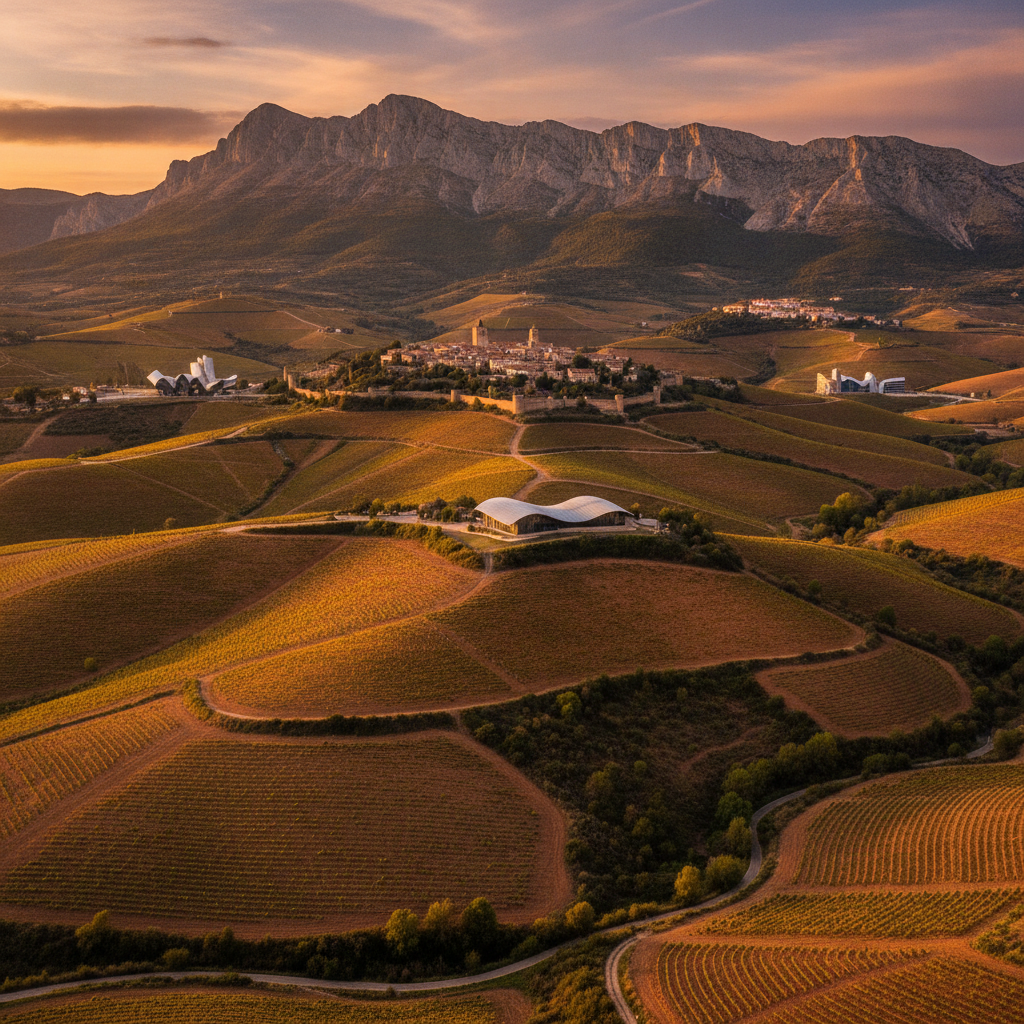
The Rioja Alavesa (the Basque section of the Rioja wine appellation — the DO Calificada Rioja wine region, the most prestigious red wine appellation in Spain, the region that produces the Tempranillo-based red wines of the Rioja): the extraordinary wine architecture of the Rioja Alavesa (the landmark wineries designed by the international architects — Santiago Calatrava's 'Bodegas Ysios' and Frank Gehry's 'Marqués de Riscal' hotel-winery) and the medieval village of Laguardia — all accessible as a day trip from San Sebastián (90 km, approximately 1 hour 15 minutes by car).
- 1
Rioja Alavesa — Tempranillo Country
The Rioja Alavesa (the 'Álava Rioja' — the Basque section of the DOCa Rioja wine appellation, the approximately 12,000 hectares of vineyards in the Álava province of the Basque Country that form the northernmost and the most distinctive sub-zone of the Rioja wine region): the wine (the Rioja Alavesa wine — the Tempranillo-based red wines of the Álava sub-zone, produced from the Tempranillo grape variety (known in the Rioja as 'Tinto Fino' or 'Cencibel' and in the Ribera del Duero as 'Tinto Fino') on the red clay-limestone ('arcillo-calizo') soils of the rolling hillsides below the Sierra Cantabria: the wines of the Rioja Alavesa characterized by the lighter colour, the more delicate fruit character, and the higher acidity compared to the wines of the Rioja Alta and the Rioja Baja (the two other sub-zones of the Rioja appellation), the characteristics that have made the Rioja Alavesa wines particularly popular with the modern wine palate that prefers the finesse and the elegance over the power and the weight): the wine styles (the Rioja wine classifications by aging period: the 'Joven' (the young wine, aged for less than 1 year), the 'Crianza' (aged for a minimum of 2 years, with at least 1 year in the oak barrel), the 'Reserva' (aged for a minimum of 3 years, with at least 1 year in oak), and the 'Gran Reserva' (aged for a minimum of 5 years, with at least 2 years in oak) — the Gran Reserva representing the most traditional and the most complex style of Rioja wine.
- 2
Marqués de Riscal Hotel by Frank Gehry
The Marqués de Riscal Hotel (the 'Hotel Marqués de Riscal — A Luxury Collection Hotel' in the village of Elciego in the Rioja Alavesa — the landmark hotel-winery complex designed by the Canadian-American architect Frank Gehry (b.1929, the 1989 Pritzker Prize laureate) and opened in 2006): the building (the Marqués de Riscal Hotel — the building that is the most spectacular work of contemporary architecture in the Basque wine country: the sinuous titanium canopy (the 'velo' — the metallic 'veil') in the gold, silver, and rose titanium that covers the hotel building in the swirling, organic curves that are Gehry's trademark (the same architectural language as the Guggenheim Bilbao, designed 10 years earlier): the canopy (the titanium canopy of the Marqués de Riscal Hotel — the three colours of the titanium panels (the gold (referencing the wine), the silver (referencing the aluminium foil of the Riscal wine capsule), and the rose (referencing the colour of the Riscal 'clarete' wine)) that ripple above the historic Riscal winery buildings of the 19th century): the winery (the Bodegas Marqués de Riscal — the most prestigious Rioja winery, founded in 1858 by Camillo Hurtado de Amézaga, the Marquis of Riscal, the first winery to introduce the Bordeaux varieties (the Cabernet Sauvignon, the Merlot) to the Rioja and the first to build a modern winery using the Bordeaux techniques: the winery famous for the 'Barón de Chirel' (the flagship wine from the old Cabernet Sauvignon vines planted in 1969) and the 'Marqués de Riscal Reserva' (the most internationally distributed Rioja Reserva wine)).
- 3
Bodegas Ysios by Santiago Calatrava
The Bodegas Ysios (the winery designed by the Spanish architect Santiago Calatrava (b.1951 in Valencia) in the village of Laguardia in the Rioja Alavesa — the winery completed in 2001): the building (the Bodegas Ysios — the sinuous undulating roofline of the winery (the cedar wood roof rising and falling in the wave-form that echoes the profile of the Sierra Cantabria ridge behind the building), the aluminum-clad facade (the facade of aluminum panels that reflect the light of the Rioja Alavesa sky and the surrounding vineyards in different colours throughout the day), and the long narrow plan of the winery (the 196-metre long, 26-metre wide plan of the winery building, the building that is oriented east-west to maximize the sun exposure on the south-facing facade)): Santiago Calatrava (the architect Santiago Calatrava — the Valencia-born architect and engineer known for the dramatic structural expressionism of his buildings and bridges (the 'City of Arts and Sciences' in Valencia, the 'Milwaukee Art Museum' in the USA, the 'Turning Torso' tower in Malmö, the 'Oculus' at the World Trade Center Transportation Hub in New York)): the wine (the Bodegas Ysios wine — the Rioja Alavesa Tempranillo produced by the winery owned by the 'Allied Domecq' company (now 'Pernod Ricard'), the winery producing the 'Ysios Reserva' (the Rioja Reserva from the Tempranillo vines on the estate) and the 'Ysios Edición Limitada' (the limited production wine from the finest selected barrels)).
- 4
Laguardia — The Medieval Wine Town
Laguardia (the 'Biasteri' in Basque — the medieval fortified town on the hilltop in the centre of the Rioja Alavesa wine district, the most perfectly preserved medieval village in the Basque Country): the village (Laguardia — the fortified medieval town on the flat-topped hill rising from the surrounding vineyards, the town enclosed within the medieval walls (the 'murallas') that are almost entirely intact, the most perfectly preserved medieval fortified town in the Rioja and one of the best-preserved in the entire Iberian Peninsula): the underground cellars (the 'bodegas subterráneas' (the underground wine cellars) of Laguardia — the extraordinary network of underground wine cellars tunnelled beneath the houses and the streets of the medieval town: the medieval Laguardia residents tunnelling the cellars into the soft sandstone rock below the town to create the cool, dark storage space for the wine (the underground cellar maintaining a constant temperature of 8-12°C (46-54°F) year-round, ideal for wine storage), the cellars that extend beneath almost every house in the old town): the city walls (the medieval walls of Laguardia — the 11th-15th century fortifications that surround the old town, the walls with the battlements and the towers still intact, the most complete medieval defensive walls in the Álava province): the wine tastings (the wine tasting opportunities in Laguardia — the wine tourism infrastructure of the town, the bodegas that offer cellar tours and tastings (the Bodegas El Fabulista in the underground cellar beneath the Plaza Mayor, the Bodegas Palacio (founded 1894)), and the wine bars and restaurants of the Plaza Mayor.
- 5
Rioja Wine Tasting & the Bodega Experience
The Rioja bodega experience (the wine tourism experience of the Rioja Alavesa bodegas — the winery visits and tastings that are available at virtually every significant producer in the Rioja Alavesa): the bodega visit structure (the typical Rioja Alavesa bodega visit — the guided tour of the winery (the cellar — the 'nave de crianza' (the ageing cellar) with the rows of the American or French oak barrels ('barricas' — the 225-litre Bordeaux barrique that is the standard aging barrel of the Rioja), the 'nave de elaboración' (the production cellar with the stainless steel tanks for the fermentation), and the 'bodega de añadas' (the library of the old vintages)), followed by the tasting of 3-5 wines of the producer (typically including the 'Joven', the 'Crianza', the 'Reserva', and occasionally the 'Gran Reserva' or the single-vineyard wine)): the most important bodegas for visits in the Rioja Alavesa (the Bodegas CVNE (Compañía Vinícola del Norte de España) in Haro (the Rioja Alta town 30 km west of Laguardia — the bodega founded in 1879, one of the oldest and most prestigious Rioja producers, famous for the 'Imperial' and the 'Viña Real' wines), the Bodegas Roda in Haro (the boutique bodega founded in 1987, famous for the 'Roda I Reserva' and the 'Cirsion' — the most expensive Rioja wine), and the Bodegas Muga in Haro (the traditional Rioja producer famous for the use of the egg-white fining and the hand-riddling of the wines in the most traditional manner of the old Rioja producers)).
- 6
Basque Country Farmhouse Cuisine & the Etxebarri Experience
Asador Etxebarri (the restaurant of the chef Victor Arguinzoniz (b.1961) in the village of Axpe in the Atxondo Valley (45 km south of San Sebastián) — the restaurant consistently ranked in the top 5 restaurants in the world and the restaurant that has been described as 'the most important restaurant in the world for understanding the essence of cooking'): the concept (the Asador Etxebarri — the restaurant that has achieved the status of the most anticipated dining experience in the Basque Country and one of the most anticipated in the world, with the reservation waitlist of 2-3 months for a lunch table, by the apparent simplicity of its concept: the restaurant that serves only food cooked over the live wood fire (the 'brasa' — the glowing embers of the charcoal made from different wood types (the oak, the holm oak, the vine cuttings, and the cherry), the fire that is tended by Victor Arguinzoniz himself from 6 am each morning)): the menu (the Etxebarri menu — the seasonal, product-focused menu of approximately 12-15 courses that showcases the finest local Basque products cooked over the live fire: the 'chorizos caseros' (the house-made chorizo, grilled over the embers), the 'nécoras a la brasa' (the live spider crab grilled directly over the coals), the 'txangurro' (the spider crab tartare), the 'percebes' (the barnacles — the Galician stalked barnacle, one of the most prized (and the most expensive) shellfish in Spain, served barely warmed over the embers), the 'leche de oveja' (the sheep's milk ice cream, made daily from the milk of the Basque 'Latxa' sheep), and the 'txuleta' (the aged Basque ox steak, the 'txuleta de vaca vieja' — the steak of the 8-10 year old Basque dairy cow, aged for 40-60 days and cooked on the bespoke adjustable grill over the embers of the holm oak)).
Walk this route with audio
Stories play automatically as you reach each stop — no tapping needed.
More in san-sebastian
Pasajes Harbour, Hondarribia & the Basque Border Coast
Sagardotegi, Basque Cider Houses & Seasonal Traditions
Monte Igueldo, Monte Urgull & San Sebastián's Panoramic Views
Basque Culture, Euskara & the Ancient Identity of San Sebastián
Pintxos, Old Town & San Sebastián's World-Class Gastronomy