Stargazing at the Salar de Uyuni: One of the Best Night Skies on Earth
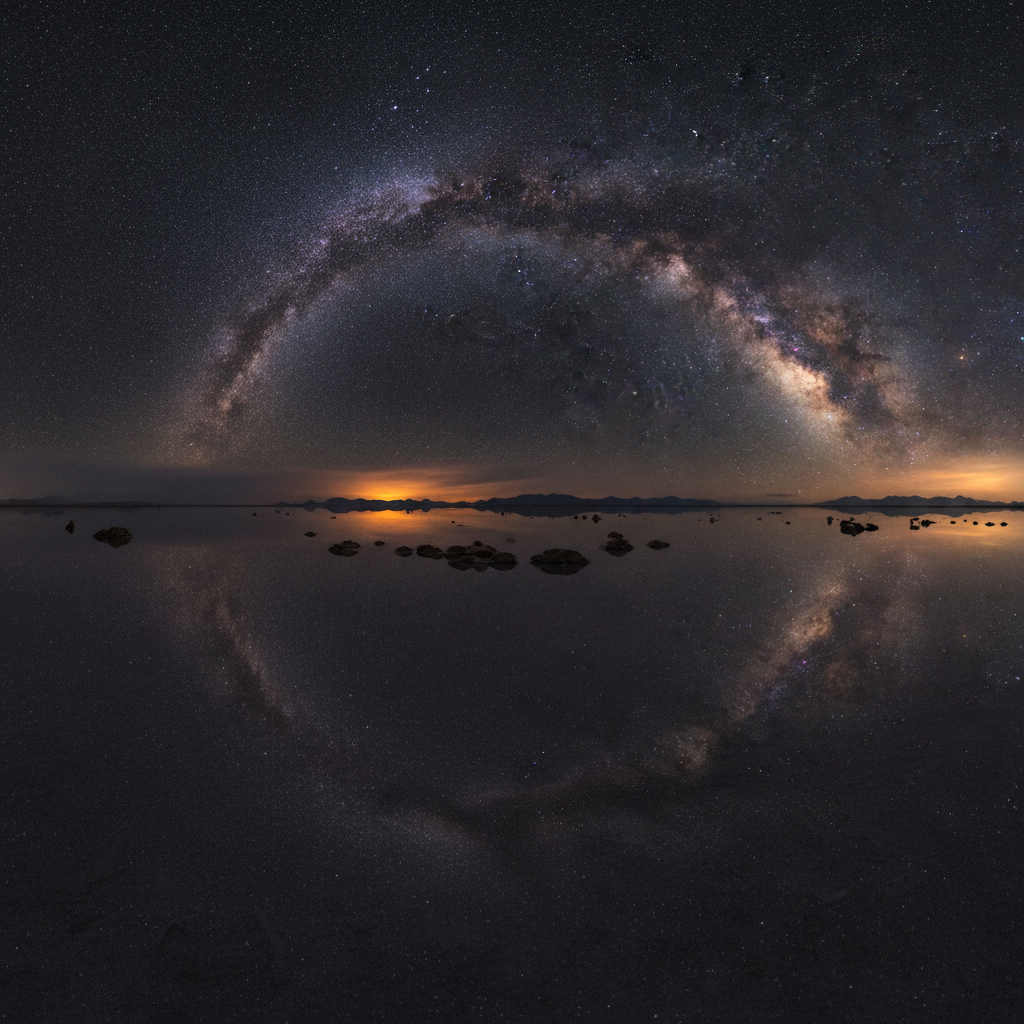
The Salar de Uyuni combines several factors that make it one of the premier stargazing destinations in the world: altitude at 3,656 meters reduces atmospheric interference, the extreme aridity of the southwestern Bolivian altiplano minimizes cloud cover for most of the year, the complete absence of light pollution across hundreds of kilometers of uninhabited salt flat and puna, and the reflective white surface of the salt that in the dry season appears to merge the sky above with the ground below, creating the sensation of floating in stars. The Milky Way rises directly over the flat with a clarity rarely seen outside of high-altitude observatories. The salt flat is additionally one of the few places where the southern Milky Way core, the Large and Small Magellanic Clouds, and the full southern celestial sphere are visible together without horizon obstruction.
- 1
The Altitude Advantage: Why the Altiplano Sky is So Clear
Astronomical observation quality improves dramatically with altitude for two primary reasons: reduced atmospheric column above the observer means less light is scattered and absorbed by air molecules before reaching the eye, and lower humidity above the observer means less water vapor that scatters light and creates diffuse glow. The Salar de Uyuni at 3,656 meters already provides a substantial atmospheric advantage over sea-level observations, and the surrounding Eduardo Avaroa Reserve peaks above 5,000 meters used as observation sites by researchers amplify this further. The Atacama Desert in neighboring Chile, at similar altitudes and in the same hyperarid climate system, hosts several of the worlds major professional observatories including the European Southern Observatory facilities at Cerro Paranal and La Silla and the ALMA millimeter radio telescope array, for the same reasons that make the Bolivian altiplano excellent for naked-eye and amateur telescope observation. The southern altiplano additionally benefits from stable atmospheric conditions in the dry season from April to October, when persistent high pressure systems produce week after week of clear cloudless nights ideal for extended stargazing.
- 2
The Southern Sky: Milky Way Core and Magellanic Clouds
The southern hemisphere sky visible from the Salar de Uyuni includes several objects invisible or poorly placed from the northern hemisphere. The center of the Milky Way galaxy, the densest and most spectacular section of the galactic band, transits high in the sky from the Bolivian altiplano and is visible as a broad luminous band with dark dust lanes and star-forming nebulae resolvable with the naked eye under ideal conditions. The Large and Small Magellanic Clouds, the two closest satellite galaxies to the Milky Way at approximately 160,000 and 200,000 light years respectively, appear as detached sections of the Milky Way to the unaided eye and are among the most striking objects in the southern sky; they are invisible from most of the northern hemisphere and improperly placed for observation from the northern tropics. The Eta Carinae nebula, the Carina nebula complex, the Omega Centauri globular cluster, and the Centaurus A radio galaxy are among the additional southern objects best observed from high-altitude southern locations. The Southern Cross constellation, visible from all southern hemisphere latitudes and a significant portion of the tropics, is directly overhead from the Salar at certain times of year.
- 3
Light Pollution Absence: The Darkest Large Landscape on Earth
The Salar de Uyuni and surrounding southwestern Bolivian altiplano constitute one of the largest areas of genuine dark sky on Earth, defined as sky with a Bortle scale rating of 1, the darkest possible category. The nearest significant artificial light sources are the mining towns of Oruro and Potosi, both over 150 kilometers distant, and the Chilean mining operations near Antofagasta, over 300 kilometers away across the Atacama. The human population density of the Bolivian altiplano is among the lowest in South America, with vast areas between towns containing only scattered herding communities without grid electricity. On a moonless night at the center of the salt flat, the Milky Way casts a visible shadow, the air glow of the upper atmosphere creates a faint luminous dome over the horizon, and the zodiacal light, a faint cone of light caused by sunlight scattered off interplanetary dust, is visible stretching from the horizon along the ecliptic. The combination of these phenomena, all invisible from light-polluted locations, creates the experience of a sky that observers from urban and suburban backgrounds frequently describe as the most overwhelming natural sight they have ever encountered.
- 4
Photography Under the Stars: Salt Flat Astrophotography Techniques
The Salar de Uyuni offers a unique astrophotography opportunity that no other location on Earth precisely duplicates: the possibility of photographing the Milky Way reflected in the thin water layer covering the salt flat in the wet season, creating images in which the galaxy appears both above and below the camera. This specific image type, pioneered by French photographer Olivier Grunewald in the early 2010s and subsequently reproduced by thousands of photographers, requires wet season timing when a few centimeters of standing water cover the flat, a windless night to prevent rippling, a full or near-full moon exclusion period to preserve dark sky, and a wide-angle lens with large aperture capability for the long exposures needed in dark conditions. Standard dry season astrophotography on the flat is simpler technically, requiring no water and benefiting from stable conditions, but produces the more conventional Milky Way over white salt landscape. Tour operators offer dedicated night photography tours departing from Uyuni for both wet and dry season conditions, typically involving transport to the center of the flat by midnight and waiting through the early hours when the Milky Way core is highest above the horizon.
- 5
Meteor Showers and Planetary Visibility from the Altiplano
The reliable clear skies of the dry season Bolivian altiplano make it an excellent location for observing the major annual meteor showers and planetary conjunctions that require sustained clear periods to observe well. The Eta Aquariid meteor shower in early May, produced by debris from Halley's Comet, has a higher observable rate from southern hemisphere locations than from the north and is well-placed for observation from the Salar during a period that typically falls in the late dry season onset. The Southern Taurid and Northern Taurid showers in October and November coincide with the beginning of the wet season but occasional clear nights still allow observation. The planets Saturn and Jupiter, when at opposition and therefore at their closest and brightest, are conspicuous naked-eye objects from the Salar and resolve into detail with even modest binoculars; Saturn's rings are visible with a small telescope from the stable altiplano atmosphere. Several dedicated astronomy tour operators have begun offering telescope-equipped night sky tours from Uyuni, targeting visiting amateur astronomers who want guided observations of specific objects rather than general dark sky experience.
- 6
The Reflective Ground: When Earth Becomes Sky
The perceptual and psychological experience of standing on the mirror-covered Salar de Uyuni on a clear night deserves separate attention from the astronomical facts of what is visible. When the salt flat is covered with a thin reflective film of water in the wet season and the sky is clear and moonless, the reflective ground eliminates the visual boundary between earth and sky entirely, and an observer standing in the flat appears to be suspended in three-dimensional space with stars above, below, and on every side. The orientation cues that normally locate a person in a landscape, the visible ground beneath the feet, the horizon line, the darker region below and lighter above, all disappear. The effect is intensely disorienting in a way that even experienced outdoor visitors find profound, and many accounts describe it as one of the most singular sensory experiences available in the natural world. The practical implication for astrophotography is that foreground interest, normally a compositional challenge in landscape astrophotography, becomes irrelevant; the reflection provides infinite foreground depth that matches the sky above, and the photographer can point the camera in any direction and find compositional material.
Walk this route with audio
Stories play automatically as you reach each stop — no tapping needed.
More in Salar de Uyuni
Salar de Uyuni History: Pre-Columbian Peoples, Colonial Routes, and Bolivian Independence
Salar de Uyuni Practical Guide: Getting There, Tour Types, Packing, and Safety
Wildlife of the Bolivian Salt Flat Region: Vicunas, Viscachas, and Desert Adaptations
Uyuni Tour Logistics: Jeep Tours, Seasons, and the Three-Day Itinerary

Geology of the Bolivian Altiplano: Volcanoes, Minerals, and the Andean Plateau