The Colosseum, Roman Forum & Palatine Hill: Walking Through Two Thousand Years of Roman History
The ancient core of Rome—the Colosseum, the Roman Forum, and the Palatine Hill—is the largest open-air archaeological site in the world and the most layered concentration of Roman history in existence. Within one square kilometer, you can stand in the arena where gladiators fought before 80,000 spectators, walk the Sacred Way along which Roman triumphal processions passed, and stand on the hill where Rome's emperors had their palaces. These are not ruins in the conventional sense—they are the world's most complete surviving evidence of the most powerful civilization the Western world has ever produced.
- 1
The Colosseum — The Greatest Arena of the Ancient World
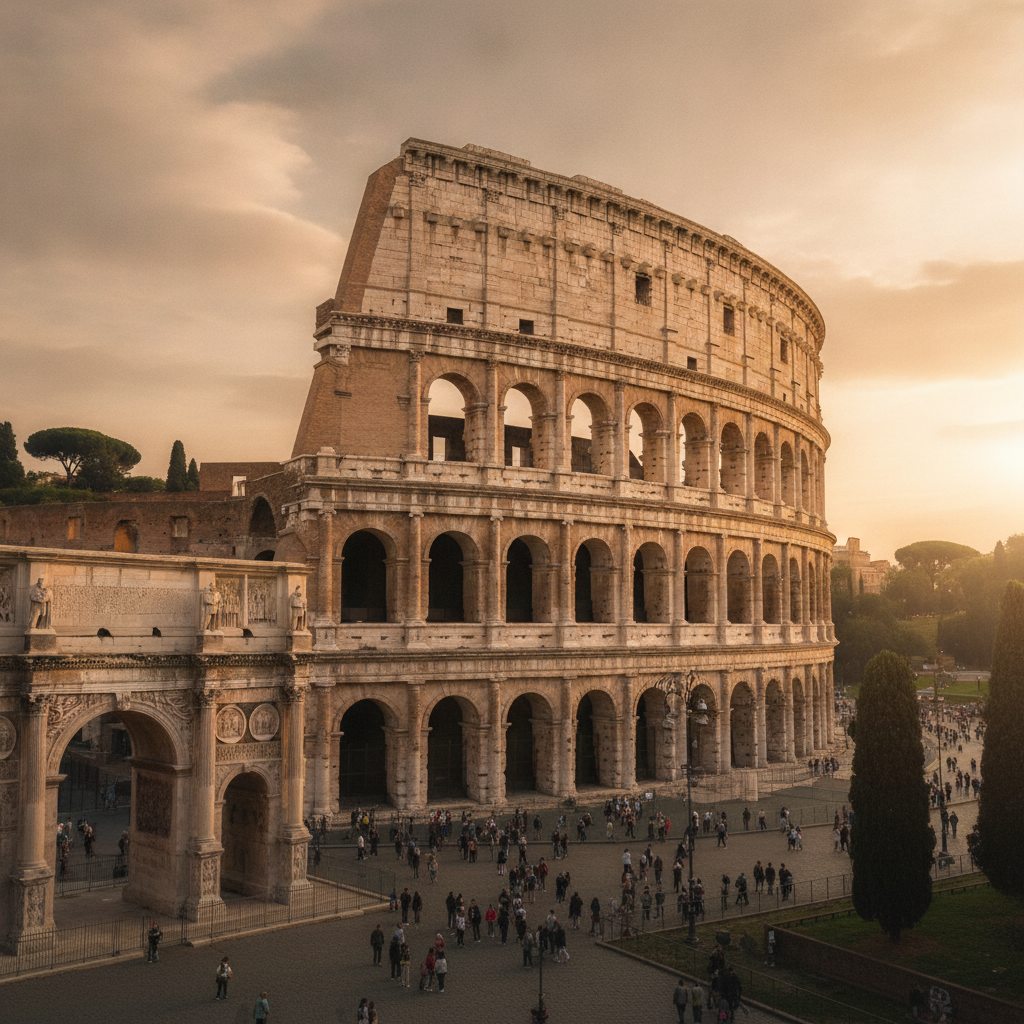
The Colosseum (Flavian Amphitheatre), completed in 80 AD by Emperor Titus, is the largest amphitheatre ever built: 188 meters long, 156 meters wide, 48 meters tall, with a seating capacity of 50,000–80,000 spectators (scholars debate the exact figure). It hosted gladiatorial contests, animal hunts (venatio), public executions, dramas based on Classical mythology, and—briefly—mock sea battles (naumachiae) when the arena floor was flooded. Games ran from dawn to dusk; spectators entered through numbered arches (vomitoria) to their assigned sections, stratified by social class (senators at the front, women and slaves at the back). The hypogeum (underground tunnels and chambers beneath the arena floor, now visible) housed the gladiators, animals, and stage machinery. Construction required 100,000 cubic meters of travertine stone, transported from Tivoli 30 km east; the iron clamps that held the stones together (totaling 300 tonnes) were ripped out in the medieval period, leaving the distinctive hole-pattern visible in the remaining stonework. A combined ticket with the Roman Forum and Palatine Hill is the most economical option; book online to avoid the very substantial queues.
- 2
Arch of Constantine — The Last Great Triumphal Arch
The Arch of Constantine (315 AD), standing between the Colosseum and the Palatine Hill, is the largest surviving Roman triumphal arch (21 meters tall, 25.7 meters wide) and was erected to commemorate Constantine I's victory over Maxentius at the Battle of Milvian Bridge in 312 AD—the battle that effectively ended the Roman Civil Wars and established Constantine as sole emperor of the West. The arch is remarkable for its wholesale appropriation of decorative elements from earlier monuments: the large roundels on the sides were taken from a Hadrianic monument; the narrative panels above the side arches were taken from a Trajanic monument; only the narrow frieze running continuously around the arch at the base of the attic level was carved specifically for Constantine's arch. The practice—known to art historians as 'spoliation'—reflects either a shortage of skilled sculptors in the early 4th century, a deliberate program of associating Constantine with his distinguished predecessors, or both.
- 3
The Roman Forum — The Center of the Ancient World
The Roman Forum (Foro Romano) was the political, commercial, religious, and triumphal center of ancient Rome and, by extension, of the Roman Empire: all roads led here, all formal business was conducted here, and all triumphant generals paraded through here on the Sacred Way (Via Sacra). The Forum entered its definitive form over roughly 500 years (4th century BC to 2nd century AD), accumulating temples, basilicas, arches, and public buildings as each generation of rulers added their contributions. Key monuments: the Temple of Saturn (497 BC, one of the oldest buildings in Rome; the eight grey columns still standing are from a 4th-century AD reconstruction); the Temple of Vesta (the circular temple housing the sacred eternal flame, tended by the Vestal Virgins); the Basilica of Maxentius and Constantine (4th century AD; the immense coffered barrel vaults that survive give the best sense of the scale of Roman interior architecture); the Temple of Romulus (4th century AD, now the entrance to the church of Santi Cosma e Damiano—the original bronze doors, dating to 309 AD, are still in use). A map or audio guide is essential; the site is extremely easy to navigate without context.
- 4
Palatine Hill — Where Rome's Emperors Lived
The Palatine Hill (Colle Palatino) is the central and most ancient of Rome's seven hills, directly overlooking the Forum to the north and the Circus Maximus to the south, and is the origin of the word 'palace' (palatium). According to Roman tradition, Rome was founded here by Romulus in 753 BC; archaeological evidence confirms occupation from at least the 8th century BC. By the 1st century BC the hill had become the most fashionable address in Rome (Cicero, Crassus, and Mark Antony all had houses here); Augustus built his house on the hill in 28 BC and all subsequent emperors followed, eventually covering the entire hilltop with a vast imperial palace complex. The ruins now visible—the House of Augustus (with remarkable painted frescoes, one of the best-preserved interiors in Rome), the House of Livia, the Flavian Palace (covering 4 hectares, with a surviving dining room and audience hall)—represent only portions of the complex. The Farnese Gardens on the north side of the hill (16th century, built over the ruins of Tiberius's palace) offer the finest view over the Forum.
- 5
Circus Maximus — The World's Largest Sports Venue
The Circus Maximus, the long valley between the Palatine and Aventine Hills, was ancient Rome's chariot racing track and, at its maximum capacity, could accommodate 250,000–300,000 spectators—making it by far the largest sports venue ever built in human history. The track was 621 meters long and 118 meters wide; up to 12 chariots raced simultaneously over 7 laps, a total of approximately 8 km per race. The central barrier (spina) was decorated with Egyptian obelisks (two survive in Rome: one now stands in Piazza del Popolo, one in Piazza San Giovanni in Laterano). The track was also used for athletic competitions, animal hunts, and public festivals. Very little is visible above ground today—the valley is now a public park used for concerts and jogging—but the scale and orientation of the original track are still clearly readable from the surrounding ground level. The Palatine Hill's south face, rising steeply above the park's north side, preserves remnants of the imperial box (pulvinar) from which emperors watched the races.
- 6
Bocca della Verità — The Mouth of Truth
The Bocca della Verità ('Mouth of Truth') is a marble mask, approximately 1.75 meters in diameter, built into the external wall of the church of Santa Maria in Cosmedin in the Foro Boario (the ancient cattle market). The mask—probably a 1st-century AD manhole cover or the face of an ancient river god—became famous in medieval Rome for the legend that it would bite off the hand of any liar who placed their hand in its mouth; this led to its use as an informal lie detector in legal proceedings. Gregory Peck and Audrey Hepburn's scene with the mask in Roman Holiday (1953) made it one of the most visited tourist attractions in Rome, with queues sometimes exceeding two hours. Santa Maria in Cosmedin itself (free entry) is one of the finest early medieval churches in Rome: the interior, with its ancient granite columns, Cosmatesque floor, and 12th-century bell tower, preserves the atmosphere of the medieval city. The adjacent Foro Boario contains two of the best-preserved Roman temples in the world: the circular Temple of Hercules Victor (2nd century BC, wrongly called the Temple of Vesta for centuries) and the rectangular Temple of Portunus (1st century BC).
Walk this route with audio
Stories play automatically as you reach each stop — no tapping needed.
More in rome
Campo de' Fiori, the Jewish Ghetto & Trastevere: Rome's Most Lived-In Neighborhoods
The Vatican, St. Peter's Basilica & Castel Sant'Angelo: The Heart of Christendom from River to Dome
The Capitoline Hill, Trajan's Markets & the Monti Neighborhood: Between Rome's Ancient Power and its Liveliest Quarter
The Appian Way & the Catacombs: Rome's Ancient Road to the Dead
The Aventine Hill, the Knights' Keyhole & Testaccio: Rome's Best-Kept Secrets