The Capitoline Hill, Trajan's Markets & the Monti Neighborhood: Between Rome's Ancient Power and its Liveliest Quarter
The Capitoline Hill (Campidoglio), the smallest but most symbolically important of Rome's seven hills, was the political and religious center of the Roman world: the Capitolium (temple of Jupiter Optimus Maximus, the supreme deity of the Roman state) stood at its summit; triumphs ended here; generals dedicated their laurel wreaths here. Today it houses the Capitoline Museums—the oldest public museums in the world (founded 1471). At its base, Trajan's Markets preserve the commercial heart of imperial Rome; behind them, the Monti neighborhood is Rome's most popular destination for independent restaurants, bars, and vintage shopping.
- 1
Capitoline Hill & Museums — The Center of the Roman World
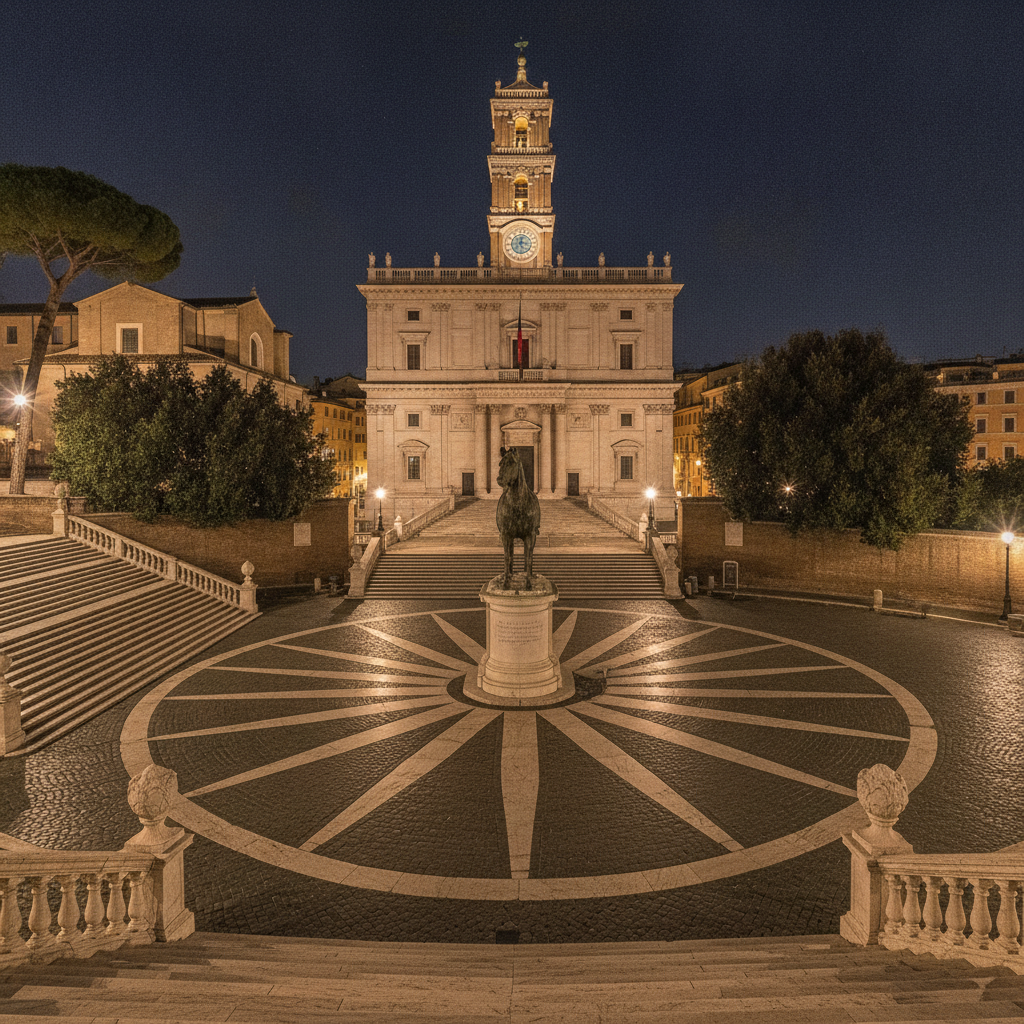
The Capitoline Hill (Colle Capitolino) and its twin summit (the Capitolium to the south, the Arx to the north, with a saddle between them now occupied by the Piazza del Campidoglio) were the religious center of Rome: the Temple of Jupiter Optimus Maximus (built 509 BC, rebuilt multiple times, last version standing until ca. 455 AD) was the most important temple in the Roman world—every Roman triumph ended here, with the general offering his laurel wreath to Jupiter. The Capitoline Museums (Musei Capitolini), the world's oldest public museums (founded by Pope Sixtus IV in 1471 with a gift of ancient bronzes to the Roman people), occupy the three palaces of the Piazza del Campidoglio (Palazzo dei Senatori, Palazzo dei Conservatori, and Palazzo Nuovo) plus the underground Tabularium. The collection includes: the original equestrian statue of Marcus Aurelius (2nd century AD, the only gilded bronze equestrian statue to survive antiquity); the Capitoline Wolf (the Etruscan or medieval bronze she-wolf nursing Romulus and Remus, Rome's founding myth); the Capitoline Venus; the Dying Gaul; and extensive collections of Roman portrait sculpture, inscriptions, and architectural fragments. The Piazza del Campidoglio was redesigned by Michelangelo (commissioned 1536; his design not fully realized until the 17th century)—the trapezoidal pavement with its oval geometric star pattern centered on the Marcus Aurelius statue is one of the masterworks of Renaissance urban design.
- 2
Trajan's Markets — The World's First Shopping Mall
Trajan's Markets (Mercati di Traiano), built 100–112 AD by the architect Apollodorus of Damascus as part of the Trajan's Forum complex (the largest of the Imperial Fora), are the best-preserved example of a multi-story commercial complex from the ancient world: six semi-circular levels of shops and offices (originally approximately 150 units) built into the slope of the Quirinal Hill behind Trajan's Forum. The complex served simultaneously as commercial space, administrative offices, and possibly housing. The market hall (the Great Hall, originally a basilica-like two-story structure with a barrel-vaulted ceiling) is one of the most impressive interior spaces in ancient Rome to survive intact. The complex is now the Museum of the Imperial Fora (Museo dei Fori Imperiali), with permanent exhibits tracing the history and appearance of all five of the Imperial Fora (Augustus, Nerva, Trajan, Caesar, and Vespasian). Trajan's Column, visible from the markets (and from many points in Rome), is the most important narrative sculpture in the Roman world: a 38-meter-high column with a continuous frieze spiraling around its shaft depicting Trajan's Dacian campaigns (101-102 AD and 105-106 AD) in 155 separate scenes with 2,662 figures.
- 3
Monti Neighborhood — Rome's Most Authentic Village Within the City
Monti (the area between the Colosseum, the Forum, the Esquiline Hill, and the Via Nazionale) is the oldest residential neighborhood continuously inhabited within ancient Rome's walls—its name derives from the multiple hills and slopes that define its geography. Historically working-class (it was the subura, Rome's most crowded and crime-ridden district in antiquity), Monti began gentrifying in the 1990s and is now Rome's most fashionable neighborhood for independent restaurants, vintage clothing shops, craft workshops, and aperitivo bars, without having lost its residential character—Romans still live here, children still play in the main piazza (Piazza della Madonna dei Monti), laundry still hangs from the windows. The neighborhood is best explored on foot through its narrow streets, particularly Via del Boschetto, Via Urbana, and Via della Madonna dei Monti. The area is liveliest in the evening, when the steps of the Fountain of the Madonna dei Monti become an informal gathering point.
- 4
San Pietro in Vincoli — Michelangelo's Moses
The church of San Pietro in Vincoli ('Saint Peter in Chains'), founded in the 5th century and rebuilt in the 15th, contains two extraordinary things: the Chains of Saint Peter (the relic chains allegedly used to bind Peter during his imprisonment in Jerusalem and in Rome, now displayed in a gilded bronze reliquary under the high altar—the chains are the church's titular relic and primary reason for pilgrimage) and Michelangelo's Moses (1513–1515, one of the supreme masterworks of Renaissance sculpture, originally designed as part of the never-completed Tomb of Pope Julius II). The Moses—larger than life-size, depicted seated with the Tablets of the Law under his arm and his beard flowing over his right hand—is one of the most intensely psychological sculptures in the world. Freud analyzed it in a famous essay (1914). The two flanking figures (Rachel and Leah) are also by Michelangelo. The church is free to enter; the Moses is visible immediately upon entering the nave.
- 5
Santa Maria Maggiore — The Greatest of Rome's Four Basilicas
Santa Maria Maggiore, the greatest of the four papal basilicas (the others being St. Peter's, San Giovanni in Laterano, and San Paolo fuori le Mura), is the most important church dedicated to the Virgin Mary in Rome and one of the best-preserved early Christian basilicas in the world. The interior is substantially original to its 5th-century construction (432–440 AD): the 36 Ionic columns of the nave are original Roman spolia; the 5th-century apse and triumphal arch mosaics are the finest surviving early Christian mosaics in Rome (the scenes from the life of Mary on the arch date to 432–40 AD; those in the apse to 1295 and are by Jacopo Torriti). The gilded wooden ceiling (late 15th century) was gilded with the first gold brought to Spain from the Americas, donated by the Spanish monarchs Ferdinand and Isabella. The Sistine Chapel at the Basilica (not to be confused with the Sistine Chapel in the Vatican) was built by Sixtus V in 1587 and contains his tomb.
- 6
Palazzo Massimo alle Terme — Rome's Greatest Painting Museum
Palazzo Massimo alle Terme (one of the four buildings of the National Roman Museum) is the primary home of ancient Roman painting in the world: the second floor contains the most important surviving Roman fresco cycles anywhere, recovered from luxury villas and public buildings in Rome and its suburbs. The Garden Room from the Villa of Livia (wife of Augustus, from the villa at Prima Porta, late 1st century BC) is the masterpiece of the collection and one of the most beautiful rooms in any museum in the world: four walls painted to simulate a garden seen through a low fence, with 60+ species of plants (many identifiable botanically), birds (perched and in flight), and a pale blue sky—the effect of standing in a garden that has no seasons, frozen in perpetual spring. Also on the second floor: extraordinary fresco cycles from the Villa Farnesina (depicting the mythological scenes of Polyphemus and Galatea, ca. 20 BC) and the Villa di Livia at Prima Porta. The ground floor houses the finest Roman portrait busts and the Boxer at Rest (an original Greek bronze, ca. 330–50 BC, one of the most important surviving Greek bronzes).
Walk this route with audio
Stories play automatically as you reach each stop — no tapping needed.
More in rome
Campo de' Fiori, the Jewish Ghetto & Trastevere: Rome's Most Lived-In Neighborhoods
The Vatican, St. Peter's Basilica & Castel Sant'Angelo: The Heart of Christendom from River to Dome
The Appian Way & the Catacombs: Rome's Ancient Road to the Dead
The Aventine Hill, the Knights' Keyhole & Testaccio: Rome's Best-Kept Secrets
Quirinal Palace, Via Veneto & Capuchin Crypt: From Baroque Power to Dolce Vita Glamour