Largo Argentina, Campo de' Fiori & the Old City: Where Caesar Fell and Bruno Burned
The area around Campo de' Fiori, Largo Argentina, and Piazza Venezia contains some of the most historically charged locations in Rome—and in Western history. Within a few minutes' walk: the ruins of the Pompey Theatre complex where Julius Caesar was stabbed on the Ides of March 44 BC; the square where Giordano Bruno was burned for heresy in 1600; the facade of the Vittoriano monument that marks the formal center of modern Italy; and the church that contains Michelangelo's greatest architectural project and the greatest painting in any Roman church (Raphael's mosaic in Santa Maria sopra Minerva).
- 1
Largo di Torre Argentina — Where Julius Caesar Was Killed
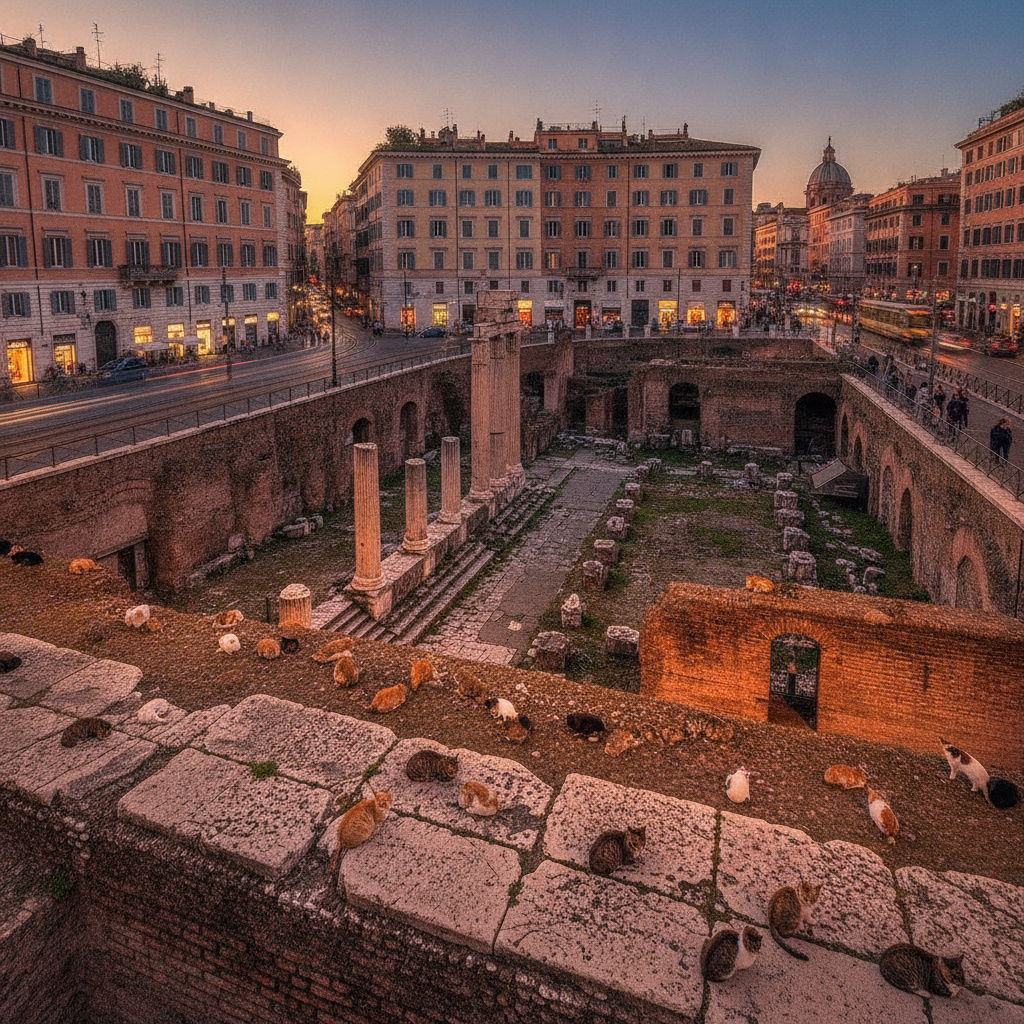
Largo di Torre Argentina, a large sunken archaeological area in the center of Rome, contains the ruins of four of the most ancient temples in the city (the oldest dating to the late 4th century BC) and is, most significantly, the site of the Portico of Pompey—the meeting hall attached to the Theatre of Pompey where the Roman Senate was meeting on March 15, 44 BC when Julius Caesar arrived and was stabbed 23 times by a group of senators led by Marcus Junius Brutus and Gaius Cassius Longinus. The act was intended to restore the Roman Republic; it instead triggered 13 years of civil war and ultimately led to the permanent replacement of the Republic by the Empire. The actual spot where Caesar fell (Curia of Pompey) was paved over by Augustus as a cursed place; a small piazza marks the location. The site is now primarily famous for its resident colony of cats—hundreds of strays maintained by a voluntary organization—which adds a surreal note to one of the most historically significant locations in the world. Free to view from above; occasional guided access to the ruins.
- 2
Campo de' Fiori — History's Most Charged Market Square
Campo de' Fiori ('Field of Flowers') is discussed separately in Route 4, but from the perspective of this walk its significance is primarily as the boundary marker between the tourist-facing food market world of the morning and the bar district of the evening, and as the location of the statue of Giordano Bruno. The market (7am–2pm, daily except Sunday) offers some of Rome's finest fresh produce, spices, and prepared foods. The bars and restaurants surrounding the square are primarily tourist-oriented, but the side streets (Via del Biscione, Via del Pellegrino) contain excellent independent restaurants and food shops. The statue—deliberately placed with its back to the Vatican—is worth pausing at: the inscription reads simply 'A Bruno / Il Campo de' Fiori' ('To Bruno / The Campo de' Fiori') with dates of birth and death.
- 3
Palazzo Farnese — The Most Beautiful Renaissance Palace in Rome
Palazzo Farnese, built for Cardinal Alessandro Farnese (later Pope Paul III) beginning in 1517 by Antonio da Sangallo the Younger and completed by Michelangelo (who designed the dramatic cornice and the third floor), is universally considered the finest Renaissance palace in Rome—and arguably the finest anywhere. The building's proportions, the relationship of its windows to the wall surface, the rusticated ground floor, and Michelangelo's great projecting cornice (an invention that was widely copied) define the classical Renaissance palace typology for all of European architecture. The piano nobile contains the most important secular fresco cycle of the late Renaissance: the Galleria Carracci, painted by Annibale Carracci between 1597 and 1608, depicting mythological scenes of the loves of the gods—a direct challenge to the classical tradition and the precursor of Baroque ceiling painting. The building has been the French Embassy since 1635. Access to the exterior and courtyard is possible; interior access (including the Carracci Gallery) requires advance arrangement through the French Embassy or one of the cultural organizations that organizes periodic tours.
- 4
The Turtle Fountain & Jewish Ghetto Edge — Rome's Most Delicate Fountain
The Fontana delle Tartarughe ('Turtle Fountain'), 1581–1584, in Piazza Mattei on the edge of the former Jewish Ghetto, is one of Rome's most beloved and most photographed fountains, and one of the most refined examples of late Renaissance sculpture in the city. The design—by Giacomo della Porta; executed by Taddeo Landini—shows four bronze youths, each with one foot on a dolphin's head and one hand holding the dolphin's tail, raising a turtle (or tortoise) to the upper basin with their free hands. The gesture of lifting the animal was added later: Bernini is traditionally (and probably inaccurately) credited with adding the turtles in 1658. The original turtles are now in the Capitoline Museums (copies stand in the fountain). The fountain is small and set in a small medieval piazza that has changed little since the 16th century—one of the most charming spots in the city.
- 5
Santa Maria sopra Minerva — The Only Gothic Church in Rome
Santa Maria sopra Minerva ('Saint Mary above the Temple of Minerva'—built on the site of a Roman temple to Minerva) is the only Gothic church in Rome: the interior, with its blue vaulted ceiling decorated with gold stars and slender pointed arches (late 13th century), is startlingly different from every other major church in the city. The church is one of the most art-rich in Rome: Fra Angelico is buried here (his tomb under the high altar); Michelangelo's Christ the Redeemer (1519–20, a marble statue of the risen Christ holding the cross) stands beside the high altar, one of the few original Michelangelo sculptures in Rome not in a museum; the Carafa Chapel (late 15th century) contains an important fresco cycle by Filippino Lippi. The church is free and is usually quiet. Bernini's elephant obelisk in the small square in front (the Piazza della Minerva) is one of Rome's most surprising and charming monuments.
- 6
Piazza Venezia & the Vittoriano — The Formal Center of Modern Italy
Piazza Venezia is the geographical center of Rome and the most important traffic hub in the city (all Rome's major traffic arteries converge here). The square is dominated by the Vittoriano (officially the Altare della Patria—'Altar of the Fatherland'), the enormous white marble neoclassical monument to Victor Emmanuel II (first king of unified Italy), designed by Giuseppe Sacconi and constructed 1885–1935. Romans call it the 'wedding cake' or 'typewriter' for its appearance; it was deeply controversial when built (it required the demolition of a substantial portion of the medieval Capitoline Hill neighborhood to clear the view from the Via del Corso). The monument contains the Tomb of the Unknown Soldier, a military museum, and offers, from its top terrace (accessed by lift from the sides; free), the finest 360-degree panoramic view of Rome from any central location. Palazzo Venezia, the 15th-century Venetian palace that faces the square on the north side, was Mussolini's headquarters from 1929 to 1943; he delivered his speeches from the central balcony. It is now a museum of medieval and Renaissance decorative arts.
Walk this route with audio
Stories play automatically as you reach each stop — no tapping needed.
More in rome
Campo de' Fiori, the Jewish Ghetto & Trastevere: Rome's Most Lived-In Neighborhoods
The Vatican, St. Peter's Basilica & Castel Sant'Angelo: The Heart of Christendom from River to Dome
The Capitoline Hill, Trajan's Markets & the Monti Neighborhood: Between Rome's Ancient Power and its Liveliest Quarter
The Appian Way & the Catacombs: Rome's Ancient Road to the Dead
The Aventine Hill, the Knights' Keyhole & Testaccio: Rome's Best-Kept Secrets