Riga Art Nouveau — Alberta Street, Mikhail Eisenstein & the World's Jugendstil Capital
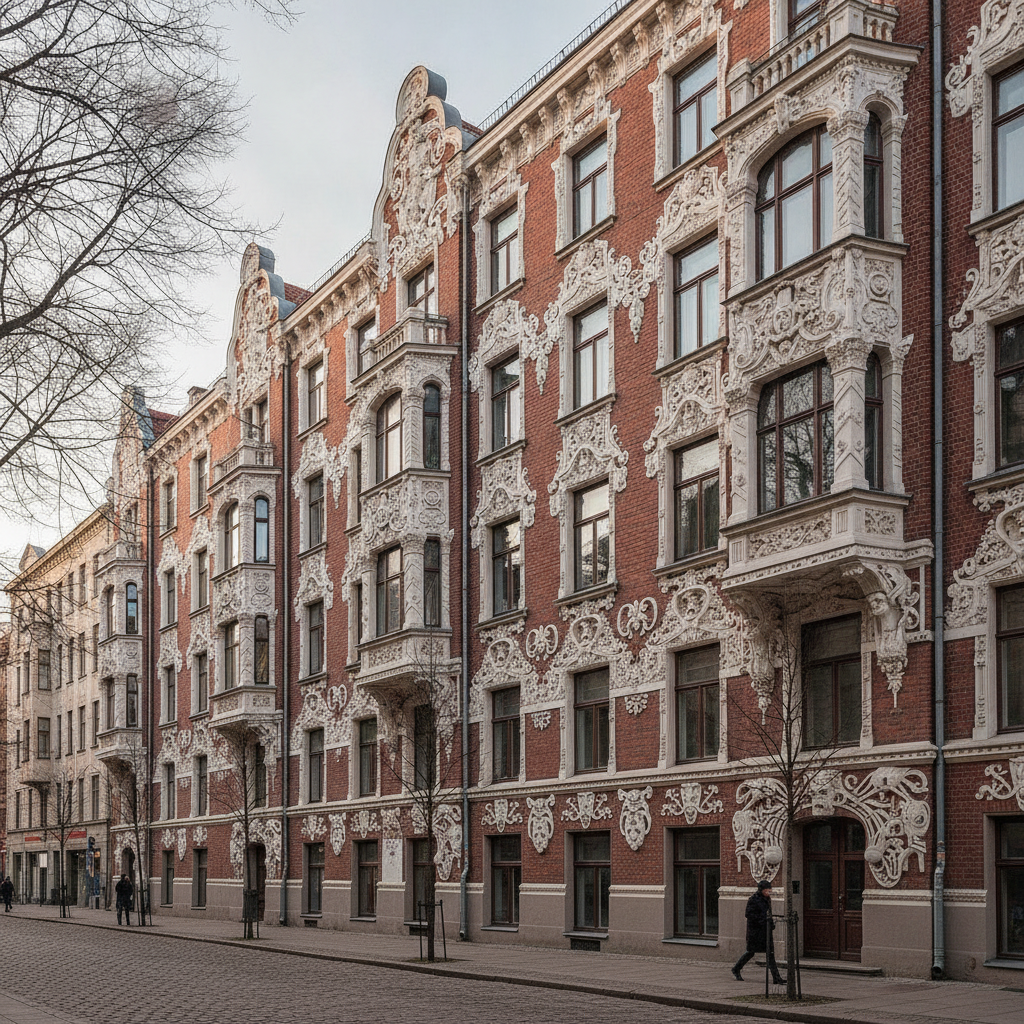
Riga contains the largest concentration of Art Nouveau architecture in the world — approximately 800 buildings in the Quiet Centre district northeast of the Old Town, built 1899-1914 during the city's industrial boom as the third-largest port in the Russian Empire. Alberta Street by Mikhail Eisenstein is the apotheosis of this tradition.
- 1
Alberta Street — the Most Extravagant Art Nouveau Street in the World
Alberta iela (the most spectacular Art Nouveau street in Europe, the one-block stretch from Strēlnieku iela to Antonijas iela containing 8 apartment buildings designed by Mikhail Eisenstein in 1903-1906, the facades of buildings 2, 2a, 4, 6, 8, 13, and the Elizabetes iela 10b facing the north end of Alberta street, all in the eclectic Jugendstil style — the facades densely covered in high-relief stucco sculpture: the screaming masks of women, the herms and the caratids, the mythological sphinxes, the eagle wings, the floral garlands and the acanthus scrolls, the building faces articulated with bay windows and corner towers in the dramatic Viennese manner, the polychrome schemes of the original facades now mostly white-painted but some restored to the original colour): the technical detail (the stucco work modelled by the sculptors working from Eisenstein's sketches and applied to the brick structure, the limestone ornaments at the window keystones and the portal surrounds, the cast iron balcony railings in the sinuous Art Nouveau plant form, the building at Alberta 4 the most extravagant — the facade incorporating 9 different face types in the masque tradition, the screaming faces at the top windows the most reproduced detail of Riga Art Nouveau in international media). Photography: best morning light 9am-12pm on the even-numbered side, afternoon light 2pm-5pm on the odd-numbered side, the facades in overcast light equally fine for the stucco detail.
- 2
Mikhail Eisenstein — the Architect Behind the Facades
Mikhail Eisenstein (1867-1921, the Riga city architect who designed the majority of the most prominent Art Nouveau buildings in Riga between 1899 and 1906, the father of the Soviet film director Sergei Eisenstein — the same Eisenstein who directed Battleship Potemkin 1925 and Ivan the Terrible 1944 — the biographical connection adding the cultural dimension to the architectural walks, the son Sergei's visual sense for dramatic composition and the grotesque mask formed in the streets of Riga's Art Nouveau district where he grew up, the father's architectural practice the model for the extravagant visual approach): Eisenstein's buildings outside Alberta Street (the Elizabetes iela 10b at the junction with Alberta — the building considered by many the finest single Eisenstein facade, the blue-green background colour restored, the sculptures of the helmeted Athena and the wrestling figures above the portal the most complex sculptural programme in the Riga Art Nouveau), Elizabetes iela 33 (the building with the most dramatic corner tower, the nautical motifs of the sea god Neptun and the anchors referencing Riga's maritime wealth), and Strēlnieku iela 4a (the transitional building combining the Romanticism of the 1890s with the full Jugendstil vocabulary of the 1900s). The Riga Art Nouveau Museum (Alberta iela 12, see below) the essential companion.
- 3
The Riga Art Nouveau Museum — Inside the Jugendstil Interior
The Riga Art Nouveau Museum (Alberta iela 12, the apartment of the architect Konstantīns Pēkšēns restored to the 1903 original interior, the most complete surviving Art Nouveau domestic interior in Latvia, €9 adults, Tuesday-Sunday 10am-6pm, the apartment on the second floor of the building Pēkšēns designed for himself in 1903 — the architect living in the building and using the apartment as a demonstration of the Jugendstil total design concept): the interior (the staircase with the original cast iron balustrade in the sinuous plant form, the apartment entry hall with the Art Nouveau tiled floor and the carved wooden wall panels, the salon with the original Jugendstil ceramic stove — the Mājas Uguns stove in the green and cream glaze, the most typical domestic heating element of Riga's Art Nouveau apartments — the dining room with the built-in sideboard in the floral carved oak, the bedroom with the original painted ceiling), the museum context (the explanatory panels on the Riga Art Nouveau in all three Baltic state languages and English, the architectural drawing collection showing the original design drawings by Eisenstein, Pēkšēns, and their contemporaries, the most useful introduction to the technical vocabulary of the Jugendstil before walking the streets) and the museum shop (the art nouveau reproductions, the architectural history publications in English, the postcards and the stucco replica ornaments the most portable souvenirs).
- 4
National Romantic Art Nouveau — the Other Riga Tradition
The National Romantic style (the second variety of Riga's Art Nouveau, developed simultaneously with the Eisenstein eclectic tradition, the National Romantic buildings using the folk art motifs and the local granite and brick rather than the imported Viennese stucco tradition — the architects Eižens Laube and Jānis Alksnis the main practitioners, the buildings expressing the emerging Latvian national identity through the architectural vocabulary, the tradition analogous to the Finnish National Romantic of Eliel Saarinen and the Estonian equivalents): the key buildings (Brīvības iela 47 by Laube — the facade using the Latvian folk song motifs, the sun and the oak and the linden tree of the Latvian dainas, in relief terracotta rather than stucco; the Latvian Cooperative Society building on Brīvības iela 35 — the most complete National Romantic commercial building in Latvia, the granite rubble masonry of the ground floor and the red brick of the upper floors in the medieval Latvian fortress tradition; the Latvian National Theatre on Kronvalda bulvāris 2 — the 1902 National Romantic building by the Latvian architects Auguste Reinbergs and Jēkabs Baumanis, the building the symbolic home of Latvian-language theatre) and the contrasting aesthetics (the National Romantic buildings reading as more restrained and more geologically solid than the Eisenstein plaster extravaganzas — the appropriate analogy is the Scottish castle versus the French chateau — both traditions within 500m of each other in the Quiet Centre district).
- 5
The Latvian War of Independence Sites
The Latvian War of Independence (1918-1920, the war in which the newly proclaimed Republic of Latvia defeated the Bolshevik Red Army, the Baltic German Landeswehr, and Bermondtian forces to establish the first Latvian state, the war the founding event of modern Latvia, the military sites in and around Riga): the Freedom Monument (see separate route, the monument the primary memorial to the war) and the Brothers' Cemetery (Brāļu kapi, Aizsaules iela 1, 3km from the Old Town, accessible by bus 21 in 15 minutes, the national military cemetery designed by the sculptor Kārlis Zāle in 1924-1936, the cemetery housing the graves of 2,000 Latvian soldiers killed in the War of Independence and subsequent conflicts, the cemetery design in the Latvian National Romantic tradition — the granite sculptures, the symbolic oak and linden plantings, the most architecturally significant cemetery in Latvia, free, open daily 8am-8pm): the central sculpture group (the three-figure allegorical composition by Zāle — Mother Latvia with two soldiers, the granite figures 6m tall, the most powerful nationalist sculpture in Latvia) and the German Occupation Memorial (the commemorative site for Latvians killed in the German occupation of 1941-1944, adjacent to the Brothers' Cemetery).
- 6
Riga Nightlife and the Music Scene
Riga's music and nightlife scene (the most varied in the Baltic states after Tallinn, the combination of the classical music institutions, the independent music clubs, and the electronic music venues making Riga competitive with Eastern European cities of 3 times its population): the classical programme (the Latvian National Opera at Aspazijas bulvāris 3 — tickets €10-60 at opera.lv — the Great Guild Hall at Amatu iela 6 — the 17th-century merchant hall now the main chamber music venue, the weekly concerts at €10-20 — and the Dom Cathedral organ concerts at noon Tuesday-Saturday, €5), the independent music clubs (the Palladium club at Dzirnavu iela 34 — the largest live music venue in Latvia, capacity 800, the programme of Baltic and international indie and rock — and the Melna Piektdiena at Matīsa iela 8 in the Miera iela neighbourhood — the most interesting independent club programme in Riga for the visitor interested in Baltic electronic and experimental music, open Thursday-Sunday from 11pm), the Miera iela district (the 'Peace Street' neighbourhood 1.5km north of the Old Town, the most gentrified neighbourhood in contemporary Riga — the independent cafes, the vinyl record shops, the natural wine bar Vīna studija, the organic restaurant Istaba, the neighbourhood the correct address for the Riga that young creative Latvians actually inhabit outside the tourist circuit of the Old Town).
Walk this route with audio
Stories play automatically as you reach each stop — no tapping needed.
More in riga
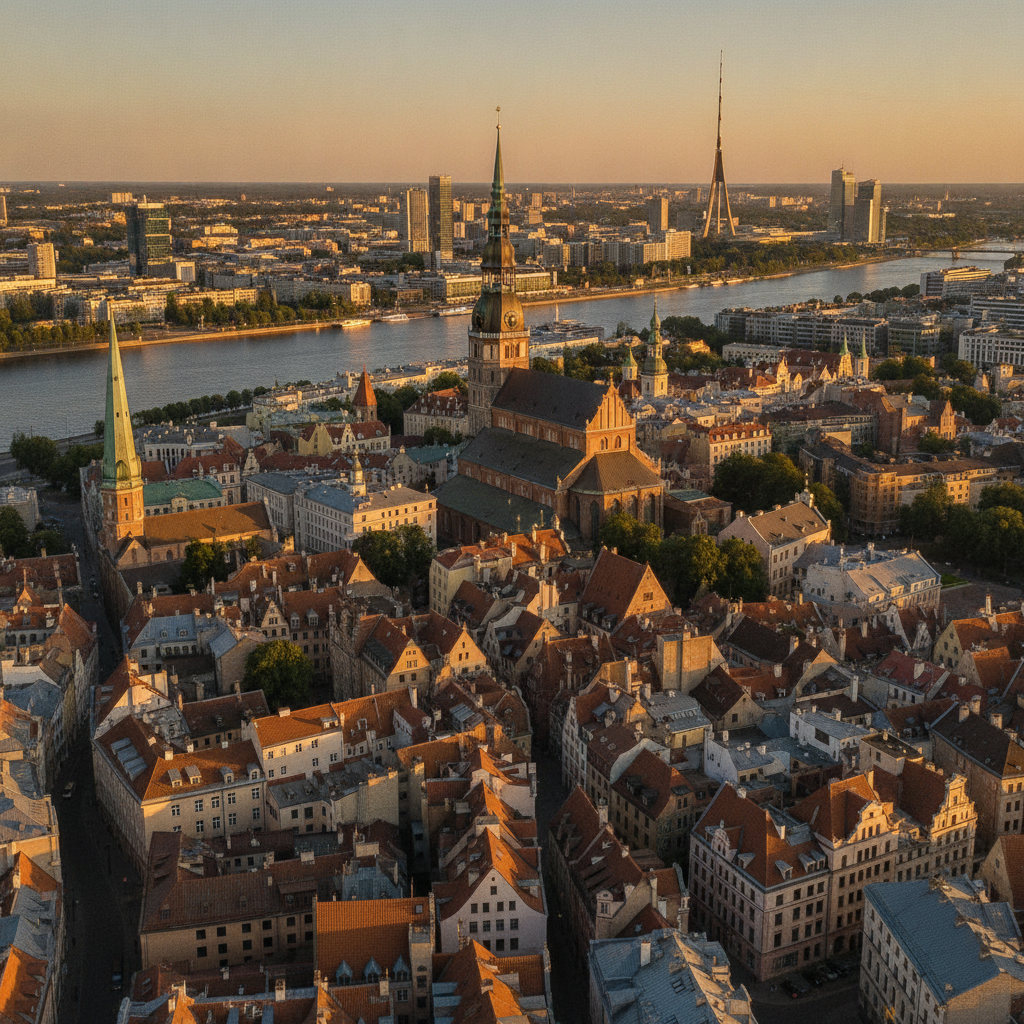
Riga Old Town — Dom Cathedral, the House of Blackheads & the Largest Art Nouveau District in Europe
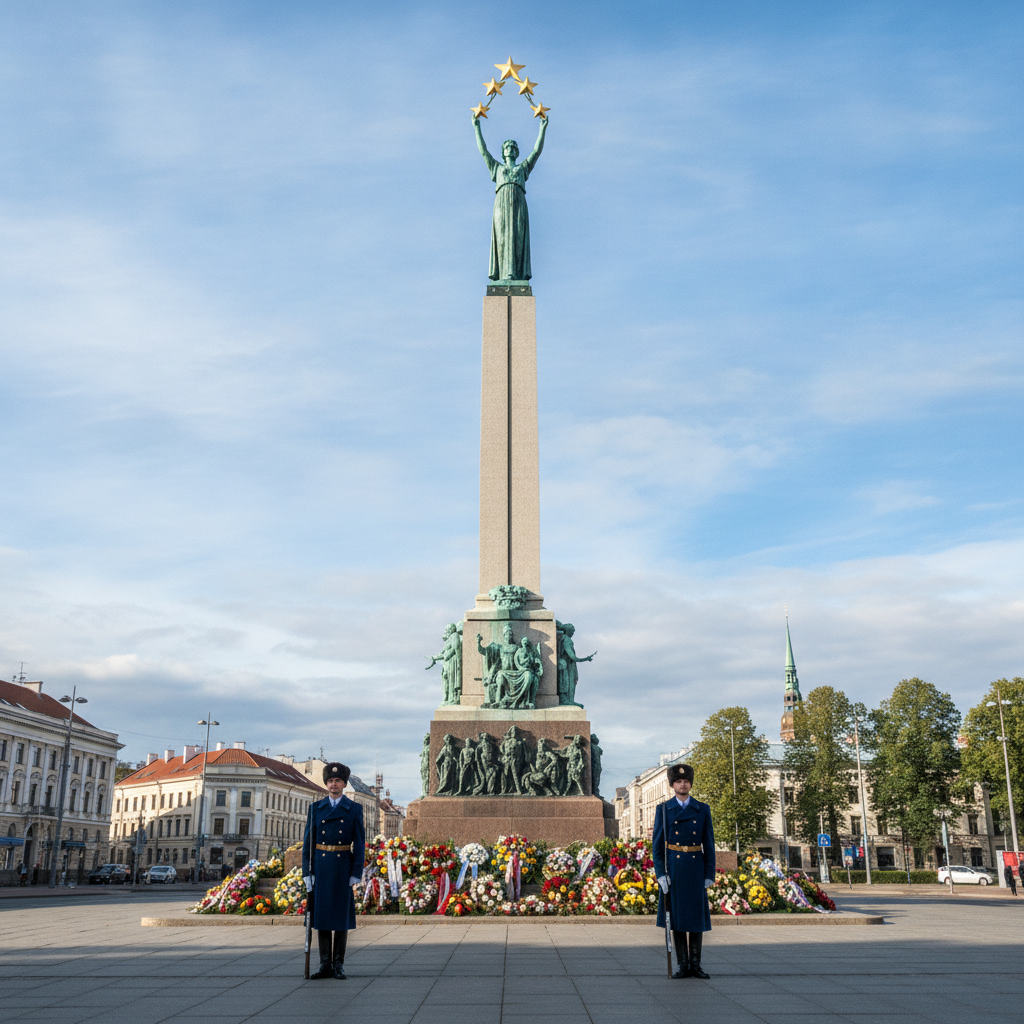
Riga — the Freedom Monument, Latvian Identity & the Museum of the Occupation
Riga Central Market & Latvian Cuisine — the Zeppelin Hangars, Grey Peas & Baltic Food Tradition
Riga & the Daugava River — the National Library, Pārdaugava & the Latvian Song and Dance Festival